Gothic throne with dark roses hand embroidery pattern
Advanced · 18 colors · 8 kinds of stitch
Download free PDFPDF, US Letter · 210 KBFor your own stitching, gifts and handmade pieces you sell. Do not resell or share this PDF. What you may do, in full
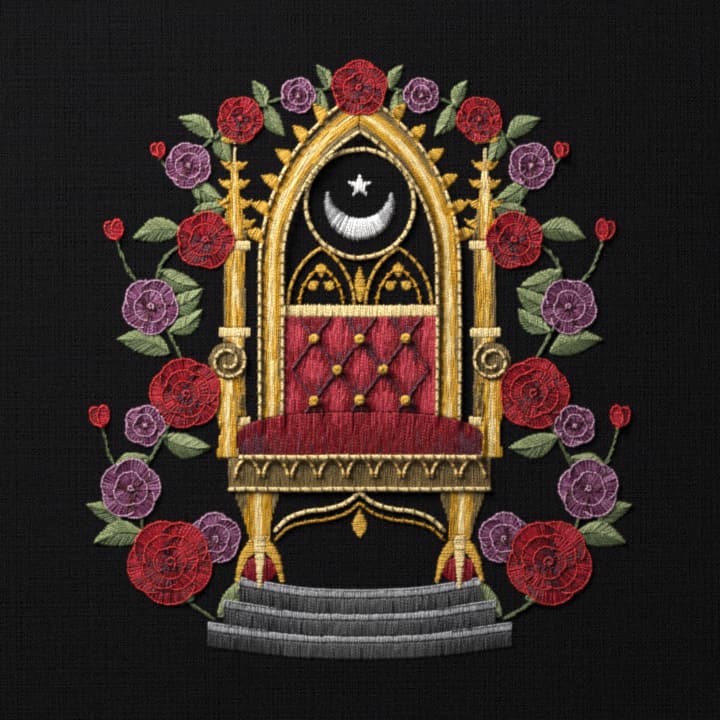
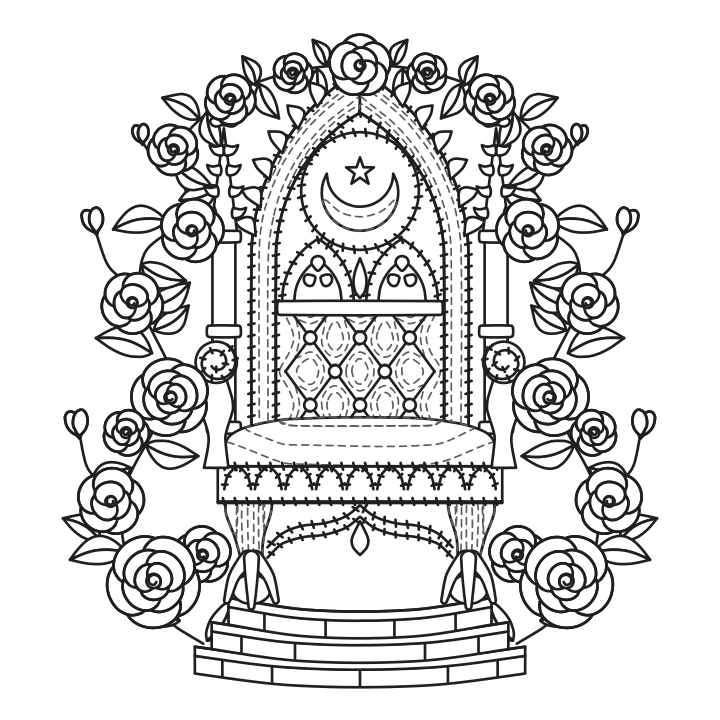
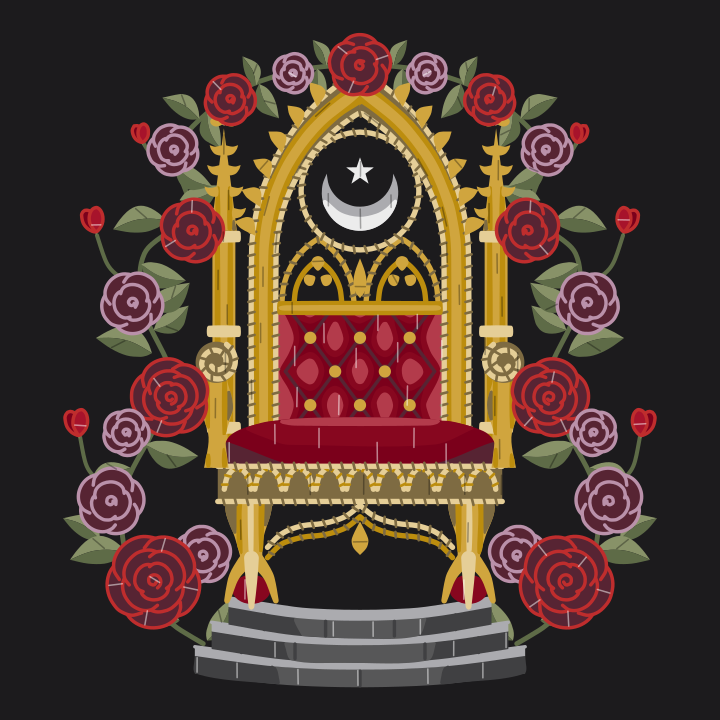
A tall gothic throne stands on three stone steps, with a silver crescent in the round window of its back and oxblood and plum roses climbing both sides. The gold moldings, the velvet and the rose petals are long and short stitch, and the tracery, edges and scrolls are couching in a thick laid gold thread. The moon is padded satin stitch; the crockets, claws and steps are satin stitch. Split stitch lights the petal rims and darkens the seams of the velvet, the vines are stem stitch with fishbone stitch leaves, and the buttons are French knots. It is drawn for black linen. In the picture of where the colors go, the fine lines show which way the stitches lie.
Size and details
Advanced. Uses long and short stitch over much of the design, couching, 18 colors and a great deal of stitching.
18 colors of floss and 8 kinds of stitch:
- Stem stitch
- Fishbone stitch
- Satin stitch
- Split stitch
- Long and short stitch
- French knot
- Couching
- Padded satin stitch
- Which stitch goes where
| Hoop | Inches | Centimeters | Satin stitch up to |
|---|---|---|---|
| 3 in (8 cm) | 1.7 × 1.9 in | 4.3 × 4.8 cm | 1/8 in (3 mm) |
| 4 in (10 cm) | 2.6 × 2.9 in | 6.6 × 7.4 cm | 3/16 in (5 mm) |
| 5 in (13 cm) | 3.4 × 3.8 in | 8.6 × 9.7 cm | 1/4 in (6 mm) |
| 6 in (15 cm) | 4.3 × 4.8 in | 10.9 × 12.2 cm | 5/16 in (8 mm) |
| 8 in (20 cm) | 6 × 6.7 in | 15.2 × 17 cm | 7/16 in (11 mm) |
- In a 3, 4 or 5 inch hoop the French knots are drawn smaller than about 2 mm (a little over 1/16 in). Use one strand of floss for them there, or choose a larger hoop.
The pattern is drawn inside a circle about half an inch (1.3 cm) smaller all around than the hoop.
What you need
- DMC 3362 Dark Pine GreenLeaves (dark), vines
- DMC 3052 Medium Green GrayLeaves (light)
- DMC 413 Dark Pewter GraySteps (lighter)
- DMC 3799 Very Dark Pewter GraySteps (darker), stone joints
- DMC 318 Light Steel GrayStep treads and step edges, moon (darker)
- DMC 729 Medium Old GoldPosts (lighter), arch, legs, arm posts and spires (light), crockets and 8 more parts
- DMC 829 Very Dark Golden OliveSeat rail and arm scrolls, arch edge (darker), arch (dark) and 8 more parts
- DMC 680 Dark Old GoldArch (middle), posts, rails and rail arches (darker), legs (dark) and 4 more parts
- DMC 676 Light Old GoldArch edge, seat rail edge and rail arches (lighter), collars and 6 more parts
- DMC 815 Medium GarnetVelvet back and velvet seat (light), claw balls
- DMC 154 Very Dark GrapeRose petals, velvet seams and rose hearts, velvet seat and velvet back (darkest)
- DMC 814 Dark GarnetVelvet seat and velvet back (dark), rose buds (darker)
- DMC 326 Very Dark RoseVelvet back and velvet seat (lightest)
- DMC 762 Very Light Pearl GrayMoon (lighter), star
- DMC 3363 Medium Pine GreenLeaves (middle)
- DMC 347 Very Dark SalmonPetal rims (darker)
- DMC 498 Dark RedRose buds (lighter)
- DMC 3836 Light GrapePetal rims (lighter)
Skeins: 2 for rose petals, velvet seams and rose hearts, velvet seat and velvet back (darkest); one of each other color. An estimate for the largest size, the 8 inch hoop: the length of each line and the area of each filled shape, a fifth added for tails and ends, a tenth of every 8 m (8.7 yd) skein kept spare.
The floss is six-strand cotton; the stitch guide says how many strands to use. You also need a hoop, an embroidery needle (a size 7 to 9 suits two or three strands) and plain cotton or linen fabric. To frame the piece in its hoop, cut a square 3 inches (8 cm) wider than the hoop: a 9 inch (23 cm) square for a 6 inch hoop.
When it is stitched, how to finish a hoop shows how to back it for the wall.
Stitch guide
- Put the pattern on the fabric (how to transfer a pattern) and the fabric in the hoop.
- Stitch the filled parts first, what lies behind before what lies in front of it.
- Then stitch the lines: stems, veins and outlines over the edges of the filled parts.
- Keep the knots for the end, so that the hoop and your hand do not flatten them.
Start each thread with a small knot on the back or one of the knotless starts, and end it by running the needle under the backs of a few stitches (starting and ending a thread). Use the strands this list gives, also where a page about a stitch names another number.
- Stem stitch 2 to 3 strandsVines
- Fishbone stitch 2 strandsLeaves
- Satin stitch 2 strandsSteps, step treads, claw balls, claws, trefoils, drop, star, rails, crockets, collars, finials, seat rail, apron drop, arm scrolls, leaves, and 2 more
- Split stitch 1 to 2 strandsStep edges, stone joints, velvet seams, petal rims
- Long and short stitch 1 to 2 strandsLegs, velvet back, arch, posts, spires, velvet seat, arm posts, rose petals
- French knot 2 strands, two wrapsVelvet buttons
- Couching 2 to 5 strandsTracery, moon window, arch edge, rail arches, seat rail edge, apron, arm scroll edge
- Padded satin stitch 2 strandsMoon
Getting it onto your fabric
The PDF holds the pattern twice at actual size: once as drawn, and once mirrored for an iron-on transfer pen. Print it at 100% with scaling off and check the one-inch square (25.4 mm) with a ruler before you trace. How to transfer a pattern explains tracing, carbon paper and the other ways. The files are under Downloads.
Downloads
- Download free PDF PDF, US Letter, 3 pages, for a 6 inch (15 cm) hoop
- Download free PDF, A4 PDF, A4, 3 pages, for a 6 inch (15 cm) hoop
More patterns like this
Advanced 3–8 in hoop · 18 colors
Cat lady in an armchair
Advanced 3–8 in hoop · 18 colors
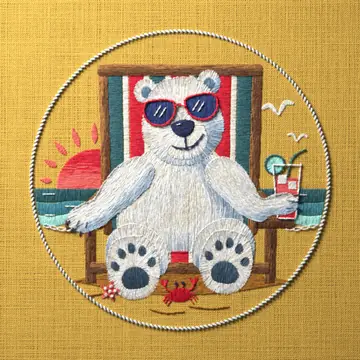
Polar bear in a beach chair
Advanced 3–8 in hoop · 18 colors
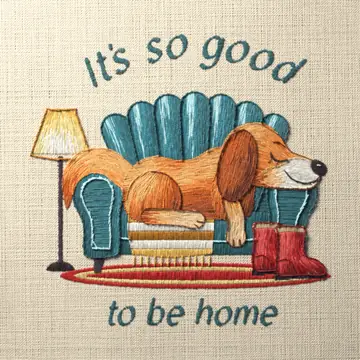
It’s so good to be home
Advanced 3–8 in hoop · 16 colors
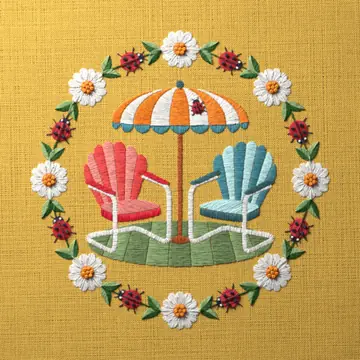
Retro chairs, daisy and ladybug border
Advanced 3–8 in hoop · 16 colors
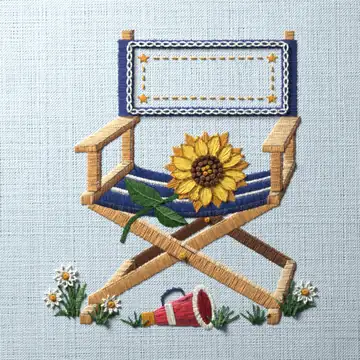
Director’s chair with room for a name
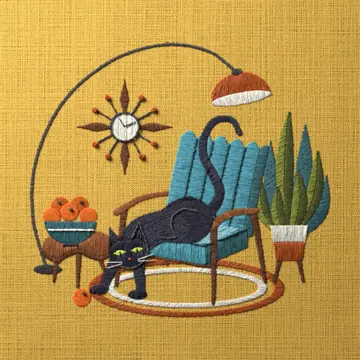
Advanced 3–8 in hoop · 15 colors
Mid century modern room with a cat
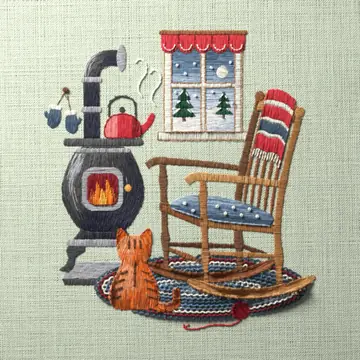
Advanced 3–8 in hoop · 24 colors
Rocking chair by the winter stove
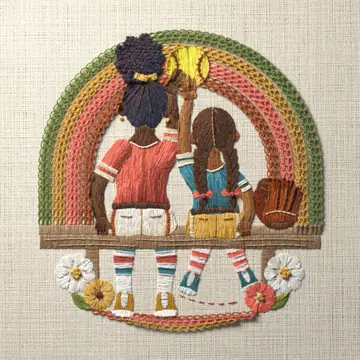
Advanced 3–8 in hoop · 24 colors
Softball sisters on a bench
New to hand embroidery? Starting hand embroidery, step by step