Softball sisters on a bench hand embroidery pattern
Advanced · 24 colors · 10 kinds of stitch
Download free PDFPDF, US Letter · 106 KBFor your own stitching, gifts and handmade pieces you sell. Do not resell or share this PDF. What you may do, in full
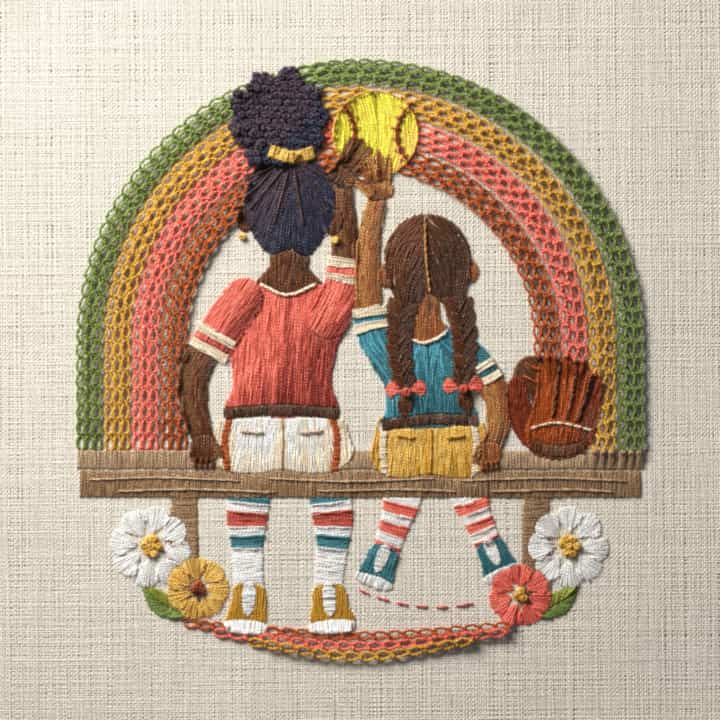
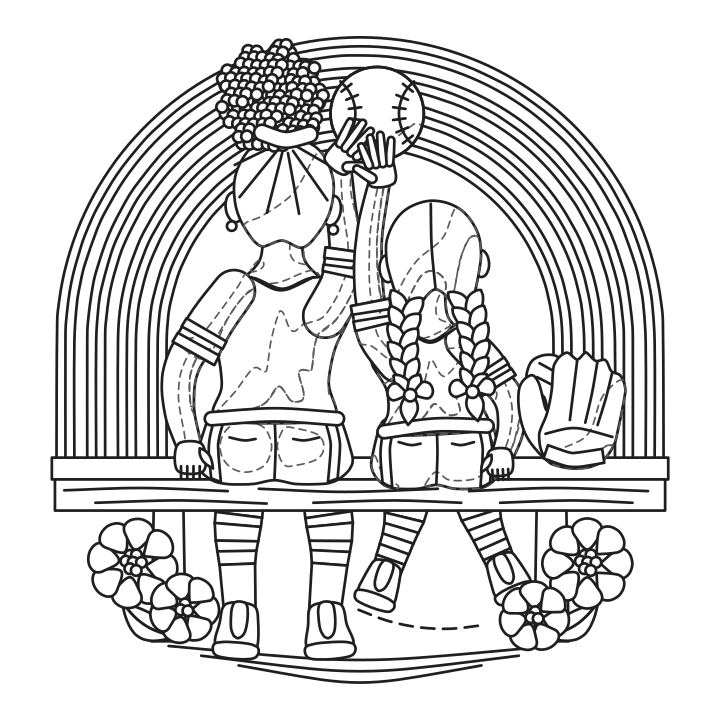
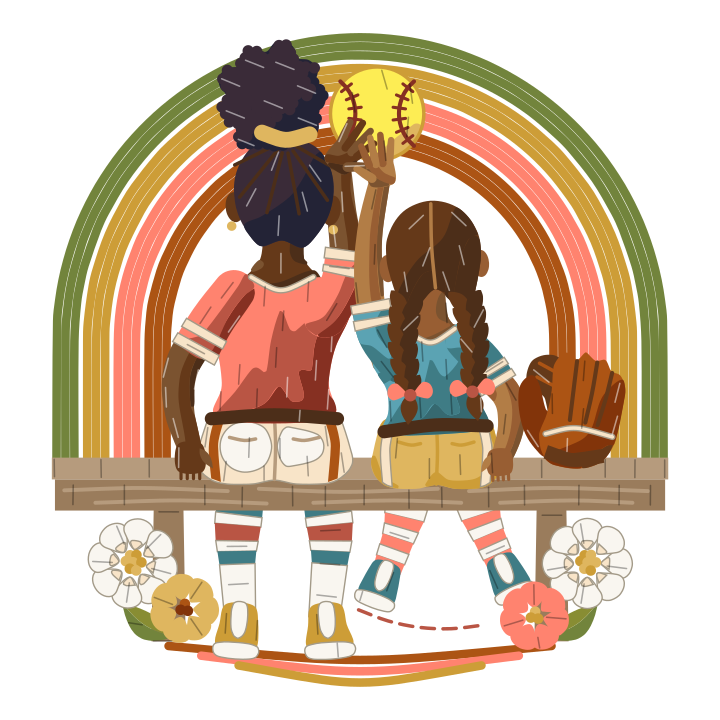
Two sisters sit on a dugout bench with their backs to us, shoulders touching, holding a yellow softball up between them where the sun would be. The sun arch and the dugout floor are rows of chain stitch. Shirts, pants, arms and the ball are long and short stitch, and the striped socks, sneakers, plaits, bench and daisies are satin stitch. The teen’s puff and the daisy centers are French knots. Split stitch marks the parting and the collars, and a running stitch line swings under the little girl’s feet, which do not reach the ground. In the picture of where the colors go, the fine lines show which way the stitches lie.
Size and details
Advanced. Uses long and short stitch over much of the design, more than a hundred French knots, satin stitch over about a fifth of the cloth in a 6 inch hoop, 24 colors and a great deal of stitching.
24 colors of floss and 10 kinds of stitch:
- Chain stitch
- Satin stitch
- Running stitch
- Stem stitch
- Long and short stitch
- Split stitch
- Straight stitch
- French knot
- Back stitch
- Fishbone stitch
- Which stitch goes where
| Hoop | Inches | Centimeters | Satin stitch up to |
|---|---|---|---|
| 3 in (8 cm) | 1.8 × 1.9 in | 4.6 × 4.8 cm | 1/8 in (3 mm) |
| 4 in (10 cm) | 2.6 × 2.8 in | 6.6 × 7.1 cm | 3/16 in (5 mm) |
| 5 in (13 cm) | 3.5 × 3.7 in | 8.9 × 9.4 cm | 1/4 in (6 mm) |
| 6 in (15 cm) | 4.4 × 4.7 in | 11.2 × 11.9 cm | 5/16 in (8 mm) |
| 8 in (20 cm) | 6.2 × 6.5 in | 15.7 × 16.5 cm | 1/2 in (13 mm) |
- In an 8 inch hoop the widest satin stitch shape is 1/2 in (13 mm) across. Satin stitches longer than about 12 mm (just under 1/2 in) tend to work loose: divide the shape into sections, or work it in long and short stitch.
- In a 3, 4 or 5 inch hoop the French knots are drawn smaller than about 2 mm (a little over 1/16 in). Use one strand of floss for them there, or choose a larger hoop.
The pattern is drawn inside a circle about half an inch (1.3 cm) smaller all around than the hoop.
What you need
- DMC 469 Avocado GreenSun arch (dark), leaves (darker)
- DMC 3852 Very Dark StrawSun arch (light), sneakers (lighter) and 5 more parts
- DMC 3340 Medium ApricotShirts and sun arch (lightest) and 4 more parts
- DMC 920 Medium CopperSun arch (darkest), glove (light) and 4 more parts
- DMC 3809 Very Dark TurquoiseShirts (middle dark), sneakers (darker) and 1 more part
- DMC 3865 Winter WhiteDaisies and striped socks (lightest) and 3 more parts
- DMC 3830 Terra CottaShirts (middle light) and 3 more parts
- DMC 840 Medium Beige BrownBench seat (darker), bench legs
- DMC 841 Light Beige BrownBench seat (lighter), wood grain, pants seams (darker)
- DMC 739 Ultra Very Light TanPants (light), sleeve bands and 4 more parts
- DMC 433 Medium BrownArms, hands and neck (middle), fingers (dark)
- DMC 898 Very Dark Coffee BrownHair (light), plaits (darker), belts and 4 more parts
- DMC 801 Dark Coffee BrownHair (lightest), neck and arms (dark) and 9 more parts
- DMC 3777 Very Dark Terra CottaShirts (darkest), softball seams
- DMC 3820 Dark StrawPants and daisies (dark) and 4 more parts
- DMC 3371 Black BrownPuff (lighter), hair (dark)
- DMC 310 BlackPuff (darker), hair (darkest)
- DMC 435 Very Light BrownArms, hands, fingers and neck (lightest), parting
- DMC 434 Light BrownArms, neck, hands and fingers (light), ears (lighter)
- DMC 597 TurquoiseShirts (light)
- DMC 3808 Ultra Very Dark TurquoiseShirts (dark)
- DMC 307 LemonSoftball (lighter)
- DMC 918 Dark Red CopperGlove (middle), daisy centers (darkest)
- DMC 580 Dark Moss GreenLeaves (lighter)
Skeins: one of each color is enough. An estimate for the largest size, the 8 inch hoop: the length of each line and the area of each filled shape, a fifth added for tails and ends, a tenth of every 8 m (8.7 yd) skein kept spare.
The floss is six-strand cotton; the stitch guide says how many strands to use. You also need a hoop, an embroidery needle (a size 7 to 9 suits two or three strands) and plain cotton or linen fabric. To frame the piece in its hoop, cut a square 3 inches (8 cm) wider than the hoop: a 9 inch (23 cm) square for a 6 inch hoop.
When it is stitched, how to finish a hoop shows how to back it for the wall.
Stitch guide
- Put the pattern on the fabric (how to transfer a pattern) and the fabric in the hoop.
- Stitch the filled parts first, what lies behind before what lies in front of it.
- Then stitch the lines: stems, veins and outlines over the edges of the filled parts.
- Keep the knots for the end, so that the hoop and your hand do not flatten them.
Start each thread with a small knot on the back or one of the knotless starts, and end it by running the needle under the backs of a few stitches (starting and ending a thread). Use the strands this list gives, also where a page about a stitch names another number.
- Chain stitch 3 strandsSun arch, ground
- Satin stitch 2 strandsStriped socks, sneakers, sneaker soles, heel tabs, bench legs, and 14 more
- Running stitch 2 strandsSwing lines
- Stem stitch 1 to 2 strandsWood grain, softball seams, glove seams
- Long and short stitch 1 strandPants, arms, neck, shirts, hair, puff, softball, hands, glove
- Split stitch 1 to 3 strandsPants seams, collars, hair strands, parting, softball edge, glove laces
- Straight stitch 1 to 3 strandsFingers, softball seams
- French knot 2 strands, two wrapsEarrings, puff, bows, daisy centers
- Back stitch 2 strandsGlove laces
- Fishbone stitch 2 strandsLeaves
Getting it onto your fabric
The PDF holds the pattern twice at actual size: once as drawn, and once mirrored for an iron-on transfer pen. Print it at 100% with scaling off and check the one-inch square (25.4 mm) with a ruler before you trace. How to transfer a pattern explains tracing, carbon paper and the other ways. The files are under Downloads.
Downloads
- Download free PDF PDF, US Letter, 3 pages, for a 6 inch (15 cm) hoop
- Download free PDF, A4 PDF, A4, 3 pages, for a 6 inch (15 cm) hoop
More patterns like this
Advanced 3–8 in hoop · 23 colors
Baseball and football with autumn mums
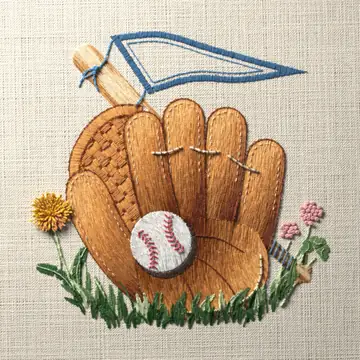
Advanced 3–8 in hoop · 23 colors
Baseball glove, bat and blank pennant
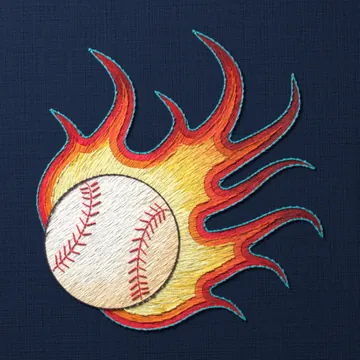
Advanced 3–8 in hoop · 16 colors
Flaming baseball
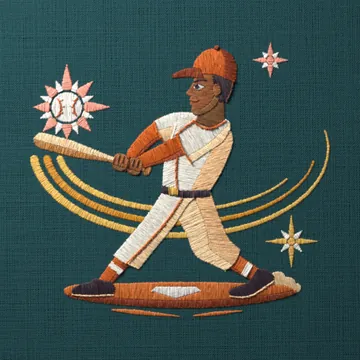
Advanced 3–8 in hoop · 15 colors
Baseball batter swinging
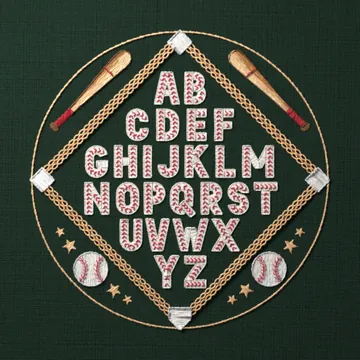
Advanced 3–8 in hoop · 10 colors
Baseball stitch letters, A to Z
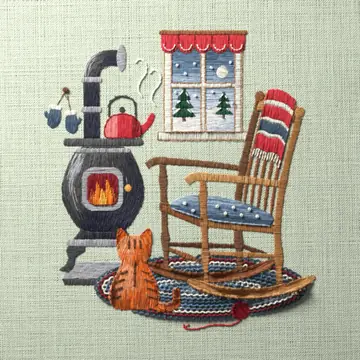
Advanced 3–8 in hoop · 24 colors
Rocking chair by the winter stove
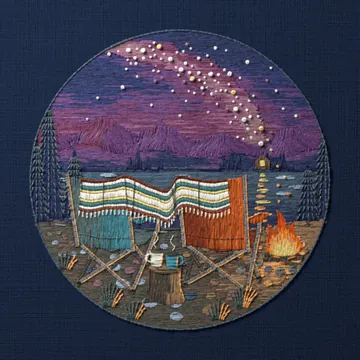
Advanced 3–8 in hoop · 24 colors
Camp chairs under the stars
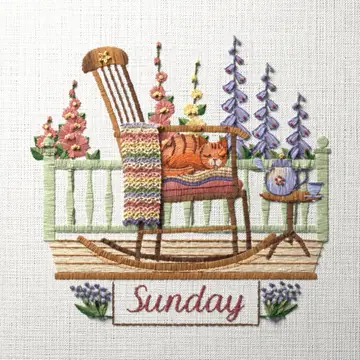
Advanced 3–8 in hoop · 24 colors
Sunday day of rest
New to hand embroidery? Starting hand embroidery, step by step