Japanese mending crane in boro patches hand embroidery pattern
Advanced · 8 colors · 4.3 × 4.7 in · 7 kinds of stitch
Download free PDFPDFPrints on US Letter and A4You may sell what you make from it by hand, in small quantities. The PDF itself is not to be sold or shared. Selling, classes and kits: the rules
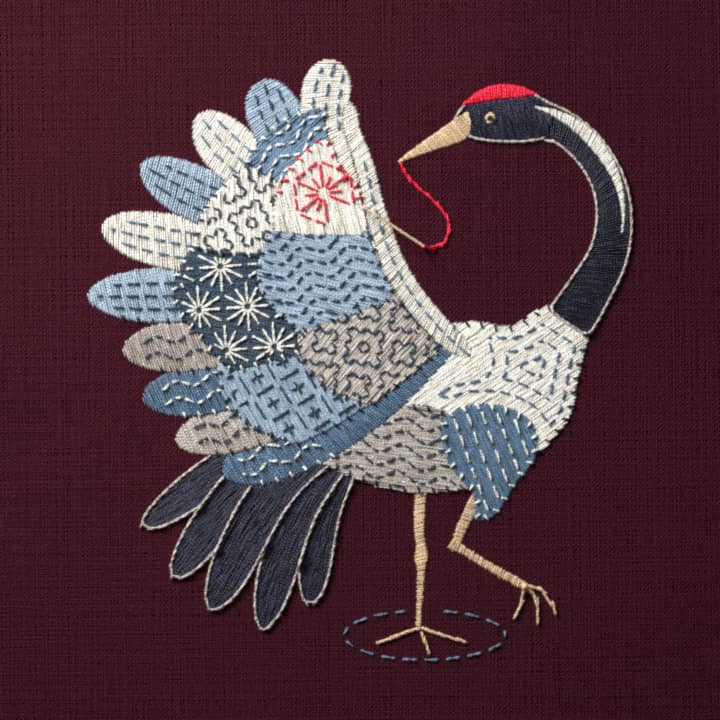
A crane stands on one leg in a ripple of water, its ink neck bent back to the wing it has lifted.
Size and details
Advanced. Uses long and short stitch over much of the design, satin stitch over about a third of the cloth in a 6 inch hoop, eight colors and a great deal of stitching; from a 5 inch hoop up some of the satin stitches are long.
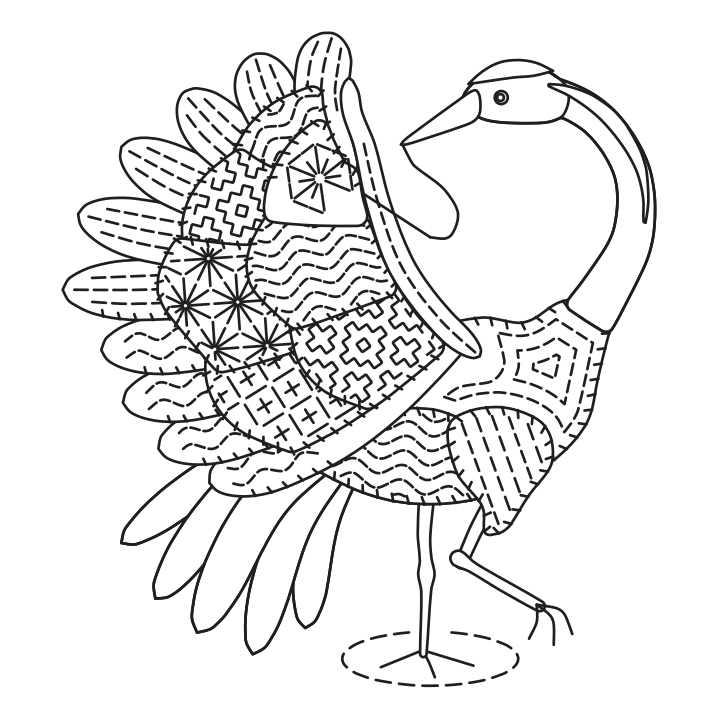
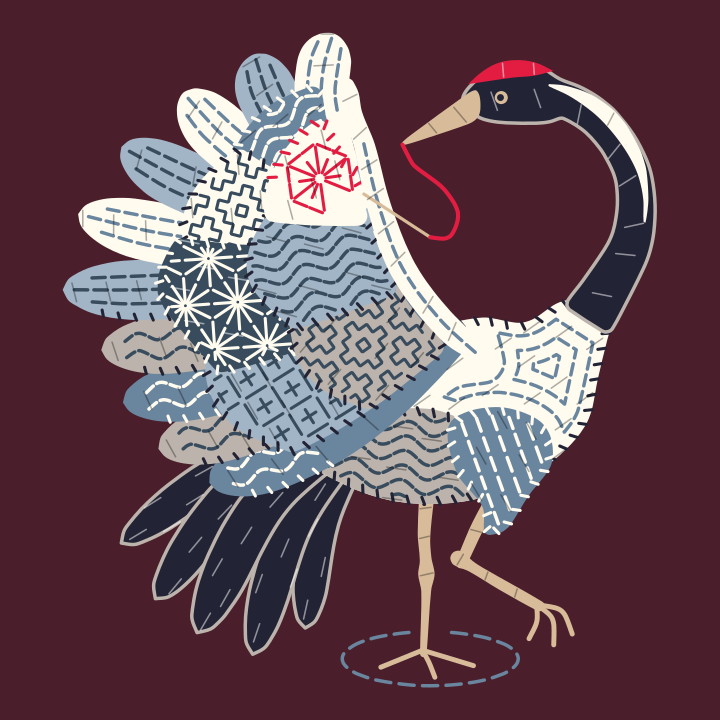
The patches of the wing and body are long and short stitch in cream, dove and three denim blues, and the flight feathers are satin stitch. Waves, echo lines, crossed squares, hemp leaf stars and persimmon flowers lie over them in running stitch, and tiny straight stitches whip each patch down at its edge. The neck and tail are edged in split stitch. A red thread in stem stitch runs from the bill to a needle and a star with one part still to work. It is drawn for wine red linen. In the picture of where the colors go, the fine lines show which way the stitches lie.
| Hoop | Inches | Centimeters | Satin stitch up to |
|---|---|---|---|
| 3 in (8 cm) | 1.7 × 1.9 in | 4.3 × 4.8 cm | 3/16 in (5 mm) |
| 4 in (10 cm) | 2.6 × 2.8 in | 6.6 × 7.1 cm | 1/4 in (6 mm) |
| 5 in (13 cm) | 3.4 × 3.8 in | 8.6 × 9.7 cm | 3/8 in (10 mm) |
| 6 in (15 cm) | 4.3 × 4.7 in | 10.9 × 11.9 cm | 7/16 in (11 mm) |
| 8 in (20 cm) | 6 × 6.6 in | 15.2 × 16.8 cm | 5/8 in (16 mm) |
- In an 8 inch hoop the widest satin stitch shape is 5/8 in (16 mm) across. Satin stitches longer than about 12 mm (just under 1/2 in) tend to work loose: divide the shape into sections, or work it in long and short stitch.
- In a 3 or 4 inch hoop the French knot is drawn smaller than about 2 mm (a little over 1/16 in). Use one strand of floss for it there, or choose a larger hoop.
What you need
- Fabric
- Plain cotton or linen in wine red, cut 9 in (23 cm) square. On white cloth its palest threads do not show: choose other colors under Options. A pencil line does not show on it: see how to transfer a pattern to dark fabric.
- Needle
- Embroidery needle, size 9 for 1 strand, size 7 for 2 or 3 (a lower number is a thicker needle).
- Floss
- 8 colors of six-strand cotton, listed below. DMC is a brand: another brand in a like color will do.
- Marker
- A pen or a sheet that suits the fabric: how to transfer a pattern says which.
Floss
- 1DMC 310 BlackTail, neck and head, whip stitches and eye (darker)
- 2DMC 648 Light Beaver GrayFlight feathers (light), belly patch, tail edge and neck edge, shoulder patches (middle)
- 3DMC 931 Medium Antique BlueFlight feathers (darkest), thigh patch, covert patches (dark) and 4 more parts
- 4DMC 3046 Medium Yellow BeigeRaised leg, standing leg, bill, raised foot, foot and needle, eye (lighter)
- 5DMC 712 CreamBreast patch, flight feathers and covert patches (lightest) and 8 more parts
- 6DMC 3750 Very Dark Antique BlueCovert patches (darkest), waves (darker), persimmon flowers and 2 more parts
- 7DMC 666 Bright RedRed hemp leaf star, crown, red thread and red whip stitches
- 8DMC 932 Light Antique BlueFlight feathers and shoulder patches (dark), covert patches (light)
Skeins: one of each color is enough. An estimate for the 6 inch hoop, from the length of each line and the area of each filled shape, with a fifth added for tails.
How to stitch it
- New to hand embroidery? Start here.
- Print at 100%, trace the pattern onto the fabric, and put it in the hoop: inner ring under, drawing up, tight as a drum.
- Floss is six strands. Cut 18 inches (45 cm), pull out the number given one at a time, and lay them together.
- Inside a filled shape start with two or three tiny stitches, which the filling covers. Start a line with a small knot on the back. End each thread by running the needle under the backs of a few stitches.
- Each small ring is one French knot. A dashed line is running stitch.
- A number under “Where colors go” is a color of the list. The fine lines on the colors show which way the stitches lie.
Stitch in this order
Filled parts from the back of the picture forward, then lines and knots. Where a stitch page names another number of strands, use the number here.
- Long and short stitch 2 strandsTail, breast patch, belly patch, thigh patch, covert patches, shoulder patches
- Satin stitch 2 strandsStanding leg, raised leg, neck, head, nape stripe, crown, bill, eye, flight feathers, wing edge
- Split stitch 2 strandsTail edge, neck edge
- Running stitch 2 strandsRipples, breast rows, waves, thigh rows, feather rows, crossed squares, persimmon flowers, hemp leaf stars, red hemp leaf star, wing edge row
- Stem stitch3 strands: foot, raised foot2 strands: red thread
- Straight stitch3 strands: needle2 strands: whip stitches, red whip stitches
- French knot 1 strand, two wrapsEye
When it is done, take off any lines that still show and finish the hoop. Guides to this kind of work: Sashiko embroidery and Stitches for fur, hair and feathers.
More patterns like this
Advanced 3–8 in hoop · 10 colors
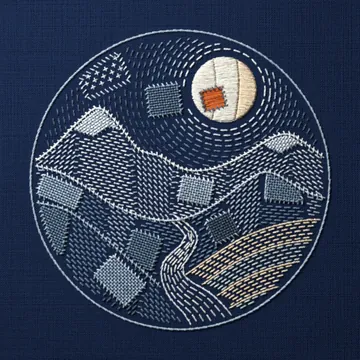
Boro patchwork mountains and moon
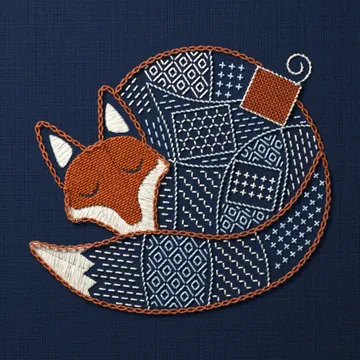
Intermediate 3–8 in hoop · 7 colors
Sashiko fox with boro-style patches
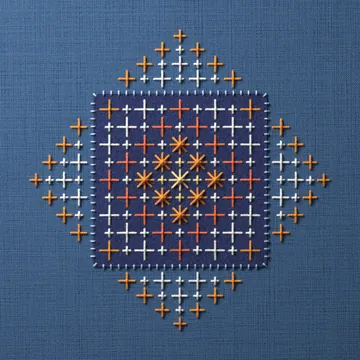
Easy prints 3–14 in · 5 colors
Easy sashiko crosses knee mend
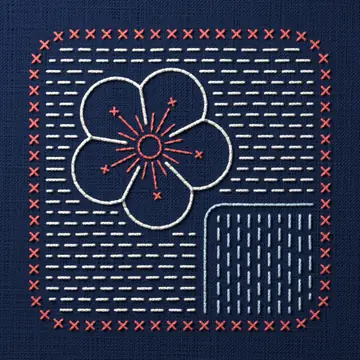
Beginner 3–8 in hoop · 3 colors
Easy boro patch with a plum blossom
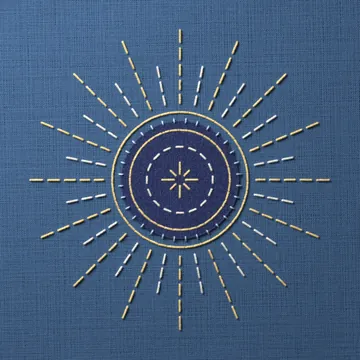
Beginner prints 3–14 in · 3 colors
Easy sunray mend for a round hole
Advanced 3–8 in hoop · 14 colors
White Chinese cranes over a pine
Advanced 3–8 in hoop · 21 colors
Flying crane with cherry blossom
Intermediate 3–8 in hoop · 8 colors
Medieval darning band with stags
New to hand embroidery? Starting hand embroidery, step by step