Japanese owl on a pine branch hand embroidery pattern
Advanced · 20 colors · 4.5 × 4.4 in · 6 kinds of stitch
Download free PDFPDFPrints on US Letter and A4You may sell what you make from it by hand, in small quantities. The PDF itself is not to be sold or shared. Selling, classes and kits: the rules
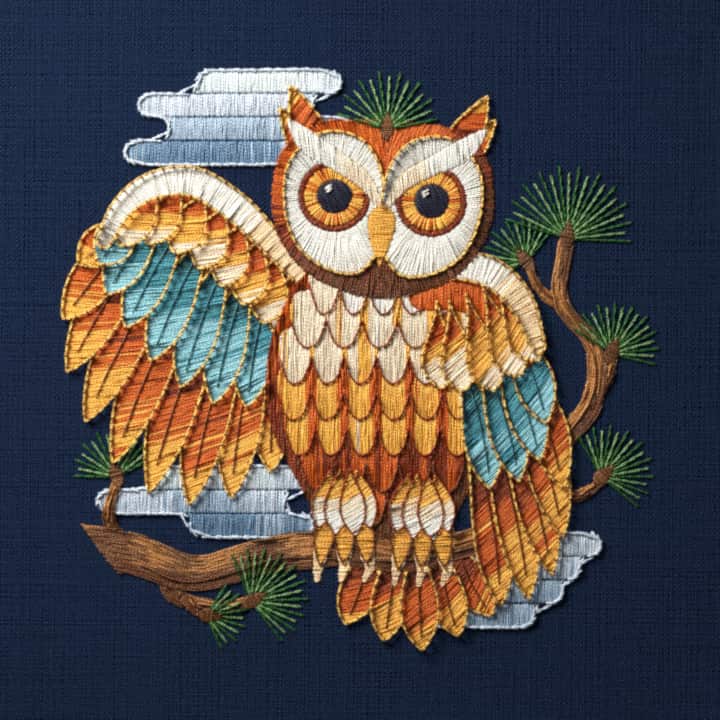
A large owl looks straight out from a twisting pine branch, one wing lifted and spread, the other folded.
Size and details
Advanced. Uses couching, long and short stitch over much of the design, satin stitch over more than half of the cloth in a 6 inch hoop, 20 colors and a great deal of stitching; from a 5 inch hoop up some of the satin stitches are long.
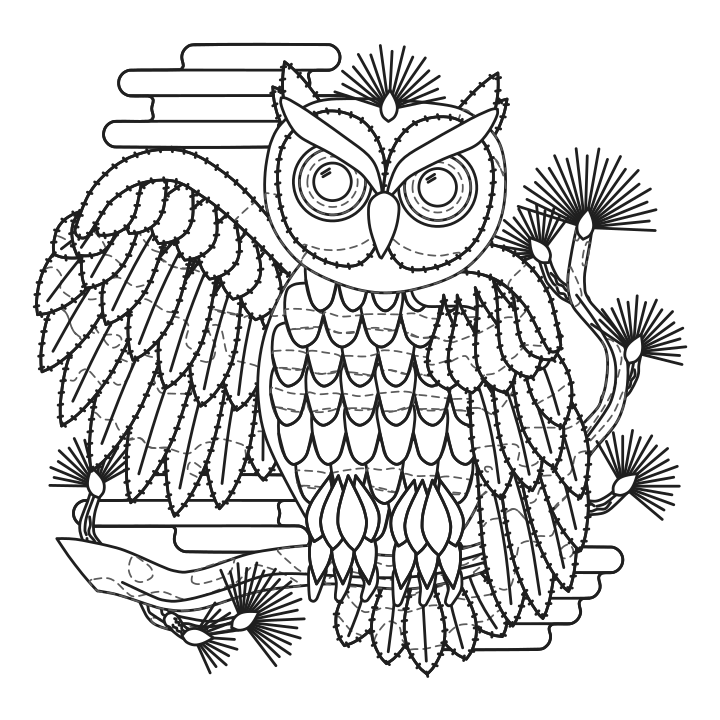
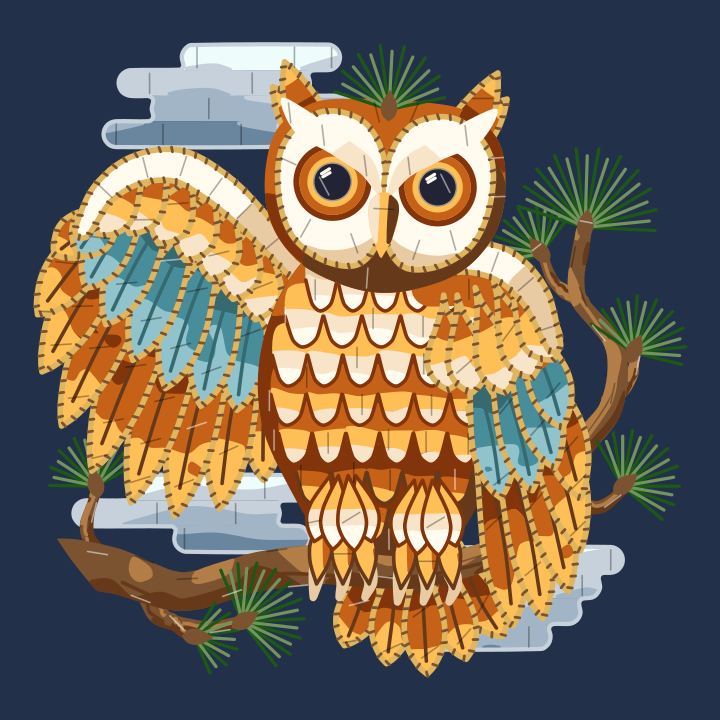
The long feathers are satin stitch that runs from brown and russet to amber, with a row of peacock blue above them, and each one is edged in couched gold. The breast is separate satin scallops, cream at the throat and russet below, parted by split stitch. Long and short stitch shades the branch, the body behind the scallops and the crown of the head. The pine needles are fans of straight stitches with a small satin bud, and one small fan rests on the head like a crest. Pale satin mist bands behind are edged in stem stitch. It is drawn for navy linen. In the picture of where the colors go, the fine lines show which way the stitches lie.
| Hoop | Inches | Centimeters | Satin stitch up to |
|---|---|---|---|
| 3 in (8 cm) | 1.8 × 1.8 in | 4.6 × 4.6 cm | 3/16 in (5 mm) |
| 4 in (10 cm) | 2.7 × 2.7 in | 6.9 × 6.9 cm | 1/4 in (6 mm) |
| 5 in (13 cm) | 3.6 × 3.5 in | 9.1 × 8.9 cm | 3/8 in (10 mm) |
| 6 in (15 cm) | 4.5 × 4.4 in | 11.4 × 11.2 cm | 7/16 in (11 mm) |
| 8 in (20 cm) | 6.4 × 6.2 in | 16.3 × 15.7 cm | 5/8 in (16 mm) |
- In an 8 inch hoop the widest satin stitch shape is 5/8 in (16 mm) across. Satin stitches longer than about 12 mm (just under 1/2 in) tend to work loose: divide the shape into sections, or work it in long and short stitch.
What you need
- Fabric
- Plain cotton or linen in navy, cut 9 in (23 cm) square. On white cloth its palest threads do not show: choose other colors under Options. A pencil line does not show on it: see how to transfer a pattern to dark fabric.
- Needle
- Embroidery needle, size 9 for 1 strand, size 7 for 2 (a lower number is a thicker needle).
- Floss
- 20 colors of six-strand cotton, listed below. DMC is a brand: another brand in a like color will do.
- Marker
- A pen or a sheet that suits the fabric: how to transfer a pattern says which.
On clothes. Wash and dry the garment first. Denim and twill need no backing and take a sharp needle, embroidery or chenille; T-shirts, sweatshirts and other knits need a backing that sticks or irons on. How to embroider on clothes has every step, the guide to jackets and coats says how to get behind a lining, the guide to patches has the other way, for a jacket whose lining is not opened, and the placement chart says where a design goes.
Floss
- 1DMC 3756 Ultra Very Light Baby BlueMist (lightest)
- 2DMC 3752 Very Light Antique BlueMist (light), mist edges
- 3DMC 932 Light Antique BlueMist (dark)
- 4DMC 931 Medium Antique BlueMist (darkest)
- 5DMC 921 CopperLong wing feathers and head (light), breast feathers (dark) and 6 more parts
- 6DMC 801 Dark Coffee BrownBody (dark), feather shafts (darker), long wing feathers (darkest) and 8 more parts
- 7DMC 918 Dark Red CopperBody (middle), long wing feathers (dark), breast feathers (darkest) and 5 more parts
- 8DMC 742 Light TangerineBreast feathers (middle dark), long wing feathers (lightest) and 7 more parts
- 9DMC 3820 Dark StrawGold edging (lighter)
- 10DMC 433 Medium BrownGold edging (darker), branch (middle), pine buds
- 11DMC 435 Very Light BrownBranch (light), bark lines (lighter)
- 12DMC 3345 Dark Hunter GreenPine needles (darker)
- 13DMC 3347 Medium Yellow GreenPine needles (lighter)
- 14DMC 3810 Dark TurquoiseBlue wing feathers (middle)
- 15DMC 3808 Ultra Very Dark TurquoiseBlue wing feathers (dark), feather shafts (lighter)
- 16DMC 598 Light TurquoiseBlue wing feathers (light)
- 17DMC 739 Ultra Very Light TanBreast feathers, wing scales and beak (light), leg feathers (middle), brows (darker)
- 18DMC 712 CreamFace, wing edge and brows (lighter), leg feathers (light) and 2 more parts
- 19DMC 738 Very Light TanBreast feathers (middle light), wing edge and face (darker), claws
- 20DMC 310 BlackPupils
Skeins: one of each color is enough. An estimate for the 6 inch hoop, from the length of each line and the area of each filled shape, with a fifth added for tails.
How to stitch it
- New to hand embroidery? Start here.
- Print at 100%, trace the pattern onto the fabric, and put it in the hoop: inner ring under, drawing up, tight as a drum.
- Floss is six strands. Cut 18 inches (45 cm), pull out the number given one at a time, and lay them together.
- Begin with no knot on the back where it is seen and washed, as on a towel, a napkin or clothes; for a piece in a hoop a small knot is fine. End each thread by whipping it around the backs of four or five stitches, with one small hitch.
- A fine broken line inside a shape is where two shades meet: trace it, do not stitch it.
- A number under “Where colors go” is a color of the list. The fine lines on the colors show which way the stitches lie.
Stitch in this order
Filled parts from the back of the picture forward, then lines. Where a stitch page names another number of strands, use the number here.
- Satin stitch 2 strandsMist, tail, pine buds, long wing feathers, blue wing feathers, wing scales, wing edge, breast feathers, claws, toes, leg feathers, ear tufts, face, eye rims, eyes, pupils, brows, beak
- Long and short stitch 1 strandBranch, body, head
- Stem stitch 2 strandsMist edges
- Split stitch 1 strandFeather shafts, bark lines, breast edges, toe edges
- Couching 2 strandsGold edging
- Straight stitch 2 strandsPine needles, eye lights
When it is done, take off any lines that still show. A guide to this kind of work: Stitches for fur, hair and feathers.
More patterns like this
Advanced 3–8 in hoop · 21 colors
Owl in the forest
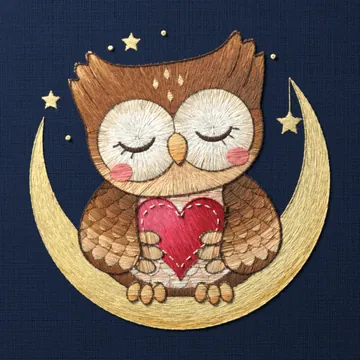
Advanced prints 3–14 in · 19 colors
Cute sleeping owl with a heart
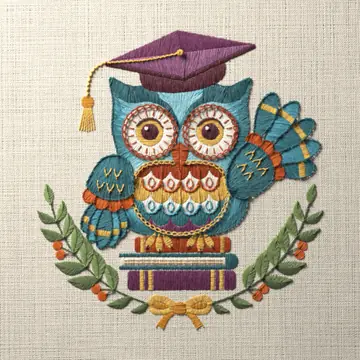
Advanced prints 3–14 in · 15 colors
Graduation owl card
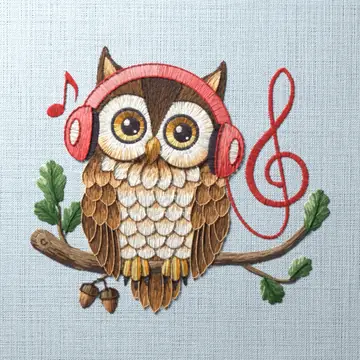
Advanced 3–8 in hoop · 21 colors
Musical owl with headphones
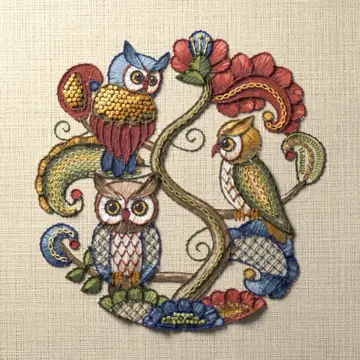
Advanced prints 3–14 in · 22 colors
Three owls in a crewel tree
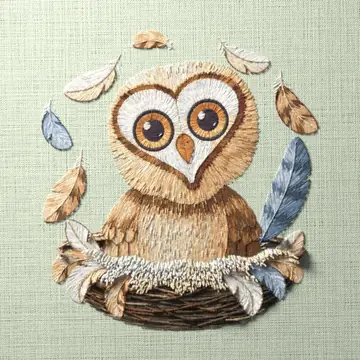
Advanced 3–8 in hoop · 20 colors
Baby owl in a feather nest
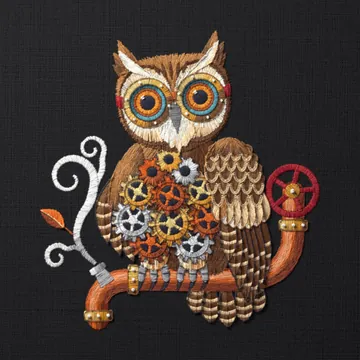
Advanced 3–8 in hoop · 20 colors
Steampunk owl with goggles and gears
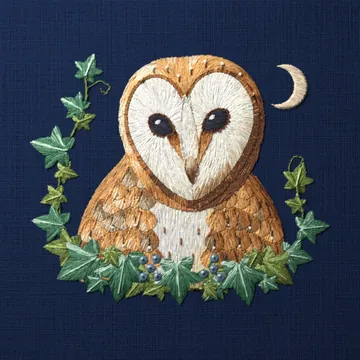
Advanced 3–8 in hoop · 22 colors
Barn owl among ivy
New to hand embroidery? Starting hand embroidery, step by step