Japanese temple foo dogs in a bunka look hand embroidery pattern
Advanced · 13 colors · 4.5 × 3.8 in · 7 kinds of stitch
Download free PDFPDFPrints on US Letter and A4You may sell what you make from it by hand, in small quantities. The PDF itself is not to be sold or shared. Selling, classes and kits: the rules
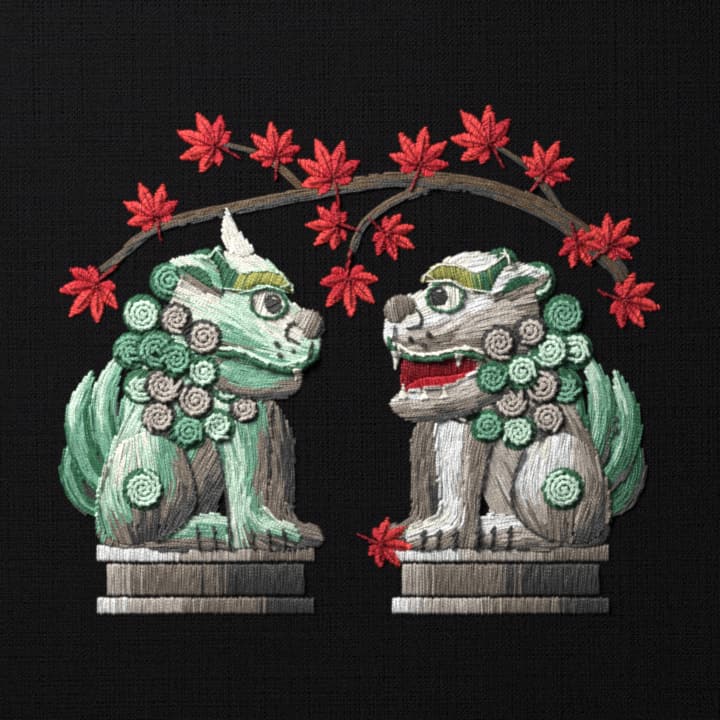
Two stone guardian dogs face each other on their plinths, the right one open mouthed and the left one closed and horned.
Size and details
Advanced. Uses long and short stitch over much of the design, padded satin stitch, satin stitch over about a fifth of the cloth in a 6 inch hoop, 13 colors and a great deal of stitching.
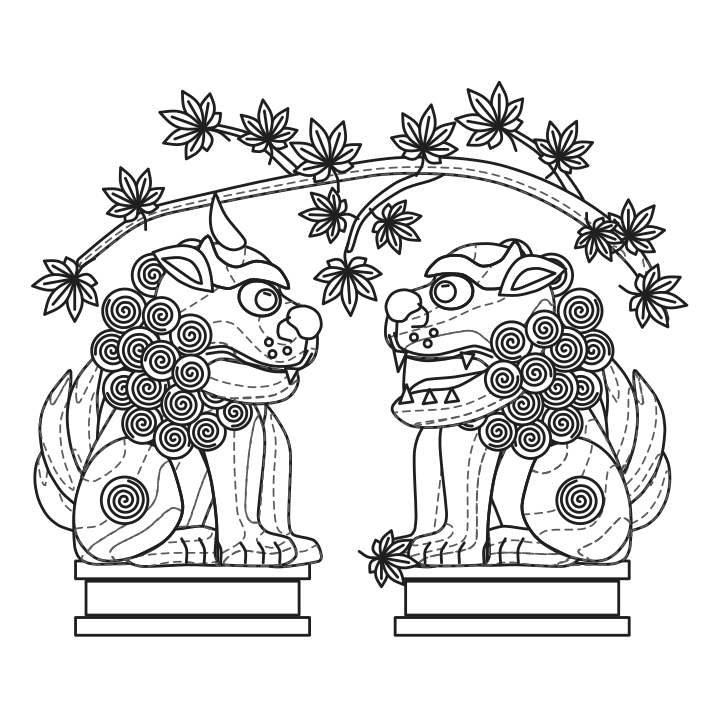
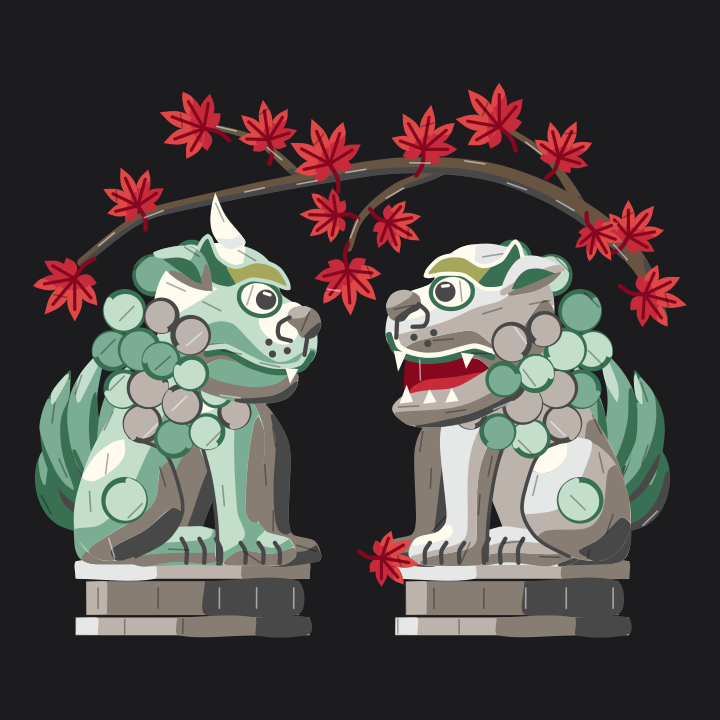
Their bodies are broad strokes of long and short stitch that follow each form, from grey and celadon to ivory where the light falls, and they suit lustrous rayon floss. The manes are tight spirals of stem stitch on satin stitch, the brows and noses are padded satin stitch, and the toes are stem stitch. The plinths and the red maple leaves are satin stitch, and one fallen leaf lies by a great paw. It is drawn for black linen. In the picture of where the colors go, the fine lines show which way the stitches lie.
| Hoop | Inches | Centimeters | Satin stitch up to |
|---|---|---|---|
| 3 in (8 cm) | 1.8 × 1.5 in | 4.6 × 3.8 cm | 1/8 in (3 mm) |
| 4 in (10 cm) | 2.7 × 2.3 in | 6.9 × 5.8 cm | 3/16 in (5 mm) |
| 5 in (13 cm) | 3.6 × 3.1 in | 9.1 × 7.9 cm | 1/4 in (6 mm) |
| 6 in (15 cm) | 4.5 × 3.8 in | 11.4 × 9.7 cm | 5/16 in (8 mm) |
| 8 in (20 cm) | 6.3 × 5.4 in | 16 × 13.7 cm | 7/16 in (11 mm) |
- In a 3 or 4 inch hoop the French knots are drawn smaller than about 2 mm (a little over 1/16 in). Use one strand of floss for them there, or choose a larger hoop.
What you need
- Fabric
- Plain cotton or linen in black, cut 9 in (23 cm) square. On white cloth its palest threads do not show: choose other colors under Options. A pencil line does not show on it: see how to transfer a pattern to dark fabric.
- Needle
- Embroidery needle, size 9 for 1 strand, size 7 for 2 or 3, size 3 for 4 or 5 (a lower number is a thicker needle).
- Floss
- 13 colors of six-strand cotton, listed below. DMC is a brand: another brand in a like color will do.
- Marker
- A pen or a sheet that suits the fabric: how to transfer a pattern says which.
Floss
- 1DMC 839 Dark Beige BrownBough (lighter)
- 2DMC 844 Ultra Dark Beaver GrayMane ground (darker), plinths (darkest), bodies (shade 1 of 7) and 12 more parts
- 3DMC 321 RedMaple leaves and fallen leaf (darker), tongue
- 4DMC 350 Medium CoralMaple leaves and fallen leaf (lighter)
- 5DMC 815 Medium GarnetLeaf veins, mouth and leaf stalks
- 6DMC 648 Light Beaver GrayBodies, haunches and heads (shade 4 of 7), plinths (light) and 5 more parts
- 7DMC 646 Dark Beaver GrayPlinths (dark), legs, bodies, heads and haunches (shade 2 of 7) and 3 more parts
- 8DMC 3072 Very Light Beaver GrayHeads, legs and bodies (shade 6 of 7), plinths and paws (lightest) and 3 more parts
- 9DMC 501 Dark Blue GreenMane ground (lighter), tails and lips (dark), brows (darker), eye edges and inner ears
- 10DMC 503 Medium Blue GreenBodies and heads (shade 3 of 7), tails (light), mane (dark) and 4 more parts
- 11DMC 504 Very Light Blue GreenHeads, legs, haunches and bodies (shade 5 of 7), mane (light) and 6 more parts
- 12DMC 712 CreamHeads, bodies, haunches and legs (shade 7 of 7), eyes and 5 more parts
- 13DMC 3012 Medium Khaki GreenBrows (lighter)
Skeins: one of each color is enough. An estimate for the 6 inch hoop, from the length of each line and the area of each filled shape, with a fifth added for tails.
How to stitch it
- New to hand embroidery? Start here.
- Print at 100%, trace the pattern onto the fabric, and put it in the hoop: inner ring under, drawing up, tight as a drum.
- Floss is six strands. Cut 18 inches (45 cm), pull out the number given one at a time, and lay them together.
- Inside a filled shape start with two or three tiny stitches, which the filling covers. Start a line with a small knot on the back. End each thread by running the needle under the backs of a few stitches.
- Each small ring is one French knot. A fine broken line inside a shape is where two shades meet: trace it, do not stitch it.
- A number under “Where colors go” is a color of the list. The fine lines on the colors show which way the stitches lie.
Stitch in this order
Filled parts from the back of the picture forward, then lines and knots. Where a stitch page names another number of strands, use the number here.
- Long and short stitch 2 strandsBough, tails, legs, bodies, paws, haunches, heads, ears, horn
- Satin stitch 2 strandsMaple leaves, plinths, mane ground, teeth, eyes, pupils, inner ears, mouth, tongue, fallen leaf
- Padded satin stitch 2 strandsNoses, brows
- Stem stitch2 to 5 strands: lips4 strands: haunch spirals, mane2 strands: leaf stalks, toes, eye edges1 strand: brow edges
- Straight stitch 1 strandLeaf veins, eye lights
- Split stitch 2 strandsForm lines
- French knot 1 strand, two wrapsWhisker dots
When it is done, take off any lines that still show and finish the hoop. A guide to this kind of work: Stitches for fur, hair and feathers.
More patterns like this
Advanced prints 3–14 in · 23 colors
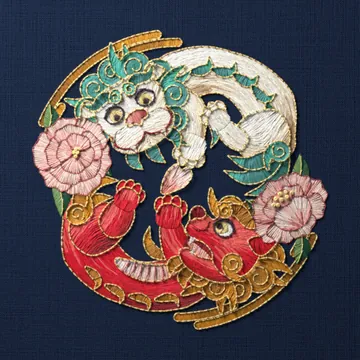
Two Japanese lions in peonies
Advanced 3–8 in hoop · 23 colors
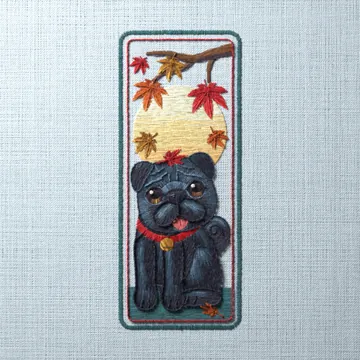
Black pug bookmark with maple leaves
Advanced 3–8 in hoop · 12 colors
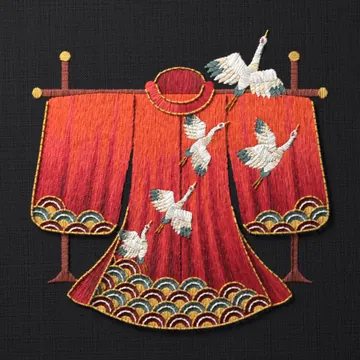
Red and gold kimono with cranes
Advanced prints 3–14 in · 13 colors
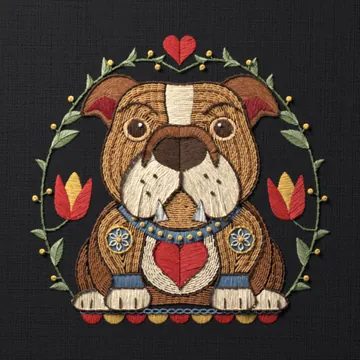
Country folk bulldog with a heart
Advanced 3–8 in hoop · 13 colors
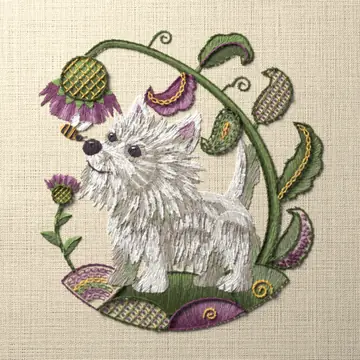
West Highland terrier in crewel
Advanced 3–8 in hoop · 15 colors
Japanese lotus in ancient silk style
Advanced prints 3–14 in · 16 colors
Japanese birds over waves
Advanced 3–8 in hoop · 15 colors
Dachshund in a gingham Christmas coat
New to hand embroidery? Starting hand embroidery, step by step