Red and gold kimono with cranes hand embroidery pattern
Advanced · 12 colors · 4.4 × 4.4 in · 6 kinds of stitch
Download free PDFPDFPrints on US Letter and A4You may sell what you make from it by hand, in small quantities. The PDF itself is not to be sold or shared. Selling, classes and kits: the rules
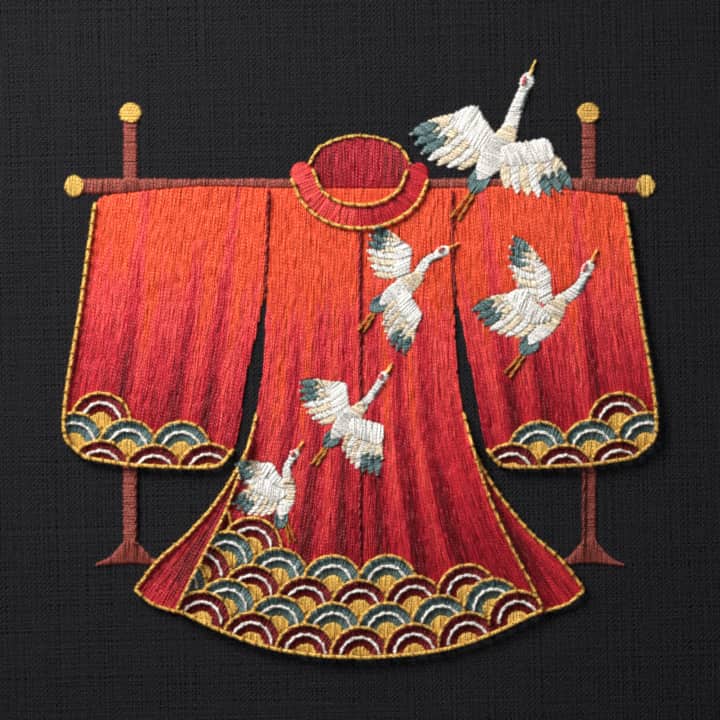
The robe is shown from behind with its sleeves open wide, and its color deepens from vermilion at the shoulders to garnet at the hem in long and short stitch.
Size and details
Advanced. Uses couching, long and short stitch over much of the design, satin stitch over about a third of the cloth in a 6 inch hoop, twelve colors and a great deal of stitching; from a 6 inch hoop up some of the satin stitches are long.
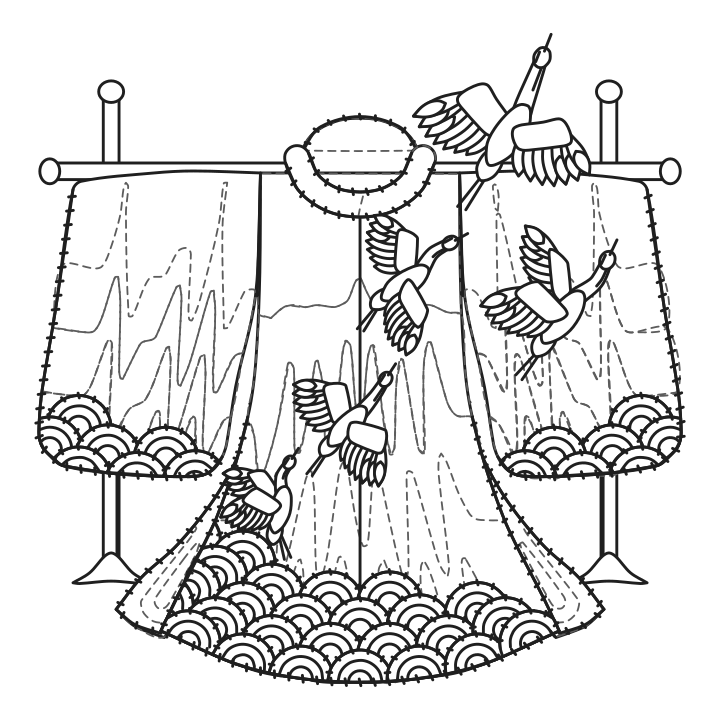
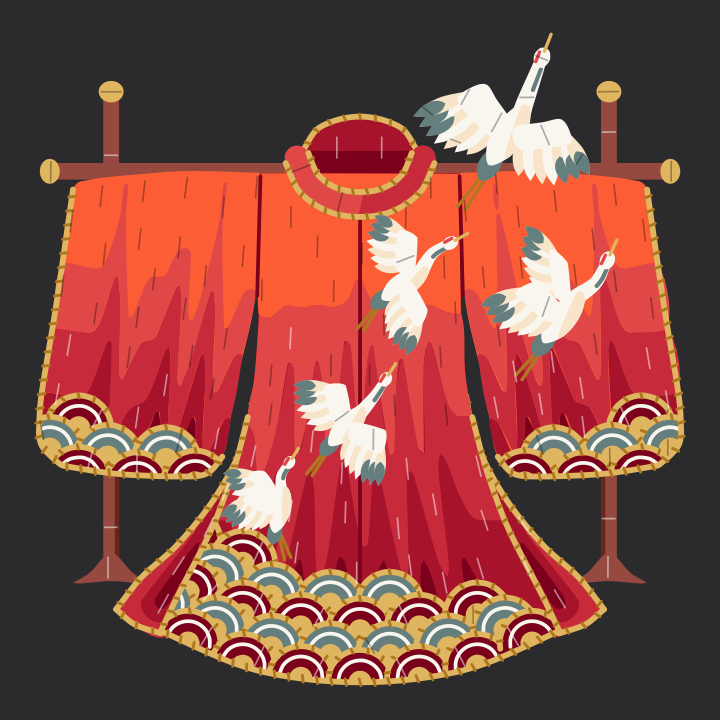
Couching in gold draws the collar, the sleeve ends and the hem. Bands of scalloped waves in satin stitch, with couched gold rims and split stitch foam, fill the hem and the sleeve corners. Five ivory cranes with gray teal wing tips climb the back in satin stitch, with straight stitch bills and legs, and the last one slips off the sleeve into the air. The stand and its gold caps are satin stitch on bare charcoal cloth. In the picture of where the colors go, the fine lines show which way the stitches lie.
| Hoop | Inches | Centimeters | Satin stitch up to |
|---|---|---|---|
| 3 in (8 cm) | 1.8 × 1.8 in | 4.6 × 4.6 cm | 1/8 in (3 mm) |
| 4 in (10 cm) | 2.6 × 2.6 in | 6.6 × 6.6 cm | 1/4 in (6 mm) |
| 5 in (13 cm) | 3.5 × 3.5 in | 8.9 × 8.9 cm | 5/16 in (8 mm) |
| 6 in (15 cm) | 4.4 × 4.4 in | 11.2 × 11.2 cm | 3/8 in (10 mm) |
| 8 in (20 cm) | 6.1 × 6.1 in | 15.5 × 15.5 cm | 1/2 in (13 mm) |
- In an 8 inch hoop the widest satin stitch shape is 1/2 in (13 mm) across. Satin stitches longer than about 12 mm (just under 1/2 in) tend to work loose: divide the shape into sections, or work it in long and short stitch.
What you need
- Fabric
- Plain cotton or linen in charcoal, cut 9 in (23 cm) square. On white cloth its palest threads do not show: choose other colors under Options. A pencil line does not show on it: see how to transfer a pattern to dark fabric.
- Needle
- Embroidery needle, size 9 for 1 strand, size 7 for 2 or 3, size 5 for 4 (a lower number is a thicker needle).
- Floss
- 12 colors of six-strand cotton, listed below. DMC is a brand: another brand in a like color will do.
- Marker
- A pen or a sheet that suits the fabric: how to transfer a pattern says which.
Floss
- 1DMC 3858 Medium RosewoodLacquer stand
- 2DMC 3857 Dark RosewoodStand shadow
- 3DMC 3820 Dark StrawGold waves and gold edges (lighter), wave hearts, gold caps and bills
- 4DMC 814 Dark GarnetWave bands and lining (darker), back and train and sleeves (darkest) and 2 more parts
- 5DMC 498 Dark RedBack and train and sleeves (dark), front panels (middle), lining (lighter)
- 6DMC 782 Dark TopazGold edges and gold waves (darker), legs
- 7DMC 608 Bright OrangeSleeves and back and train (lightest)
- 8DMC 321 RedBack and train and sleeves (middle), front panels (light), collar (darker)
- 9DMC 350 Medium CoralSleeves and back and train (light), collar (lighter), crowns
- 10DMC 3865 Winter WhiteWave lines, wings, necks and heads, wing feathers and bodies (lighter)
- 11DMC 3768 Dark Gray GreenWave bands (lighter), wing tips, tail feathers and neck bands
- 12DMC 739 Ultra Very Light TanWing feathers and bodies (darker)
Skeins: one of each color is enough. An estimate for the 6 inch hoop, from the length of each line and the area of each filled shape, with a fifth added for tails.
How to stitch it
- New to hand embroidery? Start here.
- Print at 100%, trace the pattern onto the fabric, and put it in the hoop: inner ring under, drawing up, tight as a drum.
- Floss is six strands. Cut 18 inches (45 cm), pull out the number given one at a time, and lay them together.
- Inside a filled shape start with two or three tiny stitches, which the filling covers. Start a line with a small knot on the back. End each thread by running the needle under the backs of a few stitches.
- A fine broken line inside a shape is where two shades meet: trace it, do not stitch it.
- A number under “Where colors go” is a color of the list. The fine lines on the colors show which way the stitches lie.
Stitch in this order
Filled parts from the back of the picture forward, then lines. Where a stitch page names another number of strands, use the number here.
- Satin stitch 2 strandsLacquer stand, gold caps, lining, wave bands, wave hearts, collar, wing feathers, wing tips, wings, tail feathers, necks, bodies, heads
- Long and short stitch 1 strandSleeves, front panels, back and train
- Stem stitch2 strands: stand shadow1 strand: neck bands
- Couching2 to 4 strands: gold edges2 strands: gold waves
- Split stitch 2 strandsSeams, wave lines
- Straight stitch 2 strandsLegs, bills, crowns
When it is done, take off any lines that still show and finish the hoop. A guide to this kind of work: Stitches for fur, hair and feathers.
More patterns like this
Advanced 3–8 in hoop · 20 colors
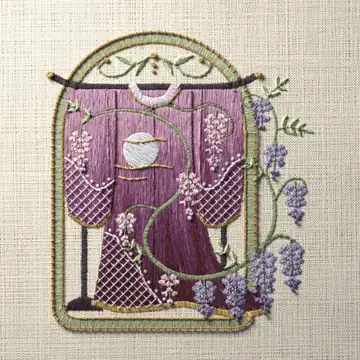
Wisteria kimono on a stand
Advanced prints 3–14 in · 16 colors
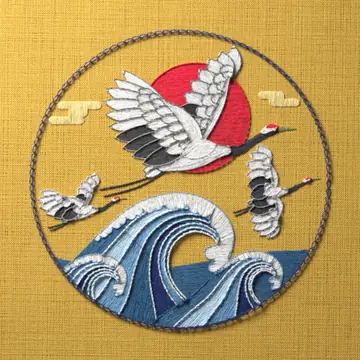
Japanese birds over waves
Advanced 3–8 in hoop · 21 colors
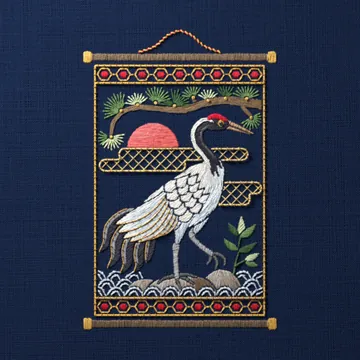
Japanese crane and pine wall hanging
Intermediate prints 3–14 in · 9 colors
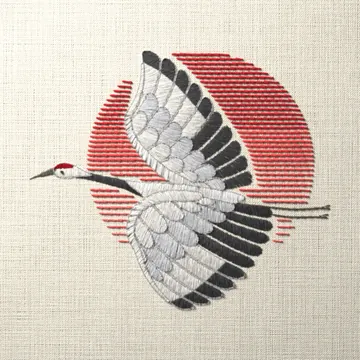
Japanese crane and red sun for a photo
Advanced 3–8 in hoop · 15 colors
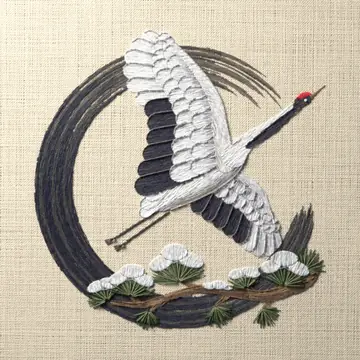
Enso circle with crane and snowy pine
Advanced 3–8 in hoop · 13 colors
Japanese temple foo dogs in a bunka look
Advanced 3–8 in hoop · 15 colors
Japanese lotus in ancient silk style
Advanced 3–8 in hoop · 18 colors
Temari ball with a chrysanthemum
New to hand embroidery? Starting hand embroidery, step by step