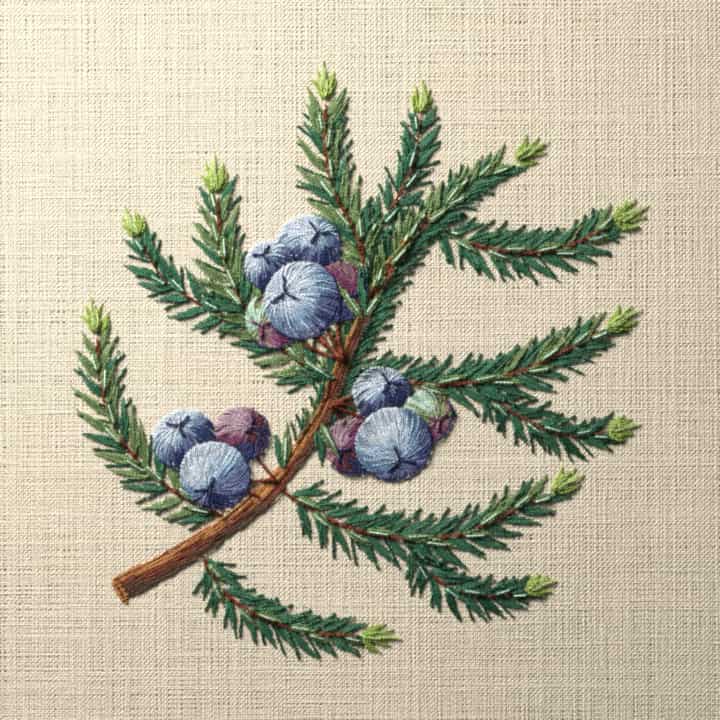
Juniper sprig with blue berries hand embroidery pattern
Advanced · 20 colors · 6 kinds of stitch
Download free PDFPDF, US Letter · 134 KB
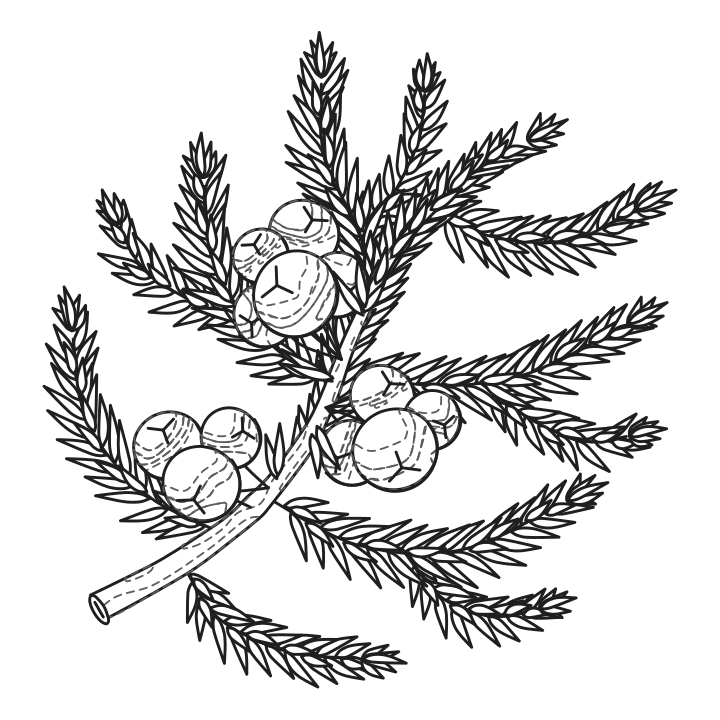
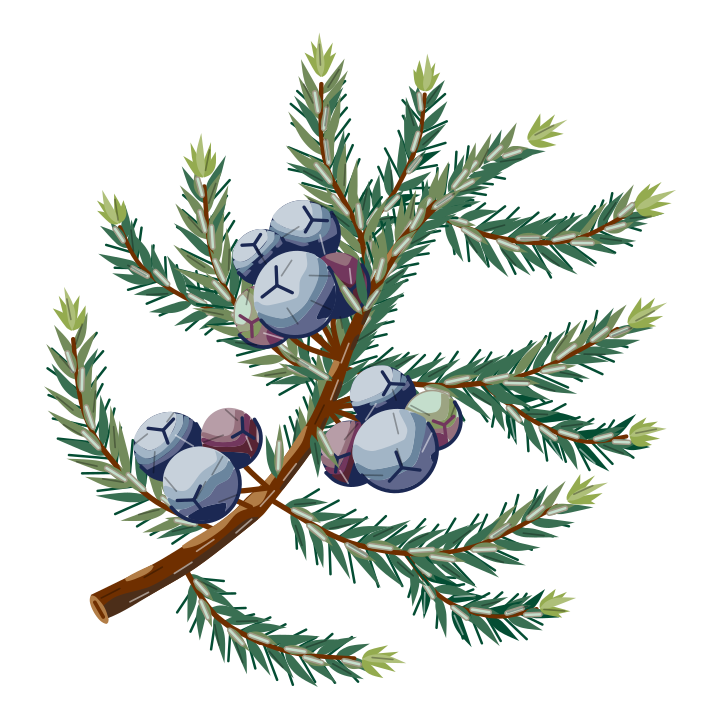
One sprig rises in a curve from a cut woody foot, with side twigs left and right and three groups of berries held close to the stem: seven blue, three plum and two still turning from green. Each needle is a narrow pointed shape in satin stitch, with finer straight stitch needles behind it and a pale straight stitch on those that catch the light. The twig ends are yellow-green satin stitch. The main stem and the berries are long and short stitch, the twigs and berry stalks are stem stitch, and each berry has a split stitch edge and a small three-armed star in straight stitch. In the picture of where the colors go, the fine lines show which way the stitches lie.
Size and details
Advanced. Uses long and short stitch, 20 colors and a great deal of stitching; from a 6 inch hoop up the widest satin stitches are long.
20 colors of floss and 6 kinds of stitch:
- Straight stitch
- Satin stitch
- Stem stitch
- Long and short stitch
- Back stitch
- Split stitch
- Which stitch goes where
| Hoop | Inches | Centimeters | Satin stitch up to |
|---|---|---|---|
| 3 in (8 cm) | 1.7 × 1.7 in | 4.3 × 4.3 cm | 1/8 in (3 mm) |
| 4 in (10 cm) | 2.5 × 2.6 in | 6.4 × 6.6 cm | 1/4 in (6 mm) |
| 5 in (13 cm) | 3.4 × 3.5 in | 8.6 × 8.9 cm | 5/16 in (8 mm) |
| 6 in (15 cm) | 4.2 × 4.4 in | 10.7 × 11.2 cm | 3/8 in (10 mm) |
| 8 in (20 cm) | 5.9 × 6.1 in | 15 × 15.5 cm | 1/2 in (13 mm) |
- In an 8 inch hoop the widest satin stitch shape is 1/2 in (13 mm) across. Satin stitches longer than about 12 mm (just under 1/2 in) tend to work loose: divide the shape into sections, or work it in long and short stitch.
The pattern is drawn inside a circle about half an inch (1.3 cm) smaller all around than the hoop.
What you need
- DMC 500 Very Dark Blue GreenUnder needles, needles (dark)
- DMC 501 Dark Blue GreenNeedles (middle)
- DMC 300 Very Dark MahoganyTwigs and berry stalks, main stem (middle), cut end (darker)
- DMC 504 Very Light Blue GreenNeedle lights, berries (shade 12 of 12)
- DMC 470 Light Avocado GreenNew growth (darker)
- DMC 471 Very Light Avocado GreenNew growth (lighter)
- DMC 988 Medium Forest GreenNeedles (light)
- DMC 898 Very Dark Coffee BrownMain stem (dark)
- DMC 435 Very Light BrownMain stem (light), cut end (lighter)
- DMC 3834 Dark GrapeBerries (shade 3 of 12), berry stars (lighter)
- DMC 3041 Medium Antique VioletBerries (shade 5 of 12)
- DMC 3364 Pine GreenBerries (shade 7 of 12)
- DMC 3053 Green GrayBerries (shade 8 of 12)
- DMC 939 Very Dark Navy BlueBerries (shade 1 of 12), berry edges, berry stars (darker)
- DMC 3807 Cornflower BlueBerries (shade 4 of 12)
- DMC 931 Medium Antique BlueBerries (shade 6 of 12)
- DMC 932 Light Antique BlueBerries (shade 10 of 12)
- DMC 3752 Very Light Antique BlueBerries (shade 11 of 12)
- DMC 154 Very Dark GrapeBerries (shade 2 of 12)
- DMC 3042 Light Antique VioletBerries (shade 9 of 12)
The floss is six-strand cotton; the stitch guide says how many strands to use. You also need a hoop, an embroidery needle (a size 7 to 9 suits two or three strands) and plain cotton or linen fabric. To frame the piece in its hoop, cut a square 3 inches (8 cm) wider than the hoop: a 9 inch (23 cm) square for a 6 inch hoop.
Stitch guide
- Straight stitch 1 to 2 strandsUnder needles, needle lights, berry stars
- Satin stitch 2 strandsNeedles, new growth, cut end
- Stem stitch 1 to 3 strandsTwigs, berry stalks
- Long and short stitch 1 strandMain stem, berries
- Back stitch 1 strandCut end
- Split stitch 1 strandBerry edges
Getting it onto your fabric
The PDF holds the pattern twice at actual size: once as drawn, and once mirrored for an iron-on transfer pen. Print it at 100% with scaling off and check the one-inch square (25.4 mm) with a ruler before you trace. How to transfer a pattern explains tracing, carbon paper and the other ways. The files are under Downloads.
Downloads
- Download free PDF PDF, US Letter, 3 pages, for a 6 inch (15 cm) hoop
- Download free PDF, A4 PDF, A4, 3 pages, for a 6 inch (15 cm) hoop
For your own stitching, gifts and handmade pieces you sell. Do not resell or share this PDF.
More patterns like this
New to hand embroidery? Starting hand embroidery, step by step