Mardi Gras elephant, duck and giraffe hand embroidery pattern
Advanced · 20 colors · 7 kinds of stitch
Download free PDFPDF, US Letter · 110 KBFor your own stitching, gifts and handmade pieces you sell. Do not resell or share this PDF or copies of it. Selling, classes and kits: the rules
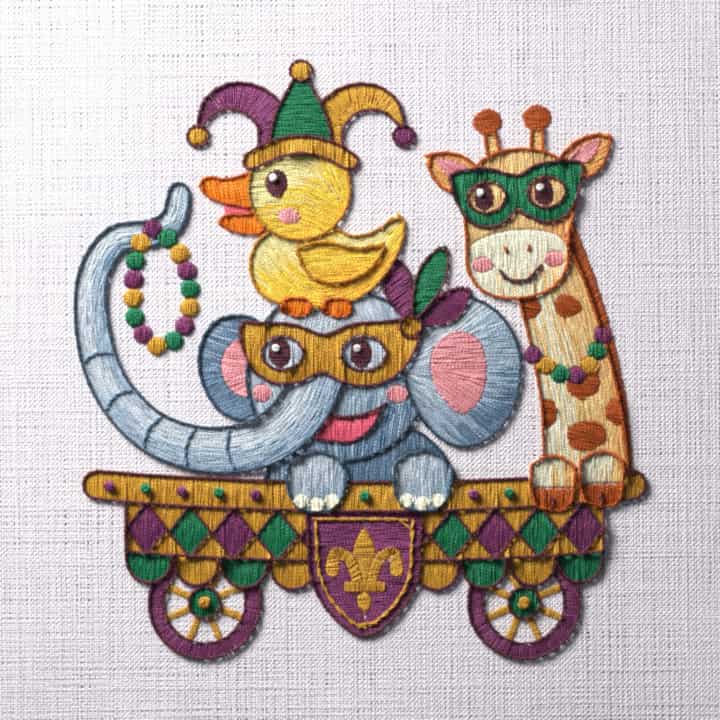
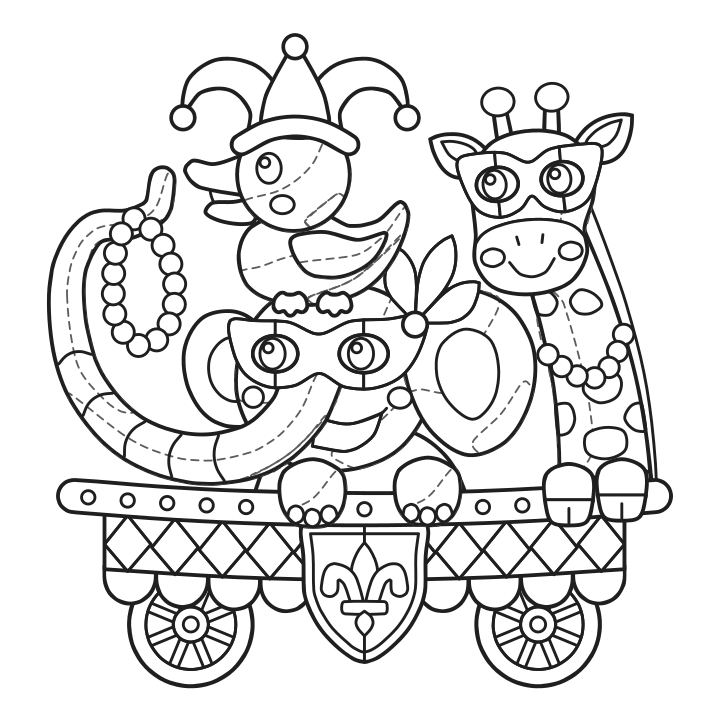
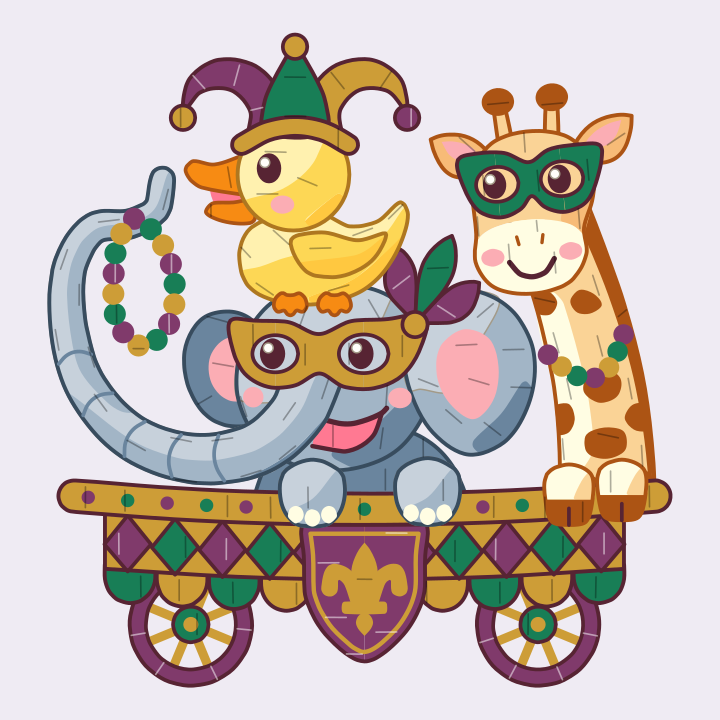
Three friends share a little parade float: a masked elephant swings out its trunk with a loop of beads, a duck in a jester cap sits on its head, and a giraffe in a green mask and beads rides beside them. Their coats are long and short stitch with a firm split stitch edge in a darker shade. The masks, cap, plumes, harlequin diamonds, scallops, shield and wheels are satin stitch, and the beads, bells and toenails are padded satin stitch. Stem stitch draws the smiles, straight stitch the nostrils, and French knots dot the rail and catch the light in the eyes. In the picture of where the colors go, the fine lines show which way the stitches lie.
Size and details
Advanced. Uses long and short stitch over much of the design, padded satin stitch, satin stitch over about a third of the cloth in a 6 inch hoop, 20 colors and a great deal of stitching; from a 5 inch hoop up some of the satin stitches are long.
20 colors of floss and 7 kinds of stitch:
- Satin stitch
- Split stitch
- French knot
- Long and short stitch
- Padded satin stitch
- Straight stitch
- Stem stitch
- Which stitch goes where
| Hoop | Inches | Centimeters | Satin stitch up to |
|---|---|---|---|
| 3 in (8 cm) | 1.7 × 1.8 in | 4.3 × 4.6 cm | 3/16 in (5 mm) |
| 4 in (10 cm) | 2.5 × 2.6 in | 6.4 × 6.6 cm | 1/4 in (6 mm) |
| 5 in (13 cm) | 3.4 × 3.5 in | 8.6 × 8.9 cm | 3/8 in (10 mm) |
| 6 in (15 cm) | 4.2 × 4.4 in | 10.7 × 11.2 cm | 7/16 in (11 mm) |
| 8 in (20 cm) | 5.9 × 6.2 in | 15 × 15.7 cm | 5/8 in (16 mm) |
- In an 8 inch hoop the widest satin stitch shape is 5/8 in (16 mm) across. Satin stitches longer than about 12 mm (just under 1/2 in) tend to work loose: divide the shape into sections, or work it in long and short stitch.
- In a 3, 4, 5 or 6 inch hoop the French knots are drawn smaller than about 2 mm (a little over 1/16 in). Use one strand of floss for them there, or choose a larger hoop.
The pattern is drawn inside a circle about half an inch (1.3 cm) smaller all around than the hoop.
What you need
- DMC 3852 Very Dark StrawBand ground, float rail and elephant mask, scallop hem (lighter) and 9 more parts
- DMC 552 Medium VioletShield and wheels, harlequin diamonds (darker), jester cap (dark) and 4 more parts
- DMC 154 Very Dark GrapeCart lines, mask edges, cap edges, eyes, plume edges, smiles and hoof lines
- DMC 910 Dark Emerald GreenScallop hem (darker), giraffe mask, harlequin diamonds (lighter) and 5 more parts
- DMC 920 Medium CopperGiraffe edges, giraffe mane, giraffe patches, bill edges and hooves and 2 more parts
- DMC 3855 Light Autumn GoldGiraffe (middle), eye patches (lighter), giraffe horns
- DMC 3827 Pale Golden BrownGiraffe ears, giraffe (dark)
- DMC 3823 Ultra Pale YellowGiraffe (light), giraffe muzzle and toenails
- DMC 3326 Light RoseElephant inner ears, cheeks and giraffe inner ears
- DMC BLANC WhiteEye lights
- DMC 931 Medium Antique BlueElephant and elephant ears (dark), trunk wrinkles
- DMC 932 Light Antique BlueElephant and elephant ears (middle)
- DMC 3750 Very Dark Antique BlueElephant edges
- DMC 3752 Very Light Antique BlueElephant and elephant ears (light), eye patches (darker)
- DMC 3705 Dark MelonDuck mouth and mouth
- DMC 727 Very Light TopazDuck (light)
- DMC 725 Medium Light TopazDuck (dark), duck wing (darker)
- DMC 726 Light TopazDuck (middle), duck wing (lighter)
- DMC 782 Dark TopazDuck edges
- DMC 970 Light PumpkinDuck bill and duck feet
Skeins: one of each color is enough. An estimate for the largest size, the 8 inch hoop: the length of each line and the area of each filled shape, a fifth added for tails and ends, a tenth of every 8 m (8.7 yd) skein kept spare.
On clothes. Wash and dry the garment first. Denim and twill need no backing and take a sharp needle, embroidery or chenille; T-shirts, sweatshirts and other knits need a stabilizer that sticks or irons on. How to embroider on clothes has every step, the guide to shirts says how to reach a neckline, a collar or a sleeve, and the placement chart says where a design goes.
In a hoop. The floss is six-strand cotton; the stitch guide says how many strands to use. You also need a hoop, an embroidery needle (a size 9 or 10 for one strand, 7 to 9 for two or three) and plain cotton or linen fabric. To frame the piece in its hoop, cut a square 3 inches (8 cm) wider than the hoop: a 9 inch (23 cm) square for a 6 inch hoop.
When it is stitched, how to finish a hoop shows how to back it for the wall.
Stitch guide
- Put the pattern on the fabric (how to transfer a pattern) and the fabric in the hoop.
- Stitch the filled parts first, what lies behind before what lies in front of it.
- Then stitch the lines: stems, veins and outlines over the edges of the filled parts.
- Keep the knots for the end, so that the hoop and your hand do not flatten them.
Begin with no knot on the back where it is seen and washed, as on a towel, a napkin or clothes; for a piece in a hoop a small knot is fine. End each thread by running the needle under the backs of a few stitches. (Starting and ending a thread shows how.) Use the strands this list gives, and begin as it says, also where a page about a stitch names another number or begins with a knot.
- Satin stitch 2 strandsSpokes, wheels, hubs, giraffe mane, giraffe patches, giraffe ears, giraffe inner ears, giraffe horns, giraffe horn tips, cheeks, and 19 more
- Split stitch 2 to 3 strandsCart lines, giraffe edges, mask edges, elephant edges, trunk wrinkles, plume edges, duck edges, bill edges, cap edges, hoof lines
- French knot 2 strands, two wrapsGold knots, eye lights, rail knots
- Long and short stitch 1 strandGiraffe, giraffe muzzle, elephant, elephant ears, duck, duck wing
- Padded satin stitch 2 strandsBeads, mask jewel, bells, toenails
- Straight stitch 3 strandsNostrils
- Stem stitch 2 to 3 strandsSmiles, shield trim
Getting it onto your fabric
The PDF holds the pattern twice at actual size: once as drawn, and once mirrored for an iron-on transfer pen. Print it at 100% with scaling off and check the one-inch square (25.4 mm) with a ruler before you trace. How to transfer a pattern explains tracing, carbon paper, the sticky wash-away sheet for knits, denim and dark cloth, and the other ways. The files are under Downloads.
Downloads
- Download free PDF PDF, US Letter, 3 pages, for a 6 inch (15 cm) hoop
- Download free PDF, A4 PDF, A4, 3 pages, for a 6 inch (15 cm) hoop
More patterns like this
Advanced prints 3–14 in · 20 colors
Harlequin diamond medallion
Intermediate 3–8 in hoop · 3 colors
Seven plume fan with handle
Advanced prints 3–14 in · 20 colors
Swirly zoo animals on parade
Advanced prints 3–14 in · 23 colors
Baobab tree at African sunset
Advanced prints 3–14 in · 22 colors
Safari birthday numbers with a lion
Advanced 3–8 in hoop · 18 colors
Birthday lion and giraffe
Advanced 3–8 in hoop · 15 colors
Giraffe baby milestone bib, twelve spots
Advanced 3–8 in hoop · 10 colors
Giraffe on a bicycle with an elephant
New to hand embroidery? Starting hand embroidery, step by step