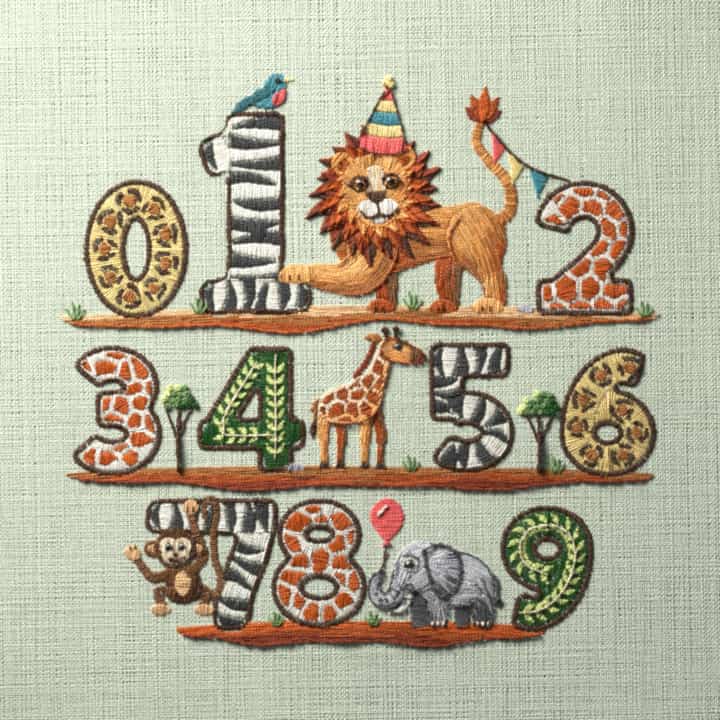
Safari birthday numbers with a lion hand embroidery pattern
Advanced · 22 colors · 8 kinds of stitch
Download free PDFPDF, US Letter · 182 KBFor your own stitching, gifts and handmade pieces you sell. Do not resell or share this PDF. What you may do, in full
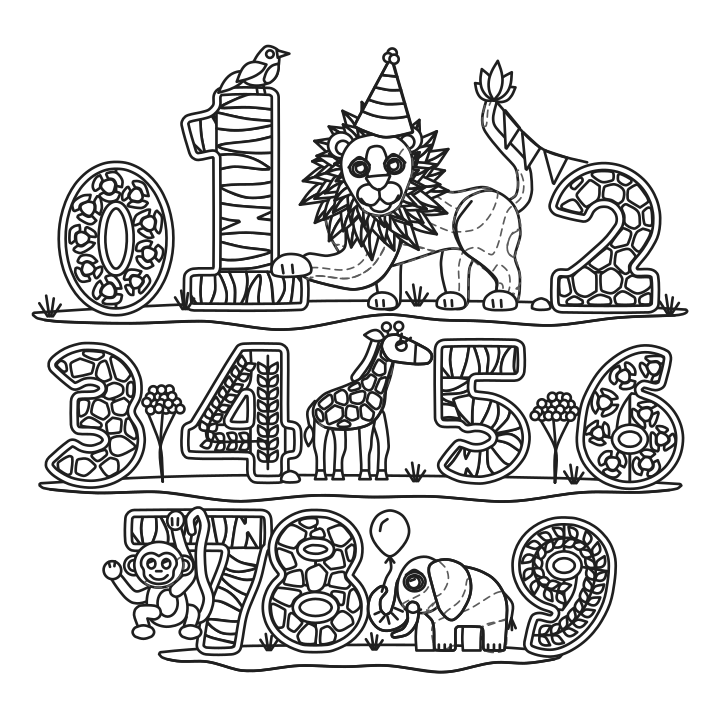
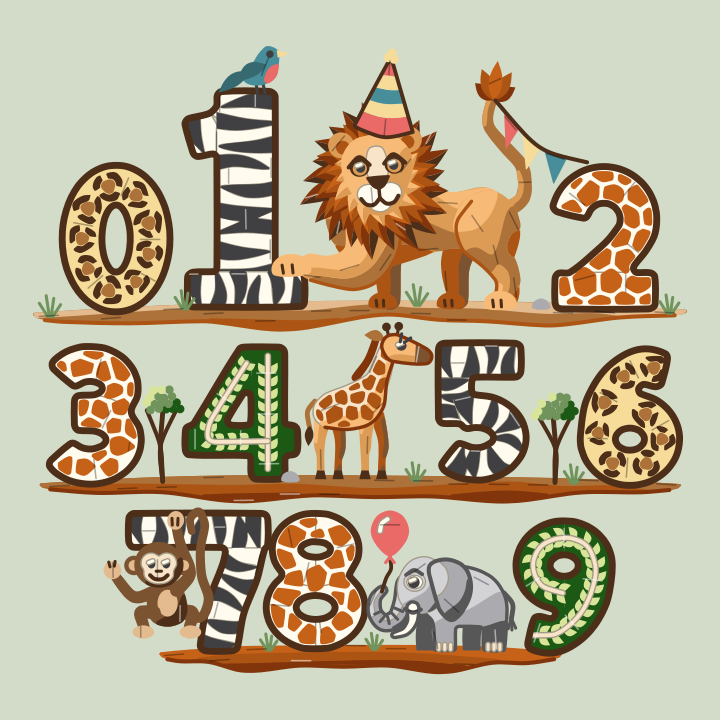
Ten sturdy numbers stand on three banks of earth, each filled with zebra stripes, giraffe patches, leopard rosettes or a leafy vine. The fillings and the dark edges are satin stitch, and the vines run in stem stitch. The lion, the giraffe, the elephant calf and the banks are shaded in long and short stitch, and the mane is many small leaves in fishbone stitch. French knots make the acacia tops and the pompom on the hat. Use one number with its animal for a birthday shirt, or stitch the whole scene. It is drawn for sage green linen. In the picture of where the colors go, the fine lines show which way the stitches lie.
Size and details
Advanced. Uses long and short stitch, dozens of French knots, satin stitch over about a third of the cloth in a 6 inch hoop, 22 colors and a great deal of stitching.
22 colors of floss and 8 kinds of stitch:
- Long and short stitch
- Stem stitch
- Satin stitch
- Straight stitch
- Split stitch
- Fishbone stitch
- French knot
- Back stitch
- Which stitch goes where
| Hoop | Inches | Centimeters | Satin stitch up to |
|---|---|---|---|
| 3 in (8 cm) | 1.9 × 1.8 in | 4.8 × 4.6 cm | 1/8 in (3 mm) |
| 4 in (10 cm) | 2.9 × 2.7 in | 7.4 × 6.9 cm | 3/16 in (5 mm) |
| 5 in (13 cm) | 3.8 × 3.6 in | 9.7 × 9.1 cm | 1/4 in (6 mm) |
| 6 in (15 cm) | 4.8 × 4.6 in | 12.2 × 11.7 cm | 5/16 in (8 mm) |
| 8 in (20 cm) | 6.7 × 6.4 in | 17 × 16.3 cm | 7/16 in (11 mm) |
- In a 3, 4, 5 or 6 inch hoop the French knots are drawn smaller than about 2 mm (a little over 1/16 in). Use one strand of floss for them there, or choose a larger hoop.
The pattern is drawn inside a circle about half an inch (1.3 cm) smaller all around than the hoop.
What you need
- DMC 3826 Golden BrownBanks of earth (light) and 7 more parts
- DMC 920 Medium CopperBanks of earth (dark) and 9 more parts
- DMC 437 Light TanBanks of earth (lightest) and 4 more parts
- DMC 3822 Light StrawLeopard numerals and 4 more parts
- DMC 898 Very Dark Coffee BrownNumeral edges and 14 more parts
- DMC 712 CreamGiraffe numerals and 8 more parts
- DMC 921 CopperGiraffe patches (lighter) and 2 more parts
- DMC 3799 Very Dark Pewter GrayZebra stripes and 6 more parts
- DMC 977 Light Golden BrownLion body (light) and 8 more parts
- DMC 918 Dark Red CopperLion mane (dark) and 4 more parts
- DMC 433 Medium BrownMonkey (lighter) and 5 more parts
- DMC 3827 Pale Golden BrownLion legs (lightest) and 6 more parts
- DMC 739 Ultra Very Light TanGiraffe (light) and 4 more parts
- DMC 351 CoralBalloon (darker) and 3 more parts
- DMC 3810 Dark TurquoiseTurquoise bird (middle) and 2 more parts
- DMC 3808 Ultra Very Dark TurquoiseBird wing, turquoise bird (dark)
- DMC 3345 Dark Hunter GreenLeafy numerals, acacia tops (dark)
- DMC 3347 Medium Yellow GreenGrass, acacia tops (middle)
- DMC 472 Ultra Light Avocado GreenNumeral leaves (darker), acacia tops (light)
- DMC 413 Dark Pewter GrayElephant lines and 3 more parts
- DMC 415 Pearl GrayElephant calf and elephant ear (light)
- DMC 318 Light Steel GrayElephant calf and elephant ear (middle), stones
Skeins: one of each color is enough. An estimate for the largest size, the 8 inch hoop: the length of each line and the area of each filled shape, a fifth added for tails and ends, a tenth of every 8 m (8.7 yd) skein kept spare.
The floss is six-strand cotton; the stitch guide says how many strands to use. You also need a hoop, an embroidery needle (a size 7 to 9 suits two or three strands) and plain cotton or linen fabric. To frame the piece in its hoop, cut a square 3 inches (8 cm) wider than the hoop: a 9 inch (23 cm) square for a 6 inch hoop.
When it is stitched, how to finish a hoop shows how to back it for the wall.
Stitch guide
- Put the pattern on the fabric (how to transfer a pattern) and the fabric in the hoop.
- Stitch the filled parts first, what lies behind before what lies in front of it.
- Then stitch the lines: stems, veins and outlines over the edges of the filled parts.
- Keep the knots for the end, so that the hoop and your hand do not flatten them.
Start each thread with a small knot on the back or one of the knotless starts, and end it by running the needle under the backs of a few stitches (starting and ending a thread). Use the strands this list gives, also where a page about a stitch names another number.
- Long and short stitch 1 to 2 strandsBanks of earth, lion legs, lion body, lion face, and 5 more
- Stem stitch 1 to 3 strandsBank edges, lion lines, party hat, bunting string, and 8 more
- Satin stitch 2 strandsLeopard numerals, rosette centers, rosettes, and 38 more
- Straight stitch 1 to 3 strandsLion lines, lion eyes, bird legs, giraffe horns, and 9 more
- Split stitch 1 strandLion lines, giraffe edges, elephant lines
- Fishbone stitch 1 strandLion mane
- French knot 1 to 2 strands, two wrapsLion eyes, hat pompom, bird eye, acacia tops, giraffe horns
- Back stitch 2 strandsLion lines
Getting it onto your fabric
The PDF holds the pattern twice at actual size: once as drawn, and once mirrored for an iron-on transfer pen. Print it at 100% with scaling off and check the one-inch square (25.4 mm) with a ruler before you trace. How to transfer a pattern explains tracing, carbon paper and the other ways. The files are under Downloads.
Downloads
- Download free PDF PDF, US Letter, 3 pages, for a 6 inch (15 cm) hoop
- Download free PDF, A4 PDF, A4, 3 pages, for a 6 inch (15 cm) hoop
More patterns like this
Advanced 3–8 in hoop · 18 colors
Birthday lion and giraffe
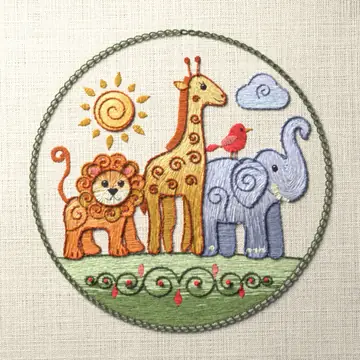
Advanced 3–8 in hoop · 20 colors
Swirly zoo animals on parade
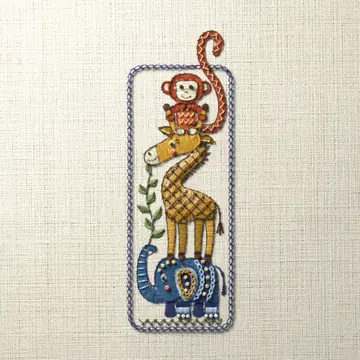
Advanced 3–8 in hoop · 15 colors
Giraffe, elephant and monkey bookmark
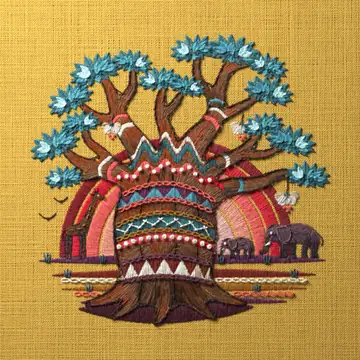
Advanced 3–8 in hoop · 23 colors
Baobab tree at African sunset
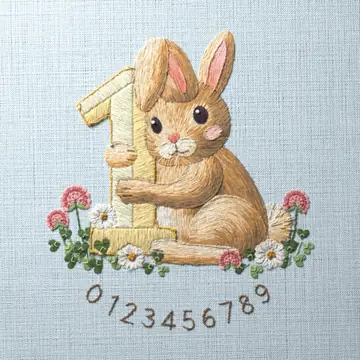
Advanced 3–8 in hoop · 23 colors
Bunny hugging number one, with 0 to 9
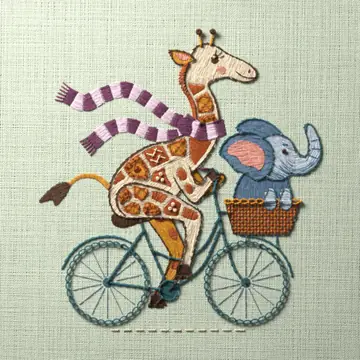
Advanced 3–8 in hoop · 10 colors
Giraffe on a bicycle with an elephant
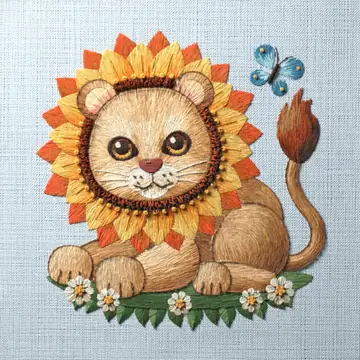
Advanced 3–8 in hoop · 23 colors
Baby lion with a sun mane
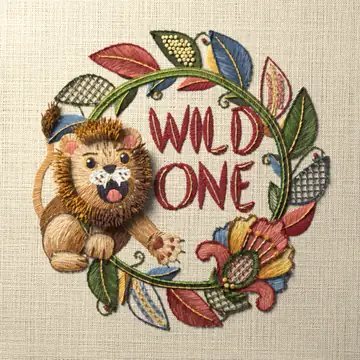
Advanced 3–8 in hoop · 21 colors
Wild one in a laurel wreath
New to hand embroidery? Starting hand embroidery, step by step