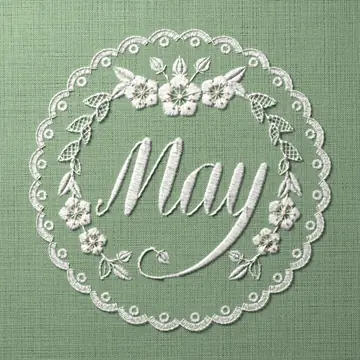
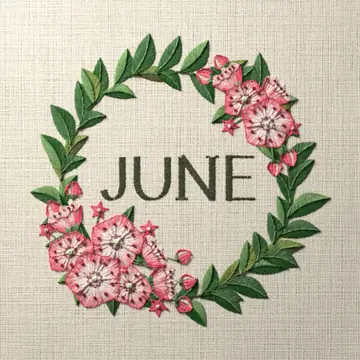
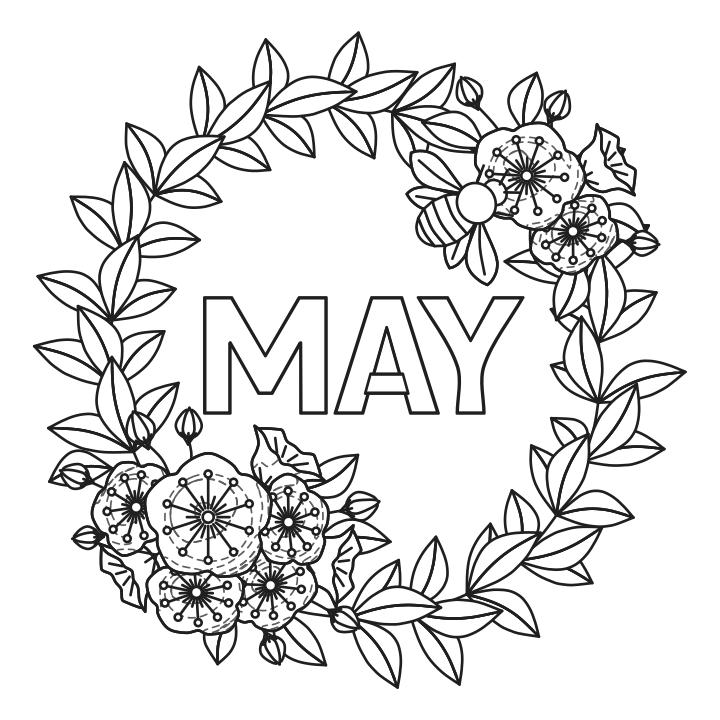
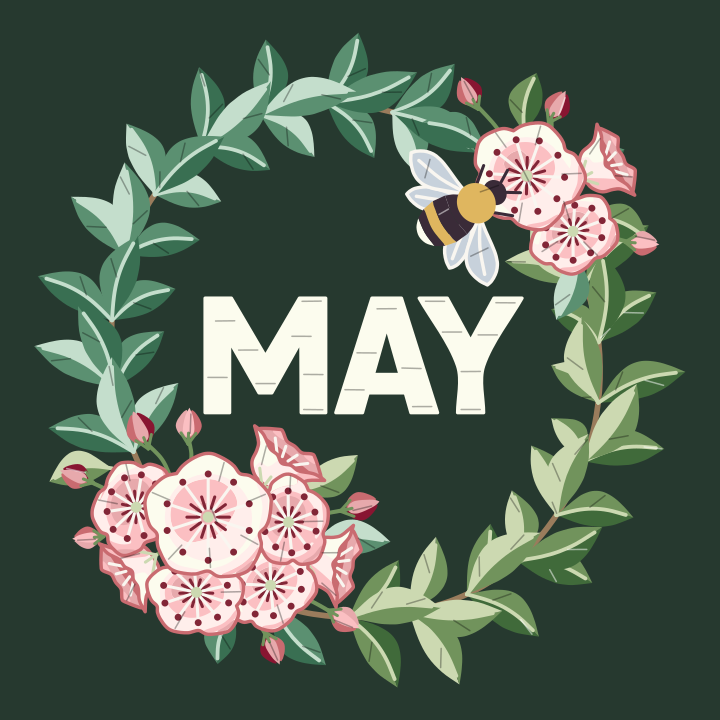
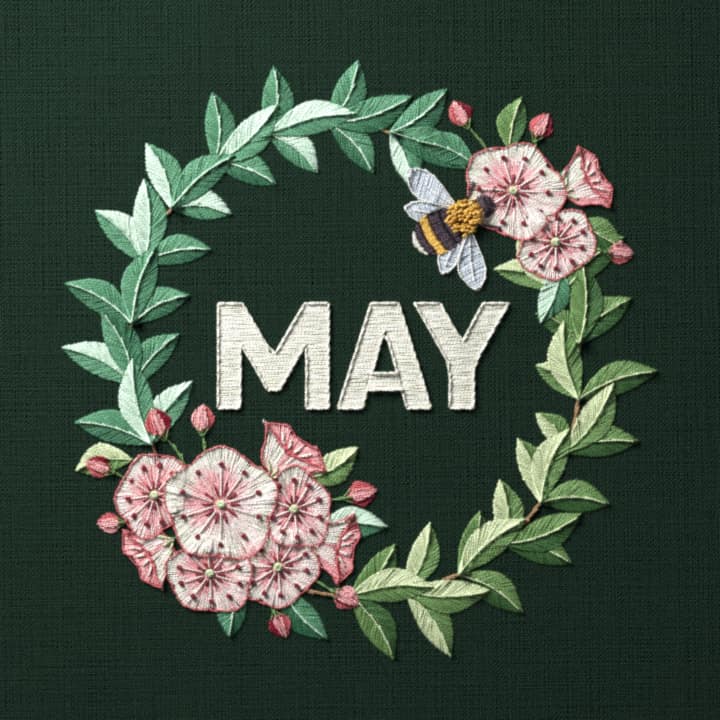
May in laurel hand embroidery pattern
Advanced · 18 colors · 4.8 × 4.8 in · 9 kinds of stitch
A number is a color of the list. Fine lines show which way the stitches lie: do not stitch them.
Download free PDFPDFYou may sell what you make from it by hand, in small quantities. The PDF itself is not to be sold or shared. Selling, classes and kits: the rules
Mountain laurel blooms in May, and here it sweeps round the month in an oval wreath: blue-green leaves up the left, olive leaves along the foot and up the right, a heavy cluster of cups at the lower left and a lighter one at the upper right.
Choose a size
| Hoop | Inches | Centimeters | Satin stitch up to |
|---|---|---|---|
| 3 in (8 cm) | 1.9 × 1.9 in | 4.8 × 4.8 cm | 1/8 in (3 mm) |
| 4 in (10 cm) | 2.9 × 2.9 in | 7.4 × 7.4 cm | 1/4 in (6 mm) |
| 5 in (13 cm) | 3.8 × 3.8 in | 9.7 × 9.7 cm | 5/16 in (8 mm) |
| 6 in (15 cm) | 4.8 × 4.8 in | 12.2 × 12.2 cm | 3/8 in (10 mm) |
| 8 in (20 cm) | 6.7 × 6.7 in | 17 × 17 cm | 1/2 in (13 mm) |
- In an 8 inch hoop the widest satin stitch shape is 1/2 in (13 mm) across. Satin stitches longer than about 12 mm (just under 1/2 in) tend to work loose: divide the shape into sections, or work it in long and short stitch.
- In a 3, 4 or 5 inch hoop the French knots are drawn smaller than about 2 mm (a little over 1/16 in). Use one strand of floss for them there, or choose a larger hoop.
Before you start
- New to this? Try an easy pattern first, or see how to read one.
- Print at actual size (100%, not “fit”). Dark fabric: trace with a white pencil over a bright light, or use a wash-away sheet. Then put it in the hoop, tight as a drum.
- Print at actual size (100%, not “fit”), tape the sheets and trace all of it. Hoop one part, stitch it, then move the hoop; raised parts and knots last.
- Floss has six strands: cut 18 inches (45 cm), pull out the number named one at a time, and lay them together.
- Start a filling with tiny stitches, a line with a small knot; end under stitches on the back.
- On the drawing a ring is one French knot; a broken line inside a shape is where two shades meet: trace it, do not stitch it.
What you need
- Hoop
- 6 in (15 cm), 4.8 × 4.8 in stitched. Another size
- Fabric
- Plain cotton or linen in dark green or another dark color, cut 9 in (23 cm) square.
- Needle
- Embroidery needle, size 9, and size 5 for 4 strands.
- Floss
- 18 colors of six-strand cotton. Skeins: one of each color is enough, an estimate for the 6 inch hoop from the drawing’s lines and shapes.
- Also
- White pencil, small scissors.
DMC is a brand, the number its color: another brand in a like color will do.
Threads and stitches
- 1DMC 840 Medium Beige Brown
- 2DMC 501 Dark Blue Green
- 3DMC 502 Blue Green
- 4DMC 504 Very Light Blue Green
- 5DMC 3346 Hunter Green
- 6DMC 3347 Medium Yellow Green
- 7DMC 3348 Light Yellow Green
- 8DMC 3687 Mauve
- 9DMC 3685 Very Dark Mauve
- 10DMC 3688 Medium Mauve
- 11DMC 3689 Light Mauve
- 12DMC 3865 Winter White
- 13DMC 819 Light Baby Pink
- 14DMC 746 Off White
- 15DMC 902 Very Dark Garnet
- 16DMC 3752 Very Light Antique Blue
- 17DMC 3371 Black Brown
- 18DMC 3820 Dark Straw
Stitch in this order
Where a stitch page says otherwise, follow this list.
- Stem stitch4 strands: woody shoots2 strands: flower stalks
- Fishbone stitch 2 strandsBlue-green leaves, olive leaves
- Long and short stitch 1 strandLaurel cups
- Satin stitch 2 strandsFluted buds, bee wings, bee stripes, bee head, letters
- Stem stitch 1 strandLines of the blue-green leaves, lines of the olive leaves
- Straight stitch1 strand: green cup, stamens2 strands: maroon zigzag, bee legs
- Split stitch1 strand: cup edges, wing edges2 strands: letter edges
- Back stitch 1 strandWing veins
- French knot two wraps1 strand: dimples2 strands: cup hearts
- Turkey work 2 strandsBee coat
Take out lines that still show, press face down, finish the hoop or sew a pillow.
About this pattern
Advanced. Uses long and short stitch, dozens of French knots, 18 colors and a great deal of stitching; from a 6 inch hoop up the widest satin stitches are long.
Each cup is shaded in long and short stitch, edged in split stitch, with straight stitch stamens that reach toward ten French knot dimples. The leaves are fishbone stitch, the fluted buds and the capitals are satin stitch, and the woody shoots are stem stitch. The bumblebee wears a turkey work coat and satin stitch stripes. Stitch it on forest green cloth so the cream and pink glow.
1 DMC 840: woody shoots. 2 DMC 501: blue-green leaves (dark). 3 DMC 502: blue-green leaves (middle). 4 DMC 504: blue-green leaves (light). 5 DMC 3346: olive leaves (dark). 6 DMC 3347: olive leaves (middle), flower stalks, green cup (darker). 7 DMC 3348: olive leaves (light), green cup (lighter), cup hearts. 8 DMC 3687: cup edges, fluted buds (dark), laurel cups (darkest). 9 DMC 3685: fluted buds (darkest). 10 DMC 3688: laurel cups (dark), fluted buds (light). 11 DMC 3689: laurel cups (middle), fluted buds (lightest). 12 DMC 3865: stamens, wing edges and wing veins. 13 DMC 819: laurel cups (light). 14 DMC 746: letters and letter edges, laurel cups (lightest), bee stripes (light). 15 DMC 902: maroon zigzag and dimples. 16 DMC 3752: bee wings. 17 DMC 3371: bee stripes (dark), bee head and bee legs. 18 DMC 3820: bee coat, bee stripes (middle).
A guide to this kind of work: Stitches for letters, words and names.