Merry-go-round at dusk hand embroidery pattern
Advanced · 20 colors · 6 kinds of stitch
Download free PDFPDF, US Letter · 102 KBFor your own stitching, gifts and handmade pieces you sell. Do not resell or share this PDF. What you may do, in full
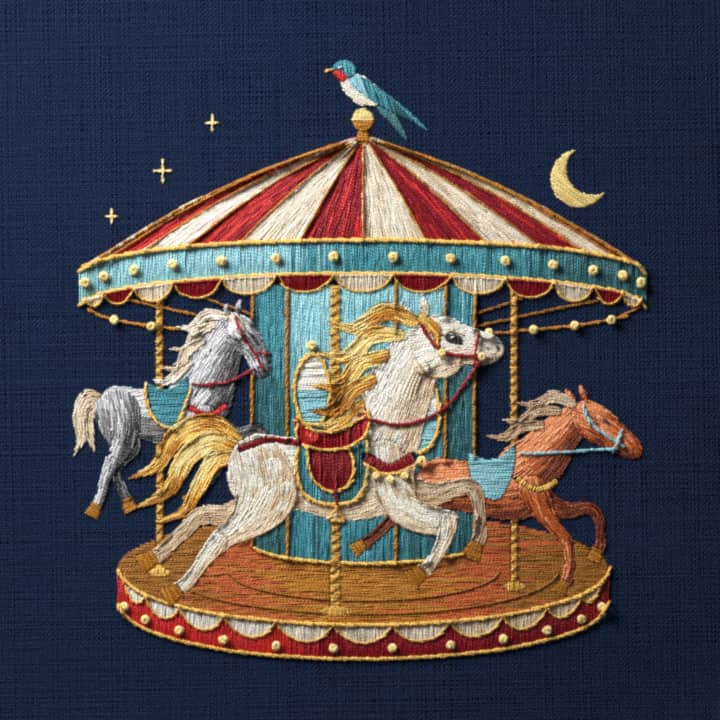
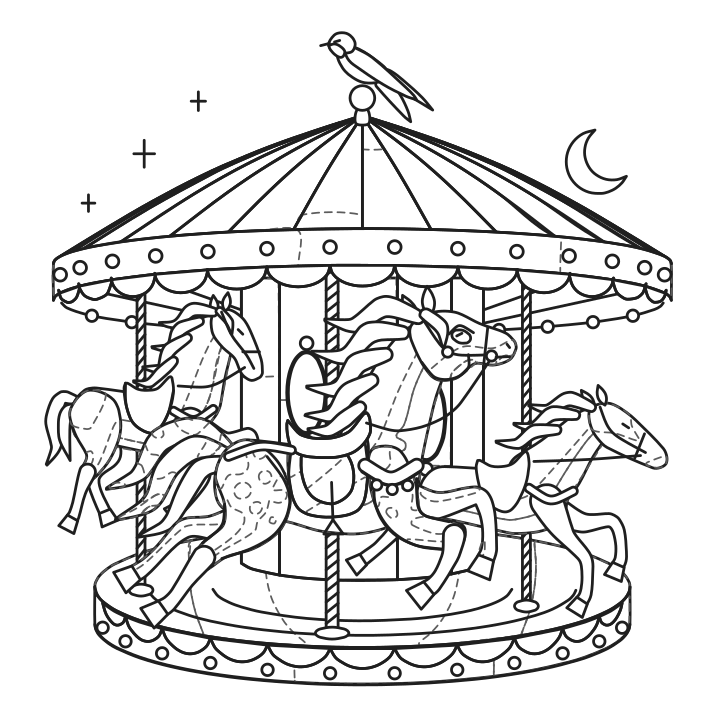
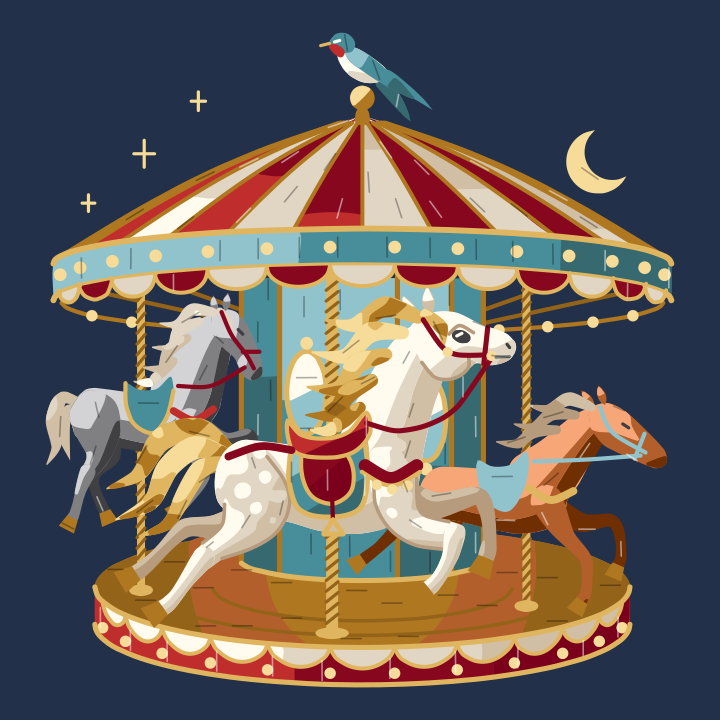
A dapple-cream horse leaps at the front of this old-time carousel, with a gray behind it and a chestnut stretching ahead. The coats, manes, canopy stripes and floor are long and short stitch. The teal board, scallops, saddles, poles and crescent moon are satin stitch, with stem stitch for the gold cords and bridles and split stitch for fine lines on the cream horse. Every bulb is a French knot, and straight stitches twist the poles. A swallow rests on the finial. It is drawn for navy linen. In the picture of where the colors go, the fine lines show which way the stitches lie.
Size and details
Advanced. Uses long and short stitch over much of the design, dozens of French knots, 20 colors and a great deal of stitching; from a 5 inch hoop up the widest satin stitches are long.
20 colors of floss and 6 kinds of stitch:
- Stem stitch
- French knot
- Satin stitch
- Long and short stitch
- Split stitch
- Straight stitch
- Which stitch goes where
| Hoop | Inches | Centimeters | Satin stitch up to |
|---|---|---|---|
| 3 in (8 cm) | 1.8 × 1.8 in | 4.6 × 4.6 cm | 3/16 in (5 mm) |
| 4 in (10 cm) | 2.6 × 2.7 in | 6.6 × 6.9 cm | 1/4 in (6 mm) |
| 5 in (13 cm) | 3.5 × 3.7 in | 8.9 × 9.4 cm | 3/8 in (10 mm) |
| 6 in (15 cm) | 4.4 × 4.6 in | 11.2 × 11.7 cm | 7/16 in (11 mm) |
| 8 in (20 cm) | 6.1 × 6.4 in | 15.5 × 16.3 cm | 5/8 in (16 mm) |
- In an 8 inch hoop the widest satin stitch shape is 5/8 in (16 mm) across. Satin stitches longer than about 12 mm (just under 1/2 in) tend to work loose: divide the shape into sections, or work it in long and short stitch.
- In a 3, 4 or 5 inch hoop the French knots are drawn smaller than about 2 mm (a little over 1/16 in). Use one strand of floss for them there, or choose a larger hoop.
The pattern is drawn inside a circle about half an inch (1.3 cm) smaller all around than the hoop.
What you need
- DMC 780 Ultra Very Dark TopazFloor boards (dark), pole twists, canopy ribs (darker) and 3 more parts
- DMC 782 Dark TopazFloor boards (light), canopy seams, drum frames (darker) and 5 more parts
- DMC 3822 Light StrawCream horse tail and cream horse mane (lightest), bulbs and 6 more parts
- DMC 347 Very Dark SalmonPlatform front (light), canopy stripes (dark) and 3 more parts
- DMC 814 Dark GarnetPlatform front (dark), saddles (darkest), stirrups (darker)
- DMC 815 Medium GarnetCanopy stripes (darkest), platform front (middle) and 5 more parts
- DMC 301 Medium MahoganyFloor boards and chestnut horse (middle), chestnut ears (darker)
- DMC 712 CreamCream horse and canopy stripes (lightest) and 7 more parts
- DMC 3820 Dark StrawPoles, rim cords and platform edge and 12 more parts
- DMC 3033 Very Light Mocha BrownCream horse and canopy stripes (light) and 4 more parts
- DMC 842 Very Light Beige BrownCream horse (dark), canopy stripes (middle) and 4 more parts
- DMC 3808 Ultra Very Dark TurquoiseDrum panels, rim board and saddle cloth (dark) and 2 more parts
- DMC 3810 Dark TurquoiseDrum panels, rim board and saddle cloth (middle) and 4 more parts
- DMC 598 Light TurquoiseDrum panels and rim board (light), mirrors (darker) and 4 more parts
- DMC 3799 Very Dark Pewter GrayGray horse (dark), eyes (darker)
- DMC 414 Dark Steel GrayGray horse (middle), gray ears (darker), eyes (lighter)
- DMC 415 Pearl GrayGray horse (light), gray ears (lighter)
- DMC 300 Very Dark MahoganyChestnut horse (dark)
- DMC 402 Very Light MahoganyChestnut horse (light), chestnut ears (lighter)
- DMC 841 Light Beige BrownCream horse (darkest), cream horse contours, chestnut mane (darker)
Skeins: 2 for floor boards (light), canopy seams, drum frames (darker) and 5 more parts; one of each other color. An estimate for the largest size, the 8 inch hoop: the length of each line and the area of each filled shape, a fifth added for tails and ends, a tenth of every 8 m (8.7 yd) skein kept spare.
The floss is six-strand cotton; the stitch guide says how many strands to use. You also need a hoop, an embroidery needle (a size 7 to 9 suits two or three strands) and plain cotton or linen fabric. To frame the piece in its hoop, cut a square 3 inches (8 cm) wider than the hoop: a 9 inch (23 cm) square for a 6 inch hoop.
When it is stitched, how to finish a hoop shows how to back it for the wall.
Stitch guide
- Put the pattern on the fabric (how to transfer a pattern) and the fabric in the hoop.
- Stitch the filled parts first, what lies behind before what lies in front of it.
- Then stitch the lines: stems, veins and outlines over the edges of the filled parts.
- Keep the knots for the end, so that the hoop and your hand do not flatten them.
Start each thread with a small knot on the back or one of the knotless starts, and end it by running the needle under the backs of a few stitches (starting and ending a thread). Use the strands this list gives, also where a page about a stitch names another number.
- Stem stitch 1 to 4 strandsCanopy ribs, platform swag edges, platform edge, mirror frames, drum frames, canopy seams, and 6 more
- French knot 2 strands, two wrapsBulbs, platform knots, mirror frames, tassels
- Satin stitch 2 strandsPlatform front, platform swags, mirrors, poles, pole feet, rim board, scallops, hooves, gray ears, and 13 more
- Long and short stitch 1 to 2 strandsFloor boards, drum panels, canopy stripes, gray mane and tail, gray horse, chestnut horse, and 5 more
- Split stitch 1 strandBoard lines, cream horse contours
- Straight stitch 1 to 3 strandsPole twists, eyes, eye light, swallow bill, swallow eye, stars
Getting it onto your fabric
The PDF holds the pattern twice at actual size: once as drawn, and once mirrored for an iron-on transfer pen. Print it at 100% with scaling off and check the one-inch square (25.4 mm) with a ruler before you trace. How to transfer a pattern explains tracing, carbon paper and the other ways. The files are under Downloads.
Downloads
- Download free PDF PDF, US Letter, 3 pages, for a 6 inch (15 cm) hoop
- Download free PDF, A4 PDF, A4, 3 pages, for a 6 inch (15 cm) hoop
More patterns like this
Advanced 3–8 in hoop · 13 colors
Vintage carousel reindeer
Advanced 3–8 in hoop · 20 colors
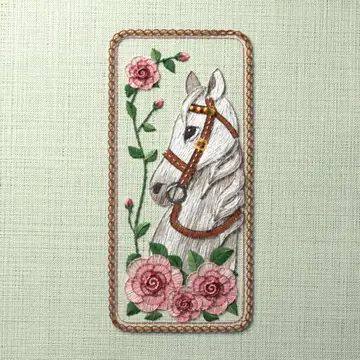
Horse bridle and roses bookmark
Advanced 3–8 in hoop · 18 colors
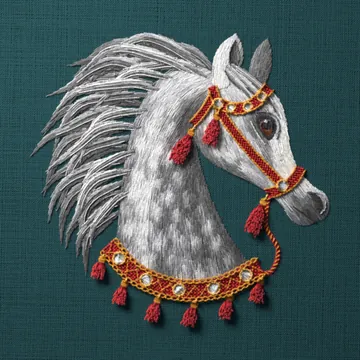
Arabian horse head with tassels
Advanced 3–8 in hoop · 18 colors
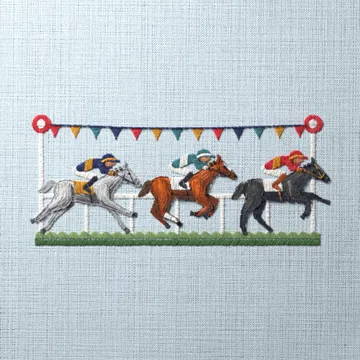
Racehorses border
Advanced 3–8 in hoop · 23 colors
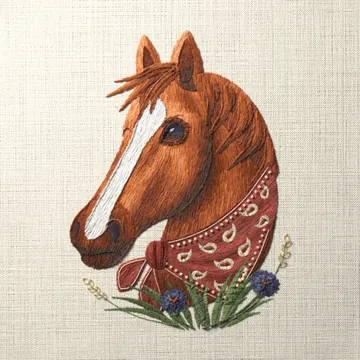
Horse in a paisley bandana
Advanced 3–8 in hoop · 24 colors
Western horse and rider
Advanced 3–8 in hoop · 24 colors
Sleigh ride to a snowy covered bridge
Advanced 3–8 in hoop · 24 colors
Andalusian horse in the Spanish walk
New to hand embroidery? Starting hand embroidery, step by step