Muscle car in the desert hand embroidery pattern
Advanced · 24 colors · 8 kinds of stitch
Download free PDFPDF, US Letter · 86 KBFor your own stitching, gifts and handmade pieces you sell. Do not resell or share this PDF. What you may do, in full
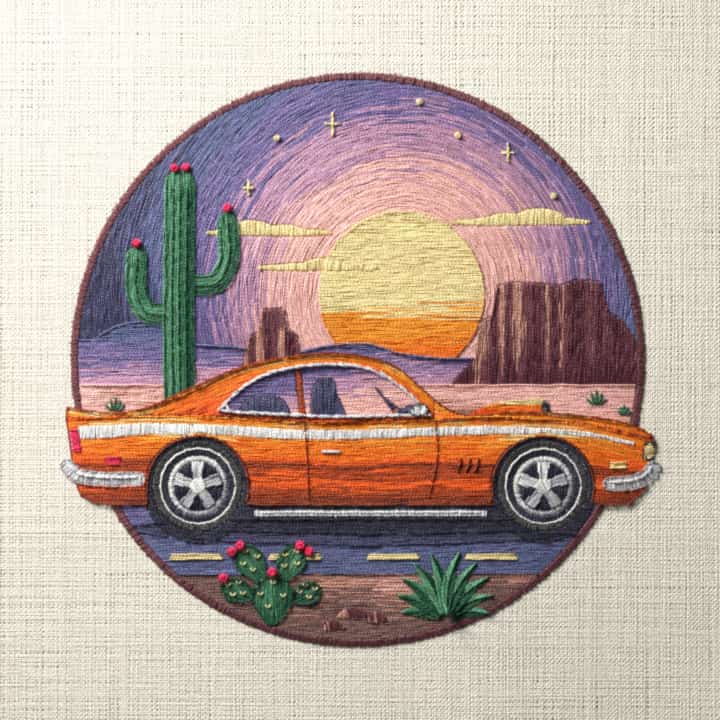
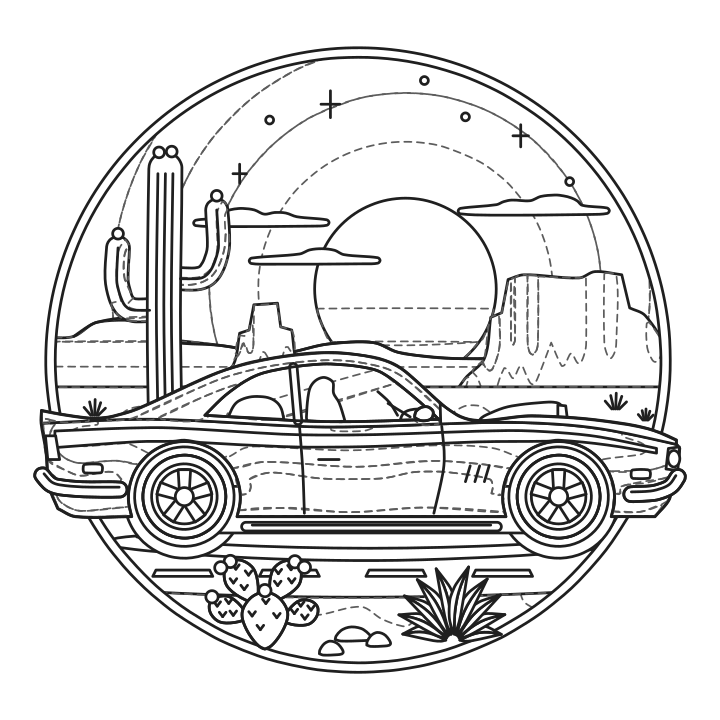
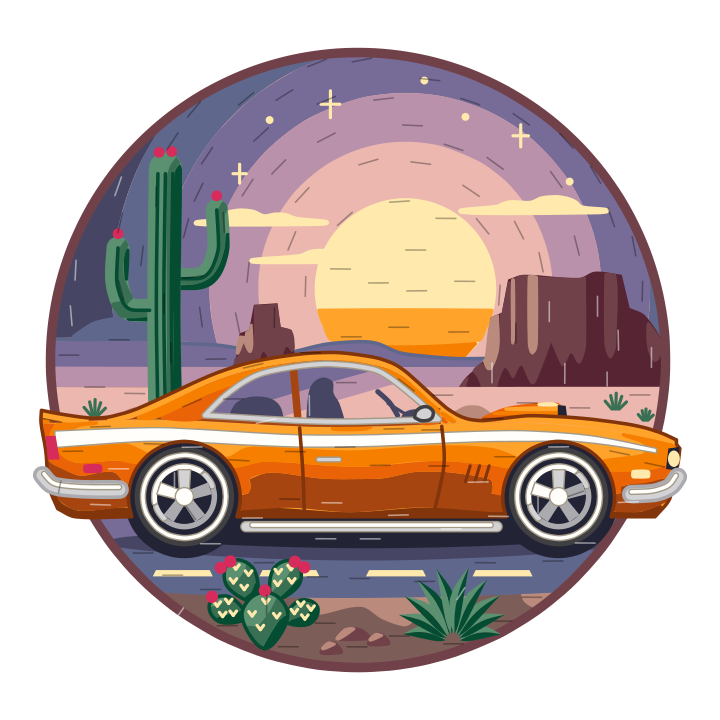
A long orange fastback in the manner of the late 1960s and early 1970s stands on a desert road, seen straight from the side, with its nose and tail running out past the edge of a round scene. The body is long and short stitch in six shades, laid along the car so that the flank catches the sky and the dark line of the horizon, with a fine split stitch edge. The stripe, tires, wheels, bumpers and lamps are satin stitch, and through the windows you can see the seats and the steering wheel against the sunset. Behind it the sky is worked in rings of long and short stitch round a low gold sun, with plum mesas, a saguaro ribbed in back stitch and a few straight stitch stars. A prickly pear with French knot blooms and a fishbone stitch agave grow at the near side of the road, and a satin stitch edge closes the round. In the picture of where the colors go, the fine lines show which way the stitches lie.
Size and details
Advanced. Uses long and short stitch over much of the design, 24 colors and a great deal of stitching; from a 6 inch hoop up the widest satin stitches are long.
24 colors of floss and 8 kinds of stitch:
- Long and short stitch
- Satin stitch
- Straight stitch
- French knot
- Split stitch
- Back stitch
- Stem stitch
- Fishbone stitch
- Which stitch goes where
| Hoop | Inches | Centimeters | Satin stitch up to |
|---|---|---|---|
| 3 in (8 cm) | 1.8 × 1.8 in | 4.6 × 4.6 cm | 3/16 in (5 mm) |
| 4 in (10 cm) | 2.8 × 2.6 in | 7.1 × 6.6 cm | 1/4 in (6 mm) |
| 5 in (13 cm) | 3.7 × 3.5 in | 9.4 × 8.9 cm | 5/16 in (8 mm) |
| 6 in (15 cm) | 4.6 × 4.4 in | 11.7 × 11.2 cm | 7/16 in (11 mm) |
| 8 in (20 cm) | 6.4 × 6.1 in | 16.3 × 15.5 cm | 9/16 in (14 mm) |
- In an 8 inch hoop the widest satin stitch shape is 9/16 in (14 mm) across. Satin stitches longer than about 12 mm (just under 1/2 in) tend to work loose: divide the shape into sections, or work it in long and short stitch.
- In a 3, 4 or 5 inch hoop the French knots are drawn smaller than about 2 mm (a little over 1/16 in). Use one strand of floss for them there, or choose a larger hoop.
The pattern is drawn inside a circle about half an inch (1.3 cm) smaller all around than the hoop.
What you need
- DMC 224 Very Light Shell PinkSky (lightest), sand and windows (light)
- DMC 791 Very Dark Cornflower BlueSky (darkest) and 4 more parts
- DMC 3807 Cornflower BlueRoad (darker), sky (dark) and 2 more parts
- DMC 3746 Dark Blue VioletRoad (lighter), sky (middle) and 2 more parts
- DMC 3836 Light GrapeSky and far mesas (light), windows (middle)
- DMC 745 Light Pale YellowSun (light), clouds and 6 more parts
- DMC 971 PumpkinLower body (light), sun (dark) and 3 more parts
- DMC 741 Medium TangerineLower body (lightest) and 4 more parts
- DMC 154 Very Dark GrapeMesas (dark)
- DMC 3802 Very Dark Antique MauveRound edge, mesas (middle), stones (darker)
- DMC 3859 Light RosewoodSand (middle), mesas (light), stones (lighter)
- DMC 3860 CocoaSand (dark)
- DMC 310 BlackWheel wells and underbody and 5 more parts
- DMC 501 Dark Blue GreenSaguaro and prickly pear (middle), scrub
- DMC 502 Blue GreenSaguaro (light) and 2 more parts
- DMC 500 Very Dark Blue GreenSaguaro ribs, saguaro (dark) and 3 more parts
- DMC 309 Ultra Very Dark RoseCactus blooms and tail lamp and 1 more part
- DMC 3799 Very Dark Pewter GrayTires (lighter), mirror edge
- DMC BLANC WhiteSide stripe and tire line and 5 more parts
- DMC 318 Light Steel GrayRims and wheel spokes (dark), bumper edge
- DMC 415 Pearl GrayWindow trim and bumpers and 5 more parts
- DMC 918 Dark Red CopperCar outline and 3 more parts
- DMC 919 Red CopperRoof (darkest), lower body (dark), window post
- DMC 946 Medium Burnt OrangeLower body (middle) and 3 more parts
Skeins: 3 for sky (lightest), sand and windows (light), 2 for road (lighter), sky (middle) and 2 more parts and 2 for sand (middle), mesas (light), stones (lighter); one of each other color. An estimate for the largest size, the 8 inch hoop: the length of each line and the area of each filled shape, a fifth added for tails and ends, a tenth of every 8 m (8.7 yd) skein kept spare.
The floss is six-strand cotton; the stitch guide says how many strands to use. You also need a hoop, an embroidery needle (a size 7 to 9 suits two or three strands) and plain cotton or linen fabric. To frame the piece in its hoop, cut a square 3 inches (8 cm) wider than the hoop: a 9 inch (23 cm) square for a 6 inch hoop.
When it is stitched, how to finish a hoop shows how to back it for the wall.
Stitch guide
- Put the pattern on the fabric (how to transfer a pattern) and the fabric in the hoop.
- Stitch the filled parts first, what lies behind before what lies in front of it.
- Then stitch the lines: stems, veins and outlines over the edges of the filled parts.
- Keep the knots for the end, so that the hoop and your hand do not flatten them.
Start each thread with a small knot on the back or one of the knotless starts, and end it by running the needle under the backs of a few stitches (starting and ending a thread). Use the strands this list gives, also where a page about a stitch names another number.
- Long and short stitch 1 strandSky, sun, far mesas, mesas, sand, road, shadow, and 9 more
- Satin stitch 2 strandsClouds, road line, round edge, tires, rims, and 16 more
- Straight stitch 1 to 3 strandsStars, scrub, steering wheel, door handle, vents, and 1 more
- French knot 1 to 2 strands, two wrapsStars, cactus blooms
- Split stitch 1 strandMesa edges, tire line, car outline, prickly pear edge
- Back stitch 1 to 2 strandsSaguaro ribs, door lines, side pipe shine, and 3 more
- Stem stitch 2 to 3 strandsSteering wheel, window trim
- Fishbone stitch 1 strandAgave
Getting it onto your fabric
The PDF holds the pattern twice at actual size: once as drawn, and once mirrored for an iron-on transfer pen. Print it at 100% with scaling off and check the one-inch square (25.4 mm) with a ruler before you trace. How to transfer a pattern explains tracing, carbon paper and the other ways. The files are under Downloads.
Downloads
- Download free PDF PDF, US Letter, 3 pages, for a 6 inch (15 cm) hoop
- Download free PDF, A4 PDF, A4, 3 pages, for a 6 inch (15 cm) hoop
More patterns like this
Advanced 3–8 in hoop · 23 colors
Little car with luggage on the roof
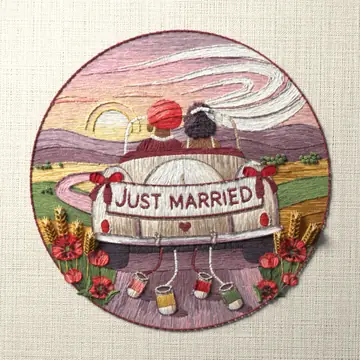
Advanced 3–8 in hoop · 23 colors
Just married
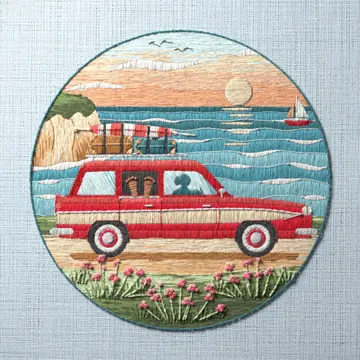
Advanced 3–8 in hoop · 21 colors
Station wagon with luggage
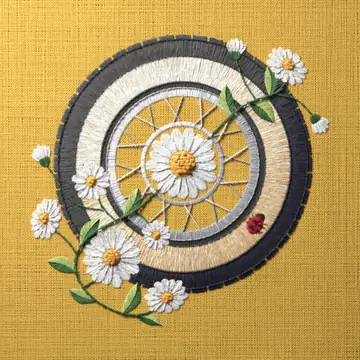
Advanced 3–8 in hoop · 16 colors
Whitewall tire with daisies
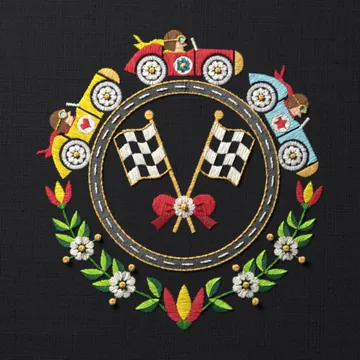
Advanced 3–8 in hoop · 14 colors
Three race cars with crossed flags
Advanced 3–8 in hoop · 9 colors
Race car bookmark
Advanced 3–8 in hoop · 8 colors
Crossed pistons with a rose
Advanced 3–8 in hoop · 24 colors
Southwest pottery and yucca
New to hand embroidery? Starting hand embroidery, step by step