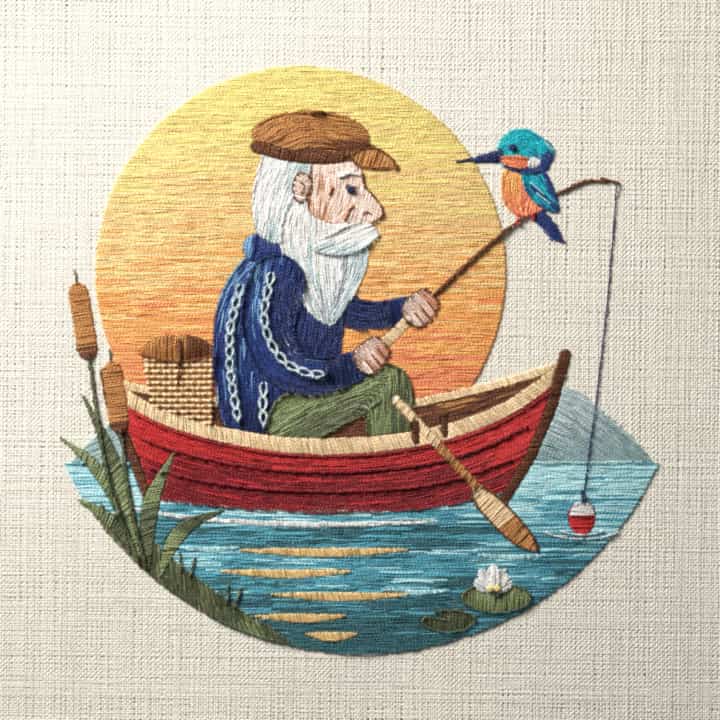
Vintage fisherman in a rowing boat hand embroidery pattern
Advanced · 24 colors · 9 kinds of stitch
Download free PDFPDF, US Letter · 60 KBFor your own stitching, gifts and handmade pieces you sell. Do not resell or share this PDF. What you may do, in full
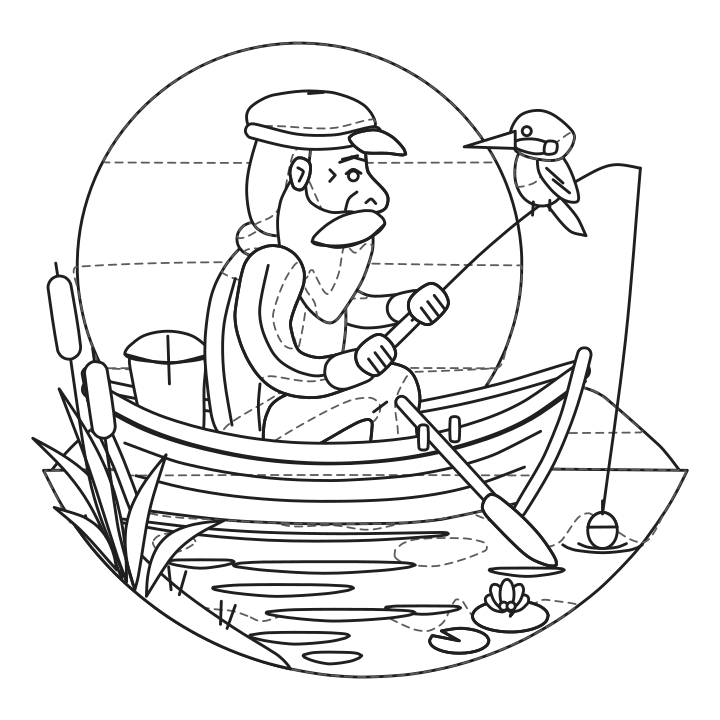
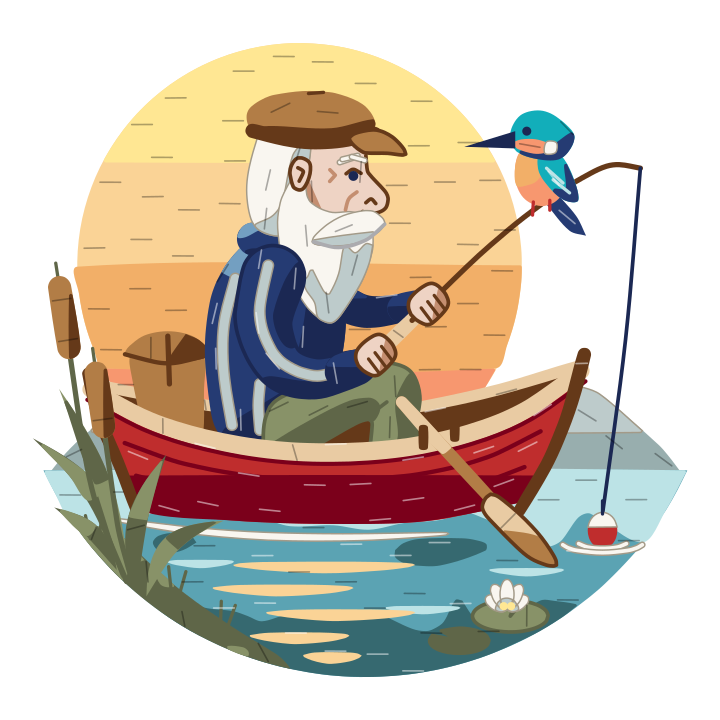
An old fisherman waits in his rowing boat at sunset while a kingfisher, perched on his rod, stares straight back at him. The sun, the water, the sweater, the beard and the boat side are long and short stitch. The rails, oar, float, cattails and reed blades are satin stitch, the creel is woven filling stitch, and the trim on the sweater is chain stitch. The rod and plank lines are stem stitch, the fishing line and small outlines are back stitch, the profile and lid lines are split stitch, and French knots make the eyes. The sky is left bare. In the picture of where the colors go, the fine lines show which way the stitches lie.
Size and details
Advanced. Uses long and short stitch over much of the design, 24 colors and a great deal of stitching.
24 colors of floss and 9 kinds of stitch:
- Long and short stitch
- Satin stitch
- Woven filling stitch
- Stem stitch
- Chain stitch
- Split stitch
- Back stitch
- Straight stitch
- French knot
- Which stitch goes where
| Hoop | Inches | Centimeters | Satin stitch up to |
|---|---|---|---|
| 3 in (8 cm) | 1.8 × 1.7 in | 4.6 × 4.3 cm | 1/8 in (3 mm) |
| 4 in (10 cm) | 2.7 × 2.6 in | 6.9 × 6.6 cm | 3/16 in (5 mm) |
| 5 in (13 cm) | 3.5 × 3.4 in | 8.9 × 8.6 cm | 1/4 in (6 mm) |
| 6 in (15 cm) | 4.4 × 4.3 in | 11.2 × 10.9 cm | 5/16 in (8 mm) |
| 8 in (20 cm) | 6.2 × 6 in | 15.7 × 15.2 cm | 7/16 in (11 mm) |
- In a 3 or 4 inch hoop the French knots are drawn smaller than about 2 mm (a little over 1/16 in). Use one strand of floss for them there, or choose a larger hoop.
The pattern is drawn inside a circle about half an inch (1.3 cm) smaller all around than the hoop.
What you need
- DMC 3855 Light Autumn GoldSun (light), sun on the water
- DMC 722 Light Orange SpiceSun (darkest), kingfisher breast (darker)
- DMC 3854 Medium Autumn GoldSun (dark), kingfisher breast (lighter)
- DMC 744 Pale YellowSun (lightest), water lily center
- DMC 926 Medium Gray GreenFar hills (darker)
- DMC 927 Light Gray GreenFar hills (lighter), beard (darker) and 4 more parts
- DMC 597 TurquoiseWater (middle)
- DMC 3808 Ultra Very Dark TurquoiseWater (dark)
- DMC 3811 Very Light TurquoiseWater (light), ripples (darker), kingfisher feathers
- DMC 801 Dark Coffee BrownBoat inside, stem posts and cap band and 13 more parts
- DMC 738 Very Light TanTop strake and far rail and 3 more parts
- DMC 435 Very Light BrownCreel, cap and cattails (lighter) and 5 more parts
- DMC 939 Very Dark Navy BlueSweater (dark), sleeves (darker) and 7 more parts
- DMC 336 Navy BlueSweater (middle), sleeves (lighter) and 3 more parts
- DMC 334 Medium Baby BlueSweater and sweater collar (light)
- DMC 3052 Medium Green GrayTrousers, reed blades, bank and lily pads (lighter)
- DMC 3051 Dark Green GrayReed blades, bank and trousers (darker) and 5 more parts
- DMC 950 Light Desert SandFace and hands (lighter)
- DMC 3064 Desert SandFace and hands (darker), face lines (lighter)
- DMC 3865 Winter WhiteBeard, hair and ripples (lighter) and 6 more parts
- DMC 318 Light Steel GrayMustache edge
- DMC 347 Very Dark SalmonBoat side (lighter), float (middle), kingfisher feet
- DMC 814 Dark GarnetBoat side (darker), plank lines and rail edge
- DMC 3844 Dark Bright TurquoiseKingfisher back (lighter)
Skeins: 2 for sun (light), sun on the water; one of each other color. An estimate for the largest size, the 8 inch hoop: the length of each line and the area of each filled shape, a fifth added for tails and ends, a tenth of every 8 m (8.7 yd) skein kept spare.
The floss is six-strand cotton; the stitch guide says how many strands to use. You also need a hoop, an embroidery needle (a size 7 to 9 suits two or three strands) and plain cotton or linen fabric. To frame the piece in its hoop, cut a square 3 inches (8 cm) wider than the hoop: a 9 inch (23 cm) square for a 6 inch hoop.
When it is stitched, how to finish a hoop shows how to back it for the wall.
Stitch guide
- Put the pattern on the fabric (how to transfer a pattern) and the fabric in the hoop.
- Stitch the filled parts first, what lies behind before what lies in front of it.
- Then stitch the lines: stems, veins and outlines over the edges of the filled parts.
- Keep the knots for the end, so that the hoop and your hand do not flatten them.
Start each thread with a small knot on the back or one of the knotless starts, and end it by running the needle under the backs of a few stitches (starting and ending a thread). Use the strands this list gives, also where a page about a stitch names another number.
- Long and short stitch 1 strandSun, far hills, water, boat inside, sleeves, sweater, trousers, face, and 9 more
- Satin stitch 2 strandsFar rail, creel lid, cuffs, sweater collar, face, cap band, cap peak, and 17 more
- Woven filling stitch 3 strandsCreel
- Stem stitch 1 to 3 strandsCreel rim, creel strap, rod, plank lines, rail edge, reeds
- Chain stitch 2 strandsSweater cables
- Split stitch 1 to 2 strandsTrouser lines, face lines, mustache edge, eyelid, cap peak edge, and 3 more
- Back stitch 1 strandTrouser lines, face lines, hand lines, fishing line, rings
- Straight stitch 1 to 3 strandsEyebrow, cap button, hand lines, float, kingfisher feathers, and 3 more
- French knot 1 strand, two wrapsEye, water lily center
Getting it onto your fabric
The PDF holds the pattern twice at actual size: once as drawn, and once mirrored for an iron-on transfer pen. Print it at 100% with scaling off and check the one-inch square (25.4 mm) with a ruler before you trace. How to transfer a pattern explains tracing, carbon paper and the other ways. The files are under Downloads.
Downloads
- Download free PDF PDF, US Letter, 3 pages, for a 6 inch (15 cm) hoop
- Download free PDF, A4 PDF, A4, 3 pages, for a 6 inch (15 cm) hoop
More patterns like this
Advanced 3–8 in hoop · 24 colors
Vietnamese silk style lotus and bird
Advanced 3–8 in hoop · 24 colors
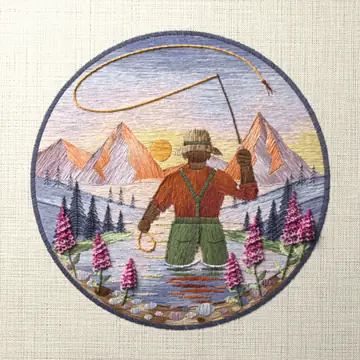
Man fly fishing at mountain dawn
Advanced 3–8 in hoop · 23 colors
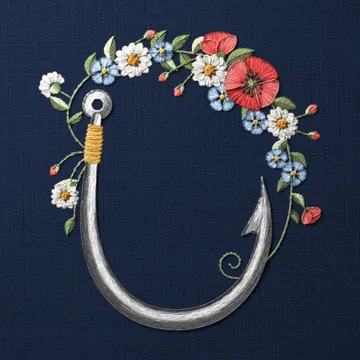
Fish hook monogram frame
Advanced 3–8 in hoop · 23 colors
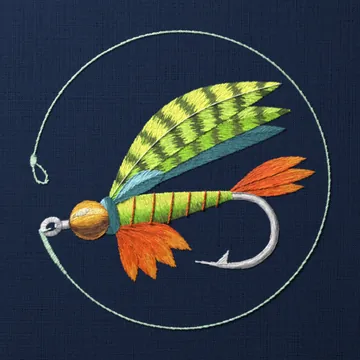
Chartreuse bead head fishing fly
Advanced 3–8 in hoop · 23 colors
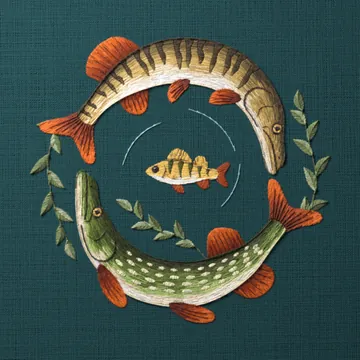
Muskie and northern pike circling
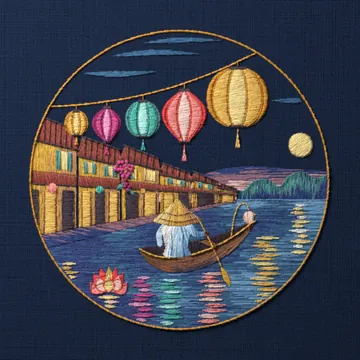
Advanced 3–8 in hoop · 24 colors
Hoi An lanterns on the river at night
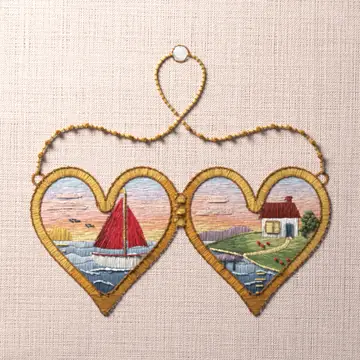
Advanced 3–8 in hoop · 24 colors
Open locket with a sailboat
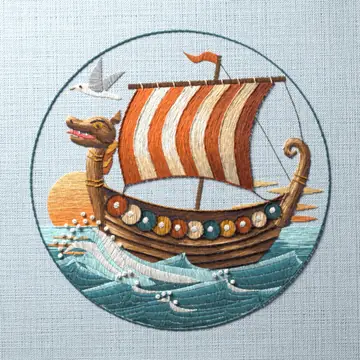
Advanced 3–8 in hoop · 23 colors
Viking longship with a striped sail
New to hand embroidery? Starting hand embroidery, step by step