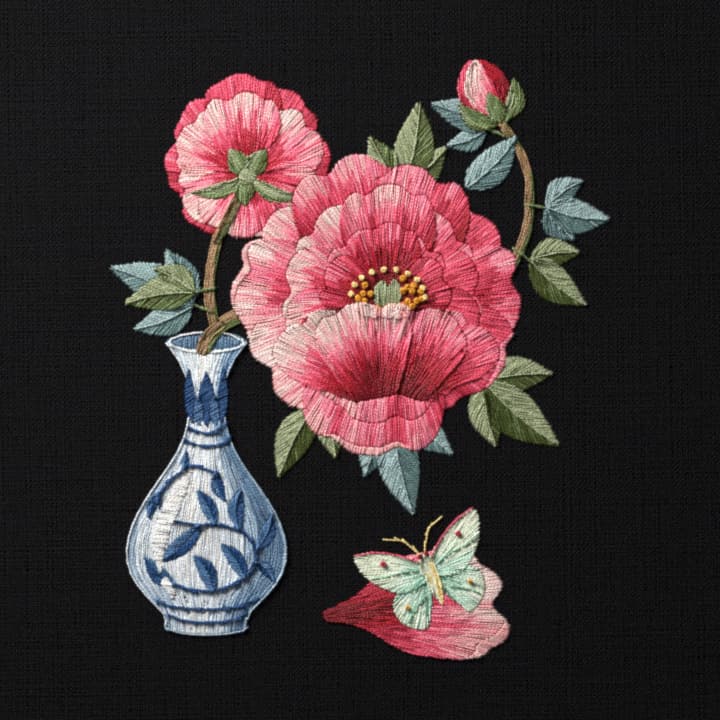
Peonies in a Ming style vase hand embroidery pattern
Advanced · 24 colors · 3.8 × 4.5 in · 7 kinds of stitch
Download free PDFPDFPrints on US Letter and A4You may sell what you make from it by hand, in small quantities. The PDF itself is not to be sold or shared. Selling, classes and kits: the rules
The branch leaves the vase, swings out under the open bloom and curls back to a bud at the top. A second peony shows its green cup from behind, and one petal has fallen beside the vase with a jade moth on it.
Size and details
Advanced. Uses long and short stitch over much of the design, dozens of French knots, 24 colors and a great deal of stitching.
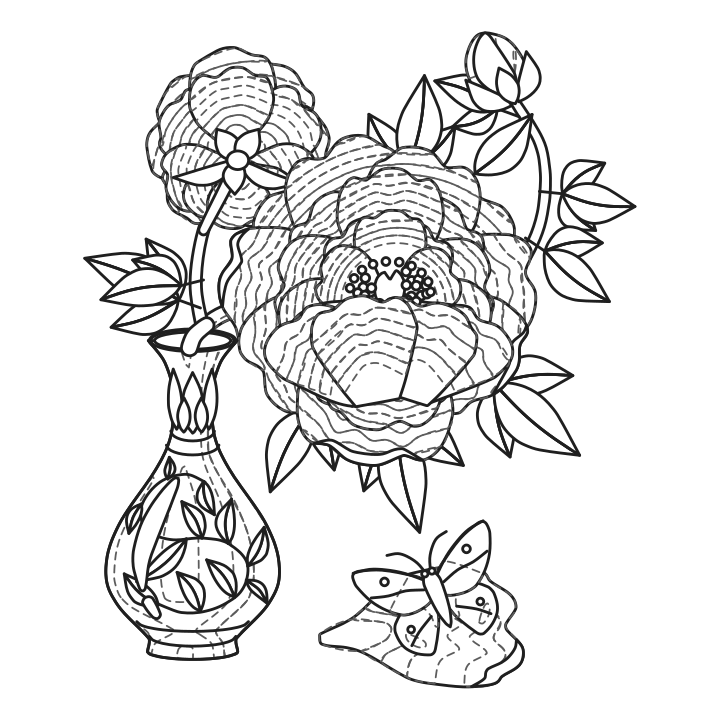
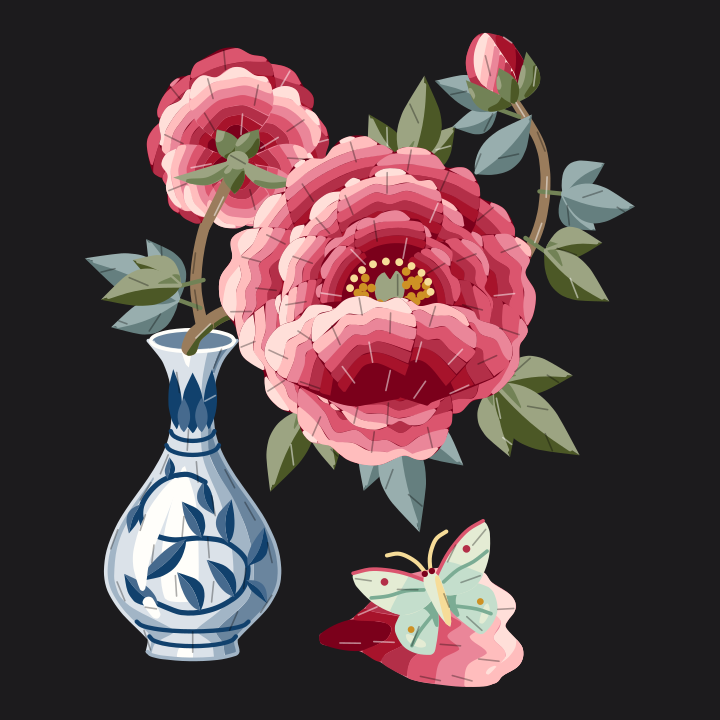
The petals, leaves, vase and moth wings are long and short stitch in a single strand, the painted leaves on the vase are fishbone stitch and the scroll is stem stitch. The stamens are French knots, satin stitch makes the window of light on the glaze, and split stitch edges the vase. It is drawn for black linen. In the picture of where the colors go, the fine lines show which way the stitches lie.
| Hoop | Inches | Centimeters | Satin stitch up to |
|---|---|---|---|
| 3 in (8 cm) | 1.5 × 1.8 in | 3.8 × 4.6 cm | 1/16 in (1.6 mm) |
| 4 in (10 cm) | 2.3 × 2.7 in | 5.8 × 6.9 cm | 1/8 in (3 mm) |
| 5 in (13 cm) | 3 × 3.6 in | 7.6 × 9.1 cm | 3/16 in (5 mm) |
| 6 in (15 cm) | 3.8 × 4.5 in | 9.7 × 11.4 cm | 3/16 in (5 mm) |
| 8 in (20 cm) | 5.3 × 6.3 in | 13.5 × 16 cm | 5/16 in (8 mm) |
- In a 3, 4 or 5 inch hoop the French knots are drawn smaller than about 2 mm (a little over 1/16 in). Use one strand of floss for them there, or choose a larger hoop.
What you need
- Fabric
- Plain cotton or linen in black, cut 9 in (23 cm) square. On white cloth its palest threads do not show: choose other colors under Options. A pencil line does not show on it: see how to transfer a pattern to dark fabric.
- Needle
- Embroidery needle, size 9 for 1 strand, size 7 for 2 or 3 (a lower number is a thicker needle).
- Floss
- 24 colors of six-strand cotton, listed below. DMC is a brand: another brand in a like color will do.
- Marker
- A pen or a sheet that suits the fabric: how to transfer a pattern says which.
Floss
- 1DMC 931 Medium Antique BlueVase (darkest), inside of the vase
- 2DMC 840 Medium Beige BrownBranch (lighter)
- 3DMC 936 Very Dark Avocado GreenLeaves (darkest), branch (darker), sepals (dark)
- 4DMC 3363 Medium Pine GreenSepals and leaves (middle), leaf stalks
- 5DMC 926 Medium Gray GreenLeaves (lightest), leaf veins (lighter)
- 6DMC 3768 Dark Gray GreenLeaves (dark)
- 7DMC 3053 Green GrayLeaves and sepals (light), leaf veins (darker), seed pods
- 8DMC 3831 Dark RaspberryGreat bloom, second bloom, bud and fallen petal (shade 3 of 7), wing spots (darker)
- 9DMC 814 Dark GarnetGreat bloom, second bloom, fallen petal and bud (shade 1 of 7), moth body (dark)
- 10DMC 498 Dark RedGreat bloom, second bloom, fallen petal and bud (shade 2 of 7)
- 11DMC 3832 Medium RaspberryGreat bloom, second bloom, fallen petal and bud (shade 4 of 7), moth edges
- 12DMC 818 Baby PinkGreat bloom, second bloom, fallen petal and bud (shade 7 of 7)
- 13DMC 3833 Light RaspberrySecond bloom, great bloom, fallen petal and bud (shade 5 of 7)
- 14DMC 3716 Very Light RoseGreat bloom, second bloom, fallen petal and bud (shade 6 of 7)
- 15DMC 783 Medium TopazStamens (darker), wing spots (lighter)
- 16DMC 3822 Light StrawStamens (lighter), antennae, moth body (middle)
- 17DMC 3753 Ultra Very Light Antique BlueVase (light), vase edges (middle)
- 18DMC 932 Light Antique BlueVase and vase edges (dark)
- 19DMC BLANC WhiteVase (lightest), window of light, vase edges (light)
- 20DMC 796 Dark Royal BluePainted leaves (darker), painted scrolls
- 21DMC 798 Dark Delft BluePainted leaves (lighter)
- 22DMC 504 Very Light Blue GreenMoth wings (middle)
- 23DMC 503 Medium Blue GreenWing veins, moth wings (dark)
- 24DMC 772 Very Light Yellow GreenMoth wings and moth body (light)
Skeins: 2 of DMC 814; one of each other color. An estimate for the 6 inch hoop, from the length of each line and the area of each filled shape, with a fifth added for tails.
How to stitch it
- New to hand embroidery? Start here.
- Print at 100%, trace the pattern onto the fabric, and put it in the hoop: inner ring under, drawing up, tight as a drum.
- Floss is six strands. Cut 18 inches (45 cm), pull out the number given one at a time, and lay them together.
- Inside a filled shape start with two or three tiny stitches, which the filling covers. Start a line with a small knot on the back. End each thread by running the needle under the backs of a few stitches.
- Each small ring is one French knot. A fine broken line inside a shape is where two shades meet: trace it, do not stitch it.
- A number under “Where colors go” is a color of the list. The fine lines on the colors show which way the stitches lie.
Stitch in this order
Filled parts from the back of the picture forward, then lines and knots. Where a stitch page names another number of strands, use the number here.
- Satin stitch 2 strandsInside of the vase, sepals, seed pods, painted leaves, window of light
- Long and short stitch 1 strandBranch, leaves, bud, sepals, second bloom, great bloom, vase, fallen petal, moth wings, moth body
- Fishbone stitch 2 strandsPainted leaves
- Stem stitch2 or 3 strands: painted scrolls2 strands: leaf stalks1 strand: leaf veins, antennae
- Split stitch 1 strandVase edges, moth edges
- Back stitch 1 strandWing veins
- French knot 1 strand, two wrapsStamens, wing spots, moth body
When it is done, take off any lines that still show and finish the hoop.
More patterns like this
Advanced 3–8 in hoop · 20 colors
Ginger kitten in a ginger jar
Advanced 3–8 in hoop · 17 colors
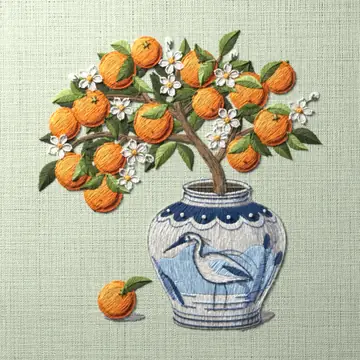
Orange tree in a blue and white jar
Advanced 3–8 in hoop · 16 colors
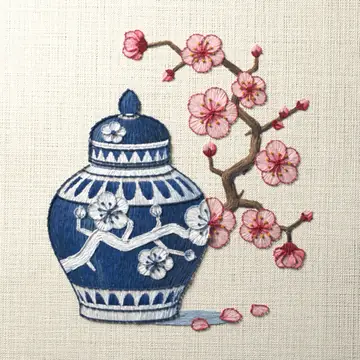
Small ginger jar with plum blossom
Intermediate 3–8 in hoop · 9 colors
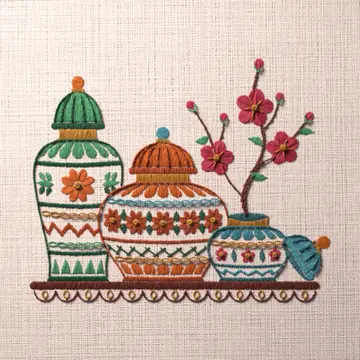
Three little ginger jars
Advanced prints 3–14 in · 23 colors
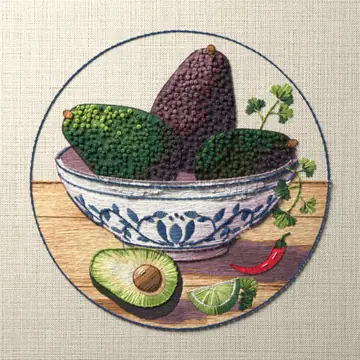
Avocados in a blue and white bowl
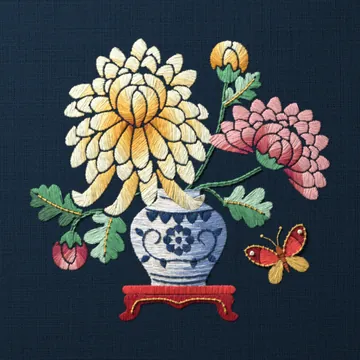
Advanced prints 3–14 in · 19 colors
Chinoiserie chrysanthemums in a jar
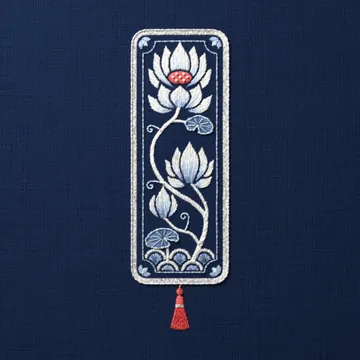
Intermediate 3–8 in hoop · 7 colors
Blue and white porcelain bookmark
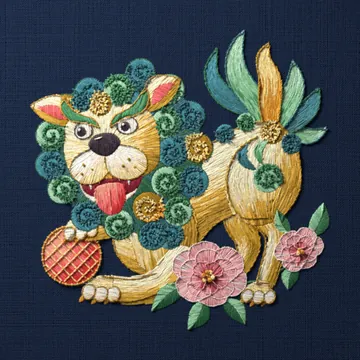
Advanced prints 3–14 in · 24 colors
Japanese temple dog and peonies
New to hand embroidery? Starting hand embroidery, step by step