Pig with pearls hand embroidery pattern
Advanced · 19 colors · 7 kinds of stitch
Download free PDFPDF, US Letter · 93 KBFor your own stitching, gifts and handmade pieces you sell. Do not resell or share this PDF or copies of it. Selling, classes and kits: the rules
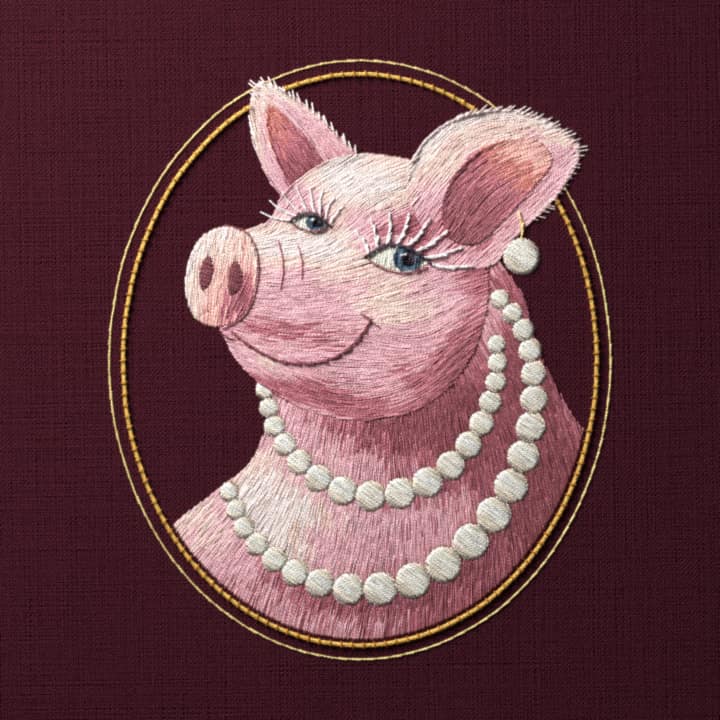
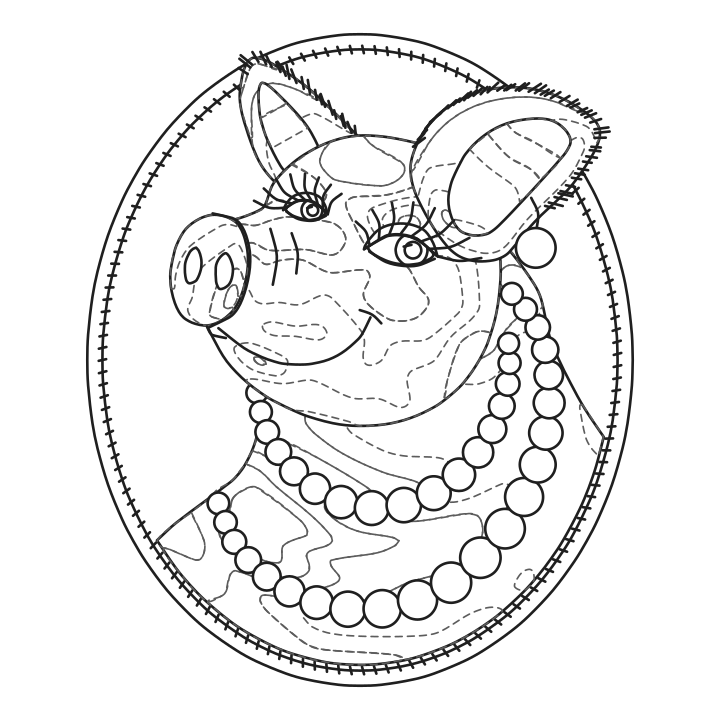
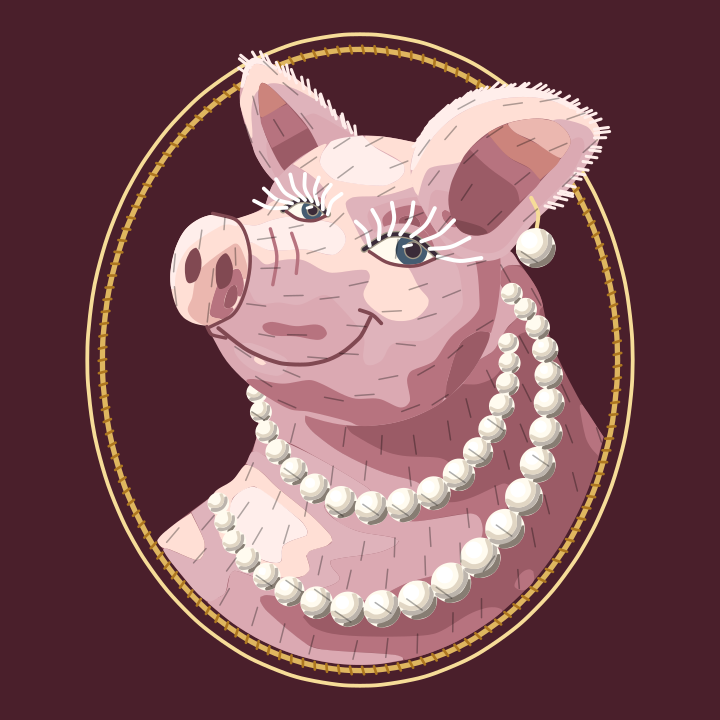
A grand sow turns her head and looks back at you sideways, with long white lashes and a faintly superior smile. Her skin runs from shell pink to dusty mauve in short long and short stitch, combed back from the snout. The pearls are padded satin stitch, shaded from ivory to grey. The oval is a couched gold thread with a fine stem stitch line outside it, and the ears stand out in front of it with straight stitch bristles along the rims. It is drawn for wine red linen. In the picture of where the colors go, the fine lines show which way the stitches lie.
Size and details
Advanced. Uses couching, long and short stitch over much of the design, padded satin stitch, 19 colors and a great deal of stitching.
19 colors of floss and 7 kinds of stitch:
- Couching
- Stem stitch
- Long and short stitch
- Padded satin stitch
- Straight stitch
- Split stitch
- Satin stitch
- Which stitch goes where
| Hoop | Inches | Centimeters | Satin stitch up to |
|---|---|---|---|
| 3 in (8 cm) | 1.6 × 1.9 in | 4.1 × 4.8 cm | 1/8 in (3 mm) |
| 4 in (10 cm) | 2.4 × 2.9 in | 6.1 × 7.4 cm | 3/16 in (5 mm) |
| 5 in (13 cm) | 3.2 × 3.8 in | 8.1 × 9.7 cm | 1/4 in (6 mm) |
| 6 in (15 cm) | 4 × 4.8 in | 10.2 × 12.2 cm | 5/16 in (8 mm) |
| 8 in (20 cm) | 5.6 × 6.7 in | 14.2 × 17 cm | 7/16 in (11 mm) |
The pattern is drawn inside a circle about half an inch (1.3 cm) smaller all around than the hoop.
What you need
- DMC 3820 Dark StrawFrame (middle)
- DMC 782 Dark TopazFrame (dark)
- DMC 3822 Light StrawFrame (light), ear drop
- DMC 3726 Dark Antique MauveNeck and shoulders, head and snout disc (darkest), inside of the ears (dark)
- DMC 316 Medium Antique MauveNeck and shoulders and head (dark), inside of the ears (middle) and 4 more parts
- DMC 3727 Light Antique MauveHead and neck and shoulders (middle dark), ears (dark), eyelids (middle)
- DMC 778 Very Light Antique MauveEars (middle), neck and shoulders and head (middle light), eyelids (light)
- DMC 225 Ultra Very Light Shell PinkNeck and shoulders, head, ears and snout disc (light)
- DMC 819 Light Baby PinkHead, neck and shoulders, ears and snout disc (lightest), ear bristles
- DMC 712 CreamPearls (light), whites of the eyes
- DMC 648 Light Beaver GrayPearls (dark)
- DMC 3033 Very Light Mocha BrownPearls (middle)
- DMC 646 Dark Beaver GrayPearls (darkest)
- DMC B5200 Snow WhitePearls (lightest), lashes and eye lights
- DMC 315 Medium Dark Antique MauveSmile, nostrils and snout edge, inside of the ears (darkest) and 2 more parts
- DMC 223 Light Shell PinkInside of the ears (light)
- DMC 224 Very Light Shell PinkSnout disc (middle), inside of the ears (lightest)
- DMC 930 Dark Antique BlueIrises
- DMC 3371 Black BrownLash lines and pupils
Skeins: 2 for neck and shoulders, head and snout disc (darkest), inside of the ears (dark) and 2 for head and neck and shoulders (middle dark), ears (dark), eyelids (middle); one of each other color. An estimate for the largest size, the 8 inch hoop: the length of each line and the area of each filled shape, a fifth added for tails and ends, a tenth of every 8 m (8.7 yd) skein kept spare.
The floss is six-strand cotton; the stitch guide says how many strands to use. You also need a hoop, an embroidery needle (a size 9 or 10 for one strand, 7 to 9 for two or three, and 3 to 5 for four or more) and plain cotton or linen fabric. To frame the piece in its hoop, cut a square 3 inches (8 cm) wider than the hoop: a 9 inch (23 cm) square for a 6 inch hoop.
When it is stitched, how to finish a hoop shows how to back it for the wall.
Stitch guide
- Put the pattern on the fabric (how to transfer a pattern) and the fabric in the hoop.
- Stitch the filled parts first, what lies behind before what lies in front of it.
- Then stitch the lines: stems, veins and outlines over the edges of the filled parts.
Inside a filled shape start with two or three tiny stitches, which the filling covers: a knot shows as a bump. A line may start with a small knot on the back or one of the knotless starts. End each thread by running the needle under the backs of a few stitches. (Starting and ending a thread shows how.) Use the strands this list gives, and begin as it says, also where a page about a stitch names another number or begins with a knot.
- Couching 6 strandsFrame
- Stem stitch 1 to 2 strandsFrame, smile, lash lines, lashes, ear drop
- Long and short stitch 1 strandNeck and shoulders, ears, inside of the ears, head, snout disc
- Padded satin stitch 2 strandsPearls
- Straight stitch 1 to 2 strandsEar bristles, eye lights
- Split stitch 1 strandSnout edge, snout creases, lower lids
- Satin stitch 2 strandsNostrils, whites of the eyes, irises, pupils, eyelids
Getting it onto your fabric
The PDF holds the pattern twice at actual size: once as drawn, and once mirrored for an iron-on transfer pen. Print it at 100% with scaling off and check the one-inch square (25.4 mm) with a ruler before you trace. How to transfer a pattern explains tracing, carbon paper, the sticky wash-away sheet for knits, denim and dark cloth, and the other ways. The files are under Downloads.
Downloads
- Download free PDF PDF, US Letter, 3 pages, for a 6 inch (15 cm) hoop
- Download free PDF, A4 PDF, A4, 3 pages, for a 6 inch (15 cm) hoop
More patterns like this
Advanced 3–8 in hoop · 23 colors
Stacked farm animals fast asleep
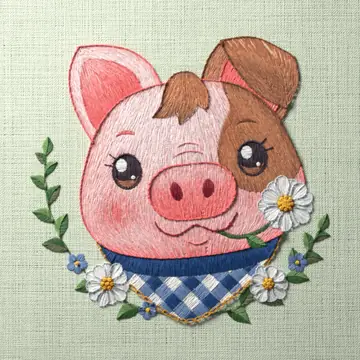
Advanced 3–8 in hoop · 20 colors
Cute pig face
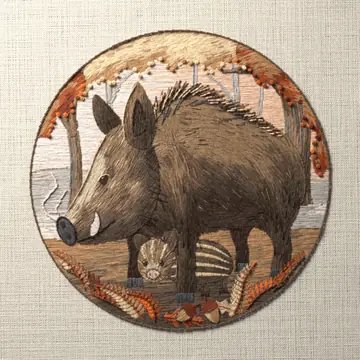
Advanced prints 3–14 in · 18 colors
Wild hog in the oak woods
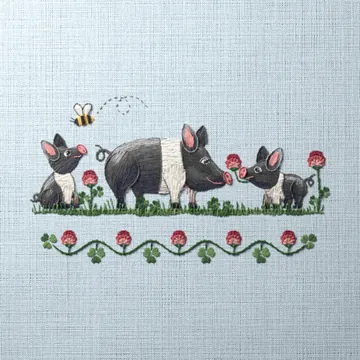
Advanced 3–8 in hoop · 21 colors
Hampshire pig and piglets border
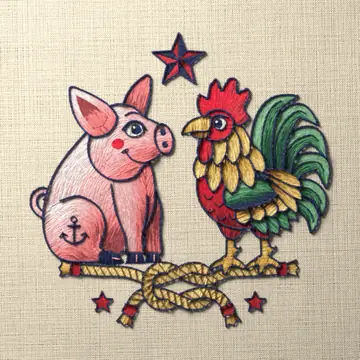
Advanced prints 3–14 in · 16 colors
Small pig and rooster tattoo pair
Intermediate 3–8 in hoop · 2 colors
Blackwork spotted pig
Advanced 3–8 in hoop · 10 colors
Flying pig over the moon
Advanced prints 3–14 in · 19 colors
One hog at a time, please
New to hand embroidery? Starting hand embroidery, step by step