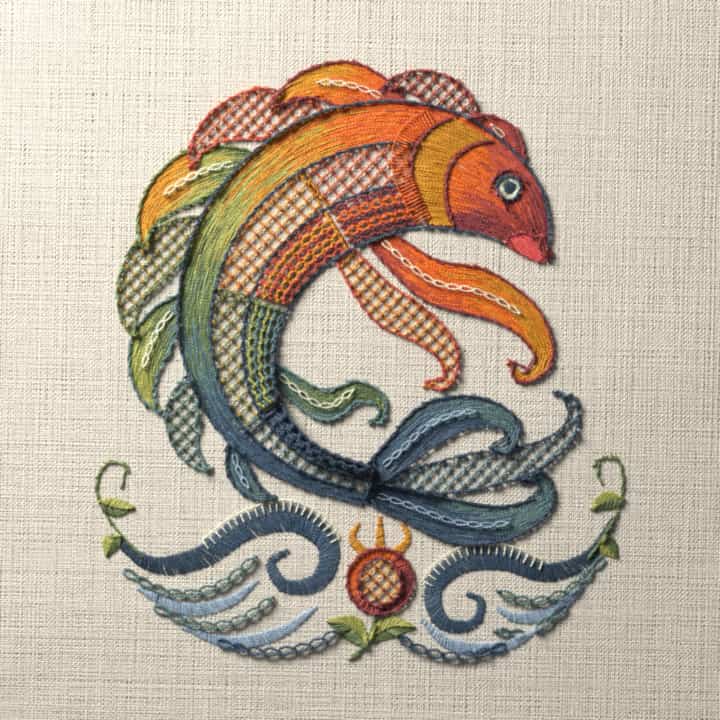
Crewel fish in rainbow colors hand embroidery pattern
Advanced · 12 colors · 8 kinds of stitch
Download free PDFPDF, US Letter · 70 KBFor your own stitching, gifts and handmade pieces you sell. Do not resell or share this PDF. What you may do, in full
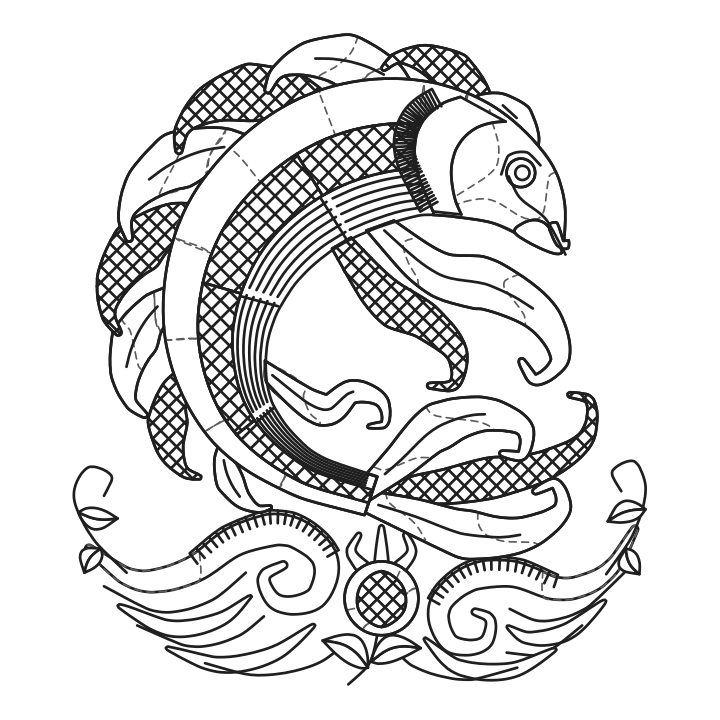
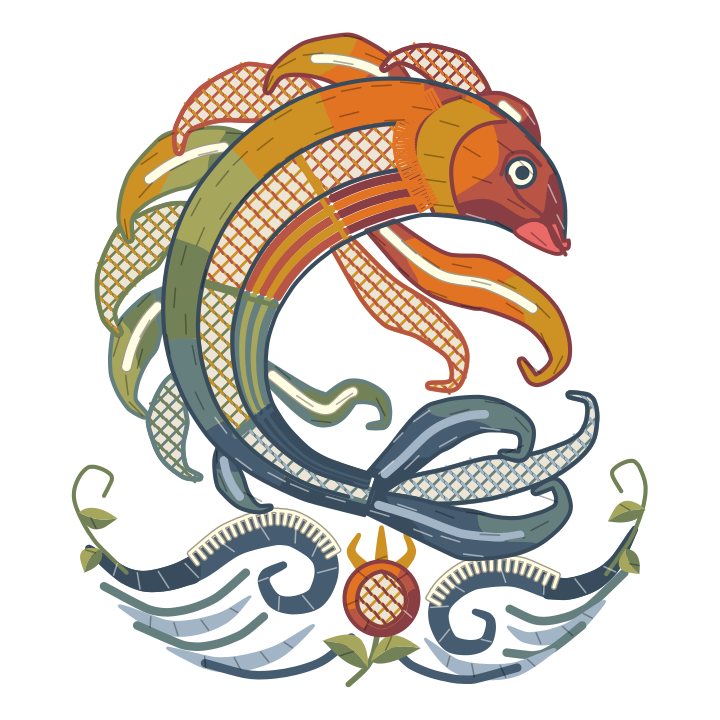
A fantastic fish leaps in one big C, graded from a madder nose through marigold and moss to an indigo tail. Its back is long and short stitch, its flank trellis stitch, its belly close rows of chain stitch, and its gill has a buttonhole stitch fringe. The long fins unfurl like leaves, some shaded and veined in chain stitch, some open trellis, all edged in stem stitch. Below, two satin stitch waves with blanket stitch foam grow tendrils, and a sea pomegranate stands between them. In the picture of where the colors go, the fine lines show which way the stitches lie.
Size and details
Advanced. Uses long and short stitch, trellis stitch, twelve colors and a great deal of stitching; from a 6 inch hoop up the widest satin stitches are long.
12 colors of floss and 8 kinds of stitch:
- Satin stitch
- Blanket stitch
- Chain stitch
- Stem stitch
- Fishbone stitch
- Long and short stitch
- Trellis stitch
- Buttonhole stitch
- Which stitch goes where
| Hoop | Inches | Centimeters | Satin stitch up to |
|---|---|---|---|
| 3 in (8 cm) | 1.6 × 1.9 in | 4.1 × 4.8 cm | 1/8 in (3 mm) |
| 4 in (10 cm) | 2.5 × 2.8 in | 6.4 × 7.1 cm | 1/4 in (6 mm) |
| 5 in (13 cm) | 3.3 × 3.7 in | 8.4 × 9.4 cm | 5/16 in (8 mm) |
| 6 in (15 cm) | 4.1 × 4.7 in | 10.4 × 11.9 cm | 3/8 in (10 mm) |
| 8 in (20 cm) | 5.8 × 6.5 in | 14.7 × 16.5 cm | 1/2 in (13 mm) |
- In an 8 inch hoop the widest satin stitch shape is 1/2 in (13 mm) across. Satin stitches longer than about 12 mm (just under 1/2 in) tend to work loose: divide the shape into sections, or work it in long and short stitch.
The pattern is drawn inside a circle about half an inch (1.3 cm) smaller all around than the hoop.
What you need
- DMC 930 Dark Antique BlueWaves (lighter), tail and wave rows (dark), back (shade 2 of 8) and 3 more parts
- DMC 3750 Very Dark Antique BlueTail edges, body edge and body lines, waves (darker), tail (darkest) and 5 more parts
- DMC 3823 Ultra Pale YellowWave foam, belly fins veins and eye, back fin veins (lighter)
- DMC 3768 Dark Gray GreenTail and back fin edges (light), back fin (shade 4 of 8), flank (dark) and 6 more parts
- DMC 932 Light Antique BlueWave rows (light), tail and flank (lightest), tail veins, back fin veins (darker)
- DMC 3363 Medium Pine GreenBack fin (shade 5 of 8), flank (middle), back fin edges (lightest) and 7 more parts
- DMC 3012 Medium Khaki GreenBack fin, back and belly (shade 8 of 8), tendril leaves and pomegranate leaves (lighter)
- DMC 783 Medium TopazBack and back fin (shade 7 of 8), belly fins (lightest), flank (light) and 5 more parts
- DMC 922 Light CopperBelly fins and pomegranate (light), back (shade 6 of 8), gill (darker) and 3 more parts
- DMC 221 Very Dark Shell PinkBack fin (shade 1 of 8), back fin edges and head (dark) and 9 more parts
- DMC 3830 Terra CottaHead (middle), back fin (shade 3 of 8), flank and belly fins (darkest) and 5 more parts
- DMC 351 CoralLips
Skeins: 2 for back and back fin (shade 7 of 8), belly fins (lightest), flank (light) and 5 more parts; one of each other color. An estimate for the largest size, the 8 inch hoop: the length of each line and the area of each filled shape, a fifth added for tails and ends, a tenth of every 8 m (8.7 yd) skein kept spare.
The floss is six-strand cotton; the stitch guide says how many strands to use. You also need a hoop, an embroidery needle (a size 7 to 9 suits two or three strands) and plain cotton or linen fabric. To frame the piece in its hoop, cut a square 3 inches (8 cm) wider than the hoop: a 9 inch (23 cm) square for a 6 inch hoop.
When it is stitched, how to finish a hoop shows how to back it for the wall.
Stitch guide
- Put the pattern on the fabric (how to transfer a pattern) and the fabric in the hoop.
- Stitch the filled parts first, what lies behind before what lies in front of it.
- Then stitch the lines: stems, veins and outlines over the edges of the filled parts.
Start each thread with a small knot on the back or one of the knotless starts, and end it by running the needle under the backs of a few stitches (starting and ending a thread). Use the strands this list gives, also where a page about a stitch names another number.
- Satin stitch 2 strandsWaves, wave rows, pomegranate crown, gill, eye, pupil, lips
- Blanket stitch 1 strandWave foam
- Chain stitch 1 to 3 strandsWave rows, back fin veins, belly fins veins, tail veins, flank bands, belly
- Stem stitch 1 to 4 strandsTendrils, pomegranate stalk, pomegranate edges, back fin edges, belly fins edges, tail edges, flank bands, body lines, gill edges, and 5 more
- Fishbone stitch 2 strandsTendril leaves, pomegranate leaves
- Long and short stitch 1 strandPomegranate, back fin, belly fins, tail, back, head
- Trellis stitch 2 strandsPomegranate heart, back fin, belly fins, tail, flank
- Buttonhole stitch 1 strandGill
Getting it onto your fabric
The PDF holds the pattern twice at actual size: once as drawn, and once mirrored for an iron-on transfer pen. Print it at 100% with scaling off and check the one-inch square (25.4 mm) with a ruler before you trace. How to transfer a pattern explains tracing, carbon paper and the other ways. The files are under Downloads.
Downloads
- Download free PDF PDF, US Letter, 3 pages, for a 6 inch (15 cm) hoop
- Download free PDF, A4 PDF, A4, 3 pages, for a 6 inch (15 cm) hoop
More patterns like this
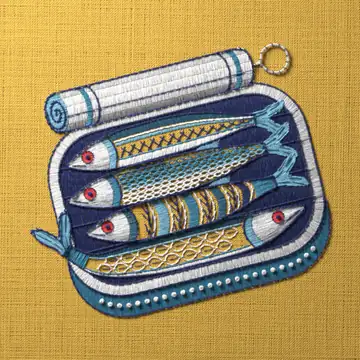
Advanced 3–8 in hoop · 10 colors
Patterned sardines in an open tin
Advanced 3–8 in hoop · 15 colors
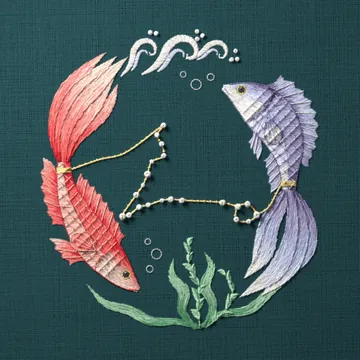
Pisces zodiac sign
Advanced 3–8 in hoop · 19 colors
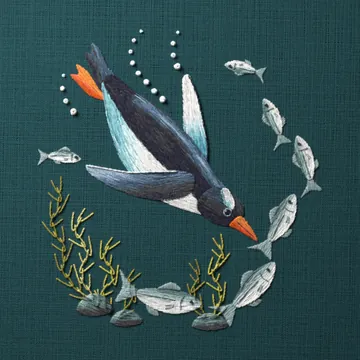
Penguin diving after silver fish
Advanced 3–8 in hoop · 20 colors
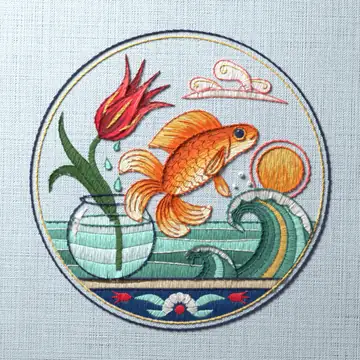
Turkish tulip with a leaping goldfish
Advanced 3–8 in hoop · 20 colors
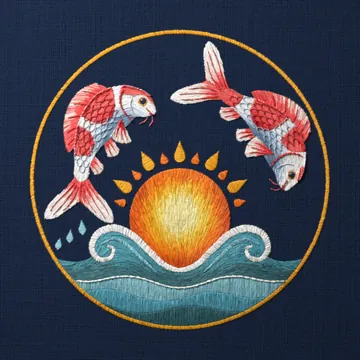
Two fish leaping over the sun
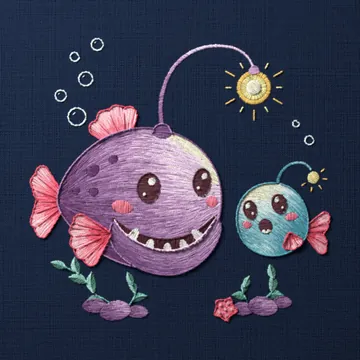
Advanced 3–8 in hoop · 21 colors
Cute little angler fish
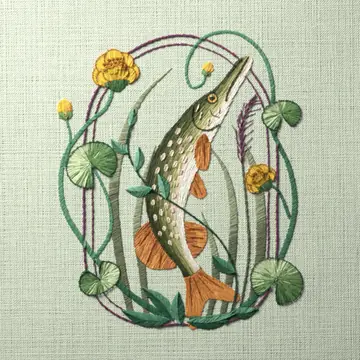
Advanced 3–8 in hoop · 22 colors
Northern pike among the reeds
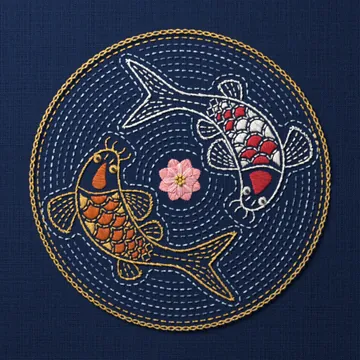
Intermediate 3–8 in hoop · 10 colors
Two fish in running stitch ripples
New to hand embroidery? Starting hand embroidery, step by step