Silver floral border for a velvet shawl hand embroidery pattern
Advanced · 7 colors · 4.2 × 4.2 in · 8 kinds of stitch
Download free PDFPDFPrints on US Letter and A4You may sell what you make from it by hand, in small quantities. The PDF itself is not to be sold or shared. Selling, classes and kits: the rules
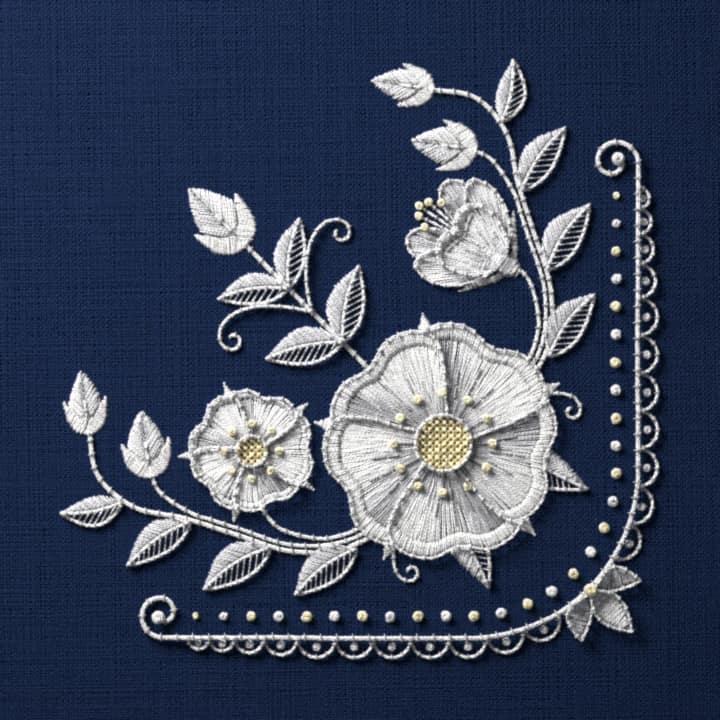
A large silver rose stands in the turn of the corner, and couched cord stems sweep away from behind it to a smaller rose on one side and a half open rose on the other.
Size and details
Advanced. Uses couching, padded satin stitch, long and short stitch, dozens of French knots and a great deal of stitching.
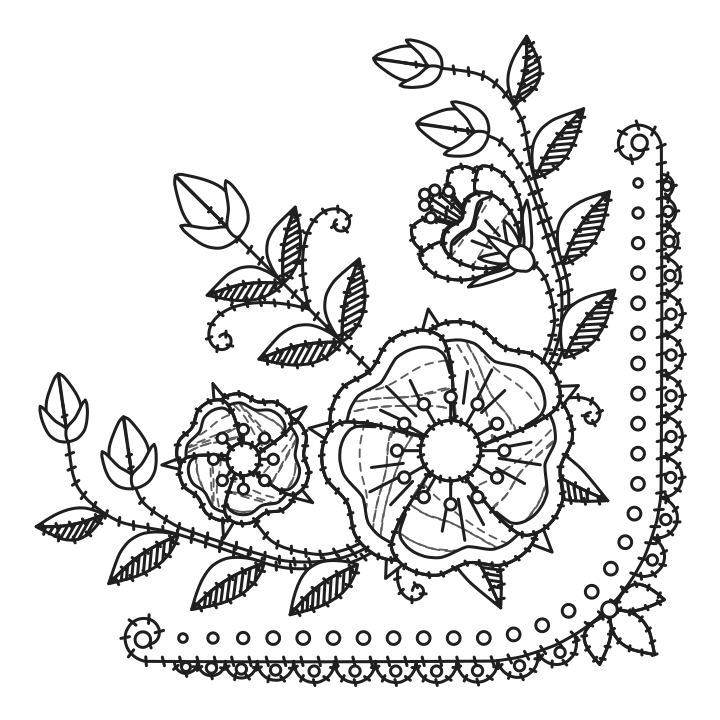
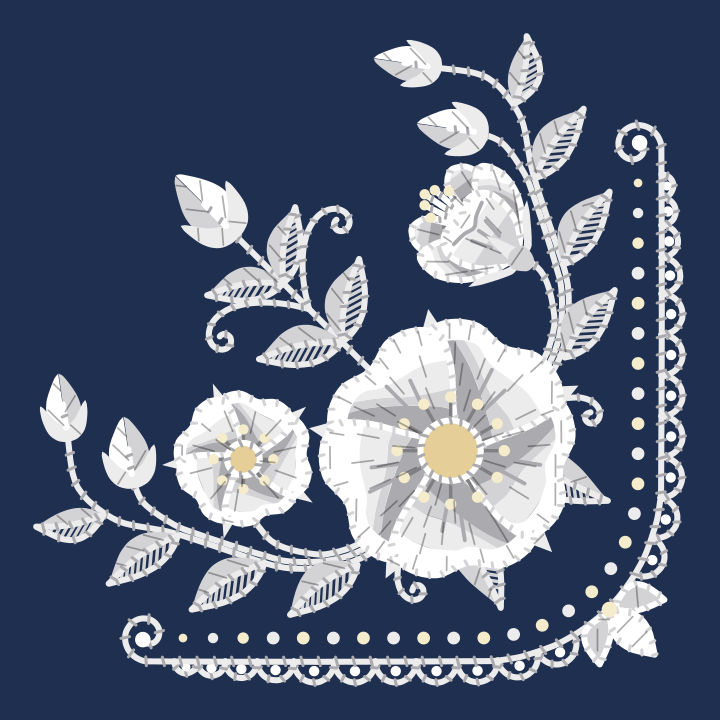
The petals are long and short stitch from gray at the throat to white at the edge, with rolled edges in padded satin stitch and couched rims round every petal. Each leaf has one half in padded satin stitch and one half in open straight stitches, and the hearts of the open roses are woven filling in pale gold ringed with French knots. A couched cord with a curl at each end makes the hem, with a row of French knots inside it, small scallops outside it and a palmette exactly on the corner. Draw it on tear-away tissue, since velvet does not take a traced line. It is drawn for indigo linen. In the picture of where the colors go, the fine lines show which way the stitches lie.
| Hoop | Inches | Centimeters | Satin stitch up to |
|---|---|---|---|
| 3 in (8 cm) | 1.7 × 1.7 in | 4.3 × 4.3 cm | 1/8 in (3 mm) |
| 4 in (10 cm) | 2.5 × 2.5 in | 6.4 × 6.4 cm | 3/16 in (5 mm) |
| 5 in (13 cm) | 3.4 × 3.4 in | 8.6 × 8.6 cm | 3/16 in (5 mm) |
| 6 in (15 cm) | 4.2 × 4.2 in | 10.7 × 10.7 cm | 1/4 in (6 mm) |
| 8 in (20 cm) | 5.9 × 5.9 in | 15 × 15 cm | 3/8 in (10 mm) |
- In a 3, 4 or 5 inch hoop the French knots are drawn smaller than about 2 mm (a little over 1/16 in). Use one strand of floss for them there, or choose a larger hoop.
On linens. Wash and press the piece first. A corner design goes in one corner, its two arms along the two hems, the same distance from each: mark that corner with a ruler before you trace. On a pillow cover measure from the seam, which takes half an inch (1.3 cm) of the cut edge. On a dinner napkin keep to 1 to 2½ inches (2.5 to 6.5 cm): the size stands under each hoop. Press face down on soft cloth. How to embroider pillowcases and napkins has the sizes and the places, and the placement chart says how far in.
What you need
- Fabric
- Plain cotton or linen in indigo, cut 9 in (23 cm) square. On white cloth its palest threads do not show: choose other colors under Options. A pencil line does not show on it: see how to transfer a pattern to dark fabric.
- Needle
- Embroidery needle, size 9 for 1 strand, size 7 for 2 or 3, size 3 for 4 to 6 (a lower number is a thicker needle).
- Floss
- 7 colors of six-strand cotton, listed below. DMC is a brand: another brand in a like color will do.
- Marker
- A pen or a sheet that suits the fabric: how to transfer a pattern says which.
Floss
- 1DMC 762 Very Light Pearl GrayPetals (light), sepals, leaf cords, boughs and hem scallops (lighter) and 5 more parts
- 2DMC 318 Light Steel GrayPetals (dark), boughs and leaf cords (darker), petal veins and 7 more parts
- 3DMC B5200 Snow WhitePetals (lightest), petal lips, petal edges and buds (lighter) and 7 more parts
- 4DMC 677 Very Light Old GoldStamen knots and palmette knots, hem knots (darker)
- 5DMC 415 Pearl GrayLeaves and leaf bars, petals (middle), petal edges and buds (darker) and 4 more parts
- 6DMC 414 Dark Steel GrayPetals (darkest), stamens (dark)
- 7DMC 676 Light Old GoldFlower hearts
Skeins: one of each color is enough. An estimate for the 6 inch hoop, from the length of each line and the area of each filled shape, with a fifth added for tails.
How to stitch it
- New to hand embroidery? Start here.
- Print at 100%, trace the pattern onto the fabric, and put it in the hoop: inner ring under, drawing up, tight as a drum.
- Floss is six strands. Cut 18 inches (45 cm), pull out the number given one at a time, and lay them together.
- Begin with no knot on the back where it is seen and washed, as on a towel, a napkin or clothes; for a piece in a hoop a small knot is fine. End each thread by whipping it around the backs of four or five stitches, with one small hitch.
- Each small ring is one French knot. A fine broken line inside a shape is where two shades meet: trace it, do not stitch it.
- A number under “Where colors go” is a color of the list. The fine lines on the colors show which way the stitches lie.
Stitch in this order
Filled parts from the back of the picture forward, then lines and knots. Where a stitch page names another number of strands, use the number here.
- Padded satin stitch 2 strandsPalmette, leaves, buds, petal lips, flower cups
- Satin stitch 2 strandsBud cups, sepals
- Long and short stitch 1 strandPetals
- Woven filling stitch 3 strandsFlower hearts
- Couching6 strands: hem cord5 strands: spray4 or 5 strands: boughs3 strands: hem scallops, leaf cords, tendrils, flower heart rims2 strands: palmette edges, bud cups, petal edges, stamens
- Straight stitch 1 strandLeaf bars, stamens
- Back stitch 1 strandPetal veins
- French knot two wraps2 strands: hem curl knots, palmette knots, stamen knots1 or 2 strands: hem scallop knots, hem knots
When it is done, take off any lines that still show and finish the hoop. A guide to this kind of work: How to embroider a rose.
More patterns like this
Advanced prints 3–14 in · 9 colors
Black and white piano shawl corner
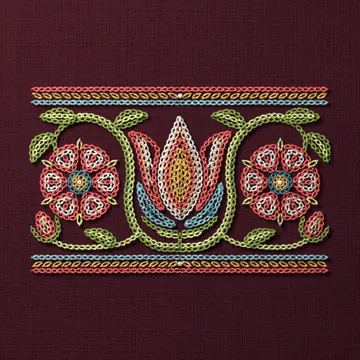
Intermediate prints 3–14 in · 8 colors
Aari style floral shawl border
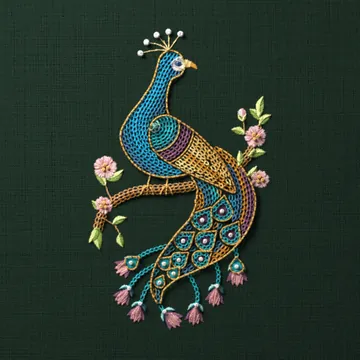
Intermediate prints 3–14 in · 19 colors
Blue and gold peacock for a shawl
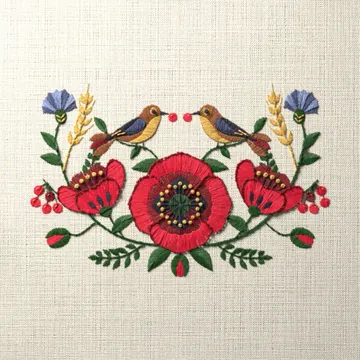
Advanced prints 3–14 in · 9 colors
Ukrainian style poppy shawl spray
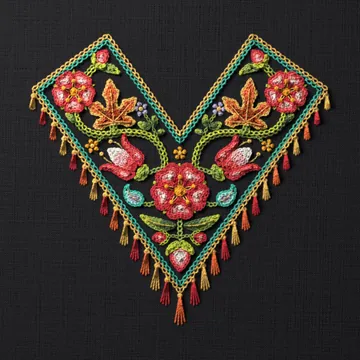
Intermediate prints 3–14 in · 14 colors
Kashmiri border for a shawl or poncho
Advanced 3–8 in hoop · 8 colors
Regency lady with a fan and shawl
Easy prints 3–14 in · 7 colors
Easy cherries for a scarf corner
Advanced prints 3–14 in · 16 colors
Cardinal lace border for a dresser scarf
New to hand embroidery? Starting hand embroidery, step by step