Small easy tomato (whole and half) hand embroidery pattern
Easy · 7 colors · 3.5 × 3.9 in · 7 kinds of stitch
Download free PDFPDFPrints on US Letter and A4You may sell what you make from it by hand, in small quantities. The PDF itself is not to be sold or shared. Selling, classes and kits: the rulesNew to it? Next: how to start
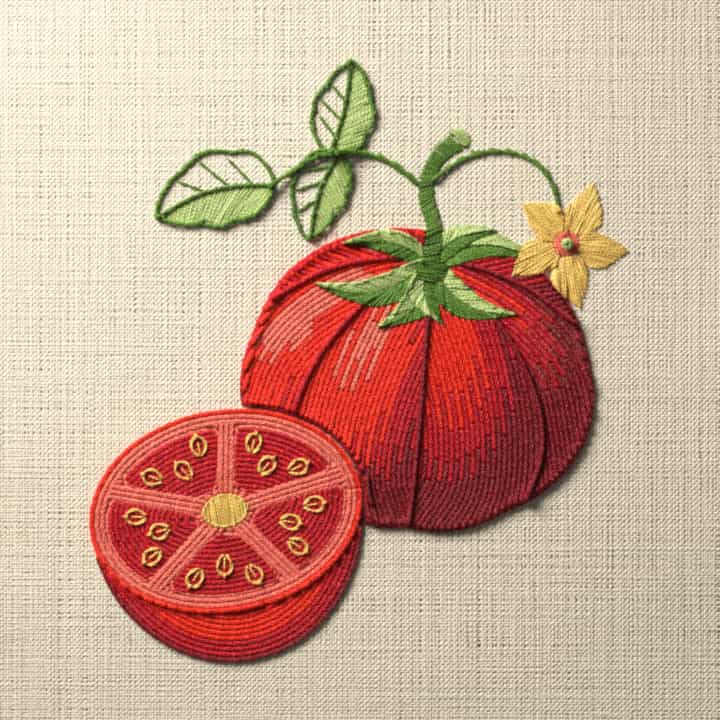
A whole ribbed tomato sits on a short piece of vine, with three leaves to the left and one yellow flower over its right shoulder. A cut half leans in front of it, its face of seeds turned up to you.
Size and details
Easy. In a hoop of 6 inches or less: line stitches and loops, fishbone stitch and French knots, with some short satin stitches; in a larger hoop the widest satin stitches are long.
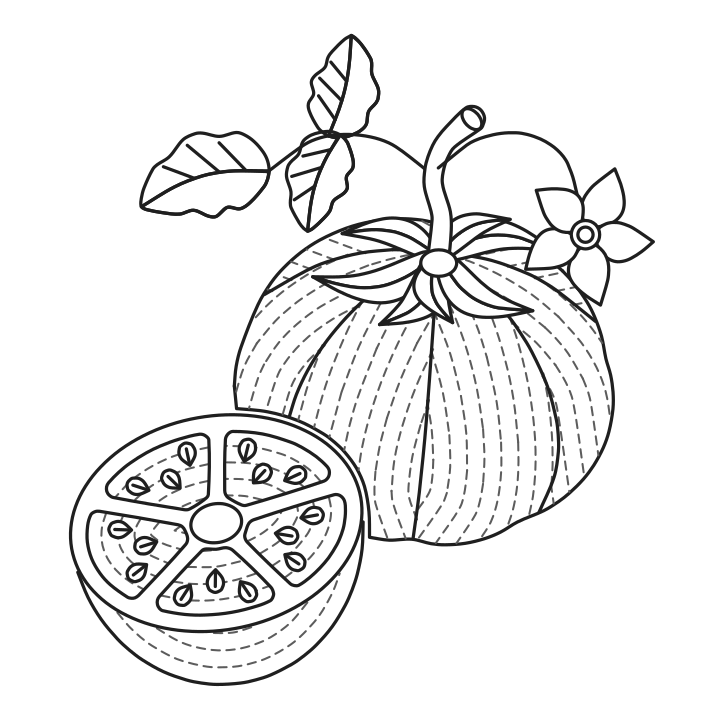
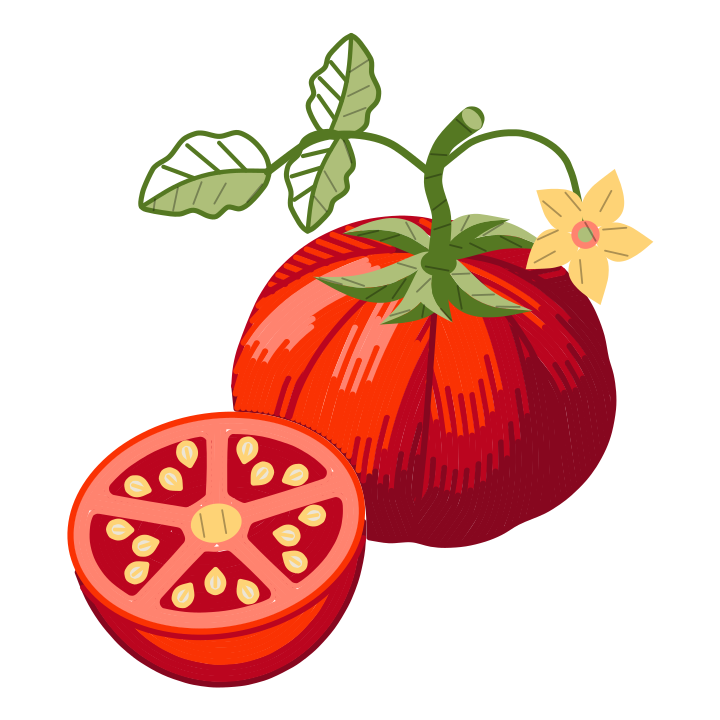
Rows of split stitch run from the green star to the foot of the fruit, and where one red gives way to the next the rows are alternately long and short, so the shade melts from coral to garnet. The half is split stitch too, with a satin stitch core and lazy daisy seeds. The star is fishbone stitch, the leaves are half satin stitch and half bare cloth inside a split stitch line, and the flower is satin stitch with one French knot. In the picture of where the colors go, the fine lines show which way the stitches lie.
| Hoop | Inches | Centimeters | Satin stitch up to |
|---|---|---|---|
| 3 in (8 cm) | 1.4 × 1.6 in | 3.6 × 4.1 cm | 1/8 in (3 mm) |
| 4 in (10 cm) | 2.1 × 2.4 in | 5.3 × 6.1 cm | 3/16 in (5 mm) |
| 5 in (13 cm) | 2.8 × 3.1 in | 7.1 × 7.9 cm | 1/4 in (6 mm) |
| 6 in (15 cm) | 3.5 × 3.9 in | 8.9 × 9.9 cm | 5/16 in (8 mm) |
| 8 in (20 cm) | 4.9 × 5.5 in | 12.4 × 14 cm | 1/2 in (13 mm) |
- In an 8 inch hoop the widest satin stitch shape is 1/2 in (13 mm) across. Satin stitches longer than about 12 mm (just under 1/2 in) tend to work loose: divide the shape into sections, or work it in long and short stitch.
- In a 3, 4 or 5 inch hoop the French knot is drawn smaller than about 2 mm (a little over 1/16 in). Use one strand of floss for it there, or choose a larger hoop.
- In a 3 inch hoop the shortest lazy daisy loops are drawn smaller than about 2 mm (a little over 1/16 in). Use one strand of floss for them there, or choose a larger hoop.
On a towel. Wash and dry the towel first. To start with, put the bottom of the design 2 to 3 inches (5 to 7.5 cm) above the hem, in the middle or in a lower corner. Keep the stitches low, and press from the back. How to embroider a towel has every step, and the placement chart has the figures for other towels.
What you need
- Fabric
- Plain cotton or linen, cut 9 in (23 cm) square.
- Needle
- Embroidery needle, size 9 for 1 strand, size 7 for 2 or 3, size 3 for 4 to 6 (a lower number is a thicker needle).
- Floss
- 7 colors of six-strand cotton, listed below. DMC is a brand: another brand in a like color will do.
- Marker
- A pen or a sheet that suits the fabric: how to transfer a pattern says which.
Floss
- 1DMC 815 Medium GarnetWhole tomato (darkest), creases (darker), half skin (dark)
- 2DMC 817 Very Dark Coral RedSeed pockets, whole tomato (dark), half skin (middle), creases (lighter)
- 3DMC 606 Bright Orange-RedWhole tomato and half skin (light), half rim
- 4DMC 3340 Medium ApricotHalf flesh and pocket edges, whole tomato (lightest), flower cone (darker)
- 5DMC 743 Medium YellowFlower, seeds and core
- 6DMC 471 Very Light Avocado GreenLeaves, calyx and flower cone (lighter), cut end of the vine
- 7DMC 904 Very Dark Parrot GreenCalyx and leaves (darker), vine, leaf veins, flower stalk and leaf stalk
Skeins: one of each color is enough. An estimate for the 6 inch hoop, from the length of each line and the area of each filled shape, with a fifth added for tails.
How to stitch it
- New to hand embroidery? Start here.
- Print at 100%, trace the pattern onto the fabric, and put it in the hoop: inner ring under, drawing up, tight as a drum.
- Floss is six strands. Cut 18 inches (45 cm), pull out the number given one at a time, and lay them together.
- Begin with no knot on the back where it is seen and washed, as on a towel, a napkin or clothes; for a piece in a hoop a small knot is fine. End each thread by whipping it around the backs of four or five stitches, with one small hitch.
- Each small ring is one French knot. Each small loop is one lazy daisy: come up at its point. A fine broken line inside a shape is where two shades meet: trace it, do not stitch it.
- A number under “Where colors go” is a color of the list. The fine lines on the colors show which way the stitches lie.
Stitch in this order
Filled parts from the back of the picture forward, then lines, loops and knots. Where a stitch page names another number of strands, use the number here.
- Satin stitch3 strands: vine, calyx, cut end of the vine2 strands: core, leaves, flower, flower cone
- Fishbone stitch 3 strandsCalyx
- Split stitch6 strands: whole tomato, creases, half skin, half flesh, seed pockets, half rim4 strands: pocket edges3 or 4 strands: leaves2 strands: leaf veins
- Straight stitch 1 strandSeeds
- Stem stitch5 strands: leaf stalk4 strands: flower stalk
- Lazy daisy stitch 2 strandsSeeds
- French knot 2 strands, two wrapsFlower cone
When it is done, take off any lines that still show and finish the hoop.
More patterns like this
Intermediate 3–8 in hoop · 8 colors
Tomato plant in a clay pot
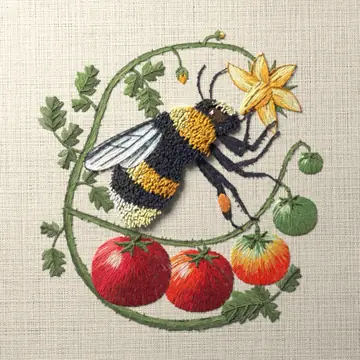
Advanced 3–8 in hoop · 24 colors
Bumblebee on a tomato vine
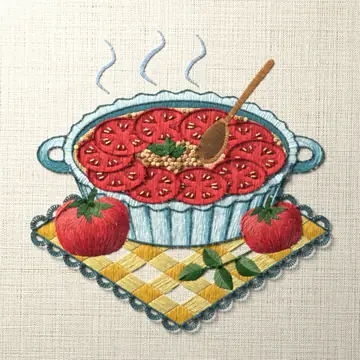
Advanced prints 3–14 in · 20 colors
Vintage scalloped tomatoes dish
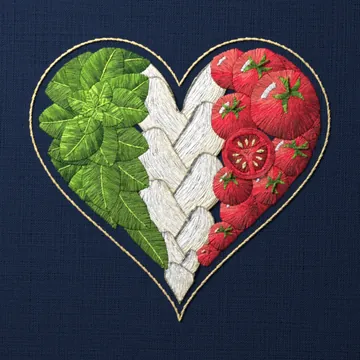
Advanced 3–8 in hoop · 18 colors
Italian flag heart of basil and tomato
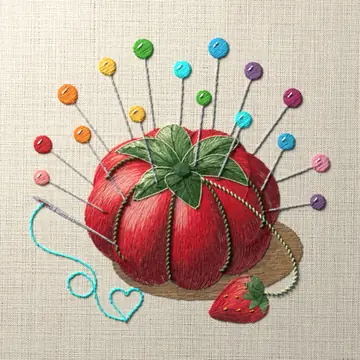
Advanced prints 3–14 in · 22 colors
Tomato pin cushion with colored pins
Advanced 3–8 in hoop · 10 colors
Pasta shapes border, basil and tomatoes
Easy 3–8 in hoop · 7 colors
Easy jalapeno peppers
Easy 3–8 in hoop · 7 colors
Easy dump truck bib for a baby boy
New to hand embroidery? Starting hand embroidery, step by step