Bumblebee on a tomato vine hand embroidery pattern
Advanced · 24 colors · 4.3 × 4.5 in · 7 kinds of stitch
Download free PDFPDFPrints on US Letter and A4You may sell what you make from it by hand, in small quantities. The PDF itself is not to be sold or shared. Selling, classes and kits: the rules
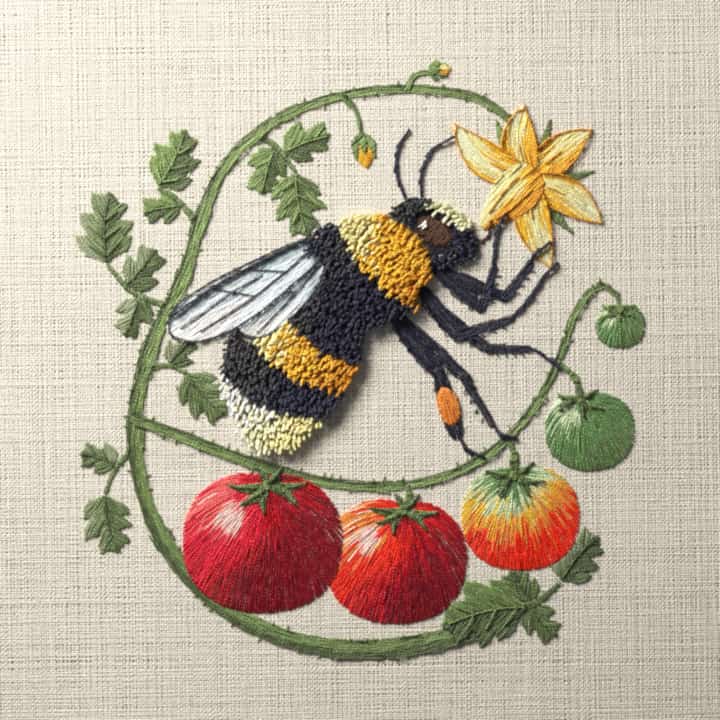
A plump bumblebee holds on to a tomato flower at the end of a leafy vine, and the truss below her carries five tomatoes, red at the left and green at the tip.
Size and details
Advanced. Uses long and short stitch over much of the design, turkey work, 24 colors and a great deal of stitching.
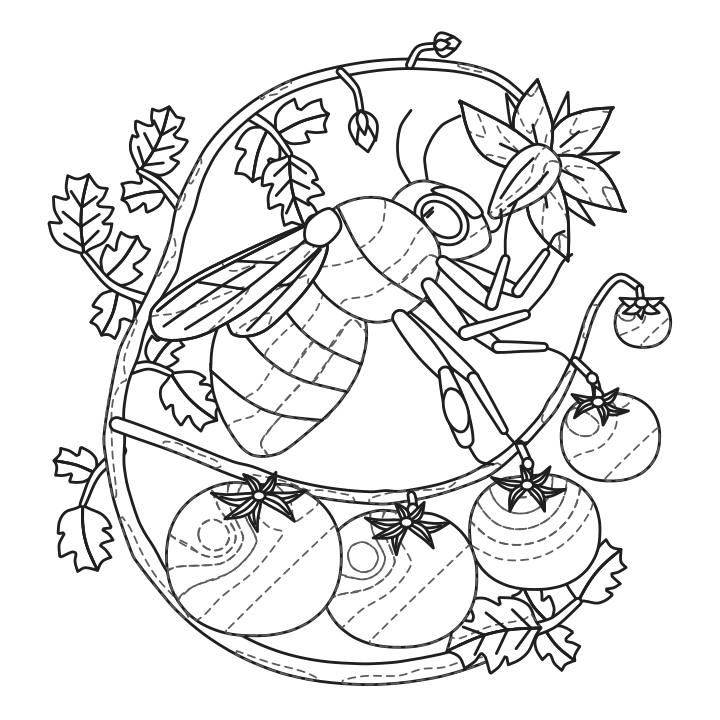
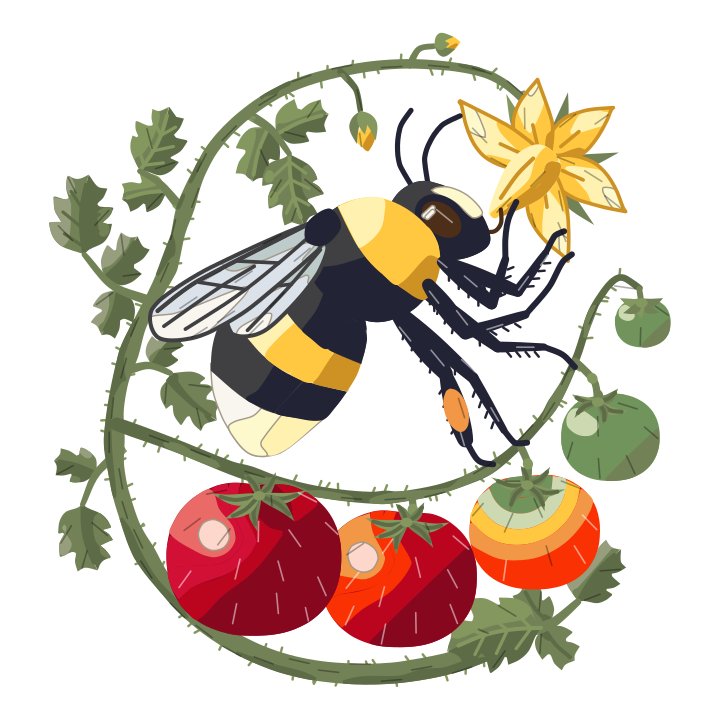
Her bands and head are turkey work cut to a soft pile, and her eye and the pollen on her hind leg are padded satin stitch. Her wings are long and short stitch, edged in stem stitch and veined in split stitch. The tomatoes, vine, petals, leaves and legs are shaded in long and short stitch. Calyxes and sepals are satin stitch, and the fine hairs on the stems are single straight stitches. In the picture of where the colors go, the fine lines show which way the stitches lie.
| Hoop | Inches | Centimeters | Satin stitch up to |
|---|---|---|---|
| 3 in (8 cm) | 1.7 × 1.8 in | 4.3 × 4.6 cm | 1/8 in (3 mm) |
| 4 in (10 cm) | 2.6 × 2.7 in | 6.6 × 6.9 cm | 3/16 in (5 mm) |
| 5 in (13 cm) | 3.4 × 3.6 in | 8.6 × 9.1 cm | 1/4 in (6 mm) |
| 6 in (15 cm) | 4.3 × 4.5 in | 10.9 × 11.4 cm | 5/16 in (8 mm) |
| 8 in (20 cm) | 6 × 6.3 in | 15.2 × 16 cm | 7/16 in (11 mm) |
What you need
- Fabric
- Plain cotton or linen, cut 9 in (23 cm) square.
- Needle
- Embroidery needle, size 9 for 1 strand, size 7 for 2 or 3, size 5 for 4 (a lower number is a thicker needle).
- Floss
- 24 colors of six-strand cotton, listed below. DMC is a brand: another brand in a like color will do.
- Marker
- A pen or a sheet that suits the fabric: how to transfer a pattern says which.
Floss
- 1DMC 522 Fern GreenLeaves (lightest)
- 2DMC 3363 Medium Pine GreenVine (lighter), leaves (dark), leaf stalks, calyx (darker) and 5 more parts
- 3DMC 3362 Dark Pine GreenLeaves (darkest), fruit truss, vine, leaf veins and flower stalks (darker), calyx veins
- 4DMC 3364 Pine GreenLeaves (light), stem hairs, leaf veins, calyx, sepals and fruit stalks (lighter)
- 5DMC 3347 Medium Yellow GreenTomatoes (shade 6 of 11)
- 6DMC 3348 Light Yellow GreenTomatoes (shade 10 of 11)
- 7DMC 606 Bright Orange-RedTomatoes (shade 5 of 11)
- 8DMC 725 Medium Light TopazFlower petals (dark), bee fur (shade 4 of 7), tomatoes (shade 9 of 11) and 2 more parts
- 9DMC 3853 Dark Autumn GoldTomatoes (shade 8 of 11), pollen
- 10DMC 817 Very Dark Coral RedTomatoes (shade 2 of 11)
- 11DMC 815 Medium GarnetTomatoes (shade 1 of 11)
- 12DMC 353 PeachTomatoes (shade 11 of 11)
- 13DMC 349 Dark CoralTomatoes (shade 3 of 11)
- 14DMC 351 CoralTomatoes (shade 7 of 11)
- 15DMC 783 Medium TopazPetal edges, bee fur (shade 3 of 7), anther cone (dark) and 4 more parts
- 16DMC 727 Very Light TopazBee fur (shade 5 of 7), flower petals, anther cone and buds (light)
- 17DMC 3078 Very Light Golden YellowBee fur (shade 7 of 7), flower petals (lightest)
- 18DMC 310 BlackBee fur (shade 1 of 7), bee legs, bee head, leg hairs and antennae
- 19DMC 898 Very Dark Coffee BrownBee eye and tongue
- 20DMC 3799 Very Dark Pewter GrayBee fur (shade 2 of 7), wing edges and wing veins
- 21DMC 3865 Winter WhiteBee fur (shade 6 of 7), wings (lightest), eye light
- 22DMC 3753 Ultra Very Light Antique BlueWings (light)
- 23DMC 926 Medium Gray GreenWings (darkest)
- 24DMC 927 Light Gray GreenWings (dark)
Skeins: one of each color is enough. An estimate for the 6 inch hoop, from the length of each line and the area of each filled shape, with a fifth added for tails.
How to stitch it
- New to hand embroidery? Start here.
- Print at 100%, trace the pattern onto the fabric, and put it in the hoop: inner ring under, drawing up, tight as a drum.
- Floss is six strands. Cut 18 inches (45 cm), pull out the number given one at a time, and lay them together.
- Inside a filled shape start with two or three tiny stitches, which the filling covers. Start a line with a small knot on the back. End each thread by running the needle under the backs of a few stitches.
- A fine broken line inside a shape is where two shades meet: trace it, do not stitch it.
- A number under “Where colors go” is a color of the list. The fine lines on the colors show which way the stitches lie.
Stitch in this order
Filled parts from the back of the picture forward, then lines and raised parts. Where a stitch page names another number of strands, use the number here.
- Long and short stitch 1 strandLeaves, vine, fruit truss, tomatoes, flower stalks, buds, flower petals, anther cone, bee legs, wings
- Satin stitch2 strands: leaf stalks, fruit stalks, bee head1 or 2 strands: calyx1 strand: sepals
- Padded satin stitch2 strands: pollen1 strand: bee eye
- Stem stitch4 strands: bee legs3 strands: antennae2 strands: tongue1 or 2 strands: wing edges1 strand: leaf veins, calyx veins, anther cone lines
- Straight stitch2 strands: eye light1 strand: leaf veins, stem hairs, leg hairs
- Split stitch 1 strandPetal edges, petal veins, wing veins
- Turkey work 2 strandsBee fur
When it is done, take off any lines that still show and finish the hoop.
More patterns like this
Intermediate 3–8 in hoop · 8 colors
Tomato plant in a clay pot
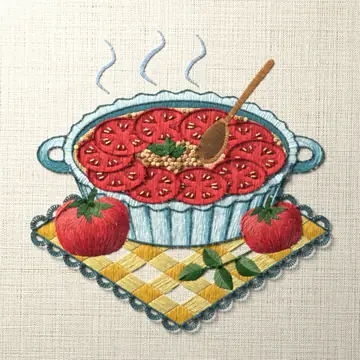
Advanced prints 3–14 in · 20 colors
Vintage scalloped tomatoes dish
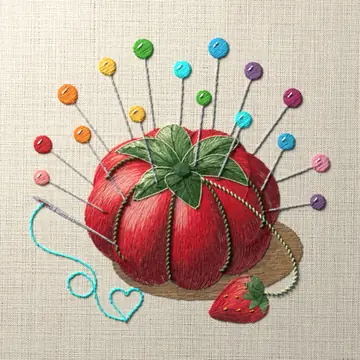
Advanced prints 3–14 in · 22 colors
Tomato pin cushion with colored pins
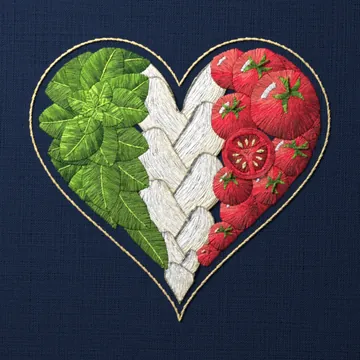
Advanced 3–8 in hoop · 18 colors
Italian flag heart of basil and tomato
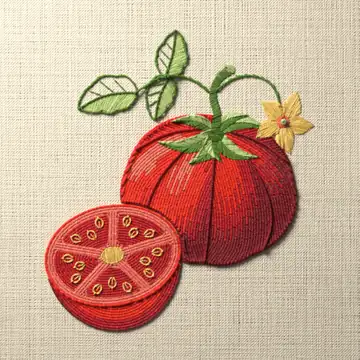
Easy 3–8 in hoop · 7 colors
Small easy tomato (whole and half)
Advanced 3–8 in hoop · 23 colors
Plump bumblebee
Advanced 3–8 in hoop · 10 colors
Pasta shapes border, basil and tomatoes
Intermediate 3–8 in hoop · 4 colors
Bumblebee in honeycomb hexagon
New to hand embroidery? Starting hand embroidery, step by step