Vintage camper full of flowers hand embroidery pattern
Advanced · 24 colors · 8 kinds of stitch

Download free PDFPDF, US Letter · 177 KBFor your own stitching, gifts and handmade pieces you sell. Do not resell or share this PDF. What you may do, in full
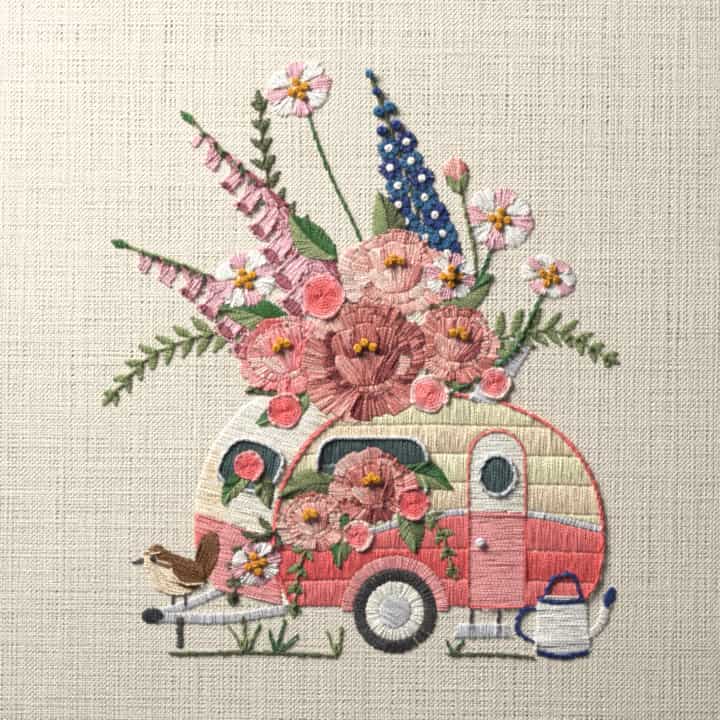
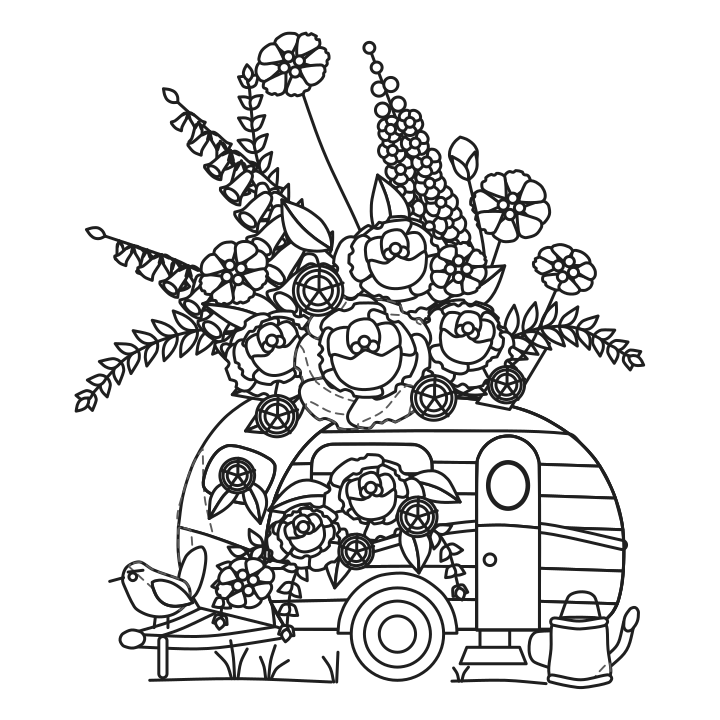
A rounded two-tone camper stands in for the vase, with flowers pouring out of its roof hatch and down from its side window, a wren on the tow bar and a watering can by the step. The siding, door, wheel and fern leaflets are satin stitch, and the peonies and foxgloves are shaded in long and short stitch. Small roses are woven wheels, larger leaves are fishbone stitch, and stems and outlines are stem stitch. French knots make the flower hearts and the topmost delphinium buds. In the picture of where the colors go, the fine lines show which way the stitches lie.
Size and details
Advanced. Uses long and short stitch over much of the design, woven wheels, dozens of French knots, satin stitch over about a quarter of the cloth in a 6 inch hoop, 24 colors and a great deal of stitching; from a 6 inch hoop up some of the satin stitches are long.
24 colors of floss and 8 kinds of stitch:
- Satin stitch
- Long and short stitch
- Stem stitch
- Split stitch
- French knot
- Straight stitch
- Fishbone stitch
- Woven wheel stitch
- Which stitch goes where
| Hoop | Inches | Centimeters | Satin stitch up to |
|---|---|---|---|
| 3 in (8 cm) | 1.5 × 1.7 in | 3.8 × 4.3 cm | 3/16 in (5 mm) |
| 4 in (10 cm) | 2.2 × 2.6 in | 5.6 × 6.6 cm | 1/4 in (6 mm) |
| 5 in (13 cm) | 2.9 × 3.4 in | 7.4 × 8.6 cm | 5/16 in (8 mm) |
| 6 in (15 cm) | 3.7 × 4.3 in | 9.4 × 10.9 cm | 7/16 in (11 mm) |
| 8 in (20 cm) | 5.2 × 6 in | 13.2 × 15.2 cm | 9/16 in (14 mm) |
- In an 8 inch hoop the widest satin stitch shape is 9/16 in (14 mm) across. Satin stitches longer than about 12 mm (just under 1/2 in) tend to work loose: divide the shape into sections, or work it in long and short stitch.
- In a 3, 4, 5 or 6 inch hoop the French knots are drawn smaller than about 2 mm (a little over 1/16 in). Use one strand of floss for them there, or choose a larger hoop.
The pattern is drawn inside a circle about half an inch (1.3 cm) smaller all around than the hoop.
What you need
- DMC 415 Pearl GrayTrim and window frames and 7 more parts
- DMC 3799 Very Dark Pewter GrayTire, coupler and jack and 4 more parts
- DMC 712 CreamFront and roof and door (lighter), whitewall
- DMC 739 Ultra Very Light TanSiding (darker) and 4 more parts
- DMC 760 SalmonPeony petals (shade 5 of 7) and 4 more parts
- DMC 3712 Medium SalmonLower siding (lighter) and 3 more parts
- DMC 677 Very Light Old GoldSiding (lighter)
- DMC 3328 Dark SalmonLower siding (darker) and 4 more parts
- DMC 924 Very Dark Gray GreenWindow and front window, door window (darker)
- DMC 3052 Medium Green GrayFern leaves (lighter) and 5 more parts
- DMC 3051 Dark Green GrayFern leaves (darker) and 4 more parts
- DMC 3727 Light Antique MauveFoxglove bells (middle)
- DMC 3346 Hunter GreenLeaves and stems (dark) and 3 more parts
- DMC 778 Very Light Antique MauveFoxglove bells (light), cosmos petals (darker)
- DMC 3726 Dark Antique MauveFoxglove bells (dark), foxglove throats
- DMC 312 Very Dark Baby BlueDelphinium and delphinium buds (lighter)
- DMC 3865 Winter WhiteCosmos petals (lighter) and 3 more parts
- DMC 336 Navy BlueDelphinium (darker), can rims and 3 more parts
- DMC 783 Medium TopazCosmos hearts and peony hearts
- DMC 223 Light Shell PinkPeony petals (shade 3 of 7), peony buds (middle)
- DMC 221 Very Dark Shell PinkPeony petals (shade 1 of 7), peony buds (dark)
- DMC 224 Very Light Shell PinkPeony petals (shade 6 of 7), peony buds (light)
- DMC 225 Ultra Very Light Shell PinkPeony petals (shade 7 of 7) and 1 more part
- DMC 433 Medium BrownWren (darker), wren tail and wren wing
Skeins: one of each color is enough. An estimate for the largest size, the 8 inch hoop: the length of each line and the area of each filled shape, a fifth added for tails and ends, a tenth of every 8 m (8.7 yd) skein kept spare.
The floss is six-strand cotton; the stitch guide says how many strands to use. You also need a hoop, an embroidery needle (a size 7 to 9 suits two or three strands) and plain cotton or linen fabric. To frame the piece in its hoop, cut a square 3 inches (8 cm) wider than the hoop: a 9 inch (23 cm) square for a 6 inch hoop.
When it is stitched, how to finish a hoop shows how to back it for the wall.
Stitch guide
- Put the pattern on the fabric (how to transfer a pattern) and the fabric in the hoop.
- Stitch the filled parts first, what lies behind before what lies in front of it.
- Then stitch the lines: stems, veins and outlines over the edges of the filled parts.
- Keep the raised parts and the knots for the end, so that the hoop and your hand do not flatten them.
Start each thread with a small knot on the back or one of the knotless starts, and end it by running the needle under the backs of a few stitches (starting and ending a thread). Use the strands this list gives, also where a page about a stitch names another number.
- Satin stitch 2 strandsTow bar, coupler, jack, siding, lower siding, trim, and 22 more
- Long and short stitch 1 strandFront and roof, lower front, foxglove bells, and 3 more
- Stem stitch 2 to 3 strandsDoor window, body edge, step legs, fern stems, stems, and 3 more
- Split stitch 1 to 4 strandsDoor edge, window frames, wing edge
- French knot 1 to 2 strands, two wrapsDoor handle, delphinium eyes, delphinium buds, and 3 more
- Straight stitch 1 to 2 strandsSepals, wren legs, wren brow, wren bill
- Fishbone stitch 2 strandsLeaves
- Woven wheel stitch 4 strandsWoven roses
Getting it onto your fabric
The PDF holds the pattern twice at actual size: once as drawn, and once mirrored for an iron-on transfer pen. Print it at 100% with scaling off and check the one-inch square (25.4 mm) with a ruler before you trace. How to transfer a pattern explains tracing, carbon paper and the other ways. The files are under Downloads.
Downloads
- Download free PDF PDF, US Letter, 3 pages, for a 6 inch (15 cm) hoop
- Download free PDF, A4 PDF, A4, 3 pages, for a 6 inch (15 cm) hoop
More patterns like this
Advanced 3–8 in hoop · 21 colors
Rustic potted lavender
Advanced 3–8 in hoop · 21 colors
Summer in daisies
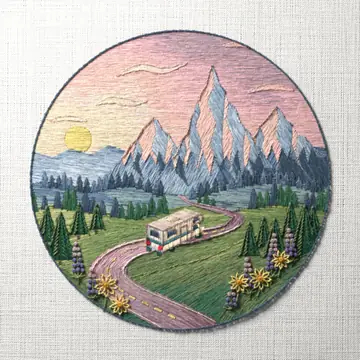
Advanced 3–8 in hoop · 24 colors
RV on a mountain road at sunrise
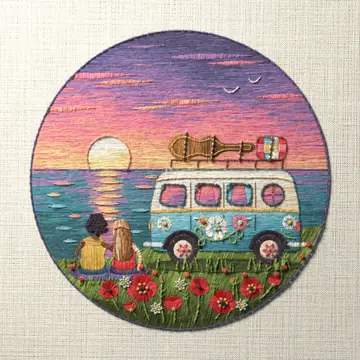
Advanced 3–8 in hoop · 23 colors
Hippie bus by the sea at sunset
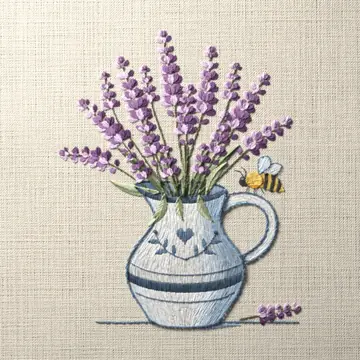
Advanced 3–8 in hoop · 16 colors
Small lavender bunch in a farmhouse jug
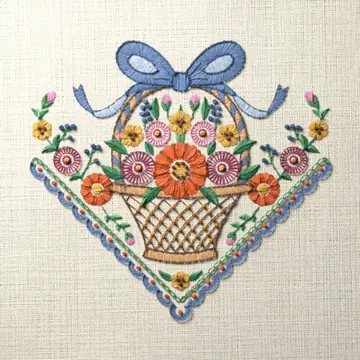
Advanced 3–8 in hoop · 16 colors
1920s flower basket corner
Advanced 3–8 in hoop · 16 colors
Rose basket with room for a name
Advanced 3–8 in hoop · 22 colors
Campervan with open back doors
New to hand embroidery? Starting hand embroidery, step by step