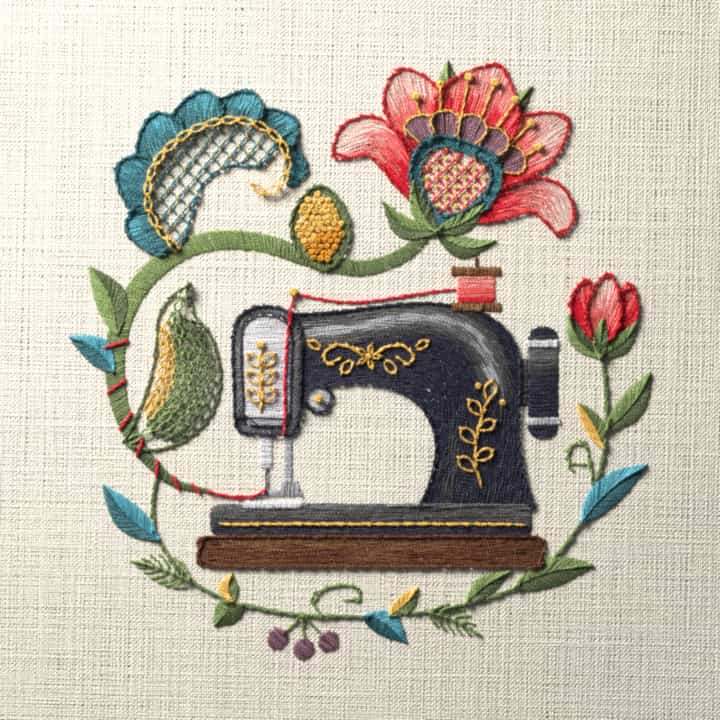
Vintage sewing machine in bloom hand embroidery pattern
Advanced · 23 colors · 10 kinds of stitch

Download free PDFPDF, US Letter · 85 KBFor your own stitching, gifts and handmade pieces you sell. Do not resell or share this PDF. What you may do, in full
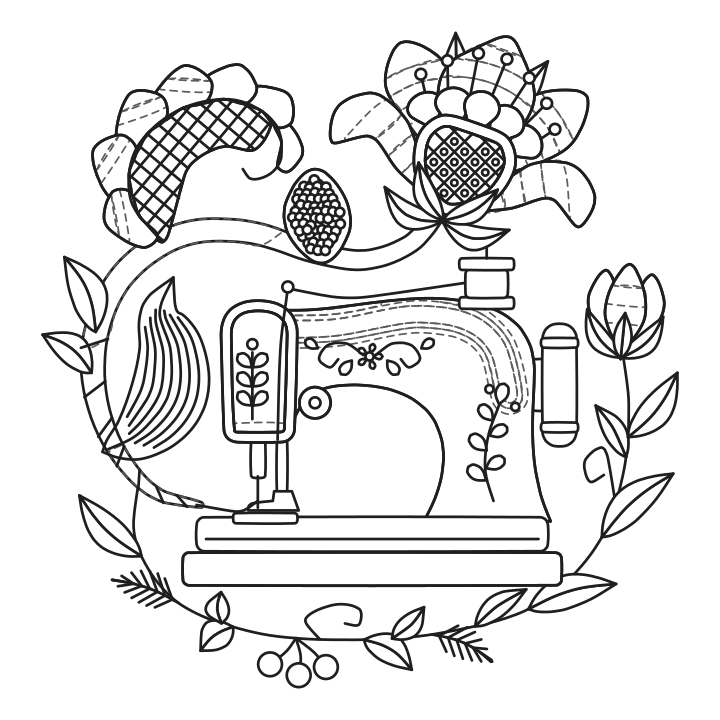
A small black sewing machine stands on a wooden base, and the coral thread that leaves its needle turns into a crewel stem, climbs back over the arm and opens as one great coral bloom. The machine, the base and the petals are long and short stitch, shaded so that light runs along the arm, and the gold scrolls on it are stem stitch with lazy daisy petals. The large curled leaf is trellis stitch with a chain stitch vein, the leaf inside the stem is rows of chain stitch, and the seed pod is packed with French knots. The main stem is satin stitch, and the small leaves are fishbone stitch and fly stitch. In the picture of where the colors go, the fine lines show which way the stitches lie.
Size and details
Advanced. Uses long and short stitch, trellis stitch, dozens of French knots, 23 colors and a great deal of stitching; from a 6 inch hoop up the widest satin stitches are long.
23 colors of floss and 10 kinds of stitch:
- Stem stitch
- Fishbone stitch
- Fly stitch
- Satin stitch
- Long and short stitch
- Trellis stitch
- Chain stitch
- French knot
- Straight stitch
- Lazy daisy stitch
- Which stitch goes where
| Hoop | Inches | Centimeters | Satin stitch up to |
|---|---|---|---|
| 3 in (8 cm) | 1.8 × 1.9 in | 4.6 × 4.8 cm | 3/16 in (5 mm) |
| 4 in (10 cm) | 2.7 × 2.8 in | 6.9 × 7.1 cm | 1/4 in (6 mm) |
| 5 in (13 cm) | 3.6 × 3.7 in | 9.1 × 9.4 cm | 5/16 in (8 mm) |
| 6 in (15 cm) | 4.5 × 4.7 in | 11.4 × 11.9 cm | 3/8 in (10 mm) |
| 8 in (20 cm) | 6.3 × 6.5 in | 16 × 16.5 cm | 9/16 in (14 mm) |
- In an 8 inch hoop the widest satin stitch shape is 9/16 in (14 mm) across. Satin stitches longer than about 12 mm (just under 1/2 in) tend to work loose: divide the shape into sections, or work it in long and short stitch.
- In a 3, 4, 5 or 6 inch hoop the French knots and the shortest lazy daisy loops are drawn smaller than about 2 mm (a little over 1/16 in). Use one strand of floss for them there, or choose a larger hoop.
The pattern is drawn inside a circle about half an inch (1.3 cm) smaller all around than the hoop.
What you need
- DMC 3364 Pine GreenMain stem (light) and 6 more parts
- DMC 3363 Medium Pine GreenMain stem (middle), lower branch and 3 more parts
- DMC 597 TurquoiseSmall leaves and leaf lobes (light)
- DMC 3808 Ultra Very Dark TurquoiseLeaf lobes (dark), leaf edges (darker) and 2 more parts
- DMC 3362 Dark Pine GreenSmall leaves (dark), leaf edges (lighter) and 4 more parts
- DMC 3820 Dark StrawGold scrolls and frill edges and 10 more parts
- DMC 3740 Dark Antique VioletBerries and frill (darker)
- DMC 3041 Medium Antique VioletFrill and berries (lighter)
- DMC 349 Dark CoralBloom heart (darker), bud (dark) and 5 more parts
- DMC 817 Very Dark Coral RedBack petals, wing petals and bud (darkest), petal edges
- DMC 351 CoralBack petals, bud, wing petals and spool thread (middle)
- DMC 352 Light CoralBack petals, wing petals, bud and spool thread (light)
- DMC 353 PeachWing petals, back petals and bud (lightest)
- DMC 3809 Very Dark TurquoiseTrellis leaf (darker), leaf lobes (middle), bloom cup
- DMC 783 Medium TopazKnotted leaf (darker)
- DMC 413 Dark Pewter GrayMachine bed, machine body and hand wheel (light)
- DMC 3799 Very Dark Pewter GrayMachine bed, machine body and hand wheel (dark)
- DMC 317 Pewter GrayMachine body (lightest), face plate rim and 3 more parts
- DMC 310 BlackMachine body (darkest), machine edge and 2 more parts
- DMC 415 Pearl GrayFace plate (lighter), tension dial and 3 more parts
- DMC 801 Dark Coffee BrownWooden base and spool (darker), wooden base edge
- DMC 433 Medium BrownWooden base and spool (lighter)
- DMC 318 Light Steel GrayPresser foot, needle bar and face plate (darker)
Skeins: one of each color is enough. An estimate for the largest size, the 8 inch hoop: the length of each line and the area of each filled shape, a fifth added for tails and ends, a tenth of every 8 m (8.7 yd) skein kept spare.
The floss is six-strand cotton; the stitch guide says how many strands to use. You also need a hoop, an embroidery needle (a size 7 to 9 suits two or three strands) and plain cotton or linen fabric. To frame the piece in its hoop, cut a square 3 inches (8 cm) wider than the hoop: a 9 inch (23 cm) square for a 6 inch hoop.
When it is stitched, how to finish a hoop shows how to back it for the wall.
Stitch guide
- Put the pattern on the fabric (how to transfer a pattern) and the fabric in the hoop.
- Stitch the filled parts first, what lies behind before what lies in front of it.
- Then stitch the lines: stems, veins and outlines over the edges of the filled parts.
- Keep the knots for the end, so that the hoop and your hand do not flatten them.
Start each thread with a small knot on the back or one of the knotless starts, and end it by running the needle under the backs of a few stitches (starting and ending a thread). Use the strands this list gives, also where a page about a stitch names another number.
- Stem stitch 1 to 4 strandsTendrils, lower branch, open leaves, petal edges, leaf edges, and 6 more
- Fishbone stitch 2 strandsSmall leaves, calyx, sepals
- Fly stitch 2 strandsOpen leaves
- Satin stitch 2 strandsBerries, main stem, knotted leaf rim, hand wheel, silver rings, and 10 more
- Long and short stitch 1 strandBud, leaf lobes, machine body, machine bed, wooden base, back petals, wing petals
- Trellis stitch 2 strandsTrellis leaf, bloom heart
- Chain stitch 2 strandsLeaf veins, chain leaf
- French knot 1 to 2 strands, two wrapsKnotted leaf, gold dots, stamen knots, bloom heart
- Straight stitch 2 to 3 strandsWinding thread, needle, spool, stamens
- Lazy daisy stitch 2 strandsGold petals
Getting it onto your fabric
The PDF holds the pattern twice at actual size: once as drawn, and once mirrored for an iron-on transfer pen. Print it at 100% with scaling off and check the one-inch square (25.4 mm) with a ruler before you trace. How to transfer a pattern explains tracing, carbon paper and the other ways. The files are under Downloads.
Downloads
- Download free PDF PDF, US Letter, 3 pages, for a 6 inch (15 cm) hoop
- Download free PDF, A4 PDF, A4, 3 pages, for a 6 inch (15 cm) hoop
More patterns like this
Advanced 3–8 in hoop · 19 colors
Crinoline lady in a hollyhock garden
Advanced 3–8 in hoop · 23 colors
Christmas tree in a painted pot
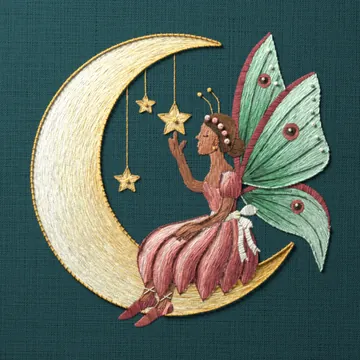
Advanced 3–8 in hoop · 23 colors
Vintage fairy on a crescent moon
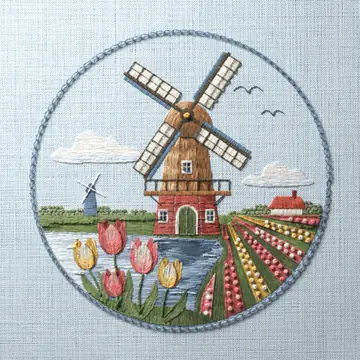
Advanced 3–8 in hoop · 23 colors
Vintage Dutch windmill and tulips
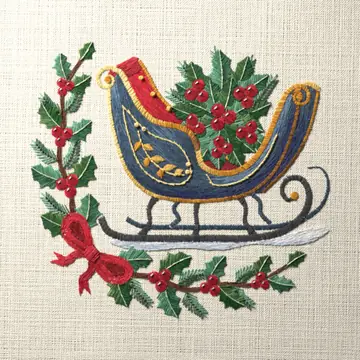
Advanced 3–8 in hoop · 23 colors
Vintage sleigh and holly corner
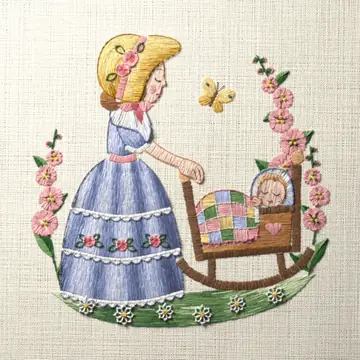
Advanced 3–8 in hoop · 23 colors
Vintage lady rocking a cradle
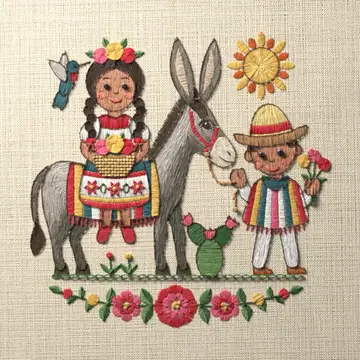
Advanced 3–8 in hoop · 23 colors
Vintage Mexican children with a burro
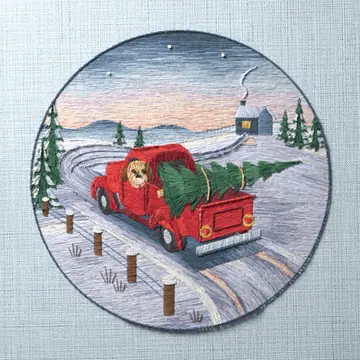
Advanced 3–8 in hoop · 23 colors
Retro red Christmas truck in the snow
New to hand embroidery? Starting hand embroidery, step by step