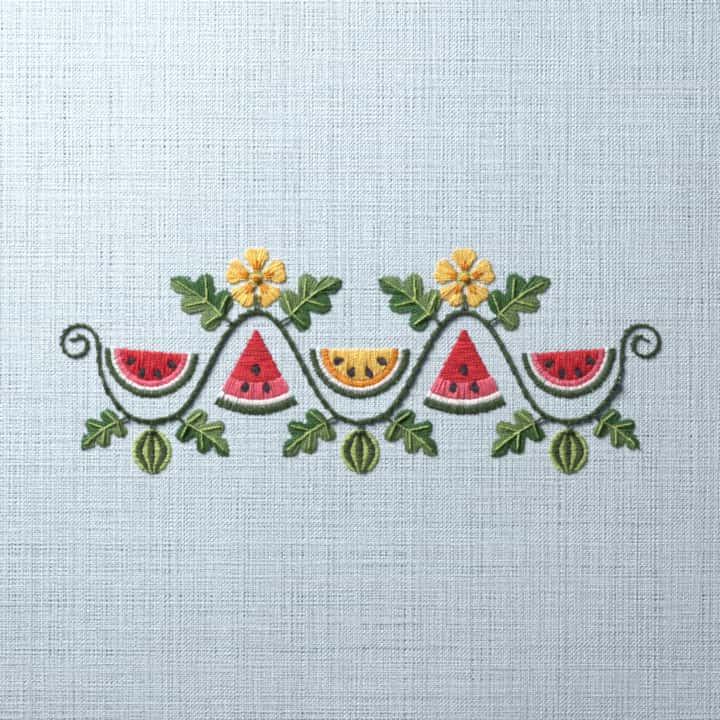
Watermelon border with one gold slice hand embroidery pattern
Intermediate · 10 colors · 4.9 × 1.8 in · 4 kinds of stitch
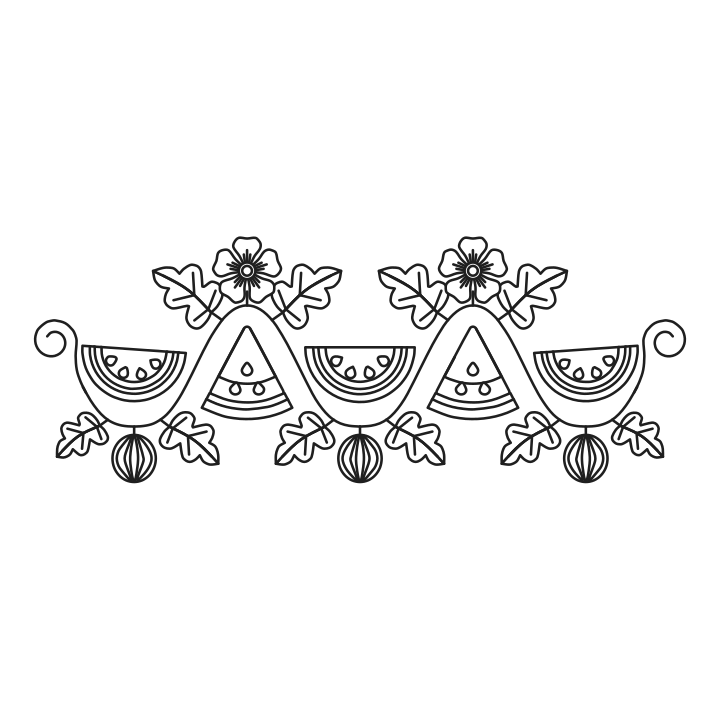
Download free PDFPDFPrints on US Letter and A4You may sell what you make from it by hand, in small quantities. The PDF itself is not to be sold or shared. Selling, classes and kits: the rules
A melon vine runs across the towel in one wave and ends both ways in a curled tendril. The gold half-round lies in the middle hollow, red half-rounds lie in the outer two, and a red wedge stands under each arch.
Size and details
Intermediate. Ten colors; from a 6 inch hoop up the widest satin stitches are long.
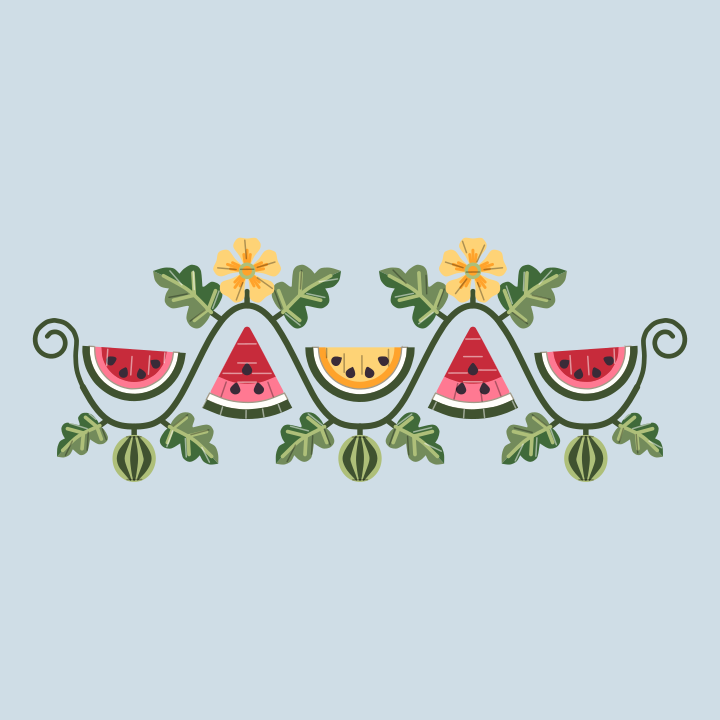
The flesh, pith, rind, seeds, leaves, blossoms and baby melons are satin stitch, and the vine, stalks and leaf veins are stem stitch. Straight stitches mark the petals and a French knot stands in the heart of each blossom. Both halves mirror each other exactly. It is drawn for pale blue linen. In the picture of where the colors go, the fine lines show which way the stitches lie.
| Hoop | Inches | Centimeters | Satin stitch up to |
|---|---|---|---|
| 3 in (8 cm) | 2 × 0.7 in | 5.1 × 1.8 cm | 3/16 in (5 mm) |
| 4 in (10 cm) | 3 × 1.1 in | 7.6 × 2.8 cm | 1/4 in (6 mm) |
| 5 in (13 cm) | 3.9 × 1.5 in | 9.9 × 3.8 cm | 5/16 in (8 mm) |
| 6 in (15 cm) | 4.9 × 1.8 in | 12.4 × 4.6 cm | 7/16 in (11 mm) |
| 8 in (20 cm) | 6.9 × 2.6 in | 17.5 × 6.6 cm | 9/16 in (14 mm) |
- In an 8 inch hoop the widest satin stitch shape is 9/16 in (14 mm) across. Satin stitches longer than about 12 mm (just under 1/2 in) tend to work loose: divide the shape into sections, or work it in long and short stitch.
- In a 3, 4 or 5 inch hoop the French knots are drawn smaller than about 2 mm (a little over 1/16 in). Use one strand of floss for them there, or choose a larger hoop.
On a towel. Wash and dry the towel first. To start with, put the bottom of the design 2 to 3 inches (5 to 7.5 cm) above the hem, in the middle or in a lower corner. Keep the stitches low, and press from the back. How to embroider a towel has every step, and the placement chart has the figures for other towels.
On linens. Wash and press the piece first. A pillowcase takes its design in the middle of the hem band; a napkin or a handkerchief in one corner, set on the diagonal. Keep the stitches short and low, and press face down on soft cloth. How to embroider pillowcases and napkins has the sizes and the places.
What you need
- Fabric
- Plain cotton or linen in pale blue, cut 9 in (23 cm) square. On white cloth its palest threads do not show: choose other colors under Options.
- Needle
- Embroidery needle, size 9 for 1 strand, size 7 for 2 or 3, size 3 for 4 or 5 (a lower number is a thicker needle).
- Floss
- 10 colors of six-strand cotton, listed below. DMC is a brand: another brand in a like color will do.
- Marker
- A pen or a sheet that suits the fabric: how to transfer a pattern says which.
Floss
- 1DMC 986 Very Dark Forest GreenRind, vine, baby melon stripes, tendrils and stalks
- 2DMC 988 Medium Forest GreenLeaves (lighter)
- 3DMC 3346 Hunter GreenLeaves (darker)
- 4DMC 471 Very Light Avocado GreenLeaf veins and baby melons, blossom hearts (lighter)
- 5DMC 743 Medium YellowBlossoms, flesh (lighter)
- 6DMC 741 Medium TangerinePetal lines, lower flesh (lighter), blossom hearts (darker)
- 7DMC 321 RedFlesh (darker)
- 8DMC 3705 Dark MelonLower flesh (darker)
- 9DMC BLANC WhitePith
- 10DMC 3371 Black BrownSeeds
Skeins: one of each color is enough. An estimate for the 6 inch hoop, from the length of each line and the area of each filled shape, with a fifth added for tails.
How to stitch it
- New to hand embroidery? Start here.
- Print at 100%, trace the pattern onto the fabric, and put it in the hoop: inner ring under, drawing up, tight as a drum.
- Floss is six strands. Cut 18 inches (45 cm), pull out the number given one at a time, and lay them together.
- Begin with no knot on the back where it is seen and washed, as on a towel, a napkin or clothes; for a piece in a hoop a small knot is fine. End each thread by whipping it around the backs of four or five stitches, with one small hitch.
- Each small ring is one French knot.
- A number under “Where colors go” is a color of the list. The fine lines on the colors show which way the stitches lie.
Stitch in this order
Filled parts from the back of the picture forward, then lines and knots. Where a stitch page names another number of strands, use the number here.
- Satin stitch 2 strandsLeaves, blossoms, blossom hearts, flesh, lower flesh, pith, rind, seeds, baby melons, baby melon stripes
- Stem stitch5 strands: vine4 strands: stalks3 strands: tendrils1 strand: leaf veins
- Straight stitch 1 strandPetal lines
- French knot 2 strands, two wrapsBlossom hearts
When it is done, take off any lines that still show and finish the hoop.
More patterns like this
Advanced 3–8 in hoop · 23 colors
Mini watermelon
Advanced 3–8 in hoop · 23 colors
Cartoon chicken eating watermelon
Advanced 3–8 in hoop · 20 colors
Two
Advanced 3–8 in hoop · 21 colors
Summertime garden flag with watermelon
Intermediate 3–8 in hoop · 10 colors
Geometric bird and flower border
Intermediate 3–8 in hoop · 10 colors
Colorful row houses border
Intermediate prints 3–14 in · 8 colors
Aari style floral shawl border
Intermediate 3–8 in hoop · 13 colors
Red kingsnake slithering border
New to hand embroidery? Starting hand embroidery, step by step