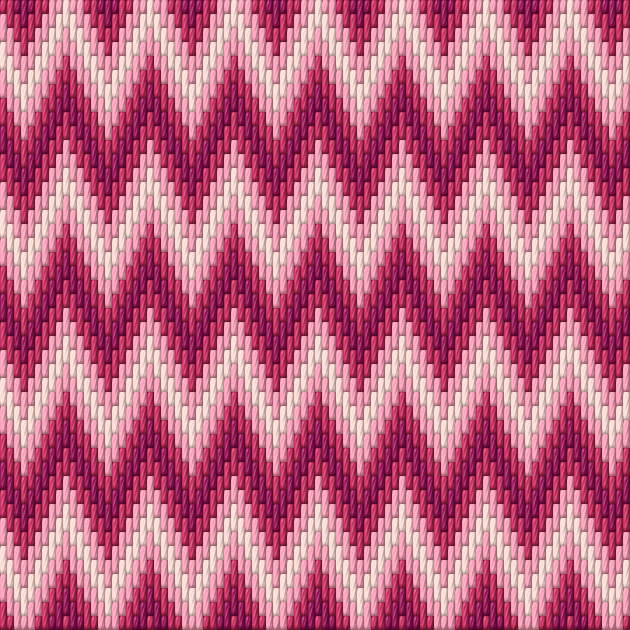
Glowing flame stitch needlepoint pattern
Beginner, 5 × 5 in on 18 mesh, 4 colors, upright stitches over 4
Colors: PinksChange
Download free PDFPDFYou may sell what you make from it by hand, in small quantities. The PDF itself is not to be sold or shared. Selling, classes and kits: the rulesNew to it? Next: how to start
Your PDF is ready: look in your downloads. Open the PDF (opens in a new tab)
What you need
- Canvas: blank mono canvas, 18 mesh (18 threads to the inch), cut 9 in square for the piece charted (for another size, 2 in more than it on every side)
- Needle: blunt tapestry, size 22. Also masking tape for the cut edges, and small scissors
- Thread: six-strand floss, 4 colors, about 6 skeins for what is charted (an estimate). Stitch with 4 strands (5 or 6 if canvas shows)
- Thread: pearl cotton size 5, 4 colors, about 4 skeins for what is charted (an estimate). Stitch with 1 length. It comes in fewer colors than floss: for one that is not made, take the nearest, or 4 strands of floss
- Thread: Persian wool, 4 colors, about 4 skeins for what is charted (an estimate). Stitch with 1 strand
Fit it into a lid. The box or tray, acid-free board and backing. Measure the opening first and add two rows of tent stitch to sit under its edge. How to fit it into a lid
Make it yours
Threads
Pinks
- DMC 603 Cranberry 2,808 squares about 12.7 yards 1 skein
- DMC 600 Very Dark Cranberry 2,596 squares about 11.8 yards 1 skein
- DMC 818 Baby Pink 1,440 squares about 6.5 yards 1 skein
- DMC 917 Medium Plum 1,256 squares about 5.7 yards 1 skein
Skeins are estimates for what is charted.
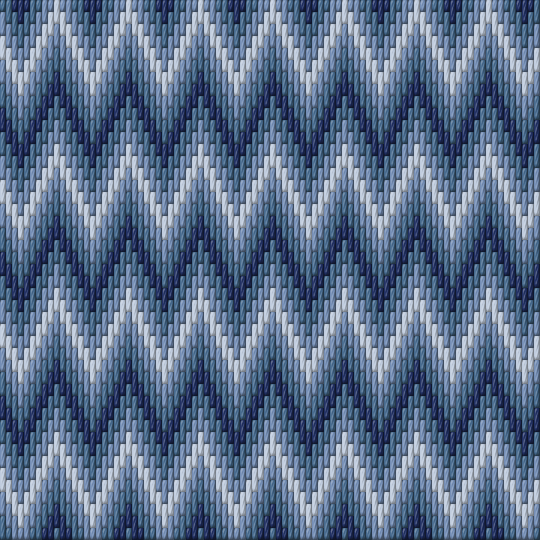
Blues
- DMC 799 Medium Delft Blue 2,808 squares about 12.7 yards 1 skein
- DMC 798 Dark Delft Blue 2,596 squares about 11.8 yards 1 skein
- DMC 800 Pale Delft Blue 1,440 squares about 6.5 yards 1 skein
- DMC 823 Dark Navy Blue 1,256 squares about 5.7 yards 1 skein
Skeins are estimates for what is charted.
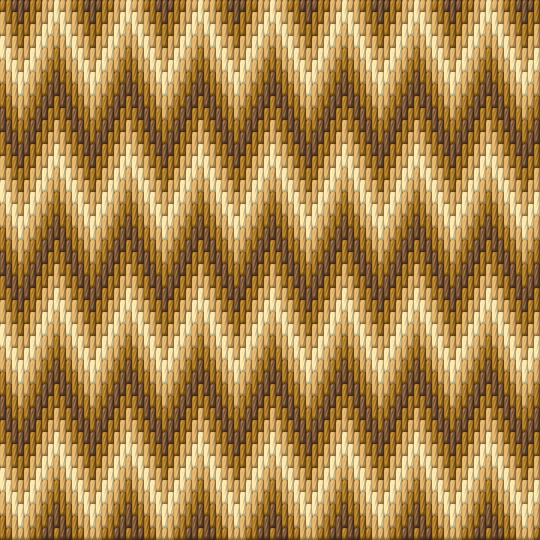
Golds
- DMC 728 Topaz 2,808 squares about 12.7 yards 1 skein
- DMC 782 Dark Topaz 2,596 squares about 11.8 yards 1 skein
- DMC 745 Light Pale Yellow 1,440 squares about 6.5 yards 1 skein
- DMC 433 Medium Brown 1,256 squares about 5.7 yards 1 skein
Skeins are estimates for what is charted.
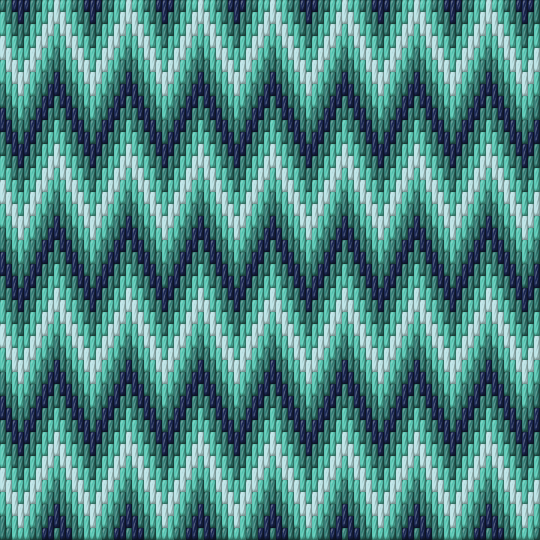
Seas
- DMC 959 Medium Seagreen 2,808 squares about 12.7 yards 1 skein
- DMC 3847 Dark Teal Green 2,596 squares about 11.8 yards 1 skein
- DMC 3811 Very Light Turquoise 1,440 squares about 6.5 yards 1 skein
- DMC 939 Very Dark Navy Blue 1,256 squares about 5.7 yards 1 skein
Skeins are estimates for what is charted.
Purples
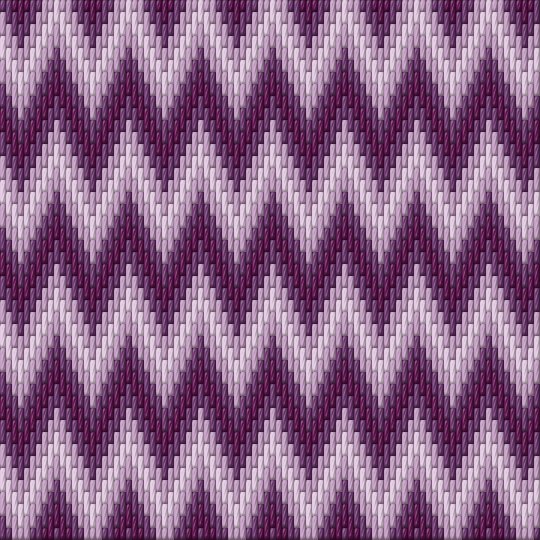
- DMC 210 Medium Lavender 2,808 squares about 12.7 yards 1 skein
- DMC 3837 Ultra Dark Lavender 2,596 squares about 11.8 yards 1 skein
- DMC 211 Light Lavender 1,440 squares about 6.5 yards 1 skein
- DMC 550 Very Dark Violet 1,256 squares about 5.7 yards 1 skein
Skeins are estimates for what is charted.
Greens
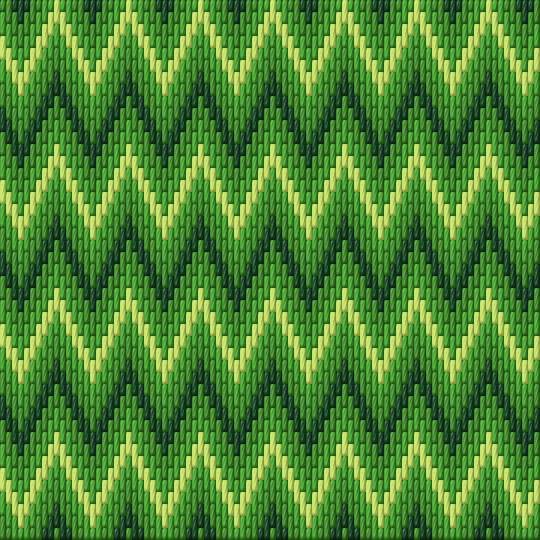
- DMC 702 Kelly Green 2,808 squares about 12.7 yards 1 skein
- DMC 701 Light Green 2,596 squares about 11.8 yards 1 skein
- DMC 907 Light Parrot Green 1,440 squares about 6.5 yards 1 skein
- DMC 890 Ultra Dark Pistachio Green 1,256 squares about 5.7 yards 1 skein
Skeins are estimates for what is charted.
Thread colors are approximate screen matches to DMC numbers. Check against real thread before you buy.
How to stitch it
- Each bar is one upright stitch over 4 canvas threads: up at 1, down at 2. A shorter bar is a shorter stitch.
- Cut 18 in of thread. Start and end it without a knot left behind.
- Mark the middle of the canvas. Start there with the row that has the heavy outline, out to both edges.
- One square up is one canvas thread; one column is one line of holes. Gray squares are on two pages: stitch them once.
First time? What is bargello
The row with the heavy outline is in DMC 603: check it against the chart, then repeat the same line in the next color, above and below. Going up the colors come in this order, and then again: DMC 603, DMC 600, DMC 917, DMC 600, DMC 603, DMC 818.
The row with the heavy outline is in DMC 799: check it against the chart, then repeat the same line in the next color, above and below. Going up the colors come in this order, and then again: DMC 799, DMC 798, DMC 823, DMC 798, DMC 799, DMC 800.
The row with the heavy outline is in DMC 728: check it against the chart, then repeat the same line in the next color, above and below. Going up the colors come in this order, and then again: DMC 728, DMC 782, DMC 433, DMC 782, DMC 728, DMC 745.
The row with the heavy outline is in DMC 959: check it against the chart, then repeat the same line in the next color, above and below. Going up the colors come in this order, and then again: DMC 959, DMC 3847, DMC 939, DMC 3847, DMC 959, DMC 3811.
The row with the heavy outline is in DMC 210: check it against the chart, then repeat the same line in the next color, above and below. Going up the colors come in this order, and then again: DMC 210, DMC 3837, DMC 550, DMC 3837, DMC 210, DMC 211.
The row with the heavy outline is in DMC 702: check it against the chart, then repeat the same line in the next color, above and below. Going up the colors come in this order, and then again: DMC 702, DMC 701, DMC 890, DMC 701, DMC 702, DMC 907.
See the chart on this page
The chart is drawn when this is opened.
Options
On another mesh
The chart is 90 × 90 canvas threads: a sample of a pattern that repeats, the size of a tray insert on 18 mesh. A tray insert is a square of needlepoint that is set into a tray made with an opening for it. The chart shows about 7 and a half repeats across and about 4 down; one repeat is 12 × 24 canvas threads. The pattern can be carried on to any size.
| Mesh | Stitched size | Canvas to cut |
|---|---|---|
| 10 | 9 × 9 in 22.9 × 22.9 cm | 13 × 13 in 33 cm |
| 12 | 7.5 × 7.5 in 19.1 × 19.1 cm | 11.5 × 11.5 in 29.2 cm |
| 13 | 6.9 × 6.9 in 17.6 × 17.6 cm | 11 × 11 in 27.9 cm |
| 14 | 6.4 × 6.4 in 16.3 × 16.3 cm | 10.5 × 10.5 in 26.7 cm |
| 18 | 5 × 5 in 12.7 × 12.7 cm | 9 × 9 in 22.9 cm |
Mesh is the number of canvas threads to the inch; the row in bold is the mesh this chart is sized for. Canvas to cut is the stitched size, the two extra rows where the finish takes them and 2 in (5.1 cm) of bare canvas on every side, up to the next half inch.
| Cushion | Repeats that cover it | Canvas to cut | Thread |
|---|---|---|---|
| 12 × 12 in, 13 mesh | 13 × 7 | 16.5 in square | 11 skeins |
| 14 × 14 in, 10 mesh | 12 × 6 | 18.5 in square | 22 skeins |
| 16 × 16 in, 10 mesh | 14 × 7 | 20.5 in square | 27 skeins |
Put the middle of one repeat on the middle of the canvas and carry the pattern on to the edges. The thread is pearl cotton size 3, all the colors together, an estimate worked out as the list is.
In another thread
The numbers are DMC color numbers. Its pearl cotton has the same numbers as its six-strand cotton, in fewer colors. Persian wool and silk are numbered differently: match those by eye. Which thread suits which mesh
In large print
The same chart in squares of about 6 mm, on 10 pages.
How the level is set
Beginner. Few colors and long stretches of one: a good first piece. Start on 13 mesh, which is easier to see: there it comes out 6.9 × 6.9 in.
Beginner: 4 colors. The chart is in long upright stitches over more than 1 canvas thread, and every band of color is the same shape as the band above it, so only the first has to be followed from the chart. With up to 7 colors, that is Beginner, and with more it is Intermediate.
How the thread is counted
The yards are of thread as it is threaded in the needle: stitched with several strands together, a thread takes that many yards of single strand for every yard counted. For six-strand cotton on 18 mesh, the thread and needle chart gives 4 to 6 strands.
An estimate. The length of thread one stitch uses on the front and back of the canvas, times the number of stitches, plus 30 percent for starting, ending and the tail left in the needle. Each count is estimated as upright over 4 canvas threads and rounded up to a tenth of a yard. The 30 percent is this site's own choice. The thread calculator works the same estimate for any count and mesh.
What you may do with it
You may sell what you make from it by hand, in small quantities. The PDF itself is not to be sold or shared. Selling, classes and kits: the rules
More patterns like this
Shaded spires bargello
Beginner 5 × 5 in
Steep flame bargello
Beginner 5 × 5 in
Stair step bargello
Beginner 5 × 5 in
Crown bargello
Beginner 5 × 5 in
Twin peaks bargello
Beginner 5 × 5 in
Modern bargello, black and orange
Beginner 16 × 12 in
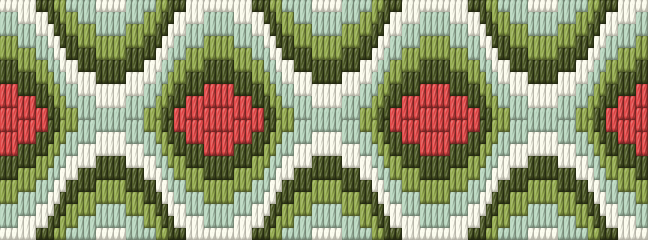
Bargello headband
Intermediate 10 × 2.2 in
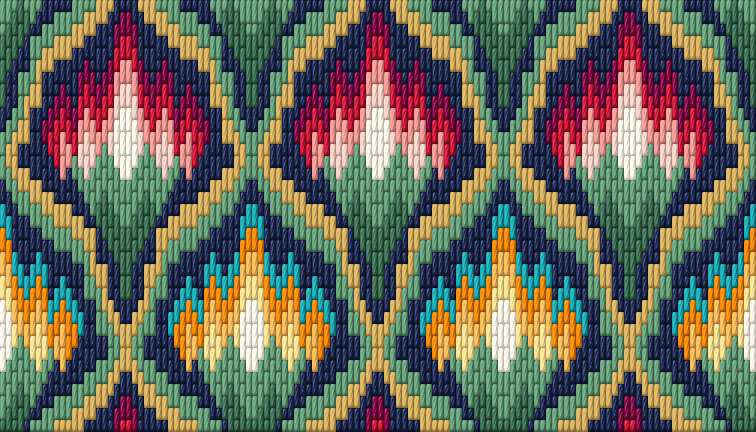
Queen Anne flame carnation clutch
Advanced 7 × 4 in
About this pattern
Zigzag bands of upright stitches run across the square in four pinks. The colors pass from magenta through raspberry and pink to a pale cream pink and back again, so dark and light bands take turns down the square.