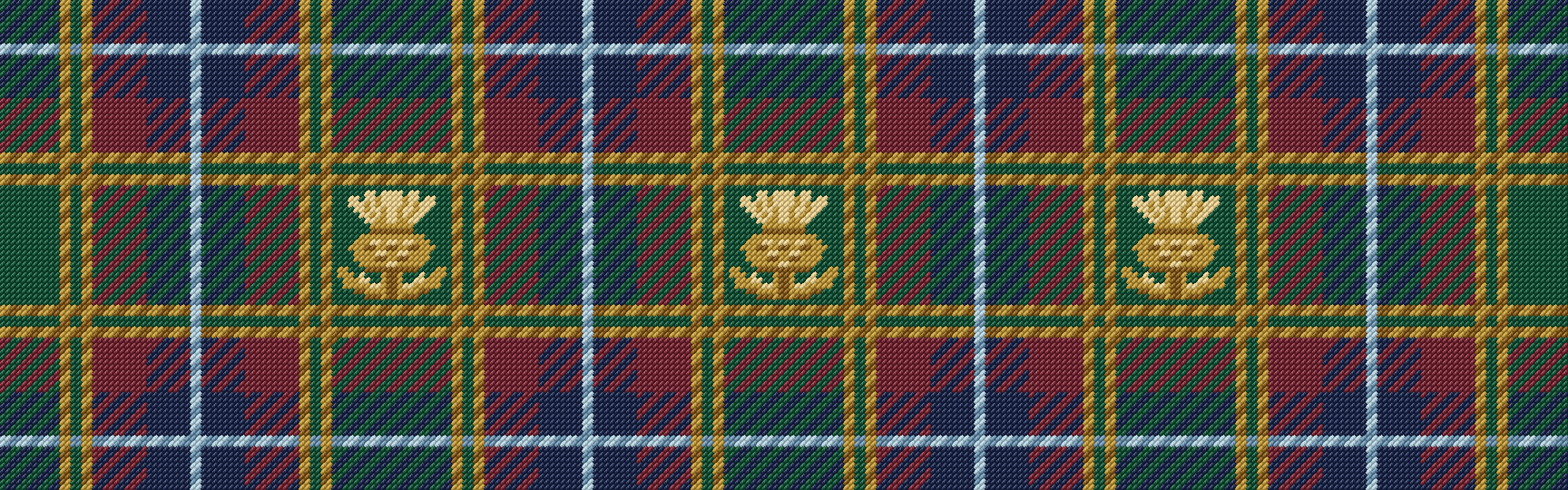
Green and claret plaid cummerbund needlepoint pattern
Needlepoint, 16 × 5 in on 18 mesh, 8 colors, intermediate
Download free PDFOptionsPDFPrints on US Letter and A4You may sell what you make from it by hand, in small quantities. The PDF itself is not to be sold or shared. Selling, classes and kits: the rules
Your PDF is ready: look in your downloads. Open the PDF (opens in a new tab)
You will need
- Canvas: blank mono canvas, 18 mesh (18 threads to the inch), cut 20 × 9 in
- Needle: tapestry, size 22. Also masking tape for the cut edges, and small scissors
- Thread: 8 colors of six-strand floss, 4 strands in the needle (5 or 6 if canvas shows), about 25 skeins in all (an estimate)
- Thread: 8 colors of pearl cotton size 5, 1 strand in the needle, about 11 skeins in all (an estimate)
- Thread: 8 colors of Persian wool, 1 strand in the needle, about 12 skeins in all (an estimate)
Make it a cummerbund. A finisher who makes cummerbunds. Measure the waist, and ask for the length and the extra rows before you stitch the ends. What to make: to wear and carry
A green and claret plaid with midnight squares, paired old-gold cords and one ice-blue line has small gold thistles along the middle. The plaid runs edge to edge, with no border.
Threads
- DMC 3818 Ultra Very Dark Emerald Green 7,229 stitches about 49.5 yards 6 skeins
- DMC 939 Very Dark Navy Blue 6,079 stitches about 41.6 yards 5 skeins
- DMC 902 Very Dark Garnet 5,266 stitches about 36.1 yards 5 skeins
- DMC 729 Medium Old Gold 2,780 stitches about 19.1 yards 3 skeins
- DMC 780 Ultra Very Dark Topaz 2,620 stitches about 18 yards 3 skeins
- DMC 334 Medium Baby Blue 906 stitches about 6.2 yards 1 skein
- DMC 827 Very Light Blue 806 stitches about 5.6 yards 1 skein
- DMC 3822 Light Straw 234 stitches about 1.7 yards 1 skein
Skeins are estimates.
Thread colors are approximate screen matches to DMC numbers. Check against real thread before you buy.
How to stitch it
- Each square is one tent stitch, up at 1, down at 2: basketweave for the background, continental for lines.
- Bind the edges. Cut 18 in of thread; start and end it without a knot left behind.
- Mark the middle of the canvas. It is the outlined square: start there. Count threads, not holes.
- Picture first, then border, background last. Gray squares are on two pages: stitch them once.
- A heavier line stands every ten squares: count by them.
- When it is done, block it square.
See the chart on this page
The chart is drawn when this is opened.
Options
Another mesh, another thread, large print and tools
On another mesh
The chart is 288 × 90 stitches: a cummerbund on 18 mesh canvas.
| Mesh | Stitched size | Canvas to cut |
|---|---|---|
| 10 | 28.8 × 9 in 73.2 × 22.9 cm | 32.8 × 13 in 83.3 × 33 cm |
| 12 | 24 × 7.5 in 61 × 19.1 cm | 28 × 11.5 in 71.1 × 29.2 cm |
| 13 | 22.2 × 6.9 in 56.3 × 17.6 cm | 26.2 × 10.9 in 66.4 × 27.7 cm |
| 14 | 20.6 × 6.4 in 52.3 × 16.3 cm | 24.6 × 10.4 in 62.4 × 26.5 cm |
| 18 | 16 × 5 in 40.6 × 12.7 cm | 20 × 9 in 50.8 × 22.9 cm |
Mesh is the number of canvas threads to the inch; the row in bold is the mesh this chart is sized for. Canvas to cut includes a margin of 2 in (5.1 cm) of bare canvas on every side.
In another thread
The numbers are DMC color numbers, which its six-strand cotton and its pearl cotton share. Persian wool and silk are numbered differently: match those by eye. Which thread suits which mesh
In large print
The same chart in squares of about 6 mm, on 22 pages.
How the level is set
Intermediate. The color changes often enough that you count as you go.
Intermediate: 8 colors. With 8 or 9 colors, a design is Intermediate, while 7 or fewer can be Beginner and 10 or more can be Advanced.
How the thread is counted
The yards are of thread as it is threaded in the needle: stitched with several strands together, a thread takes that many yards of single strand for every yard counted. For six-strand cotton on 18 mesh, the thread and needle chart gives 4 to 6 strands.
An estimate. The length of thread one stitch uses on the front and back of the canvas, times the number of stitches, plus 30 percent for starting, ending and the tail left in the needle. Each count is estimated as basketweave or continental and rounded up to a tenth of a yard. The 30 percent is this site's own choice. The thread calculator works the same estimate for any count and mesh.
What you may do with it
You may sell what you make from it by hand, in small quantities. The PDF itself is not to be sold or shared. Selling, classes and kits: the rules
More patterns like this
Advanced 25,920 stitches 16 × 5 in · 16 colors · 18 mesh
Swallows and stars cummerbund
Intermediate 12,960 stitches 10 × 4 in · 16 colors · 18 mesh
Texas longhorn cummerbund at sunset
Advanced 13.3 × 4 in · 13 colors · 18 mesh
Flamingo cummerbund in black and gold
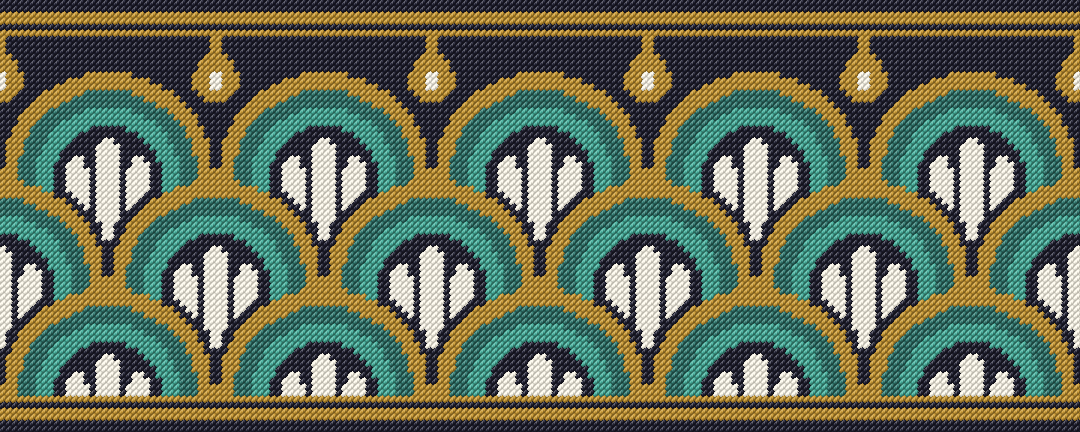
Beginner 12,960 stitches 10 × 4 in · 5 colors · 18 mesh
Art Deco fan cummerbund
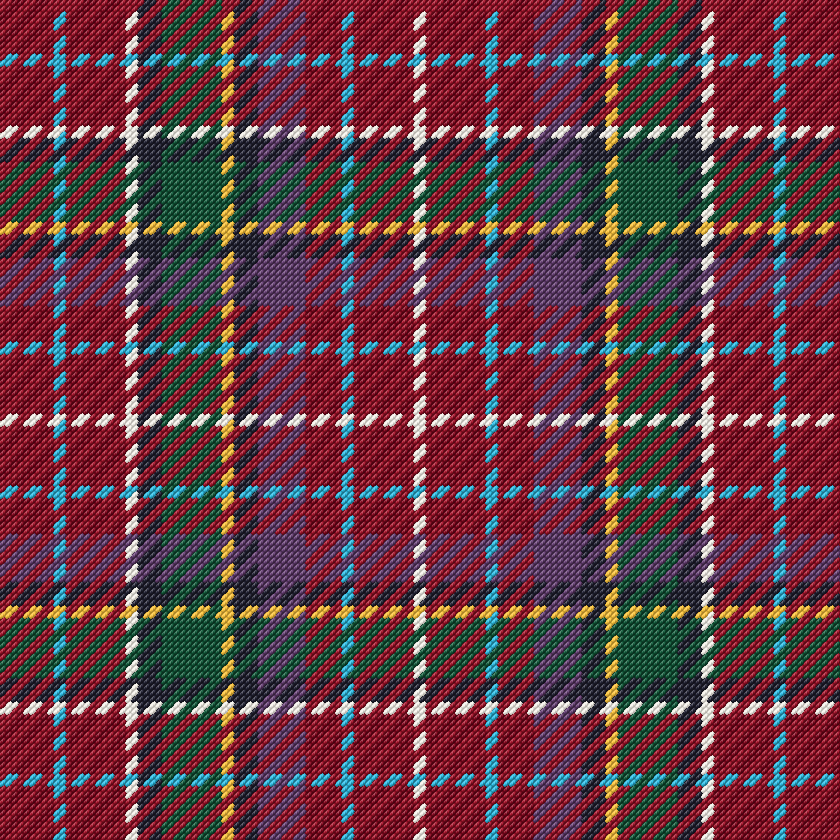
Intermediate 19,600 stitches 14 × 14 in · 8 colors · 10 mesh
Aberdeen tartan pillow
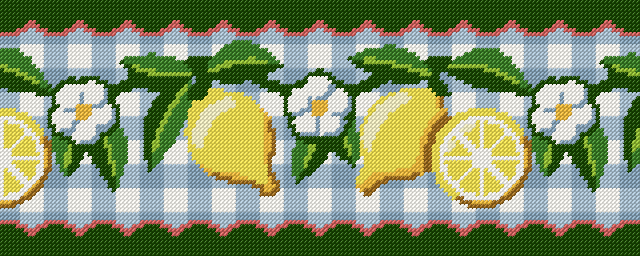
Advanced 15,360 stitches 17.1 × 4.6 in · 11 colors · 14 mesh
Lemon border for a lampshade
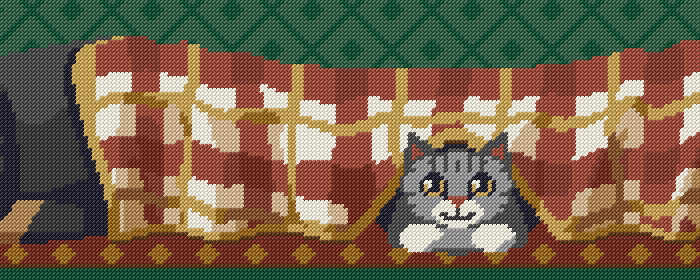
Advanced 25,200 stitches 36 × 7 in · 16 colors · 10 mesh
Draft stopper: dachshund under plaid
Advanced 3,640 stitches 3.2 × 4.1 in · 11 colors · 18 mesh
Strawberry bag charm in gingham
New to needlepoint? How to needlepoint