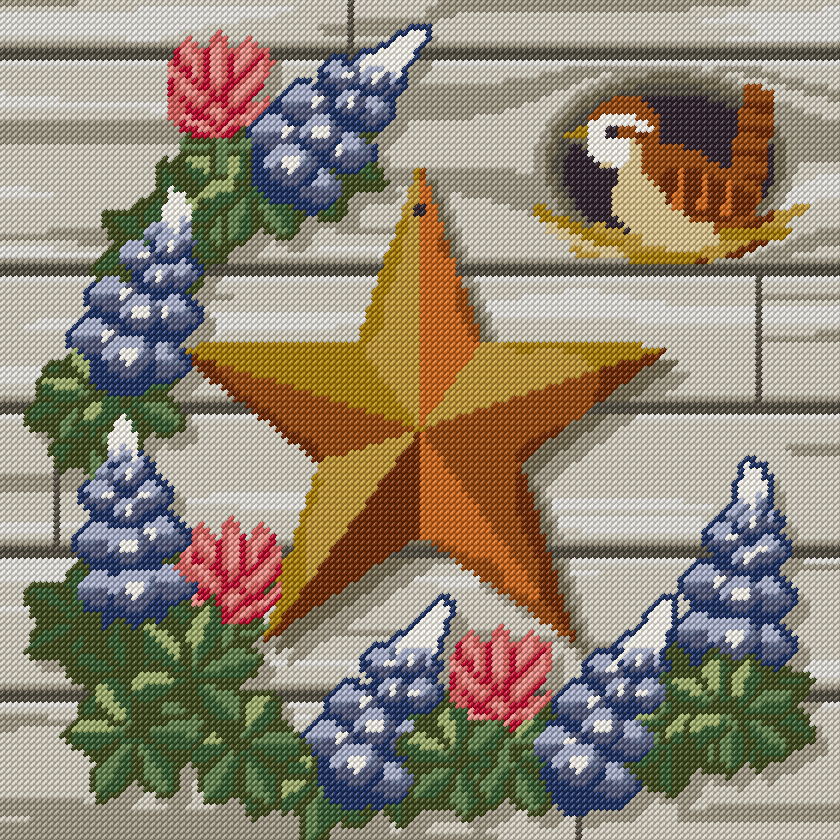
Lone star with Texas bluebonnets needlepoint pattern
Needlepoint, 14 × 14 in on 10 mesh, 24 colors, advanced
Download free PDFOptionsPDFPrints on US Letter and A4You may sell what you make from it by hand, in small quantities. The PDF itself is not to be sold or shared. Selling, classes and kits: the rules
Your PDF is ready: look in your downloads. Open the PDF (opens in a new tab)
Next: How to start · How to finish a pillow
You will need
- Canvas: blank mono canvas, 10 mesh (10 threads to the inch), cut 18 × 18 in
- Needle: tapestry, size 16 or 18. Also masking tape for the cut edges, and small scissors
- Thread: 24 colors of six-strand floss, 8 strands in the needle, six of one length and 2 of the next (9 or 10 if canvas shows), about 56 skeins in all (an estimate)
- Thread: 24 colors of pearl cotton size 3, 2 strands in the needle, about 42 skeins in all (an estimate)
- Thread: 24 colors of tapestry wool, 1 strand in the needle, about 40 skeins in all (an estimate)
- Thread: 24 colors of Persian wool, 3 strands in the needle, about 43 skeins in all (an estimate)
- Two rows more all round, each stitch in the color it lies beside, for the seam: buy 9 skeins of DMC 644, not 8; 5 of DMC 3023, not 4; 3 of DMC 3024, not 2 (an estimate)
Make it a pillow. Backing fabric, an insert the size of the stitching or an inch larger, and cord or piping for the edge. The seam takes two rows: stitch two extra rows all round. How to finish a pillow
A folded tin star in rust, copper and mustard hangs inside an open wreath of bluebonnets and coral paintbrush. A brown wren sits on her nest in a knothole at the upper right. The ground is gray-cream wood boards, with no border.
Threads
- DMC 644 Medium Beige Gray 5,021 stitches about 61.9 yards 8 skeins
- DMC 3023 Light Brown Gray 2,511 stitches about 31 yards 4 skeins
- DMC 936 Very Dark Avocado Green 1,392 stitches about 17.2 yards 3 skeins
- DMC 3024 Very Light Brown Gray 1,313 stitches about 16.2 yards 2 skeins
- DMC 336 Navy Blue 993 stitches about 12.3 yards 2 skeins
- DMC 3787 Dark Brown Gray 840 stitches about 10.4 yards 2 skeins
- DMC 3346 Hunter Green 809 stitches about 10 yards 2 skeins
- DMC 920 Medium Copper 794 stitches about 9.8 yards 2 skeins
- DMC 3807 Cornflower Blue 667 stitches about 8.3 yards 2 skeins
- DMC 341 Light Blue Violet 640 stitches about 7.9 yards 1 skein
- DMC 729 Medium Old Gold 594 stitches about 7.4 yards 1 skein
- DMC 918 Dark Red Copper 527 stitches about 6.5 yards 1 skein
- DMC 680 Dark Old Gold 493 stitches about 6.1 yards 1 skein
- DMC 922 Light Copper 408 stitches about 5.1 yards 1 skein
- DMC 3865 Winter White 401 stitches about 5 yards 1 skein
- DMC 3347 Medium Yellow Green 389 stitches about 4.8 yards 1 skein
- DMC 640 Very Dark Beige Gray 333 stitches about 4.2 yards 1 skein
- DMC 351 Coral 304 stitches about 3.8 yards 1 skein
- DMC 471 Very Light Avocado Green 237 stitches about 3 yards 1 skein
- DMC 3371 Black Brown 222 stitches about 2.8 yards 1 skein
- DMC 349 Dark Coral 186 stitches about 2.3 yards 1 skein
- DMC 352 Light Coral 181 stitches about 2.3 yards 1 skein
- DMC 793 Medium Cornflower Blue 173 stitches about 2.2 yards 1 skein
- DMC 676 Light Old Gold 172 stitches about 2.2 yards 1 skein
Skeins are estimates.
Thread colors are approximate screen matches to DMC numbers. Check against real thread before you buy.
How to stitch it
- Each square is one tent stitch, up at 1, down at 2: basketweave for the background, continental for lines.
- Bind the edges. Cut 18 in of thread; start and end it without a knot left behind.
- Mark the middle of the canvas. It is the outlined square: start there. Count threads, not holes.
- Picture first, then border, background last. Gray squares are on two pages: stitch them once.
- A heavier line stands every ten squares: count by them.
- When it is done, block it square.
See the chart on this page
The chart is drawn when this is opened.
It opens in the pattern maker, with your colors and your name on it.
Options
Another mesh, another thread, large print and tools
On another mesh
The chart is 140 × 140 stitches: a pillow on 10 mesh canvas.
| Mesh | Stitched size | Canvas to cut |
|---|---|---|
| 10 | 14 × 14 in 35.6 × 35.6 cm | 18 × 18 in 45.7 × 45.7 cm |
| 12 | 11.7 × 11.7 in 29.6 × 29.6 cm | 15.7 × 15.7 in 39.8 × 39.8 cm |
| 13 | 10.8 × 10.8 in 27.4 × 27.4 cm | 14.8 × 14.8 in 37.5 × 37.5 cm |
| 14 | 10 × 10 in 25.4 × 25.4 cm | 14 × 14 in 35.6 × 35.6 cm |
| 18 | 7.8 × 7.8 in 19.8 × 19.8 cm | 11.8 × 11.8 in 29.9 × 29.9 cm |
Mesh is the number of canvas threads to the inch; the row in bold is the mesh this chart is sized for. Canvas to cut includes a margin of 2 in (5.1 cm) of bare canvas on every side.
In another thread
The numbers are DMC color numbers, which its six-strand cotton and its pearl cotton share. Persian wool and silk are numbered differently: match those by eye. Which thread suits which mesh
In large print
The same chart in squares of about 6 mm, on 19 pages.
How the level is set
Advanced. Many colors, or changes every few stitches: best with a canvas or two behind you.
Advanced: 24 colors. Over the whole chart, changes of color are about 3 stitches apart. With 10 colors or more, closer than 4.5 apart is Advanced, 4.5 or more is Intermediate, and a design with this many colors is never Beginner.
How the thread is counted
The yards are of thread as it is threaded in the needle: stitched with several strands together, a thread takes that many yards of single strand for every yard counted. For six-strand cotton on 10 mesh, the thread and needle chart gives 8 to 10 strands.
An estimate. The length of thread one stitch uses on the front and back of the canvas, times the number of stitches, plus 30 percent for starting, ending and the tail left in the needle. Each count is estimated as basketweave or continental and rounded up to a tenth of a yard. The 30 percent is this site's own choice. The thread calculator works the same estimate for any count and mesh.
What you may do with it
You may sell what you make from it by hand, in small quantities. The PDF itself is not to be sold or shared. Selling, classes and kits: the rules
More patterns like this
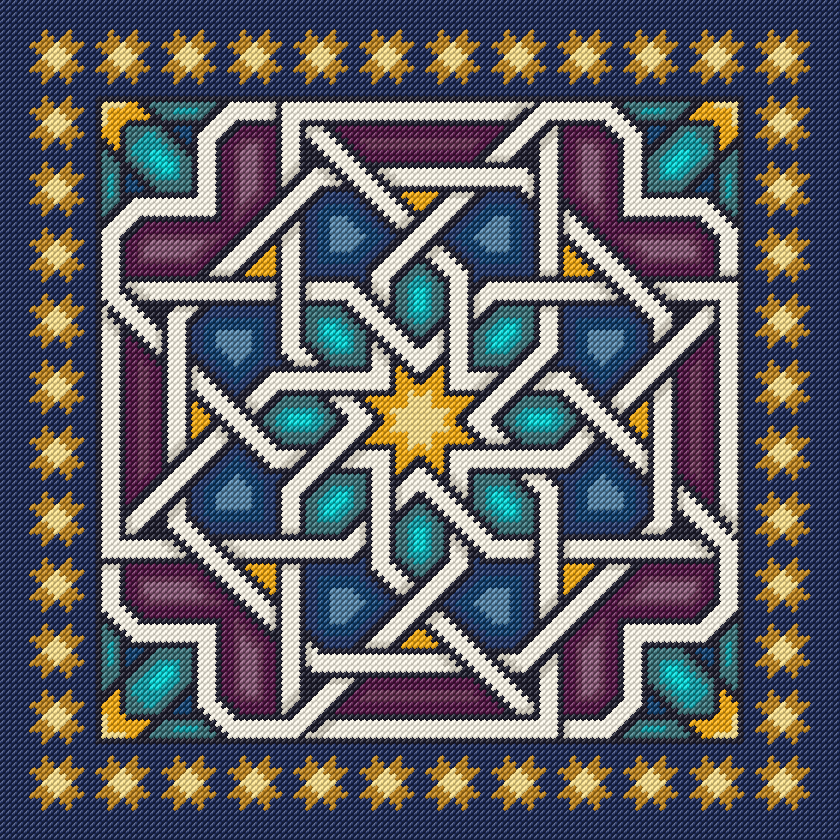
Advanced 19,600 stitches 14 × 14 in · 16 colors · 10 mesh
Islamic geometric star pillow
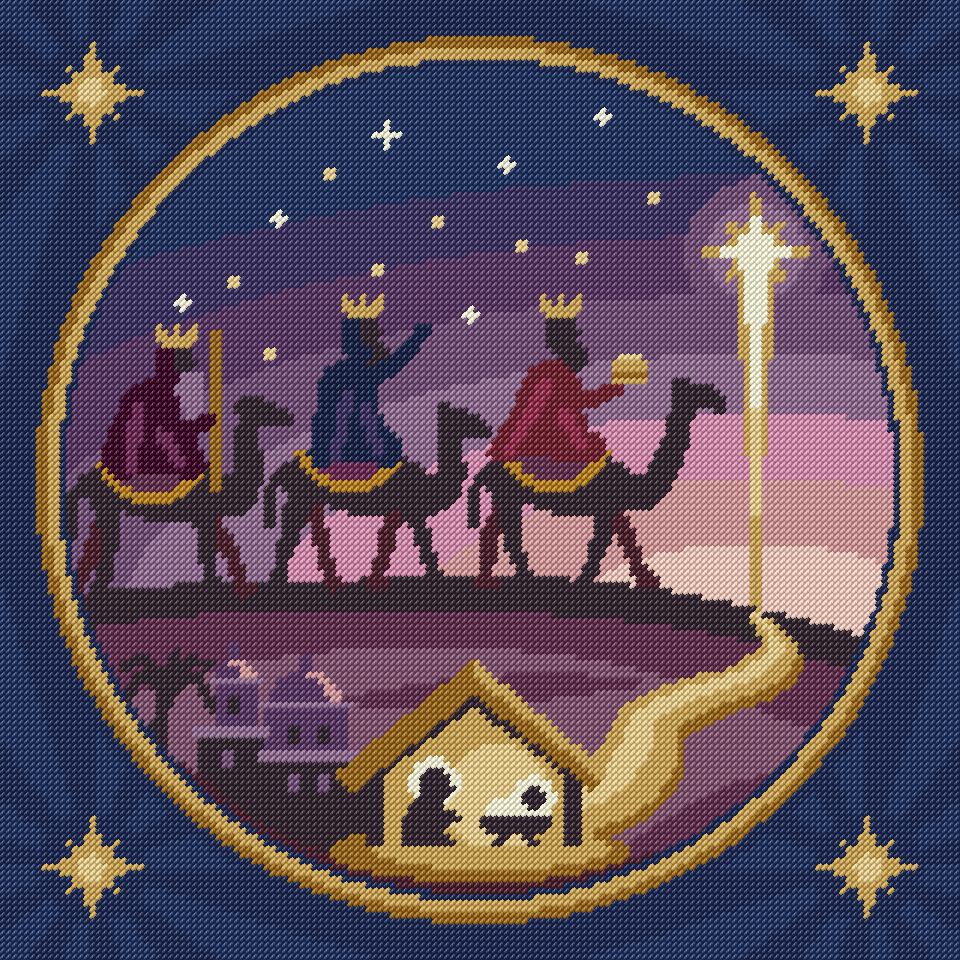
Intermediate 25,600 stitches 16 × 16 in · 23 colors · 10 mesh
Three Kings and the Christmas star
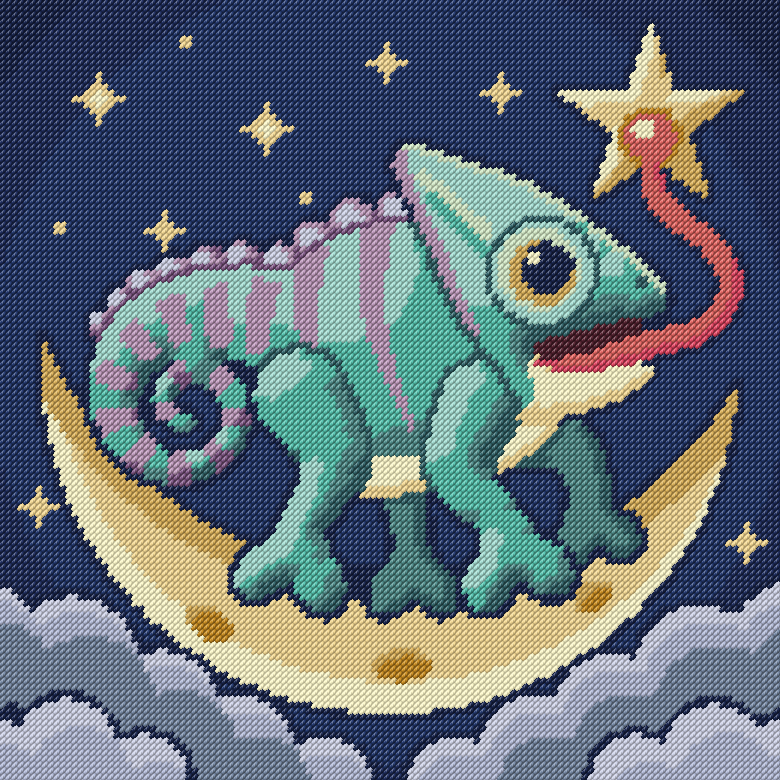
Intermediate 16,900 stitches 10 × 10 in · 20 colors · 13 mesh
Whimsical chameleon catching a star
Easy 19,600 stitches 14 × 14 in · 2 colors · 10 mesh
Black and white quilt star pillow
Advanced 19,600 stitches 14 × 14 in · 15 colors · 10 mesh
Four-point flame star pillow
Advanced 5,304 stitches 14 × 14 in · 15 colors · 10 mesh
Bargello star pillow, midnight and gold
Intermediate 5,184 stitches 4 × 4 in · 9 colors · 18 mesh
Classic star
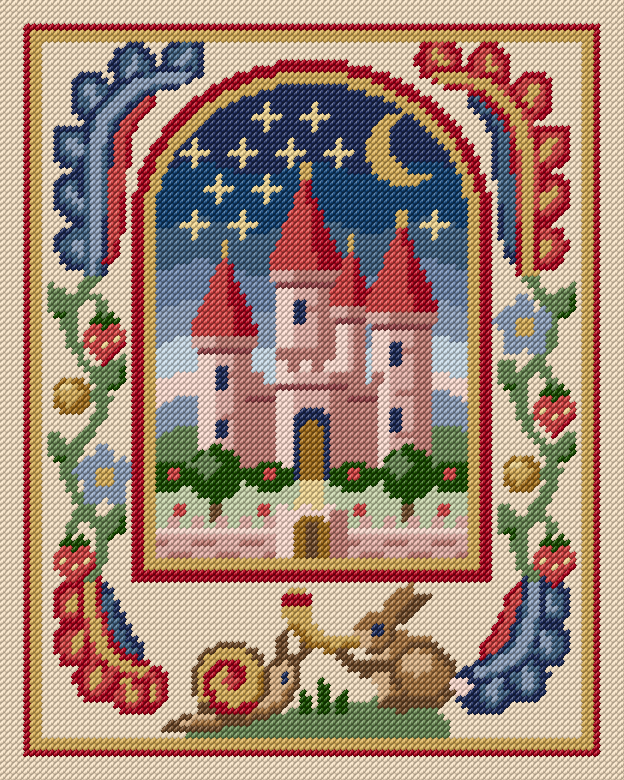
Advanced 13,520 stitches 8 × 10 in · 22 colors · 13 mesh
Illuminated manuscript castle and stars
New to needlepoint? How to needlepoint