Cross stitch guide
Old cross stitch samplers
A sampler is a cloth on which someone practiced and kept stitches, letters and motifs. If you have an old one, do not wash it, do not iron it and do not take it out of its frame. Keep it out of the light, lay it flat if it has no frame, and write down what you know of it.
On this page 15 parts
- What do you want to know?
- The first six things
- Read it, part by part
- Why samplers have alphabets, and why the J or I is missing
- How old is it?
- The history of God Bless Our Home cross stitch
- The history of Quaker cross stitch
- Look at the cloth and the thread
- What harms it, and what to do instead
- Whom to ask
- Where to see cross stitch in museums
- Stitch one for yourself
- Common mistakes
- Questions people ask
- Where to go next
What do you want to know?
| You have | Go to |
|---|---|
| A sampler in your hands, just found | The first six things |
| Letters, a house, a verse, a name | Read it, part by part |
| An alphabet with a letter missing | Why the J or I is missing |
| A year, or no year | How old is it? |
| A home blessing in an old frame | The history of God Bless Our Home cross stitch |
| Many-sided shapes (medallions), whole and half, and plain letters | The history of Quaker cross stitch |
| A cloth and a thread you cannot name | Look at the cloth and the thread |
| Stains, holes, an old frame | What harms it, and what to do instead |
| A question nobody at home can answer | Whom to ask |
| A wish to see old ones | Where to see cross stitch in museums |
| A wish to stitch one like it | Stitch one for yourself |
The first six things
- Wash your hands. Dry them well, and take off rings and bracelets.
- Lay it on a clean table. One in a frame lies on its back, in the frame. Carry one with no frame on a tray or a sheet of stiff card, so that it never hangs by its own weight.
- Put it out of the light. A shaded room or a drawer will do while you read.
- Leave it as it is. In its frame, with its backing, its dust and its stains.
- Photograph it. The front, the back if it is open, every edge, each letter and number, with a ruler beside it.
- Write down what you know. Whose it was, where it hung, who told you, and what is written on the frame or the paper at its back.
In a frame, or not? After that, do one of two things.
- In a frame: leave it in. It may hang again, on an inside wall, out of the sun and away from heat, for part of the year. For the rest of the year keep it in its frame in a cool, dry, dark cupboard. One museum shows a piece for four months and rests it for eight. See What harms it, and what to do instead for the places to avoid.
- With no frame: do not hang it. Keep it lying in a lined box. To keep it flat, further down, has the steps.
A conservator is a person trained to clean, mend and keep old things. One who works on cloth is a textile conservator. This page often says to ask one, and Whom to ask says how to find one.
Read it, part by part
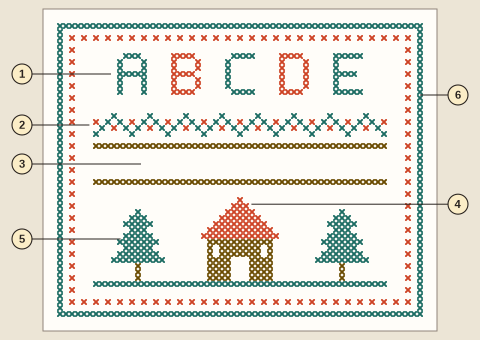
The alphabet (1). Sheets, shirts and napkins were marked with stitched letters, so that they came back to the right owner from the wash. An alphabet was practice for that. It is why so much old cross stitch is letters and numbers. Look for letters that are not there. Early alphabets often have no J and no U, as I and V did for both, and a small s in the middle of a word may look like an f without its bar.
Bands of pattern (2). Rows of border, one under the other, were a store of edgings to copy onto linen and clothes. On long, narrow samplers they fill most of the cloth, and an alphabet often stands with them.
The name, the age and the place (3). Many samplers say who made them, at what age, in which year, and sometimes the school, the teacher or the town. Others leave it out. Look for small initials too, in a row: they may be of a family.
Houses, gardens and trees (4 and 5). From the middle of the 18th century a house with its garden is a favorite of English samplers. It may be a real house, or the school's pattern. Two samplers with the same house can point to one teacher.
The border (6). A border on all four sides belongs to the squarer sampler, made to be hung up and looked at. One writer who examined many English ones found no border that closed a sampler round before 1726, and was sure that earlier ones must exist.
The verse. Short texts and moral or religious verses come in during the 17th century and go on through the 19th. Copy it out exactly, with its spelling. A verse is often one that many schools used.
People, beasts and crowns. Adam and Eve, stags, birds, hearts, flowers in a pot and crowns were copied from pattern book to sampler and from sampler to sampler, some of them for generations. They say where the design came from more than who made it.
Why samplers have alphabets, and why the J or I is missing
A girl practiced on her sampler the letters and numbers for marking linen, as "The alphabet (1)" says above. Of the samplers that carry a date, most of the 1600s have an alphabet, and nearly all of the 1700s. A needlework dictionary of 1882 still calls cross stitch the orthodox way to mark, in red cotton.
Why is J or I missing? The two were once one letter, and one shape served for both. U and V were the same. So the sampler of 1598, the earliest known with a stitched date, has a small dog with IVNO above it, for Juno. It works the other way round too: another English sampler, made before 1629, has J and no I, V and no U, as a book of 1913 copies it out.
What a missing J says of its age
It points to an older piece, and gives no year. Many early samplers leave out J and U. English came to use J as a letter of its own in the 1500s and 1600s, but a children's book of 1743 still treats I and J as one letter, and a dictionary of 1828 calls J a late addition to the alphabet. So set the letters beside the shape and the cloth: see How old is it?
Was cross stitch taught in kindergarten?
The early kindergartens taught sewing, in straight stitches. In a manual of 1869 the children prick a shape as a row of holes in squared paper or card, then sew from hole to hole with colored wool. One of 1896 goes from upright and level lines to slanting ones, then to curves. For a first cross stitch lesson today see teaching a child, and for letters to stitch the alphabet patterns.
How old is it?
What museums say of English samplers, and in the main of American ones after them:
| About when | Shape and cloth | What is on it |
|---|---|---|
| 1500s | Rare. Any shape, on linen | Motifs and stitches set down to remember. The earliest known with a stitched date is of 1598 |
| 1600s | Long and narrow bands, on linen, kept rolled; or motifs scattered as spots | Rows of border patterns in silk, cut and drawn work (pieces of the cloth cut away, or some of its threads pulled out, and the holes filled with stitches), then alphabets, names and years |
| 1700s | Squarer, more and more with a border; linen, and later woolen cloth | Alphabets, verses, a house and garden, birds and trees. Tent stitch (a single slanting stitch, half of a cross) and cross stitch take over |
| Later 1700s | Squarish, on linen, woolen cloth or satin | Darning samplers (practice in mending holes in cloth with needle and thread), and maps of counties, countries and the world |
| 1800s | Squarish, framed; linen, woolen cloth, and canvas of cotton | School samplers almost wholly in cross stitch: alphabet, numbers, verse |
| Middle 1800s | Canvas, and long strips of canvas | Colored wool in shaded pictures and geometric patterns, the pictures from printed charts |
A fashion starts in one place and lasts in another, so a style is only a hint. The table dates a kind of thing. It does not date yours. Letters are a hint too: see what a missing J says.
What a stitched year proves. Less than it seems.
- It may be another event. The sampler of 1598 also carries the birth of a child two years before. A family record carries dates years older than its stitching.
- It may have been changed. Museum records speak of samplers whose last numbers were taken out and put in again later, and of an age and a year added in ink. Look at the numbers of the year with a lens, front and back: another thread, stitches pulled tighter or looser than those beside them, holes left by a stitch that is gone.
- It may be copied. People stitch close copies of old samplers today.
- No year at all is common too.
The history of God Bless Our Home cross stitch
God Bless Our Home is a motto of the later 1800s, and many old ones are on card, not cloth. From the 1870s such words came printed on card punched with holes, to be filled in with wool. By the early 1880s this one hung on parlor walls across America. The fashion had died out by about 1910.
On card, these hint at age. They do not prove it, because such card was made again later:
- Brown card behind the stitches.
- Half crosses or long straight stitches in the letters.
- Shaded wool, which changes color along the thread.
- Foil at the back, shining through the holes.
On cloth, go by the cloth and the thread. Either may hang: see In a frame, or not? To stitch on card: perforated paper. Patterns: God bless our home, house blessings, home sweet home.
The history of Quaker cross stitch
Quakers, the members of the Religious Society of Friends, taught needlework in schools of their own. In and near London in the later 1600s their girls stitched bands of pattern with verses between. The style called Quaker today comes from later boarding schools, above all Ackworth in Yorkshire, founded in 1779, and Westtown in Pennsylvania, founded in 1799 on Ackworth's example.
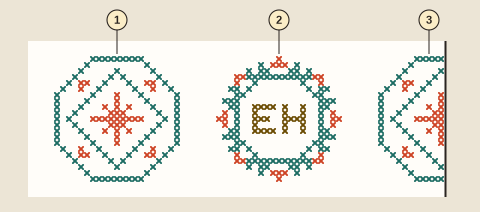
What to look for, in one color or in many:
- Medallions (1): closed shapes, round or many-sided, filled with a pattern.
- Wreaths (2): open rings of leaves or flowers, some round the initials of family or classmates.
- Half medallions (3), along the edges, often cut side outward.
- Small birds and flowers, and plain letters.
The girls made alphabet, verse and darning samplers too. Today's charts borrow the medallions: see the Quaker style patterns. Other kinds: types of cross stitch.
Look at the cloth and the thread
Use daylight that does not fall on the piece, and a lens. Never burn a thread to find out.
| What you see | What it may be |
|---|---|
| Single threads a little uneven, with thicker places along them, and no fuzz | Linen. Most samplers before the later 1700s are on it |
| A thin woolen cloth, a little hairy, perhaps with small moth holes | The woolen sampler cloth of the later 1700s and early 1800s. Moths eat wool and leave linen alone |
| Open, stiff, even cotton mesh | Canvas of the 1800s or later |
| Cloth woven in small blocks, with a hole at each corner | Aida, a cloth that came in late in the 1800s |
| Smooth thread with a shine, lying flat, hardly twisted | Silk, a long filament, the usual thread of older samplers |
| Thread with a wave in it and a soft, hairy surface | Wool |
A white, modern-looking cloth does not make it new, and a brown one does not make it old. Pale cloth browns with age from the air alone, and new cloth can be dyed with tea.
Missing dark stitches. Lines of empty holes where outlines or letters should be, or black and dark brown threads that crumble, often come from the dye: black and brown were made with iron, which eats the thread in time. It is damage, and also a sign that a natural dye was used. Do not press or brush there.
Stains. A brown line or ring may be from damp, or from a wooden board or acid card behind it. Small brown spots round a tack or pin are rust.
Later repairs. A patch on the back, a darn in another thread, a new edge sewn on. Leave them. They hold it together, and they are part of its story.
What harms it, and what to do instead
| What harms it | Why it harms | Do this instead |
|---|---|---|
| Washing it, or dabbing it with water | Old dyes may run, and wet old cloth tears | Nothing. Ask a conservator |
| Soap, bleach or spot remover | Bleach weakens the cloth, and what a detergent leaves behind stays in it | Leave the stain |
| Ironing or steaming it | Heat can weaken the threads, and it can set dirt and stains for good | Leave the creases |
| Sun, or a bright lamp | Light fades and weakens it, and the harm adds up | In its frame, a dim wall for part of the year, and a rest in the dark |
| A fire or radiator below it, or a cold outside wall behind it | Heat fades and weakens it, and damp grows mold | In its frame, an inside wall |
| Tape, glue or a sticky board | Glue leaves a residue, and taking it off does harm | Stitches, put in by someone trained |
| Tacks, staples or pins | Rust, holes and pulling | Full support behind it |
| Card, wood or newspaper against it | Acid moves into the cloth | Unbuffered acid-free tissue (explained below), or washed white cotton |
| Glass that touches it | Damp gathers there and the stitches are crushed | If it touches now, ask a conservator. In a new frame a strip, called a spacer, holds the glass off |
| Sprays of any kind | Sprays stay in the cloth | Nothing |
| Folding it | A fold becomes a crease, then a split | Flat, or rolled round a wide tube if it is too long |
| Damp, an attic or a basement | Mold, and great swings of heat | A cool, dry, dark cupboard indoors |
Dust. The one cleaning museums allow at home is a vacuum cleaner on its lowest power, held just above a piece of net or screen laid over the cloth, lifted and set down and never rubbed. Only on a sound piece. If threads are loose or crumbling, not at all.
Which tissue. Ask for acid-free tissue that is unbuffered. Acid-free paper often has an alkali, the opposite of an acid, put into it to fight acid that comes later: that is buffered. Unbuffered paper has none and is neutral. Two national bodies that write for museums both ask for the unbuffered kind next to textiles. If you cannot get it, use white cotton sheeting, washed first: one of them gives it as the other choice.
To keep it flat, if it has no frame:
- Find a box of acid-free board, larger than the sampler, so that it lies open with no fold.
- Line it with washed white cotton or unbuffered acid-free tissue.
- Lay the sampler in, face up.
- Cover it with another sheet of the same, and lay nothing on top of that.
- Put a note in with a photograph, so that nobody needs to unpack it to see what it is. Write in pencil.
- Look at it every month for moths, beetles and damp.
A long band sampler that is sound may be rolled, stitches outward so that they are not crushed, with tissue between, on a wide tube covered with the same.
Framing. A sampler that is clean and sound can be sewn to a board covered with washed cloth, and framed with the glass held off it. That mounting is a trained person's work. So is taking one out of an old frame. It is not the same job as framing new work: do not pull an old cloth over a board and lace it as mounting and lacing shows for new pieces, and do not wash it first as how to frame says for them.
Stop, and ask a conservator, if you see dyes that have run, mold, insects, glue or tape, tears, threads that turn to powder, or a piece stuck to a board. If you see insects or mold, first put the piece in a clean, clear plastic bag, close it, and keep it apart from other cloth while you wait for an answer.
Whom to ask
| Your question | Whom to ask |
|---|---|
| How old is it, and what kind of thing is it? | The textile department of a museum that has samplers. Send photographs first |
| Who was the maker? | The local historical society or record office of the town on it, with the name and the year |
| Is there another like it? | A public register of samplers. There is one for American pieces, with pictures to search by age, place and kind, and it takes word of samplers in private homes. To find it, search for the words: sampler archive |
| How do I keep or mend it? | A textile conservator. To find one, search for the words: find a textile conservator, and the name of your country. National bodies of conservators, in the United States and the United Kingdom among others, keep such lists. A museum can also name one |
| What is it worth? | An appraiser of textiles. That is a different question from its age, and this page does not answer it |
What to take. Photographs of the front, the back and the edges, the size in inches or centimeters, the count of threads to one inch (2.5 cm), every word on it copied out, and what your family knows. Take the pictures and not the sampler.
Where to see cross stitch in museums
Look for samplers: the first four museums below have many, and state and county historical societies some. Old cloth rests from the light, so few pieces are out at once: ask what is on view, and whether the museum is open. Online catalogs often show far more. To find one piece, search there for the maker's name and the year.
| Where | What it has |
|---|---|
| Victoria and Albert Museum, London | More than 700 samplers, the one of 1598 among them |
| Cooper Hewitt, Smithsonian Design Museum, New York | More than 1,000 samplers |
| Winterthur, Delaware | More than 300 samplers and embroideries by American girls, and a study room |
| DAR Museum (Daughters of the American Revolution), Washington, D.C. | More than 350 samplers and embroideries by girls |
| Ukrainian Museum, New York | Embroidered shirts and ritual cloths |
The history of needlepoint names museums for canvas work.
Stitch one for yourself
- Photograph the sampler square on, in parts. Do not trace it and do not lay a grid on it.
- Find the repeat. Of a band, chart one repeat and copy it from end to end. Of a border, chart one repeat and one corner: cross stitch borders shows how corners turn.
- Draw it on graph paper, a square to a cross. A piece with no name goes through it step by step. For an old sampler leave out its tacking threads and pins, and count from your photographs.
- Leave the maker her own name. Put yours, and the year you stitch it, in the empty place: signing your work.
- Choose a cloth and colors. Linen over two threads is nearest to the old ground, the cloth stitched on. To age the look of new cloth, see tea and coffee in dyeing fabric.
Very old designs are free to copy. A verse by a writer of our own time is not, and a chart of an old sampler drawn by someone today is theirs. A pattern that lives in a community belongs to its people's tradition: learn its stitches from those who keep it.
For patterns in the old manner, start with the antique style samplers, the band samplers, the Quaker style, the house samplers or all the samplers. All are new designs and free to download.
Common mistakes
- Washing it to see the colors. They may leave with the water.
- Opening the frame to look at the back. The cloth may be stuck to its board, and the paper there may be its only label.
- Reading the year as a birth certificate. See what the year proves.
- Throwing out the old backing. Keep every scrap of writing with it, in a clean envelope beside it.
- Hanging it where everyone can see it, in the hall window. It fades there fastest.
- Mending it with modern floss. Repairs, and the thread for them, are a conservator's choice.
- Calling every brown sampler antique. Look at the cloth, the letters and the numbers together.
Questions people ask
Why are letters missing from the alphabet? J, or I, and U are often left out of early ones: see why the J or I is missing. Any other letter may be a slip, or the end of the row.
Why is the alphabet there three times? Many samplers have more than one: in capitals, in small letters and in another stitch. They were practice for marking.
Were they all made by children? No. The oldest look like the work of practiced hands. From the 1700s most were made by girls at school or at home.
Does "aged 9" mean she finished it at nine? It is what she stitched. A record of her birth, set beside the year on the cloth, is the way to check it.
Can I clean the glass? Dust the frame and the glass lightly, and spray nothing. Do not rub it if it is plastic: rubbing charges it, and it can draw up loose threads. Never take it off to clean it.
What is a Quaker sampler? One from the schools of that faith: see The history of Quaker cross stitch.
My sampler is on canvas in wool. It may be needlepoint, or Berlin wool work (wool on canvas, from charts printed on squared paper): see old needlepoint samplers.
It has only yellowed. May I wash that out? No. How to wash says the same of old pieces.
Where to go next
Keep a paper with your own work for whoever finds it: a project journal shows what to write. For the sister craft, see vintage and antique needlepoint.