Cross stitch guide
Cross stitch with yarn
Yes, you can cross stitch with yarn. It needs something with holes big enough to take it: plastic canvas, rug canvas, needlepoint canvas, pegboard or an open cloth. Whatever you stitch on is called the ground. Pick a smooth yarn that just fills the square, thread a large blunt needle with about 18 inches (46 cm), and make one small test square before the real piece.
On this page 14 parts
- Which yarn for which ground
- Choosing the yarn
- How to stitch with yarn
- Floss instead of yarn
- Big squares in cloth: needle and strands
- What a chart comes to on big squares, in centimeters
- Patterns that suit yarn
- How a cross stitch rug is made
- Chair seats and footstools
- How to cross stitch with self-striping yarn
- How much yarn
- Common mistakes
- Questions people ask
- Where to go next
Which yarn for which ground
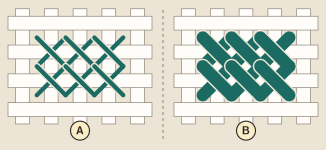
The count of a ground is its squares to the inch (2.5 cm), and each square takes one cross: 7 count makes 7 crosses to the inch (2.5 cm). Worsted weight is ordinary medium knitting yarn, marked 4 on many labels. Sport weight is a thinner one. Tapestry wool and Persian wool are sold for needlepoint. Needles run backward: size 13 is thicker than size 18.
| Ground | Yarn to start with | Needle |
|---|---|---|
| Plastic canvas, 7 count | Worsted weight, one strand | Tapestry size 16 |
| Plastic canvas, 10 count | Sport weight, or worsted if it goes through without a tug | Tapestry size 18 |
| Plastic canvas, 5 count | Worsted weight, doubled, or a bulky yarn | Size 13, or a large plastic yarn needle |
| Needlepoint canvas, 10 or 12 holes to the inch | Tapestry wool, or as many of the three strands of Persian wool as cover | Tapestry size 18 |
| Rug canvas, 3 to 5 holes to the inch | Rug yarn, doubled if it leaves gaps, or three or four strands of worsted together | Size 13 or a rug needle |
| Rug canvas, 6 or 7 holes to the inch | Worsted weight: one strand to start with, two if it leaves gaps | Tapestry size 16 |
| Pegboard, holes 1 inch (2.5 cm) apart | Worsted weight, doubled, or a very thick yarn | Large plastic yarn needle |
| Burlap | Worsted weight. Begin with crosses over three threads each way | Large blunt needle |
On burlap, count the threads in one inch (2.5 cm) both ways first. With 12 threads to the inch, a cross over three threads makes four crosses to the inch. Other fabrics has the steps.
Fine plastic canvas, 14 to the inch, is chiefly for floss, the six-strand cotton of ordinary cross stitch: worsted yarn is too thick for it. Cross stitch on plastic canvas and cross stitch on pegboard have pages of their own.
Choosing the yarn
- Smooth, not fluffy. A hairy yarn blurs the cross and hides the holes you are counting.
- Wool for anything that will be walked on, sat on or stretched back into shape. Tapestry wool, Persian wool and rug wool are all used on canvas.
- Acrylic for plastic canvas and playthings. It is cheap, hard-wearing and comes in every color.
- One thickness throughout. A color that is thicker than its neighbors makes its squares bulge.
Some yarns can be taken apart. Persian wool is three strands twisted loosely together, so you can stitch with one, two or three. A knitting yarn is best used whole.
How to stitch with yarn
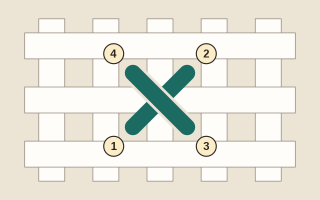
A cross covers the place where two bars of the canvas meet, with a hole at each of its four corners. On pegboard or cloth it covers one square.
- Cut a short length. About 18 inches (46 cm) is enough. A longer piece wears thin as it goes in and out.
- Thread it by a fold. Pinch the yarn round the needle, slide the needle out, and push the fold through the eye. Pull the short end through after it, and stitch with the long end. Where the table says doubled, thread two lengths together. Threading a needle shows the ways. An eye that is too small shreds the yarn, and one that is too large lets it slide about and fuzz.
- Come up at 1, from the back to the front. Leave 1 to 2 inches (2.5 to 5 cm) of yarn behind and hold it there. No knot is needed.
- Go down at 2, the hole diagonally across. That is the first leg of the cross.
- Come up at 3, the hole straight below 2.
- Go down at 4, the hole straight above 1. The second leg lies over the first, and the cross is made.
- Draw each leg up until it lies flat. A tight pull bends the canvas and thins the yarn. A loose one leaves a loop.
- Work over the tail. Your next few crosses catch it down on the back.
- Cross them all the same way. On stitches this big, one that leans wrong shows across a room.
- Let the needle hang. When the yarn twists up, let go and it will unwind.
- End under the stitches. Run the needle under the last few crosses on the back and snip.
A row there and back. To work a row, make the first leg (1 to 2) of every cross along it, then come back making all the second legs (3 to 4).
Make a test square. Work ten crosses by ten with the yarn you mean to use. If the ground shows between the legs, use a thicker yarn or add a strand. If the yarn is hard to draw through, or the crosses stand up in a lump, use a thinner one.
Do not carry yarn across the back to the next patch of color. It can pull the canvas into a curve, and it shows through the holes.
Floss instead of yarn
Yarn is not the only way to fill a large square. Floss, which is six thin strands lying together, does it too if you use enough of them. What suits depends on what the squares are made of as well as on their size.
- Low-count cloth, 6 to 10. The cloth is woven close and its holes are small, so floss is still the usual thread, with more strands of it. The table below is for this. A fine, smooth yarn can be used if the test square says so.
- Plastic canvas, 10 count. Bare plastic has to be hidden. Six strands of floss do it, or sport weight yarn.
- Plastic canvas, 7 count. Floss takes about eight strands, which are hard to get through one needle. Worsted yarn is simpler.
- Plastic canvas, 5 count, and anything with wider squares. Floss is too thin. Use yarn.
Big squares in cloth: needle and strands
| Fabric | Stitches to the inch | 100 stitches measure | Tapestry needle | Strands |
|---|---|---|---|---|
| 6 count Aida | 6 | 16 5/8 in (42.3 cm) | Size 18 | 4 or more |
| 7 count | 7 | 14 1/4 in (36.3 cm) | Size 18 | 4 or more |
| 8 count Aida | 8 | 12 1/2 in (31.8 cm) | Size 20 | 4 or more |
| 10 count | 10 | 10 in (25.4 cm) | Size 20 | 4 or more |
What a chart comes to on big squares, in centimeters
| Stitches | 6 count Aida | 7 count | 8 count Aida | 10 count |
|---|---|---|---|---|
| 20 | 8.5 cm | 7.3 cm | 6.3 cm | 5.1 cm |
| 30 | 12.7 cm | 10.9 cm | 9.5 cm | 7.6 cm |
| 40 | 16.9 cm | 14.5 cm | 12.7 cm | 10.2 cm |
| 60 | 25.4 cm | 21.8 cm | 19.1 cm | 15.2 cm |
| 80 | 33.9 cm | 29.0 cm | 25.4 cm | 20.3 cm |
| 100 | 42.3 cm | 36.3 cm | 31.8 cm | 25.4 cm |
Patterns that suit yarn
A chart is the grid a design is stitched from: each symbol is one cross. Choose one with few colors, plain shapes and no backstitch (lines of straight stitches). On 4 or 5 holes to the inch it comes out about three times as wide as on 14 count cloth, so a design 40 squares wide is already a small cushion: 40 squares are about 8 inches (20.3 cm) on 5 holes to the inch, and 10 inches (25.4 cm) on 4. The geometric patterns are a good place to look. Every color is a ball of yarn to buy and to keep untangled, so four colors are easier than twelve. The Easy patterns have four or fewer.
How a cross stitch rug is made
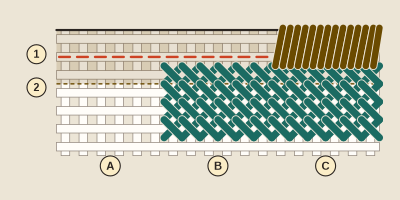
Rug canvas is stiff and has double threads each way. A pair of threads is one bar, and the big holes between the pairs are the ones you stitch through. It is sold with roughly 3 to 7 holes to the inch. To find the stitches a rug takes, multiply its size in inches by the holes to the inch. A rug 24 by 36 inches (61 by 91 cm) takes:
- on 4 holes to the inch, 96 by 144 crosses;
- on 5 holes to the inch, 120 by 180 crosses.
The covered edge adds a little more on each side.
- Cut along a row of holes. Allow at least 5 squares more on every cut side: 3 to turn back and 2 for the edge. A woven edge, the selvage, needs none. It is covered in place of the two bars.
- Turn the cut edges to the back. Fold them three squares deep, so that the holes of the two layers lie over each other. Two squares hold less well, and one alone may fray out.
- Tack the fold down. Sew along the second bar from the fold (1 in the picture) with strong thread, and draw it tight.
- Mark the middle. Draw a colored pencil line down the center row of holes each way.
- Leave the edge bars bare. Make the first row of crosses over the third bar from the fold. That row goes through both layers and holds the raw edge. The two bars outside it are covered last.
- Work a row or two right round. A plain frame first shows you that the count is right before the pattern begins.
- Fill in the pattern. Work from the center lines. Work a long row there and back, as above. In a small patch, finish each cross.
- Join new yarn under old. On the back, weave the last 2 inches (5 cm) in and out of the stitches you have made, and begin the new length the same way.
- Begin the edge. Double the yarn. Bring the needle up from the back just outside the outer row of crosses, near a corner.
- Cover the edge. Take the yarn over the fold to the back and come up again a little further along, always from the back. Use the narrow gaps between the paired threads as well as the big holes, so that the slanting stitches lie close. Make them short at a corner, so that they do not slip off.
- Press it. Use a warm iron on the wrong side, with care: wool scorches.
- Line it. Cut burlap, denim or heavy cotton a little larger than the rug, turn its edge under, and sew it by hand to the back of the outer row of crosses.
Two old handbooks begin differently. One folds the canvas before stitching, as above. The other tacks a flat canvas to a plain wooden frame with at least 1 1/2 inches (3.8 cm) bare all round, and folds it back along the last row when the work is done: the part below on backing has that fold. The frame keeps the canvas square; the fold keeps it neat from the start. They also differ on the stitch. One finishes every cross before the next for evenness, and the other works rows there and back.
A cross stitch rug is for a bedroom, or a spot where few feet go. Put it on a pad or a carpet so that it cannot slide.
If you would rather crochet one, see crochet rugs.
How to back a rug with felt or wool, and use tape
A wool rug takes rug canvas, rug wool, a blunt needle, strong thread, a back, and two tapes. If the edge was folded first, as above, begin at step 4.
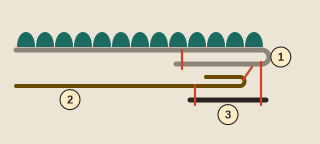
- Tape flat canvas. Fold masking tape over its cut edges. Then stitch.
- Block the rug: damp it, pull it square, pin it until dry.
- Fold the edge (1). Cut the bare canvas, tape and all, to 1 inch (2.5 cm). Fold that behind and sew it down.
- Cut the back (2): felt to size, wool cloth 1/2 inch (1.3 cm) larger all round, turned under.
- Sew it by hand to the back of the outer row.
- Add rug tape (3), a strong woven strip, over the back's edge. Sew down both its edges, loosely, or the rug curls.
How to make a rug shows the corners. Choose a rug design.
Chair seats and footstools
These are canvas work: every square is filled, in wool, so that no canvas shows. Use double-thread needlepoint canvas, which has its threads in pairs each way and keeps its shape.
- Measure the pad. Measure over its top and down its sides, at the widest places.
- Add the fold. Leave at least 3 inches (7.6 cm) of bare canvas beyond the stitching on every side, to wrap under the seat.
- Carry the plain background to the full size. The outer rows go round the edge of the pad, so keep the pattern itself well inside them.
- Block the canvas. Stitching pulls it out of square. How to block needlepoint has the method, and it is the same for crosses.
- Take out the seat. On many dining chairs the pad lifts out or is held by screws from below.
- Fix the middles first. Center the canvas on the pad and staple the middle of one side underneath, then the middle of the side opposite, then the other two.
- Work out to the corners. Keep the canvas taut but do not pull the rows out of line. Fold the corners flat.
A footstool with a lift-out pad is done in the same way. A kneeler is measured the same way, over the top and down the sides, because its sides show. How its cover is closed depends on the pad, so settle that with whoever will make it up before you cut the canvas. A chair whose cover does not come off with the seat is better left to an upholsterer.
How to cross stitch with self-striping yarn
Finish each cross before the next, and use the yarn in the order it leaves the ball. It changes color along its length, in runs long enough for stripes.
- Work a test patch to see how many crosses one color lasts.
- Use it single. Doubled, it lays two colors side by side. For more cover take a strand of two balls, started at the same color.
- Cut lengths in order and thread the end nearest the ball, so that the colors follow on.
- Make both legs of each cross at once, not on the way back.
- Choose a path. Rows right and left in turn make bands. Rounds from the middle make rings.
- Join a new ball at the same color.
Short runs speckle; long ones make blocks. Variegated floss behaves the same. Patterns for variegated thread use one color.
How much yarn
Any figure is an estimate, because yarn and pull differ. Find your own:
- Stitch one square inch (2.5 cm each way). Measure the yarn before you start and what is left, and take one from the other.
- Find each color's area. Count its squares on the chart and divide by the squares in a square inch: 16 on 4 holes to the inch, 25 on 5, 49 on 7.
- Multiply the two. Add a tenth for ends and mistakes.
As an example of the sum, suppose the test inch took 1 1/4 yards (1.1 m). A cushion front in one color, 12 by 12 inches (30.5 by 30.5 cm), is 144 square inches. 144 times 1 1/4 is 180 yards, and a tenth more makes an estimate of about 198 yards (181 m). Buy one color's yarn all at once. Yarn is dyed in batches, called dye lots, and two batches of one color can differ.
Common mistakes
- The canvas shows between the legs. The yarn is too thin. Add a strand, or choose a finer canvas.
- The yarn gets thin and hairy. The piece is too long or the eye too small. Cut shorter lengths and take a larger needle.
- The canvas curls or leans. The stitches are pulled too tight. Ease off, and block the piece when it is done.
- The edge frays. The fold was too shallow for the crosses to catch it. Turn three squares.
- A bump where yarn was knotted. Cut the knot off and run the end under stitches.
Questions people ask
Can I use yarn on 14 count Aida? No. The holes are too small for it. Use two strands of floss.
Can I use floss with yarn in one piece? Yes, for small details laid over finished crosses. Floss on its own will not fill a square of 5 to the inch or larger.
Can I cross stitch on a knitted or crocheted blanket? Yes, and yarn is the right thread for it. See cross stitch on crochet and knitting.
Do I need a hoop? Not for stiff canvas, which is held in the hand. A large flat piece is easier to keep square on a frame.
Where to go next
For the other low counts, see less common fabric counts, and for the numbers on the packet, needle sizes. The fabric calculator, opened on 60 by 60 stitches at 6 count, works out a size and the cloth to cut.