3D bunny ears for a shirt hand embroidery pattern
Advanced · 16 colors · 4 × 4.4 in · 9 kinds of stitch
Download free PDFPDFPrints on US Letter and A4You may sell what you make from it by hand, in small quantities. The PDF itself is not to be sold or shared. Selling, classes and kits: the rules
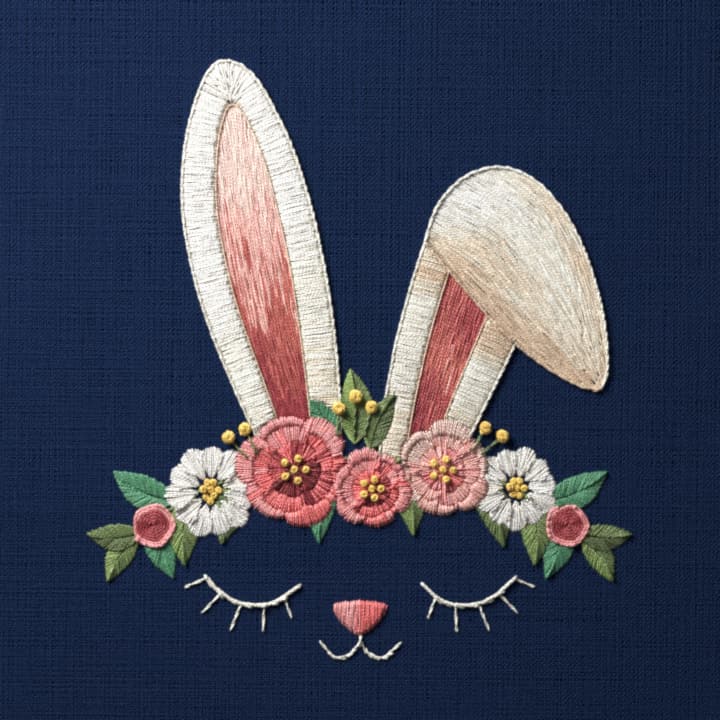
The left ear stands tall and the right ear folds over at the top, so its tip hangs down in front.
Size and details
Advanced. Uses long and short stitch, padded satin stitch, woven wheels, dozens of French knots, satin stitch over about a sixth of the cloth in a 6 inch hoop, 16 colors and a great deal of stitching.
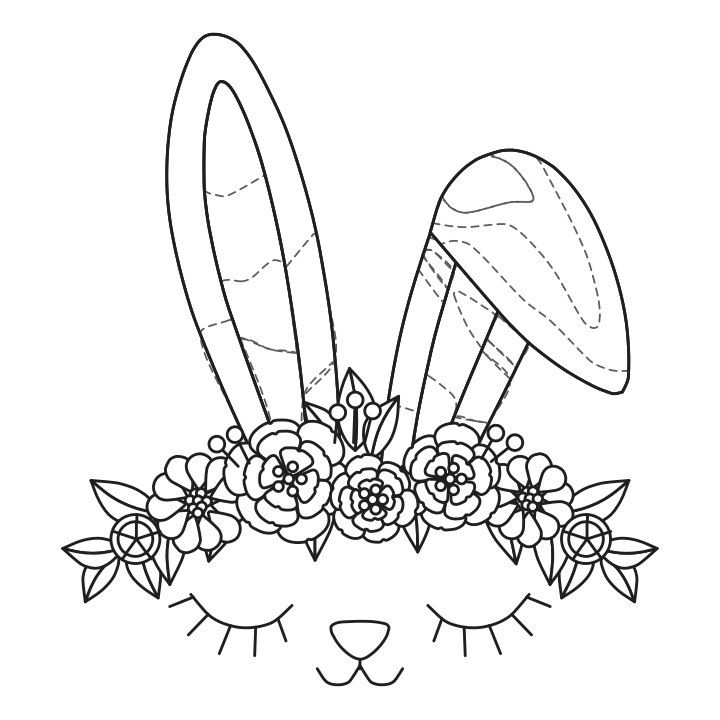
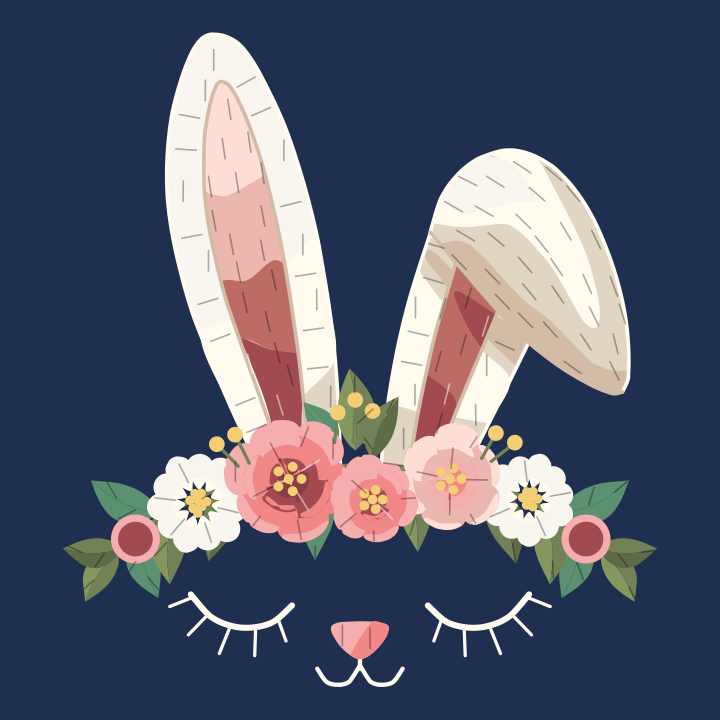
The ear rims, the outer rose petals and the nose are padded satin stitch, which makes them stand up from the cloth. The linings and the turned tip are long and short stitch, dark rose at the root and pale above, with split stitch along the ear edges. The crown has satin stitch roses and daisies, fishbone stitch leaves, woven wheel rosebuds and French knot hearts and berries. The sleeping eyes and the mouth are stem stitch with straight stitch lashes; leave them out for ears alone. On knit cloth, put a backing behind it. In the picture of where the colors go, the fine lines show which way the stitches lie.
| Hoop | Inches | Centimeters | Satin stitch up to |
|---|---|---|---|
| 3 in (8 cm) | 1.6 × 1.8 in | 4.1 × 4.6 cm | 1/8 in (3 mm) |
| 4 in (10 cm) | 2.4 × 2.7 in | 6.1 × 6.9 cm | 3/16 in (5 mm) |
| 5 in (13 cm) | 3.2 × 3.6 in | 8.1 × 9.1 cm | 1/4 in (6 mm) |
| 6 in (15 cm) | 4 × 4.4 in | 10.2 × 11.2 cm | 5/16 in (8 mm) |
| 8 in (20 cm) | 5.6 × 6.2 in | 14.2 × 15.7 cm | 7/16 in (11 mm) |
- In a 3, 4, 5 or 6 inch hoop the French knots are drawn smaller than about 2 mm (a little over 1/16 in). Use one strand of floss for them there, or choose a larger hoop.
What you need
- Fabric
- Plain cotton or linen in indigo, cut 9 in (23 cm) square. On white cloth its palest threads do not show: choose other colors under Options. A pencil line does not show on it: see how to transfer a pattern to dark fabric.
- Needle
- Embroidery needle, size 9 for 1 strand, size 7 for 2 or 3, size 5 for 4 (a lower number is a thicker needle).
- Floss
- 16 colors of six-strand cotton, listed below. DMC is a brand: another brand in a like color will do.
- Marker
- A pen or a sheet that suits the fabric: how to transfer a pattern says which.
On clothes. Wash and dry the garment first. Denim and twill need no backing and take a sharp needle, embroidery or chenille; T-shirts, sweatshirts and other knits need a backing that sticks or irons on. How to embroider on clothes has every step, the guide to shirts says how to reach a neckline, a collar or a sleeve, and the placement chart says where a design goes.
Floss
- 1DMC 224 Very Light Shell PinkEar hollows and roses (light)
- 2DMC 3721 Dark Shell PinkEar hollows (darkest), roses (dark), rosebuds (darker)
- 3DMC 3722 Medium Shell PinkEar hollows (dark)
- 4DMC 225 Ultra Very Light Shell PinkEar hollows and roses (lightest)
- 5DMC 3865 Winter WhiteEar rims and turned tip (light), daisies (darker)
- 6DMC 3033 Very Light Mocha BrownTurned tip and ear rims (dark)
- 7DMC 712 CreamEar rims and turned tip (lightest), ear edges, daisies (lighter) and 3 more parts
- 8DMC 3782 Light Mocha BrownHollow edges and crease, turned tip and ear rims (darkest)
- 9DMC 3363 Medium Pine GreenLeaves (dark), crown stems and berry stems
- 10DMC 3364 Pine GreenLeaves (lightest)
- 11DMC 3362 Dark Pine GreenLeaves (darkest)
- 12DMC 502 Blue GreenLeaves (light)
- 13DMC 3821 StrawRose hearts, berries and daisy hearts
- 14DMC 3712 Medium SalmonRoses (middle dark), nose (darker)
- 15DMC 221 Very Dark Shell PinkRoses (darkest)
- 16DMC 760 SalmonRoses (middle light), rosebuds and nose (lighter)
Skeins: one of each color is enough. An estimate for the 6 inch hoop, from the length of each line and the area of each filled shape, with a fifth added for tails.
How to stitch it
- New to hand embroidery? Start here.
- Print at 100%, trace the pattern onto the fabric, and put it in the hoop: inner ring under, drawing up, tight as a drum.
- Floss is six strands. Cut 18 inches (45 cm), pull out the number given one at a time, and lay them together.
- Begin with no knot on the back where it is seen and washed, as on a towel, a napkin or clothes; for a piece in a hoop a small knot is fine. End each thread by whipping it around the backs of four or five stitches, with one small hitch.
- Each small ring is one French knot. A fine broken line inside a shape is where two shades meet: trace it, do not stitch it.
- A number under “Where colors go” is a color of the list. The fine lines on the colors show which way the stitches lie.
Stitch in this order
Filled parts from the back of the picture forward, then lines, knots and raised parts. Where a stitch page names another number of strands, use the number here.
- Long and short stitch 1 strandEar hollows, turned tip
- Padded satin stitch 2 strandsEar rims, roses, nose
- Fishbone stitch 2 strandsLeaves
- Satin stitch 2 strandsDaisies, roses
- Split stitch2 strands: ear edges, crease1 strand: hollow edges
- Stem stitch4 strands: sleeping eyes3 strands: crown stems2 strands: mouth
- Straight stitch 2 strandsBerry stems, lashes
- French knot 2 strands, two wrapsDaisy hearts, rose hearts, berries
- Woven wheel stitch 4 strandsRosebuds
When it is done, take off any lines that still show. A guide to this kind of work: Stitches for fur, hair and feathers.
More patterns like this
Advanced 3–8 in hoop · 20 colors
Bunny ears with a daisy crown
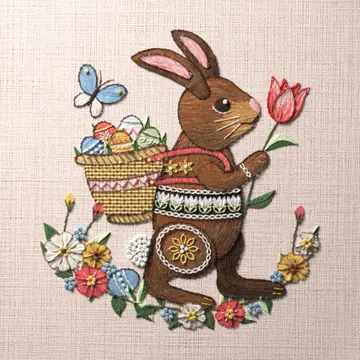
Advanced 3–8 in hoop · 16 colors
Chocolate bunny with a basket
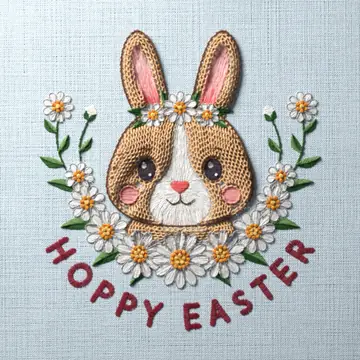
Advanced prints 3–14 in · 15 colors
Hoppy Easter in daisies
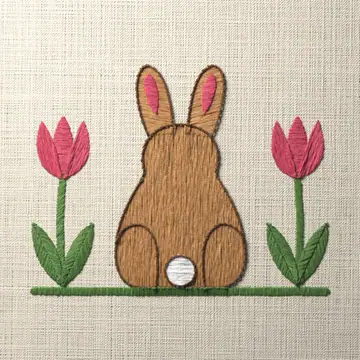
Intermediate 3–8 in hoop · 5 colors
Cottontail rabbit between two tulips
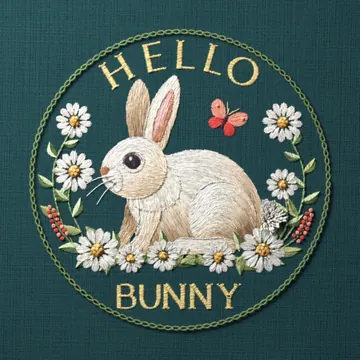
Advanced prints 3–14 in · 20 colors
Hello bunny in daisies
Advanced prints 3–14 in · 16 colors
Oak and acorn crest for a man’s shirt
Advanced prints 3–14 in · 16 colors
Small Christmas trees motif for shirts
Advanced prints 3–14 in · 16 colors
Retro neon bowling pins for a shirt
New to hand embroidery? Starting hand embroidery, step by step