Antique tatreez style sampler hand embroidery pattern
Intermediate · 8 colors · 12 kinds of stitch
Download free PDFPDF, US Letter · 36 KBFor your own stitching, gifts and handmade pieces you sell. Do not resell or share this PDF. What you may do, in full
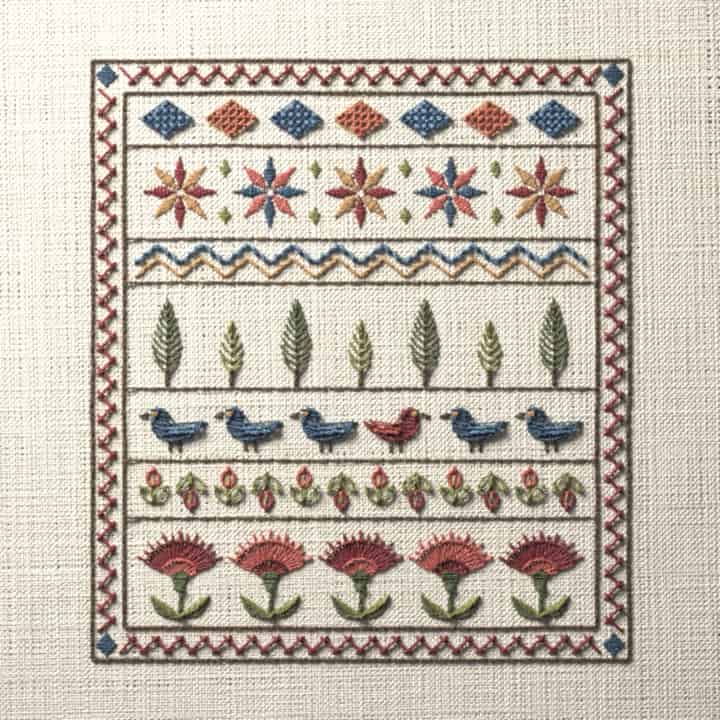
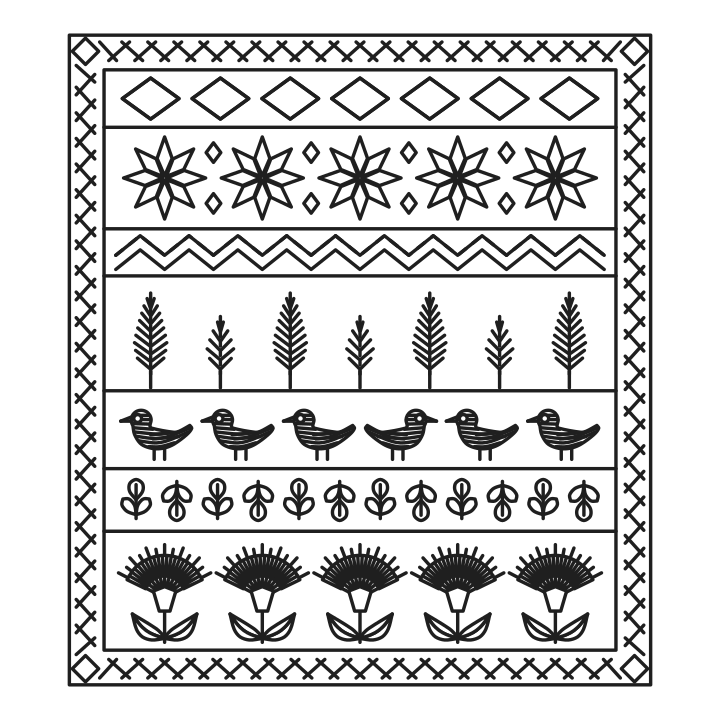
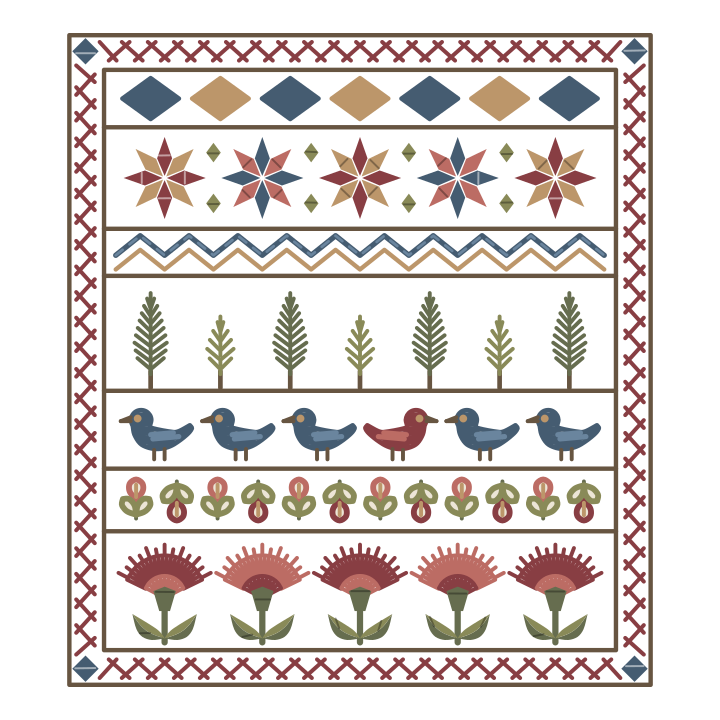
A band sampler in the manner of Palestinian tatreez, drawn fresh in threads that look softened by time. From the top come diamonds in woven filling stitch, satin stitch stars, a whipped back stitch zigzag with a straw back stitch echo, and cypress trees in fly stitch. Below them stand birds in rows of stem stitch, lazy daisy buds and buttonhole stitch carnations. Five birds look one way, and one red bird has turned round to look the other. Back stitch lines part the bands, and a herringbone stitch frame closes on all four sides. In the picture of where the colors go, the fine lines show which way the stitches lie.
Size and details
Intermediate. Eight colors.
8 colors of floss and 12 kinds of stitch:
- Back stitch
- Herringbone stitch
- Satin stitch
- Woven filling stitch
- Whipped back stitch
- Straight stitch
- Fly stitch
- Stem stitch
- French knot
- Lazy daisy stitch
- Fishbone stitch
- Buttonhole stitch
- Which stitch goes where
| Hoop | Inches | Centimeters | Satin stitch up to |
|---|---|---|---|
| 3 in (8 cm) | 1.3 × 1.5 in | 3.3 × 3.8 cm | 1/16 in (1.6 mm) |
| 4 in (10 cm) | 2 × 2.2 in | 5.1 × 5.6 cm | 1/16 in (1.6 mm) |
| 5 in (13 cm) | 2.7 × 3 in | 6.9 × 7.6 cm | 1/8 in (3 mm) |
| 6 in (15 cm) | 3.3 × 3.7 in | 8.4 × 9.4 cm | 1/8 in (3 mm) |
| 8 in (20 cm) | 4.7 × 5.2 in | 11.9 × 13.2 cm | 3/16 in (5 mm) |
- In a 3, 4 or 5 inch hoop the French knots are drawn smaller than about 2 mm (a little over 1/16 in). Use one strand of floss for them there, or choose a larger hoop.
- In a 3 or 4 inch hoop the shortest lazy daisy loops are drawn smaller than about 2 mm (a little over 1/16 in). Use one strand of floss for them there, or choose a larger hoop.
The pattern is drawn inside a circle about half an inch (1.3 cm) smaller all around than the hoop.
What you need
- DMC 839 Dark Beige BrownBand lines, outer line, inner line, bills, legs and trunks
- DMC 221 Very Dark Shell PinkFrame, carnations and carnation hearts (darker), stars (darkest) and 3 more parts
- DMC 930 Dark Antique BlueBirds (lighter), diamonds, zigzag and diamond edges (darker) and 2 more parts
- DMC 3045 Dark Yellow BeigeZigzag echo, stars (lightest), diamonds and diamond edges (lighter) and 2 more parts
- DMC 3722 Medium Shell PinkCarnations, carnation hearts, fringe and wings (lighter), stars (light), buds (middle)
- DMC 3011 Dark Khaki GreenBud leaves and small diamonds, cypress trees and carnation leaves (lighter)
- DMC 931 Medium Antique BlueZigzag (lighter), wings (darker)
- DMC 520 Dark Fern GreenCypress trees and carnation leaves (darker), carnation cups and 2 more parts
Skeins: one of each color is enough. An estimate for the largest size, the 8 inch hoop: the length of each line and the area of each filled shape, a fifth added for tails and ends, a tenth of every 8 m (8.7 yd) skein kept spare.
The floss is six-strand cotton; the stitch guide says how many strands to use. You also need a hoop, an embroidery needle (a size 7 to 9 suits two or three strands) and plain cotton or linen fabric. To frame the piece in its hoop, cut a square 3 inches (8 cm) wider than the hoop: a 9 inch (23 cm) square for a 6 inch hoop.
When it is stitched, how to finish a hoop shows how to back it for the wall.
Stitch guide
- Put the pattern on the fabric (how to transfer a pattern) and the fabric in the hoop.
- Stitch the filled parts first, what lies behind before what lies in front of it.
- Then stitch the lines: stems, veins and outlines over the edges of the filled parts.
- Keep the knots for the end, so that the hoop and your hand do not flatten them.
Start each thread with a small knot on the back or one of the knotless starts, and end it by running the needle under the backs of a few stitches (starting and ending a thread). Use the strands this list gives, also where a page about a stitch names another number.
- Back stitch 1 to 3 strandsOuter line, inner line, band lines, diamond edges, zigzag echo
- Herringbone stitch 3 strandsFrame
- Satin stitch 2 strandsFrame corners, stars, small diamonds, carnation cups
- Woven filling stitch 3 strandsDiamonds
- Whipped back stitch 3 strandsZigzag
- Straight stitch 2 to 4 strandsTrunks, cypress trees, bills, legs, bud stems, buds, fringe
- Fly stitch 2 strandsCypress trees
- Stem stitch 1 to 3 strandsBirds, wings, carnation stems
- French knot 1 strand, two wrapsEyes
- Lazy daisy stitch 2 to 3 strandsBuds, bud leaves
- Fishbone stitch 2 strandsCarnation leaves
- Buttonhole stitch 2 strandsCarnations, carnation hearts
Getting it onto your fabric
The PDF holds the pattern twice at actual size: once as drawn, and once mirrored for an iron-on transfer pen. Print it at 100% with scaling off and check the one-inch square (25.4 mm) with a ruler before you trace. How to transfer a pattern explains tracing, carbon paper and the other ways. The files are under Downloads.
Downloads
- Download free PDF PDF, US Letter, 3 pages, for a 6 inch (15 cm) hoop
- Download free PDF, A4 PDF, A4, 3 pages, for a 6 inch (15 cm) hoop
More patterns like this
Easy 3–8 in hoop · 5 colors
Tulip row band sampler
Easy 3–8 in hoop · 5 colors
Easter egg band sampler
Intermediate 3–8 in hoop · 8 colors
Tatreez style flower vine vest corner
Intermediate 3–8 in hoop · 8 colors
Pink tatreez style carnation bookmark
Intermediate 3–8 in hoop · 7 colors
Tatreez style water ripple border
Intermediate 3–8 in hoop · 8 colors
Block letter J with flowers
Intermediate 3–8 in hoop · 8 colors
Welcome to our home
Intermediate 3–8 in hoop · 5 colors
Palestinian tatreez style red star
New to hand embroidery? Starting hand embroidery, step by step