April birth flower, daisy hand embroidery pattern
Advanced · 17 colors · 3.9 × 3.7 in · 7 kinds of stitch · one of a set of 12
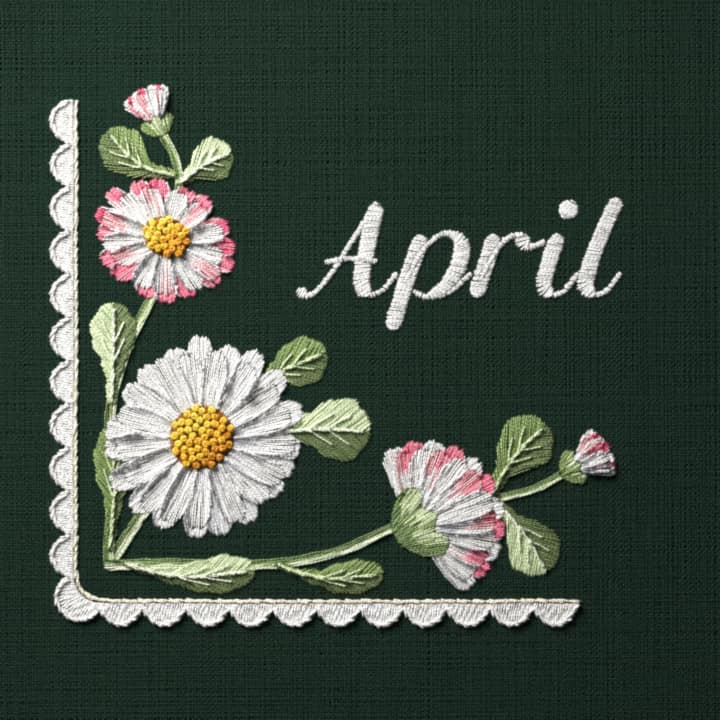
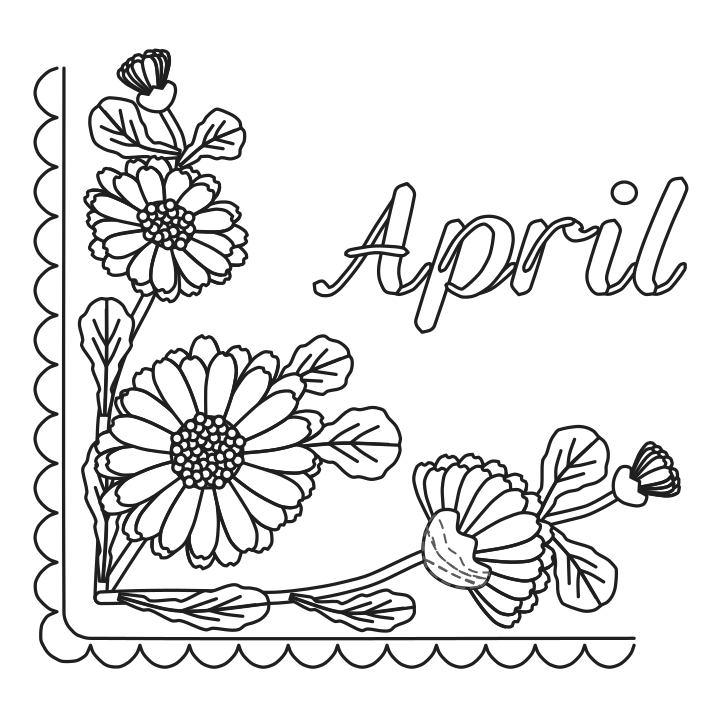
A number is a color of the list. Fine lines show which way the stitches lie: do not stitch them.
Download free PDFPDFYou may sell what you make from it by hand, in small quantities. The PDF itself is not to be sold or shared. Selling, classes and kits: the rules
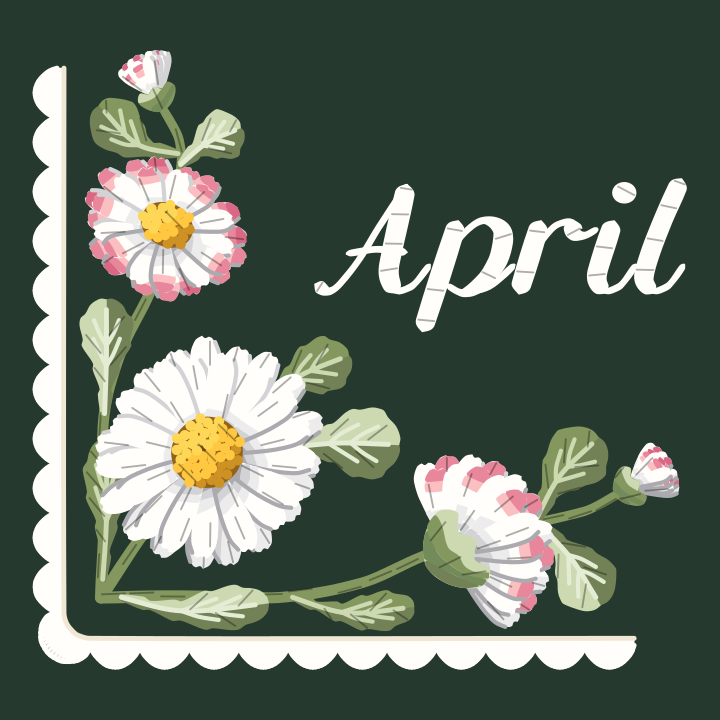
The petals are long and short stitch, white on the lit side and gray in the folds, with split stitch edges.
Choose a size
| Hoop | Inches | Centimeters | Satin stitch up to |
|---|---|---|---|
| 3 in (8 cm) | 1.6 × 1.5 in | 4.1 × 3.8 cm | 3/16 in (5 mm) |
| 4 in (10 cm) | 2.3 × 2.2 in | 5.8 × 5.6 cm | 1/4 in (6 mm) |
| 5 in (13 cm) | 3.1 × 3 in | 7.9 × 7.6 cm | 5/16 in (8 mm) |
| 6 in (15 cm) | 3.9 × 3.7 in | 9.9 × 9.4 cm | 7/16 in (11 mm) |
| 8 in (20 cm) | 5.5 × 5.2 in | 14 × 13.2 cm | 9/16 in (14 mm) |
- In an 8 inch hoop the widest satin stitch shape is 9/16 in (14 mm) across. Satin stitches longer than about 12 mm (just under 1/2 in) tend to work loose: divide the shape into sections, or work it in long and short stitch.
- In a 3 or 4 inch hoop the French knots are drawn smaller than about 2 mm (a little over 1/16 in). Use one strand of floss for them there, or choose a larger hoop.
Before you start
- New to this? Try an easy pattern first, or see how to read one.
- Print at actual size (100%, not “fit”). Dark fabric: trace with a white pencil over a bright light, or use a wash-away sheet. Then put it in the hoop, tight as a drum.
- Print at actual size (100%, not “fit”), tape the sheets and trace all of it. Hoop one part, stitch it, then move the hoop; raised parts and knots last.
- Floss has six strands: cut 18 inches (45 cm), pull out the number named one at a time, and lay them together.
- The back is seen: no knots. Start with tiny stitches; end around the backs of four or five stitches.
- On the drawing a ring is one French knot; a broken line inside a shape is where two shades meet: trace it, do not stitch it.
On linens. Pillowcase: middle of the hem band; napkin: one corner, on the diagonal. How to embroider pillowcases and napkins
What you need
- Hoop
- 6 in (15 cm), 3.9 × 3.7 in stitched. Another size
- Fabric
- Plain cotton or linen in dark green or another dark color, cut 9 in (23 cm) square.
- Needle
- Embroidery needle, size 9.
- Floss
- 17 colors of six-strand cotton. Skeins: 2 of DMC BLANC; one of each other color, an estimate for the 6 inch hoop from the drawing’s lines and shapes.
- Also
- White pencil, small scissors.
DMC is a brand, the number its color: another brand in a like color will do.
Threads and stitches
- 1DMC BLANC White
- 2DMC ECRU Ecru
- 3DMC 3364 Pine Green
- 4DMC 3363 Medium Pine Green
- 5DMC 3348 Light Yellow Green
- 6DMC 772 Very Light Yellow Green
- 7DMC 762 Very Light Pearl Gray
- 8DMC 318 Light Steel Gray
- 9DMC 415 Pearl Gray
- 10DMC 780 Ultra Very Dark Topaz
- 11DMC 783 Medium Topaz
- 12DMC 725 Medium Light Topaz
- 13DMC 726 Light Topaz
- 14DMC 3689 Light Mauve
- 15DMC 3733 Dusty Rose
- 16DMC 3731 Very Dark Dusty Rose
- 17DMC 988 Medium Forest Green
Stitch in this order
Where a stitch page says otherwise, follow this list.
- Long and short stitch 1 strandStems, petals, flower cups
- Fishbone stitch 2 strandsLeaves
- Satin stitch 2 strandsEyes, month
- Buttonhole stitch 2 strandsScalloped edge
- Stem stitch 2 strandsEdge cord, leaf veins (colors 5 and 6)
- Split stitch 1 strandLeaf veins (colors 5 and 6), petal edges
- French knot 1 strand, two wrapsKnots of the eyes
Take out lines that still show, press face down, finish the hoop.
About this pattern
Advanced. Uses long and short stitch over much of the design, dozens of French knots, 17 colors and a great deal of stitching; from a 6 inch hoop up the widest satin stitches are long.
The eyes are French knots in golds over satin stitch. The spoon leaves are fishbone stitch with stem stitch and split stitch veins. The scalloped edge is close buttonhole stitch in white with an ecru cord of stem stitch inside it, and the name of the month is satin stitch. Every month in the set of twelve has the same edge, lettering, and places for its flowers, so they match side by side.
1 DMC BLANC: petals (shade 7 of 7), scalloped edge and month. 2 DMC ECRU: edge cord. 3 DMC 3364: stems, leaves (middle), flower cups (light). 4 DMC 3363: leaves (dark), flower cups (darkest). 5 DMC 3348: leaves (light), leaf veins (darker), flower cups (lightest). 6 DMC 772: leaf veins (lighter). 7 DMC 762: petals (shade 6 of 7). 8 DMC 318: petal edges (darker), petals (shade 3 of 7). 9 DMC 415: petals (shade 5 of 7), petal edges (lighter). 10 DMC 780: eyes (darkest). 11 DMC 783: eyes (dark). 12 DMC 725: eyes (light). 13 DMC 726: eyes (lightest). 14 DMC 3689: petals (shade 4 of 7). 15 DMC 3733: petals (shade 2 of 7). 16 DMC 3731: petals (shade 1 of 7). 17 DMC 988: flower cups (dark).
A guide to this kind of work: Stitches for flowers.
The rest of this set
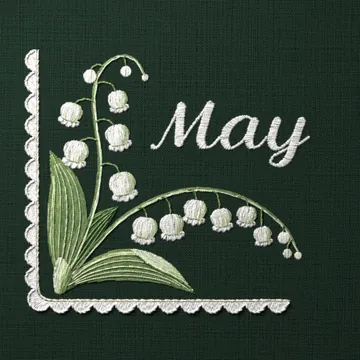
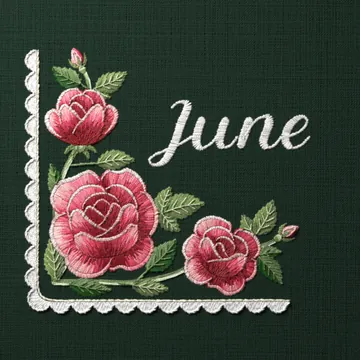
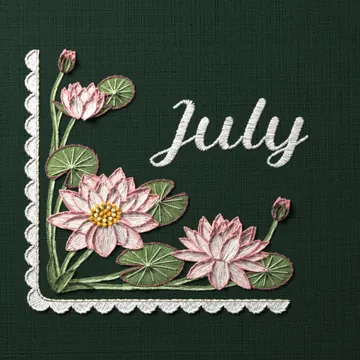
More subjects and crafts
Patterns
- September birth flower, aster
- October birth flower, marigold
- November birth flower, chrysanthemum
- December birth flower, holly
- January birth flower, carnation
- February birth flower, violet
- March birth flower, daffodil
- Blossom and daisy wreath
- Oopsie daisy in laurel
- Daisy wreath in colonial knots
- Round daisy coaster
- Daisy patch border with a blank center
- Three daisy bookmark
- Daisy crescent spray
- Rainbow with daisies