Bayeux Tapestry final scene hand embroidery pattern
Advanced · 15 colors · 9 kinds of stitch
Download free PDFPDF, US Letter · 76 KBFor your own stitching, gifts and handmade pieces you sell. Do not resell or share this PDF or copies of it. Selling, classes and kits: the rules
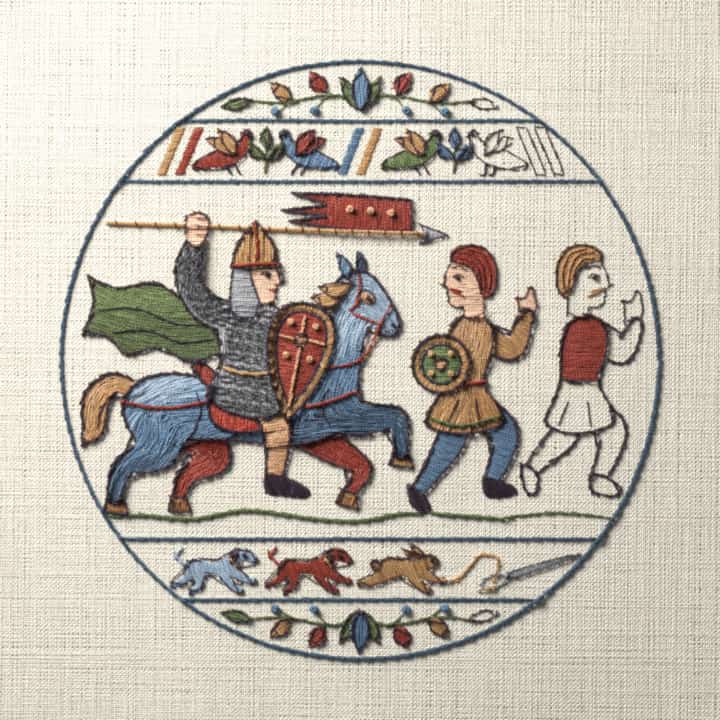
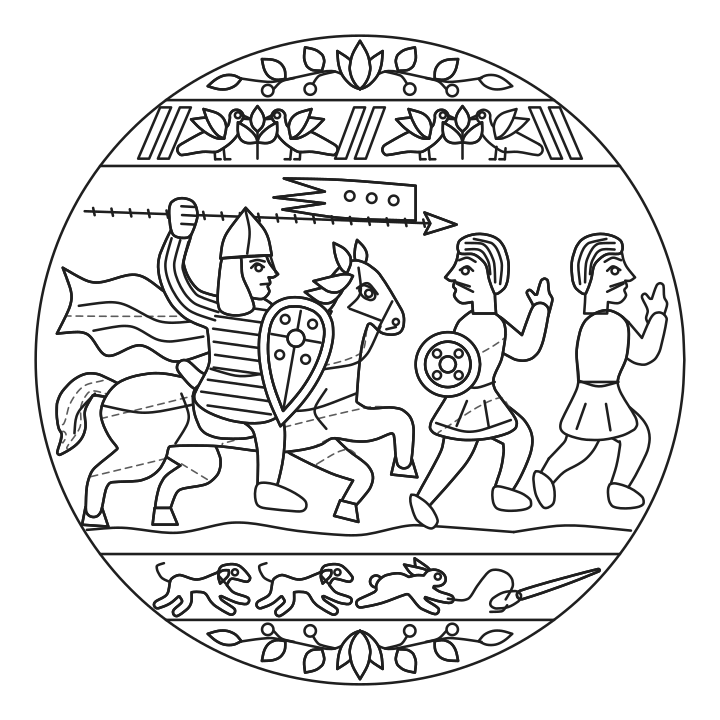
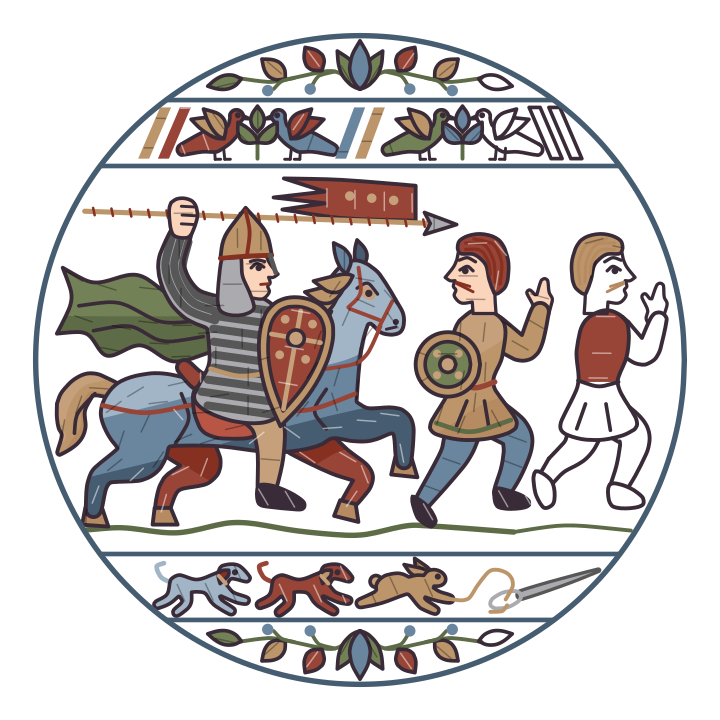
The last scene of the Bayeux Tapestry, brought close in a circle. A rider in mail and a pointed helmet gallops on a blue horse with rust far legs, his cape flying, after two Englishmen; the second is mostly outline, as if the work had just been put down. Birds and slanting bars run above, and two hounds chase a hare toward a threaded needle below. The horse and cape are long and short stitch, clothes and shields satin stitch, the mail rows of chain stitch, the lance couched, and every outline stem stitch or split stitch, with back stitch brows and French knot bosses. In the picture of where the colors go, the fine lines show which way the stitches lie.
Size and details
Advanced. Uses long and short stitch, couching, 15 colors and a great deal of stitching; from a 6 inch hoop up the widest satin stitches are long.
15 colors of floss and 9 kinds of stitch:
- Stem stitch
- Satin stitch
- French knot
- Long and short stitch
- Back stitch
- Straight stitch
- Chain stitch
- Couching
- Split stitch
- Which stitch goes where
| Hoop | Inches | Centimeters | Satin stitch up to |
|---|---|---|---|
| 3 in (8 cm) | 2 × 2 in | 5.1 × 5.1 cm | 3/16 in (5 mm) |
| 4 in (10 cm) | 3 × 3 in | 7.6 × 7.6 cm | 1/4 in (6 mm) |
| 5 in (13 cm) | 4 × 4 in | 10.2 × 10.2 cm | 5/16 in (8 mm) |
| 6 in (15 cm) | 5 × 5 in | 12.7 × 12.7 cm | 3/8 in (10 mm) |
| 8 in (20 cm) | 7 × 7 in | 17.8 × 17.8 cm | 9/16 in (14 mm) |
- In an 8 inch hoop the widest satin stitch shape is 9/16 in (14 mm) across. Satin stitches longer than about 12 mm (just under 1/2 in) tend to work loose: divide the shape into sections, or work it in long and short stitch.
- In a 3, 4 or 5 inch hoop the French knots are drawn smaller than about 2 mm (a little over 1/16 in). Use one strand of floss for them there, or choose a larger hoop.
The pattern is drawn inside a circle about half an inch (1.3 cm) smaller all around than the hoop.
What you need
- DMC 3362 Dark Pine GreenCape (darker), scroll stems, ground, tunic hem and border plants
- DMC 355 Dark Terra CottaPennon, shield, last tunic and saddle, far legs (lighter) and 11 more parts
- DMC 3371 Black BrownScroll leaf outlines, bird outlines, horse outline and last runner and 43 more parts
- DMC 3045 Dark Yellow BeigeTunic and tail (middle), shield rim and tunic sleeves, hare (darker) and 11 more parts
- DMC 3363 Medium Pine GreenCape (lighter), scroll leaves (dark), round shield, birds (middle) and 1 more part
- DMC 931 Medium Antique BlueHorse (middle), stockings and berries, scroll leaves and birds (light) and 3 more parts
- DMC 3828 Hazelnut BrownTunic and tail (dark), hooves, hair strands and moustaches (lighter)
- DMC 422 Light Hazelnut BrownRider leg, shield cross and shield bosses, tunic and tail (light) and 5 more parts
- DMC 3777 Very Dark Terra CottaFar legs, hair strands, lance and moustaches (darker), helmet band and 2 more parts
- DMC 930 Dark Antique BlueFrame, horse (dark), ears (darker)
- DMC 932 Light Antique BlueHorse (light), hounds (lightest), hounds tails (lighter)
- DMC 3830 Terra CottaSaddle cloth
- DMC 318 Light Steel GrayMail, coif, needle, needle eye and lance head
- DMC 413 Dark Pewter GrayMail rings, needle outline and helmet nasal
- DMC 945 TawnyFaces and hands
Skeins: 2 for scroll leaf outlines, bird outlines, horse outline and last runner and 43 more parts; one of each other color. An estimate for the largest size, the 8 inch hoop: the length of each line and the area of each filled shape, a fifth added for tails and ends, a tenth of every 8 m (8.7 yd) skein kept spare.
The floss is six-strand cotton; the stitch guide says how many strands to use. You also need a hoop, an embroidery needle (a size 9 or 10 for one strand, 7 to 9 for two or three, and 3 to 5 for four or more) and plain cotton or linen fabric. To frame the piece in its hoop, cut a square 3 inches (8 cm) wider than the hoop: a 9 inch (23 cm) square for a 6 inch hoop.
When it is stitched, how to finish a hoop shows how to back it for the wall.
Stitch guide
- Put the pattern on the fabric (how to transfer a pattern) and the fabric in the hoop.
- Stitch the filled parts first, what lies behind before what lies in front of it.
- Then stitch the lines: stems, veins and outlines over the edges of the filled parts.
- Keep the knots for the end, so that the hoop and your hand do not flatten them.
Inside a filled shape start with two or three tiny stitches, which the filling covers: a knot shows as a bump. A line may start with a small knot on the back or one of the knotless starts. End each thread by running the needle under the backs of a few stitches. (Starting and ending a thread shows how.) Use the strands this list gives, and begin as it says, also where a page about a stitch names another number or begins with a knot.
- Stem stitch 1 to 4 strandsScroll stems, scroll leaf outlines, ground, tail outline, tail lines, far legs outline, hooves outline, ears outline, horse outline, and 41 more
- Satin stitch 2 strandsScroll leaves, hooves, ears, mane, horse eye, saddle, saddle cloth, rider leg, shoes, pennon, lance head, hands, faces, coif, helmet, and 15 more
- French knot 1 to 2 strands, two wrapsBerries, horse eye, nostril, pennon dots, eyes, shield bosses, bird eyes, hounds eyes, hare eyes
- Long and short stitch 1 strandTail, far legs, horse, cape, mail, tunic, hair
- Back stitch 1 strandHorse eye, eyes, brows
- Straight stitch 1 to 2 strandsHorse mouth, hand lines, mouths, moustaches, bird legs, bird bills
- Chain stitch 2 strandsMail rings
- Couching 6 strandsLance
- Split stitch 1 strandFace lines, hand lines, hair strands, needle outline
Getting it onto your fabric
The PDF holds the pattern twice at actual size: once as drawn, and once mirrored for an iron-on transfer pen. Print it at 100% with scaling off and check the one-inch square (25.4 mm) with a ruler before you trace. How to transfer a pattern explains tracing, carbon paper, the sticky wash-away sheet for knits, denim and dark cloth, and the other ways. The files are under Downloads.
Downloads
- Download free PDF PDF, US Letter, 3 pages, for a 6 inch (15 cm) hoop
- Download free PDF, A4 PDF, A4, 3 pages, for a 6 inch (15 cm) hoop
More patterns like this
Advanced prints 3–14 in · 24 colors
Bayeux Tapestry ship at sea
Advanced 3–8 in hoop · 12 colors
Bayeux Tapestry story sampler
Advanced prints 3–14 in · 11 colors
Bayeux cooks and cauldron towel
Advanced prints 3–14 in · 15 colors
Cowboy silhouette roping the moon
Advanced prints 3–14 in · 13 colors
Spirit horse in the stars
Advanced prints 3–14 in · 18 colors
Arabian horse head with tassels
Advanced 3–8 in hoop · 18 colors
Racehorses border
Advanced 3–8 in hoop · 16 colors
Medieval cloak trim with pearl knots
New to hand embroidery? Starting hand embroidery, step by step