Crawfish and lemon border hand embroidery pattern
Advanced · 16 colors · 4.7 × 3.2 in · 7 kinds of stitch
Download free PDFPDFPrints on US Letter and A4You may sell what you make from it by hand, in small quantities. The PDF itself is not to be sold or shared. Selling, classes and kits: the rules
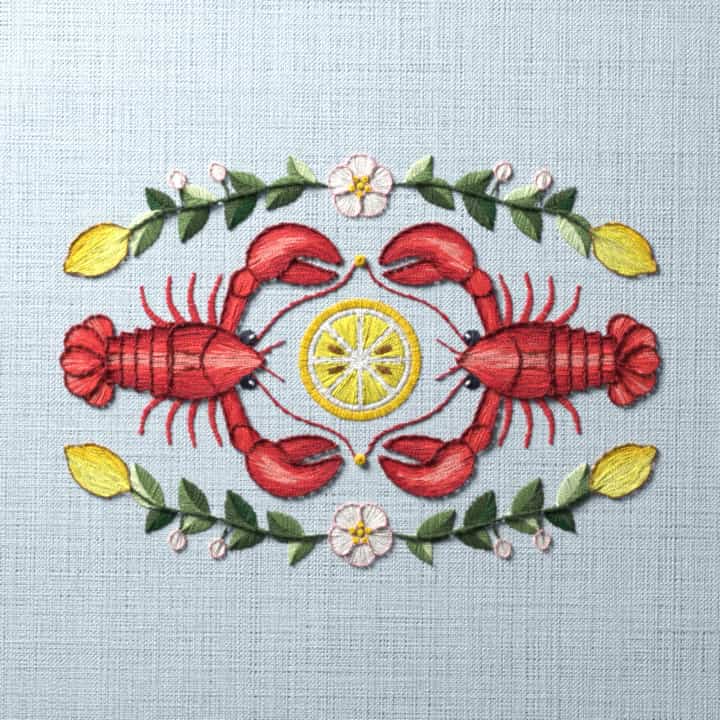
Two crawfish lie head to head along the band, seen from above, with their four claws open around one lemon slice and their long feelers meeting over and under it. A leafy bough runs along the top and the bottom with a white blossom in the middle, small buds and a whole lemon at each end.
Size and details
Advanced. Uses long and short stitch, 16 colors and a great deal of stitching.
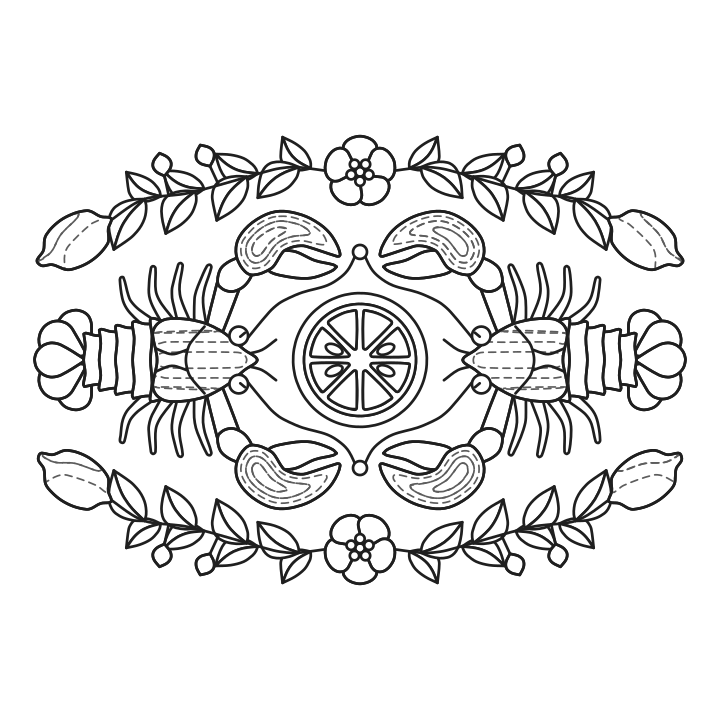
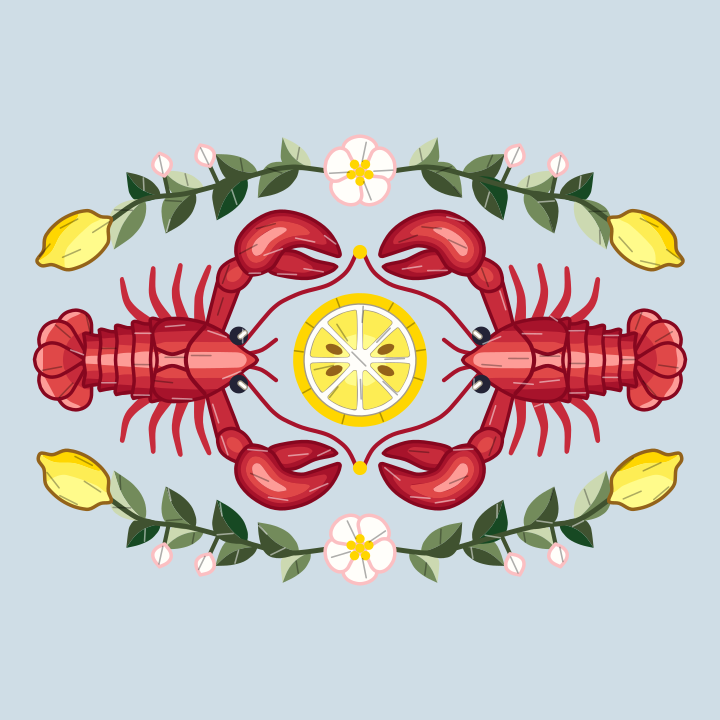
The shells, claws, tail fans and lemons are long and short stitch, the tail rings, legs and lemon slice are satin stitch, and fine split stitch draws every edge. The leaves are fishbone stitch, the boughs and feelers are stem stitch, and French knots make the blossom hearts. Repeat it tail to tail for a longer border on a towel hem or a table runner. It is drawn for pale blue linen. In the picture of where the colors go, the fine lines show which way the stitches lie.
| Hoop | Inches | Centimeters | Satin stitch up to |
|---|---|---|---|
| 3 in (8 cm) | 1.9 × 1.3 in | 4.8 × 3.3 cm | 1/8 in (3 mm) |
| 4 in (10 cm) | 2.8 × 1.9 in | 7.1 × 4.8 cm | 3/16 in (5 mm) |
| 5 in (13 cm) | 3.7 × 2.6 in | 9.4 × 6.6 cm | 1/4 in (6 mm) |
| 6 in (15 cm) | 4.7 × 3.2 in | 11.9 × 8.1 cm | 5/16 in (8 mm) |
| 8 in (20 cm) | 6.5 × 4.5 in | 16.5 × 11.4 cm | 7/16 in (11 mm) |
- In a 3, 4 or 5 inch hoop the French knots are drawn smaller than about 2 mm (a little over 1/16 in). Use one strand of floss for them there, or choose a larger hoop.
On a towel. Wash and dry the towel first. To start with, put the bottom of the design 2 to 3 inches (5 to 7.5 cm) above the hem, in the middle or in a lower corner. Keep the stitches low, and press from the back. How to embroider a towel has every step, and the placement chart has the figures for other towels.
What you need
- Fabric
- Plain cotton or linen in pale blue, cut 9 in (23 cm) square. On white cloth its palest threads do not show: choose other colors under Options.
- Needle
- Embroidery needle, size 9 for 1 strand, size 7 for 2 or 3 (a lower number is a thicker needle).
- Floss
- 16 colors of six-strand cotton, listed below. DMC is a brand: another brand in a like color will do.
- Marker
- A pen or a sheet that suits the fabric: how to transfer a pattern says which.
Floss
- 1DMC 3348 Light Yellow GreenLeaves (lightest)
- 2DMC 988 Medium Forest GreenLeaves (light)
- 3DMC 986 Very Dark Forest GreenLeaves (dark), bough and bud stalks
- 4DMC 890 Ultra Dark Pistachio GreenLeaves (darkest)
- 5DMC BLANC WhiteBlossoms, lemon pith, buds and eye light
- 6DMC 3689 Light MauveBlossom edges
- 7DMC 445 Light LemonLemons (light), lemon wedges (lighter)
- 8DMC 444 Dark LemonLemon rind, blossom hearts and feeler beads, lemons (dark)
- 9DMC 307 LemonLemon wedges (darker), lemons (middle)
- 10DMC 780 Ultra Very Dark TopazLemon edges and pips
- 11DMC 321 RedLegs, arms (middle), claws, tail rings, shell and tail fan (dark)
- 12DMC 350 Medium CoralTail rings, shell, claws and arms (light), tail fan (middle)
- 13DMC 352 Light CoralTail rings, shell and claws (lightest), tail fan (light)
- 14DMC 815 Medium GarnetEdges and shell lines
- 15DMC 498 Dark RedClaws, tail rings and shell (darkest), feelers, arms (dark)
- 16DMC 310 BlackEyes
Skeins: one of each color is enough. An estimate for the 6 inch hoop, from the length of each line and the area of each filled shape, with a fifth added for tails.
How to stitch it
- New to hand embroidery? Start here.
- Print at 100%, trace the pattern onto the fabric, and put it in the hoop: inner ring under, drawing up, tight as a drum.
- Floss is six strands. Cut 18 inches (45 cm), pull out the number given one at a time, and lay them together.
- Begin with no knot on the back where it is seen and washed, as on a towel, a napkin or clothes; for a piece in a hoop a small knot is fine. End each thread by whipping it around the backs of four or five stitches, with one small hitch.
- Each small ring is one French knot. A fine broken line inside a shape is where two shades meet: trace it, do not stitch it.
- A number under “Where colors go” is a color of the list. The fine lines on the colors show which way the stitches lie.
Stitch in this order
Filled parts from the back of the picture forward, then lines and knots. Where a stitch page names another number of strands, use the number here.
- Fishbone stitch 2 strandsLeaves
- Satin stitch 2 strandsBuds, lemon rind, lemon pith, lemon wedges, pips, legs, tail rings, arms, eyes, blossoms
- Long and short stitch 1 strandLemons, tail fan, arms, claws, shell
- Stem stitch3 strands: bough2 strands: bud stalks, feelers1 or 2 strands: shell lines
- Split stitch2 strands: edges1 strand: blossom edges, lemon edges
- Straight stitch 3 strandsEye light
- French knot 2 strands, two wrapsBlossom hearts, feeler beads
When it is done, take off any lines that still show and finish the hoop.
More patterns like this
Advanced 3–8 in hoop · 18 colors
Crawfish and blue iris
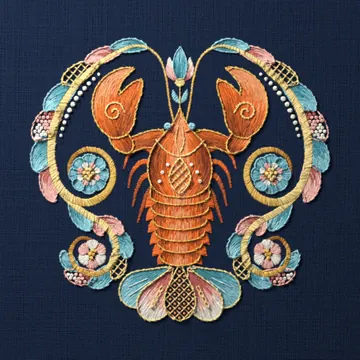
Advanced prints 3–14 in · 13 colors
Crawfish with scrolls
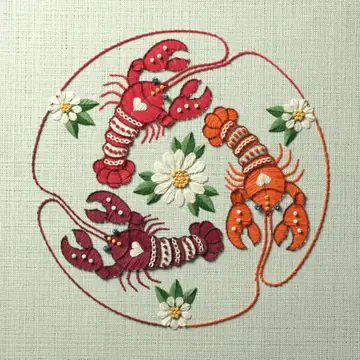
Advanced 3–8 in hoop · 11 colors
Three crawfish in a ring
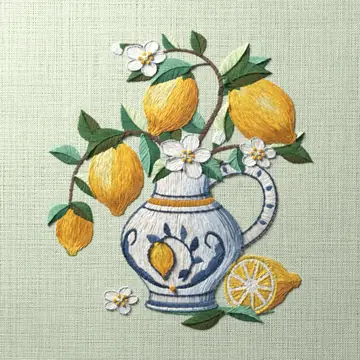
Advanced 3–8 in hoop · 17 colors
Italian lemons in a blue painted jug
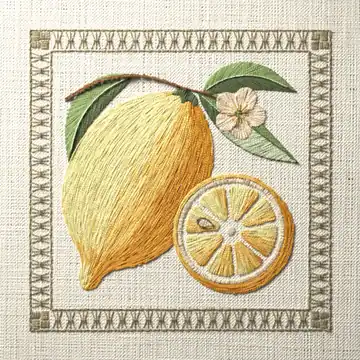
Advanced prints 3–14 in · 9 colors
Lemon coaster with a cut half
Advanced 3–8 in hoop · 20 colors
Lemon branch edging
Advanced 3–8 in hoop · 16 colors
Mahjong tile border with bamboo
Advanced prints 3–14 in · 16 colors
Cardinal lace border for a dresser scarf
New to hand embroidery? Starting hand embroidery, step by step