Daffodil, rose, thistle and shamrock jug hand embroidery pattern
Advanced · 24 colors · 9 kinds of stitch
Download free PDFPDF, US Letter · 96 KBFor your own stitching, gifts and handmade pieces you sell. Do not resell or share this PDF or copies of it. Selling, classes and kits: the rules
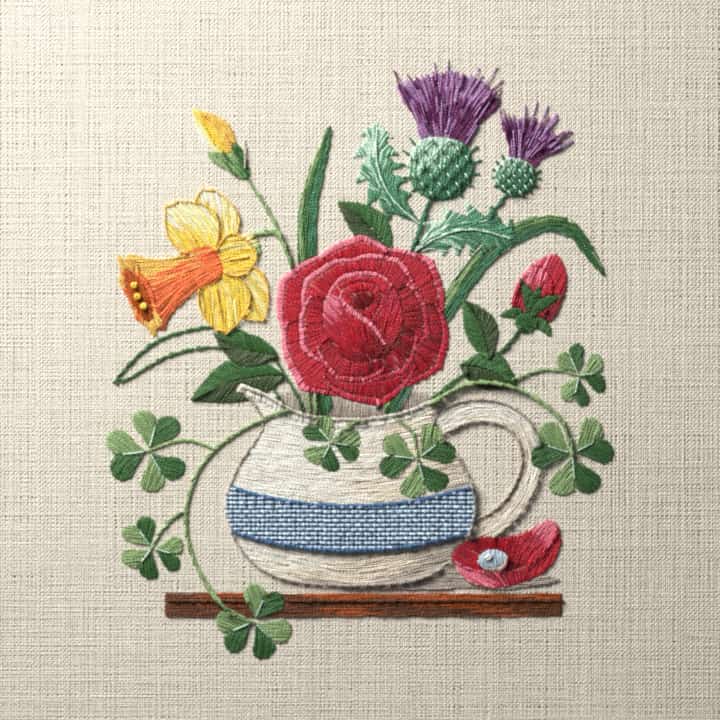
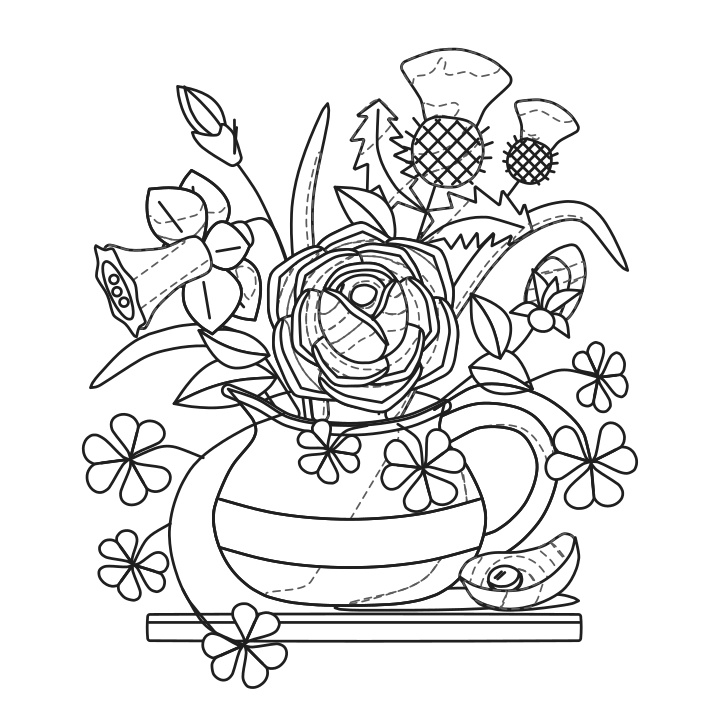
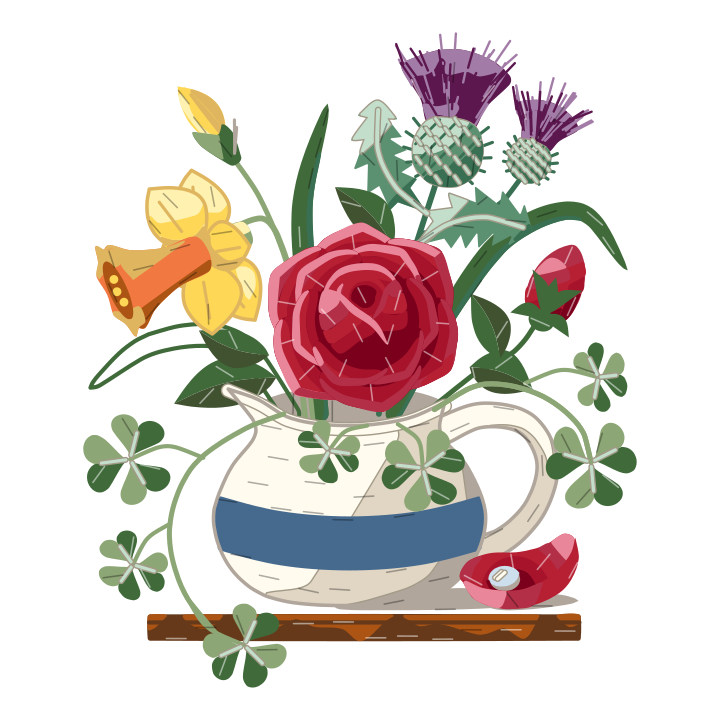
Four flowers share one cream jug: a full crimson rose, a daffodil nodding in profile, violet thistles and shamrocks that spill over the lip and down past the table edge. The petals, thistle tufts and jug are long and short stitch, and trellis stitch makes the thistle scales. The blue band is a woven filling, the rose leaves are fishbone stitch, and the shamrocks are satin stitch with pale veins in straight stitch. Stems are stem stitch, and three French knots sit in the orange trumpet. A fallen petal beside the jug cups one dewdrop. In the picture of where the colors go, the fine lines show which way the stitches lie.
Size and details
Advanced. Uses long and short stitch over much of the design, trellis stitch, 24 colors and a great deal of stitching; from a 5 inch hoop up the widest satin stitches are long.
24 colors of floss and 9 kinds of stitch:
- Long and short stitch
- Stem stitch
- Split stitch
- Satin stitch
- Fishbone stitch
- Straight stitch
- Trellis stitch
- French knot
- Woven filling stitch
- Which stitch goes where
| Hoop | Inches | Centimeters | Satin stitch up to |
|---|---|---|---|
| 3 in (8 cm) | 1.6 × 1.8 in | 4.1 × 4.6 cm | 3/16 in (5 mm) |
| 4 in (10 cm) | 2.3 × 2.8 in | 5.8 × 7.1 cm | 1/4 in (6 mm) |
| 5 in (13 cm) | 3.1 × 3.7 in | 7.9 × 9.4 cm | 3/8 in (10 mm) |
| 6 in (15 cm) | 3.9 × 4.6 in | 9.9 × 11.7 cm | 7/16 in (11 mm) |
| 8 in (20 cm) | 5.5 × 6.5 in | 14 × 16.5 cm | 5/8 in (16 mm) |
- In an 8 inch hoop the widest satin stitch shape is 5/8 in (16 mm) across. Satin stitches longer than about 12 mm (just under 1/2 in) tend to work loose: divide the shape into sections, or work it in long and short stitch.
- In a 3, 4, 5 or 6 inch hoop the French knots are drawn smaller than about 2 mm (a little over 1/16 in). Use one strand of floss for them there, or choose a larger hoop.
The pattern is drawn inside a circle about half an inch (1.3 cm) smaller all around than the hoop.
What you need
- DMC 801 Dark Coffee BrownTable edge (darker), table groove
- DMC 920 Medium CopperTable edge (lighter), trumpet throat and 1 more part
- DMC 647 Medium Beaver GrayJug outline, jug inside and shadows and 3 more parts
- DMC 3033 Very Light Mocha BrownJug (middle), jug handle (darker)
- DMC 712 CreamJug (light), jug handle (lighter), jug lip and dew light
- DMC 3346 Hunter GreenDaffodil leaves (darker) and 7 more parts
- DMC 501 Dark Blue GreenThistle scales (darker) and 5 more parts
- DMC 502 Blue GreenThistle leaves and thistle bulb (middle)
- DMC 504 Very Light Blue GreenThistle bulb (light), shamrock veins and 3 more parts
- DMC 989 Forest GreenShamrock leaves (lighter), shamrock stems and 3 more parts
- DMC 986 Very Dark Forest GreenRose leaves (darker)
- DMC 550 Very Dark VioletThistle tuft (darker)
- DMC 209 Dark LavenderThistle tuft (lighter)
- DMC 726 Light TopazDaffodil petals and daffodil bud (middle), anthers
- DMC 3820 Dark StrawPetal edges, daffodil petals (dark) and 4 more parts
- DMC 727 Very Light TopazDaffodil petals (light) and 2 more parts
- DMC 721 Medium Orange SpiceDaffodil trumpet (middle), trumpet frill (darker)
- DMC 3831 Dark RaspberryRose petal edges (middle), rosebud (light) and 2 more parts
- DMC 814 Dark GarnetRose petals and rosebud (darkest) and 3 more parts
- DMC 498 Dark RedRose petals, rosebud and fallen petal (dark)
- DMC 304 Medium RedRose petals and fallen petal (middle) and 2 more parts
- DMC 3833 Light RaspberryRose petal edges (light) and 3 more parts
- DMC 798 Dark Delft BlueWoven band and band edges
- DMC 3841 Pale Baby BlueDewdrop (lighter)
Skeins: one of each color is enough. An estimate for the largest size, the 8 inch hoop: the length of each line and the area of each filled shape, a fifth added for tails and ends, a tenth of every 8 m (8.7 yd) skein kept spare.
The floss is six-strand cotton; the stitch guide says how many strands to use. You also need a hoop, an embroidery needle (a size 9 or 10 for one strand, 7 to 9 for two or three, and 3 to 5 for four or more) and plain cotton or linen fabric. To frame the piece in its hoop, cut a square 3 inches (8 cm) wider than the hoop: a 9 inch (23 cm) square for a 6 inch hoop.
When it is stitched, how to finish a hoop shows how to back it for the wall.
Stitch guide
- Put the pattern on the fabric (how to transfer a pattern) and the fabric in the hoop.
- Stitch the filled parts first, what lies behind before what lies in front of it.
- Then stitch the lines: stems, veins and outlines over the edges of the filled parts.
- Keep the knots for the end, so that the hoop and your hand do not flatten them.
Inside a filled shape start with two or three tiny stitches, which the filling covers: a knot shows as a bump. A line may start with a small knot on the back or one of the knotless starts. End each thread by running the needle under the backs of a few stitches. (Starting and ending a thread shows how.) Use the strands this list gives, and begin as it says, also where a page about a stitch names another number or begins with a knot.
- Long and short stitch 1 strandTable edge, shadows, jug handle, daffodil leaves, thistle leaves, and 13 more
- Stem stitch 1 to 4 strandsTable groove, daffodil leaf outline, thistle stem, leaf veins, and 4 more
- Split stitch 1 to 2 strandsJug outline, petal edges, dewdrop edge
- Satin stitch 2 strandsJug inside, trumpet throat, sepals, rose hip, jug lip, shamrock leaves, and 3 more
- Fishbone stitch 2 strandsRose leaves
- Straight stitch 1 to 2 strandsThistle spines, daffodil sheath, petal veins, shamrock veins, dew light
- Trellis stitch 1 strandThistle scales
- French knot 2 strands, two wrapsAnthers
- Woven filling stitch 3 strandsWoven band
Getting it onto your fabric
The PDF holds the pattern twice at actual size: once as drawn, and once mirrored for an iron-on transfer pen. Print it at 100% with scaling off and check the one-inch square (25.4 mm) with a ruler before you trace. How to transfer a pattern explains tracing, carbon paper, the sticky wash-away sheet for knits, denim and dark cloth, and the other ways. The files are under Downloads.
Downloads
- Download free PDF PDF, US Letter, 3 pages, for a 6 inch (15 cm) hoop
- Download free PDF, A4 PDF, A4, 3 pages, for a 6 inch (15 cm) hoop
More patterns like this
Advanced prints 3–14 in · 22 colors
Medieval hare in a clover meadow
Advanced 3–8 in hoop · 15 colors
Shamrock row edging
Advanced 3–8 in hoop · 8 colors
Wheel of four shamrocks
Advanced prints 3–14 in · 8 colors
Celtic knot shamrock in gold
Advanced 3–8 in hoop · 24 colors
Calf at the barn stall
Advanced prints 3–14 in · 24 colors
St Patrick’s fox with a lucky shamrock
Advanced prints 3–14 in · 24 colors
Dice between two sprigs
Advanced prints 3–14 in · 24 colors
Hereford cow with a clover in her mouth
New to hand embroidery? Starting hand embroidery, step by step