Duck toller in autumn leaves hand embroidery pattern
Advanced · 22 colors · 6 kinds of stitch
Download free PDFPDF, US Letter · 145 KBFor your own stitching, gifts and handmade pieces you sell. Do not resell or share this PDF or copies of it. Selling, classes and kits: the rules
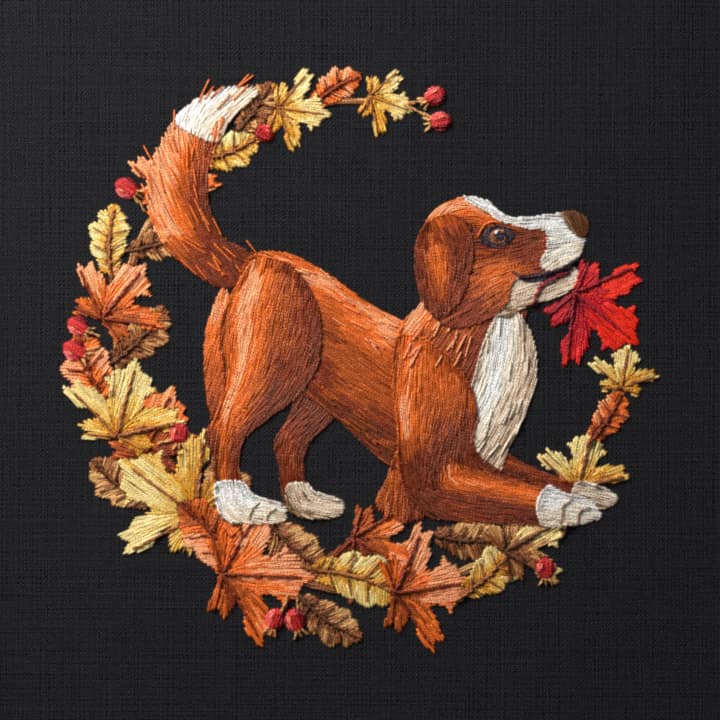
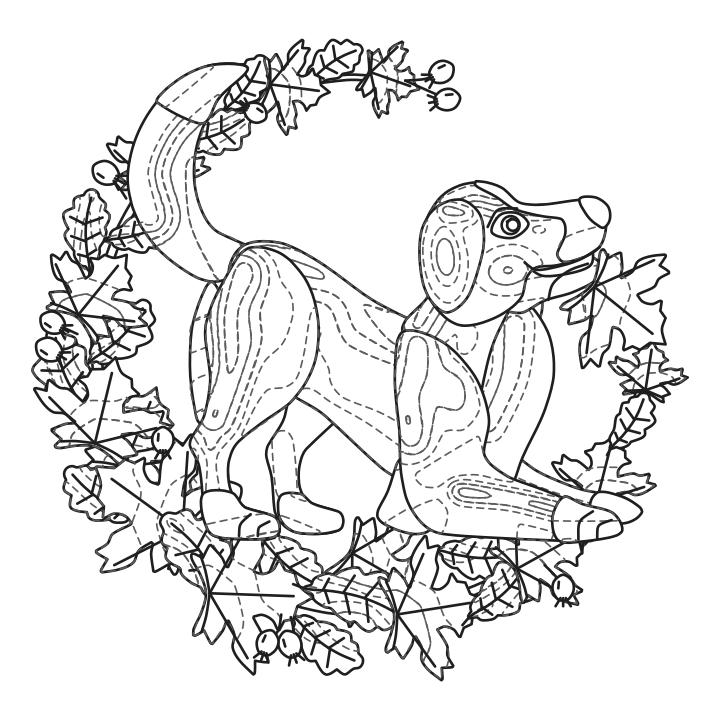
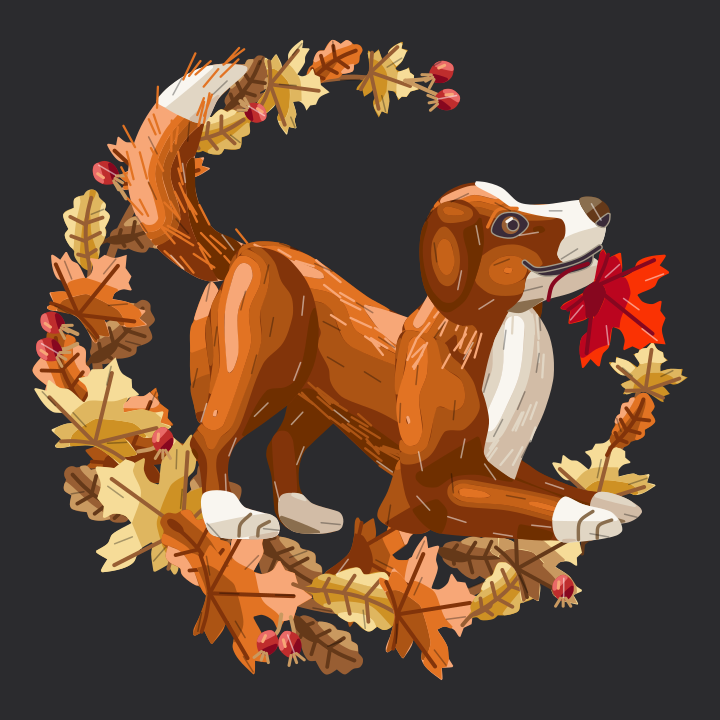
A Nova Scotia duck toller bows with its elbows down and its white-tipped tail in the air, holding one scarlet maple leaf. Maple leaves, oak leaves and rosehips sweep three quarters of the way round it. The coat and the leaves are long and short stitch, with stem stitch veins and stalks. The rosehips are padded satin stitch, and the nose and eye are satin stitch. It is drawn for charcoal linen. In the picture of where the colors go, the fine lines show which way the stitches lie.
Size and details
Advanced. Uses long and short stitch over much of the design, padded satin stitch, 22 colors and a great deal of stitching.
22 colors of floss and 6 kinds of stitch:
- Long and short stitch
- Stem stitch
- Padded satin stitch
- Straight stitch
- Split stitch
- Satin stitch
- Which stitch goes where
| Hoop | Inches | Centimeters | Satin stitch up to |
|---|---|---|---|
| 3 in (8 cm) | 1.9 × 1.9 in | 4.8 × 4.8 cm | 1/8 in (3 mm) |
| 4 in (10 cm) | 2.9 × 2.8 in | 7.4 × 7.1 cm | 3/16 in (5 mm) |
| 5 in (13 cm) | 3.8 × 3.7 in | 9.7 × 9.4 cm | 3/16 in (5 mm) |
| 6 in (15 cm) | 4.8 × 4.7 in | 12.2 × 11.9 cm | 1/4 in (6 mm) |
| 8 in (20 cm) | 6.7 × 6.6 in | 17 × 16.8 cm | 3/8 in (10 mm) |
The pattern is drawn inside a circle about half an inch (1.3 cm) smaller all around than the hoop.
What you need
- DMC 434 Light BrownOak leaves (shade 3 of 10), twigs (lighter), leaf veins (light) and 2 more parts
- DMC 801 Dark Coffee BrownLeaf veins (dark), oak leaves (shade 1 of 10), nose (middle), twigs (darker)
- DMC 436 TanOak leaves (shade 7 of 10), maple leaves (shade 6 of 9), rosehip stalks and rosehip tips
- DMC 920 Medium CopperMaple leaves (shade 3 of 9), body (middle dark) and 9 more parts
- DMC 918 Dark Red CopperBody, shoulder and foreleg, hind leg, neck and head (dark) and 9 more parts
- DMC 922 Light CopperMaple leaves (shade 4 of 9), tail (light), oak leaves (shade 5 of 10) and 7 more parts
- DMC 402 Very Light MahoganyMaple leaves (shade 7 of 9), tail, body and neck (lightest) and 6 more parts
- DMC 783 Medium TopazMaple leaves (shade 5 of 9), oak leaves (shade 6 of 10)
- DMC 3820 Dark StrawMaple leaves (shade 8 of 9), oak leaves (shade 9 of 10)
- DMC 3822 Light StrawMaple leaves (shade 9 of 9), oak leaves (shade 10 of 10)
- DMC 347 Very Dark SalmonRosehips (middle)
- DMC 815 Medium GarnetScarlet leaf veins and scarlet leaf stalk, rosehips and scarlet leaf (dark)
- DMC 351 CoralRosehips (light)
- DMC 300 Very Dark MahoganyFar hind leg and far foreleg (darker), body (darkest) and 6 more parts
- DMC 921 CopperShoulder and foreleg (middle light), hind leg feathers (middle) and 7 more parts
- DMC 3033 Very Light Mocha BrownWhite chest and white tail tip (middle), white paws (light) and 2 more parts
- DMC 3782 Light Mocha BrownWhite chest, white paws and white tail tip (dark), jaw (middle)
- DMC 3865 Winter WhiteWhite paws (lightest), white blaze (lighter), white chest (light) and 2 more parts
- DMC 3862 Dark Mocha BeigeToes, white paws (darkest), jaw (dark), nose (light)
- DMC 3371 Black BrownEye (darker), mouth and mouth line, nose (dark)
- DMC 606 Bright Orange-RedScarlet leaf (light)
- DMC 817 Very Dark Coral RedScarlet leaf (middle)
Skeins: 2 for body, shoulder and foreleg, hind leg, neck and head (dark) and 9 more parts; one of each other color. An estimate for the largest size, the 8 inch hoop: the length of each line and the area of each filled shape, a fifth added for tails and ends, a tenth of every 8 m (8.7 yd) skein kept spare.
The floss is six-strand cotton; the stitch guide says how many strands to use. You also need a hoop, an embroidery needle (a size 9 or 10 for one strand, 7 to 9 for two or three) and plain cotton or linen fabric. To frame the piece in its hoop, cut a square 3 inches (8 cm) wider than the hoop: a 9 inch (23 cm) square for a 6 inch hoop.
When it is stitched, how to finish a hoop shows how to back it for the wall.
Stitch guide
- Put the pattern on the fabric (how to transfer a pattern) and the fabric in the hoop.
- Stitch the filled parts first, what lies behind before what lies in front of it.
- Then stitch the lines: stems, veins and outlines over the edges of the filled parts.
Inside a filled shape start with two or three tiny stitches, which the filling covers: a knot shows as a bump. A line may start with a small knot on the back or one of the knotless starts. End each thread by running the needle under the backs of a few stitches. (Starting and ending a thread shows how.) Use the strands this list gives, and begin as it says, also where a page about a stitch names another number or begins with a knot.
- Long and short stitch 1 to 2 strandsTwigs, oak leaves, maple leaves, tail, white tail tip, far hind leg, white paws, far foreleg, body, hind leg feathers, hind leg, neck, and 8 more
- Stem stitch 1 to 2 strandsLeaf veins, rosehip stalks, scarlet leaf veins, scarlet leaf stalk
- Padded satin stitch 2 strandsRosehips
- Straight stitch 1 to 2 strandsRosehip tips, rosehip lights, eye light
- Split stitch 1 to 2 strandsToes, mouth line, eyelids
- Satin stitch 2 strandsMouth, nose, eye
Getting it onto your fabric
The PDF holds the pattern twice at actual size: once as drawn, and once mirrored for an iron-on transfer pen. Print it at 100% with scaling off and check the one-inch square (25.4 mm) with a ruler before you trace. How to transfer a pattern explains tracing, carbon paper, the sticky wash-away sheet for knits, denim and dark cloth, and the other ways. The files are under Downloads.
Downloads
- Download free PDF PDF, US Letter, 3 pages, for a 6 inch (15 cm) hoop
- Download free PDF, A4 PDF, A4, 3 pages, for a 6 inch (15 cm) hoop
More patterns like this
Advanced 3–8 in hoop · 23 colors
Golden retriever jumping a garden fence
Advanced 3–8 in hoop · 21 colors
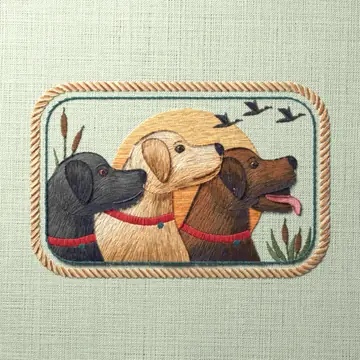
Three Labradors silhouette border
Advanced 3–8 in hoop · 21 colors
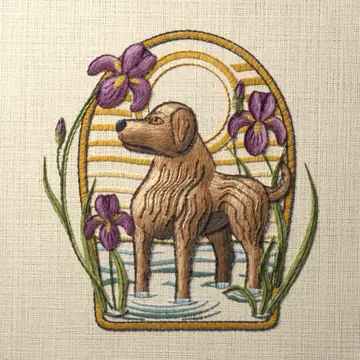
Chesapeake Bay retriever among irises
Advanced prints 3–14 in · 20 colors
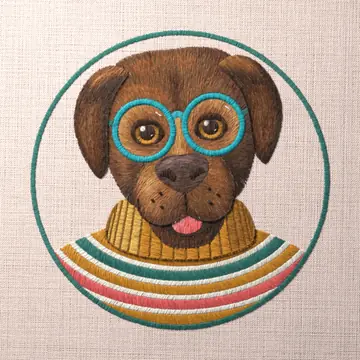
Chocolate Lab in glasses
Advanced prints 3–14 in · 19 colors
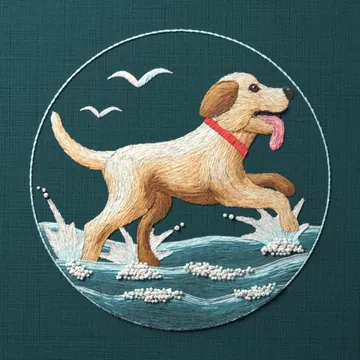
Yellow Lab running through the surf
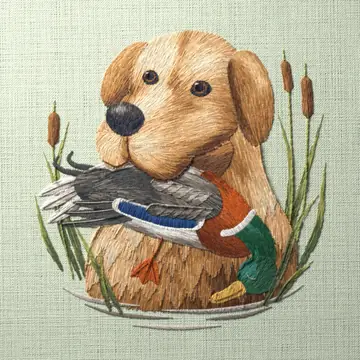
Advanced prints 3–14 in · 22 colors
Hunting Labrador with a duck
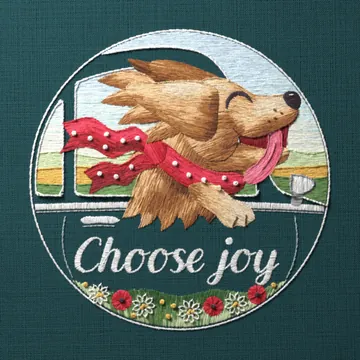
Advanced prints 3–14 in · 23 colors
Choose joy
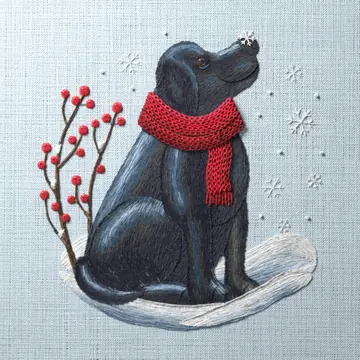
Advanced 3–8 in hoop · 21 colors
Black Lab in the snow
New to hand embroidery? Starting hand embroidery, step by step