Forget-me-not vine edging hand embroidery pattern
Advanced · 23 colors · 4.9 × 2.2 in · 7 kinds of stitch
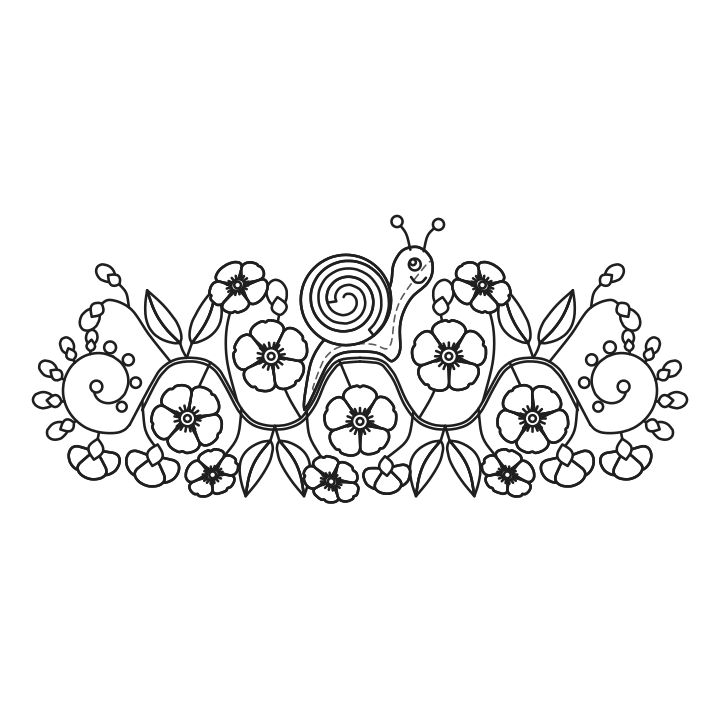
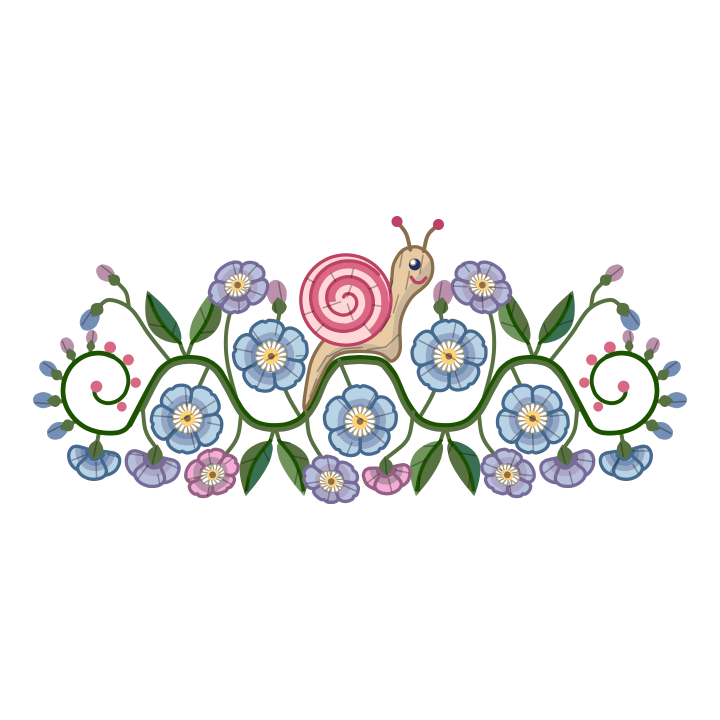
A number is a color of the list. Fine lines show which way the stitches lie: do not stitch them.
Download free PDFPDFYou may sell what you make from it by hand, in small quantities. The PDF itself is not to be sold or shared. Selling, classes and kits: the rules
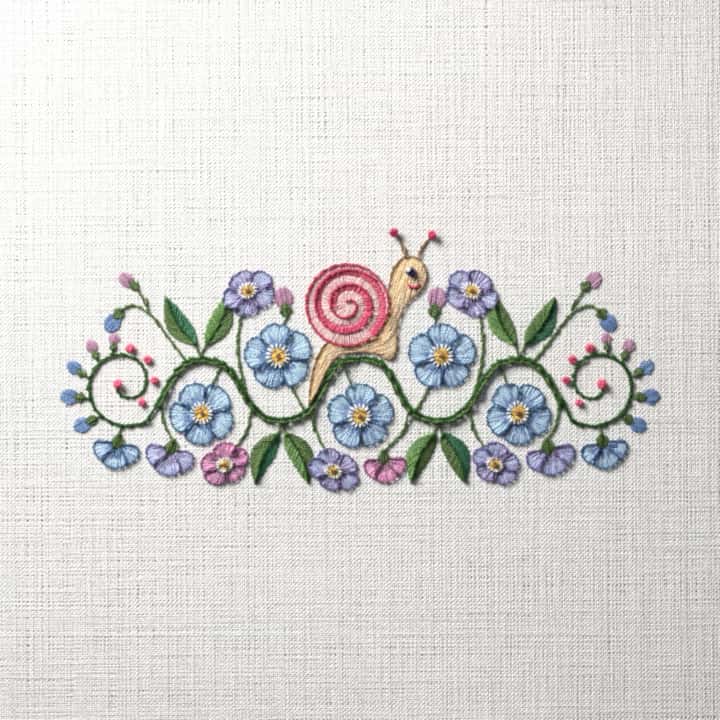
The vine is stem stitch in dark green with a lighter row beside it, and each end coils up into a curl of satin stitch buds and French knots.
Choose a size
| Hoop | Inches | Centimeters | Satin stitch up to |
|---|---|---|---|
| 3 in (8 cm) | 2 × 0.9 in | 5.1 × 2.3 cm | 1/16 in (1.6 mm) |
| 4 in (10 cm) | 2.9 × 1.3 in | 7.4 × 3.3 cm | 1/8 in (3 mm) |
| 5 in (13 cm) | 3.9 × 1.7 in | 9.9 × 4.3 cm | 1/8 in (3 mm) |
| 6 in (15 cm) | 4.9 × 2.2 in | 12.4 × 5.6 cm | 3/16 in (5 mm) |
| 8 in (20 cm) | 6.9 × 3 in | 17.5 × 7.6 cm | 1/4 in (6 mm) |
- In a 3, 4 or 5 inch hoop the French knots are drawn smaller than about 2 mm (a little over 1/16 in). Use one strand of floss for them there, or choose a larger hoop.
Before you start
- New to this? Try an easy pattern first, or see how to read one.
- Print at actual size (100%, not “fit”), trace the black lines, and put the fabric in the hoop, tight as a drum.
- Print at actual size (100%, not “fit”), tape the sheets and trace all of it. Hoop one part, stitch it, then move the hoop; raised parts and knots last.
- Floss has six strands: cut 18 inches (45 cm), pull out the number named one at a time, and lay them together.
- The back is seen: no knots. Start with tiny stitches; end around the backs of four or five stitches.
- On the drawing a ring is one French knot; a broken line inside a shape is where two shades meet: trace it, do not stitch it.
On a towel. 2 to 3 inches (5 to 7.5 cm) above the hem, stitches low. How to embroider a towel
On linens. Pillowcase: middle of the hem band; napkin: one corner, on the diagonal. How to embroider pillowcases and napkins
What you need
- Hoop
- 6 in (15 cm), 4.9 × 2.2 in stitched. Another size
- Fabric
- Plain cotton or linen in a light color, cut 9 in (23 cm) square, or a washed cotton tea towel.
- Needle
- Embroidery needle, size 9.
- Floss
- 23 colors of six-strand cotton. Skeins: one of each color is enough, an estimate for the 6 inch hoop from the drawing’s lines and shapes.
- Also
- Water-soluble pen or sharp pencil, small scissors.
DMC is a brand, the number its color: another brand in a like color will do.
Threads and stitches
- 1DMC 987 Dark Forest Green
- 2DMC 3347 Medium Yellow Green
- 3DMC 895 Very Dark Hunter Green
- 4DMC 501 Dark Blue Green
- 5DMC 3836 Light Grape
- 6DMC 341 Light Blue Violet
- 7DMC 3746 Dark Blue Violet
- 8DMC 340 Medium Blue Violet
- 9DMC BLANC White
- 10DMC 743 Medium Yellow
- 11DMC 3862 Dark Mocha Beige
- 12DMC 3325 Light Baby Blue
- 13DMC 798 Dark Delft Blue
- 14DMC 799 Medium Delft Blue
- 15DMC 809 Delft Blue
- 16DMC 3731 Very Dark Dusty Rose
- 17DMC 3835 Medium Grape
- 18DMC 3609 Ultra Light Plum
- 19DMC 738 Very Light Tan
- 20DMC 3864 Light Mocha Beige
- 21DMC 963 Ultra Very Light Dusty Rose
- 22DMC 3350 Ultra Dark Dusty Rose
- 23DMC 823 Dark Navy Blue
Stitch in this order
Where a stitch page says otherwise, follow this list.
- Stem stitch 2 strandsStalks
- Fishbone stitch 2 strandsLeaves
- Long and short stitch 1 strandBack petals, petals, young petals, snail body
- Satin stitch 2 strandsBuds, green cups, yellow eyes, shell, shell bands
- Stem stitch1 strand: lines of the leaves3 strands: vine2 strands: lines of the snail horns
- Straight stitch 2 strandsWhite rings
- Split stitch1 strand: back petals edge, petals edge, young petals edge, snail body edge2 strands: shell outline, snail smile
- French knot two wraps1 strand: eye dots, eye highlight2 strands: bud tips, knots of the snail horns, snail eye
Take out lines that still show, press face down, finish the hoop or sew a pillow.
About this pattern
Advanced. Uses long and short stitch, 23 colors and a great deal of stitching.
Every petal is long and short stitch, deep at the heart and pale at the rim, edged in split stitch, with a white ring of straight stitches round a yellow satin stitch eye. The leaves are fishbone stitch with a fine dark vein. The snail has a cream body in long and short stitch, a round shell of satin stitch bands outlined in split stitch, and French knots for the eye and the tips of the horns.
1 DMC 987: stalks and green cups, leaves (light), vine (lighter). 2 DMC 3347: leaves (lightest). 3 DMC 895: vine (darker), leaves (darkest). 4 DMC 501: leaves (dark). 5 DMC 3836: buds (lighter), young petals (middle). 6 DMC 341: back petals (light). 7 DMC 3746: back petals edge, back petals (dark). 8 DMC 340: back petals (middle). 9 DMC BLANC: white rings and eye highlight. 10 DMC 743: yellow eyes. 11 DMC 3862: snail body edge and eye dots, snail horns (lighter). 12 DMC 3325: petals (lightest). 13 DMC 798: petals edge, petals (darkest). 14 DMC 799: petals (dark), buds (darker). 15 DMC 809: petals (light). 16 DMC 3731: shell bands and bud tips. 17 DMC 3835: young petals edge, young petals (dark). 18 DMC 3609: young petals (light). 19 DMC 738: snail body (lighter). 20 DMC 3864: snail body (darker). 21 DMC 963: shell. 22 DMC 3350: shell outline and snail smile, snail horns (darker). 23 DMC 823: snail eye.
A guide to this kind of work: Stitches for borders and edges.