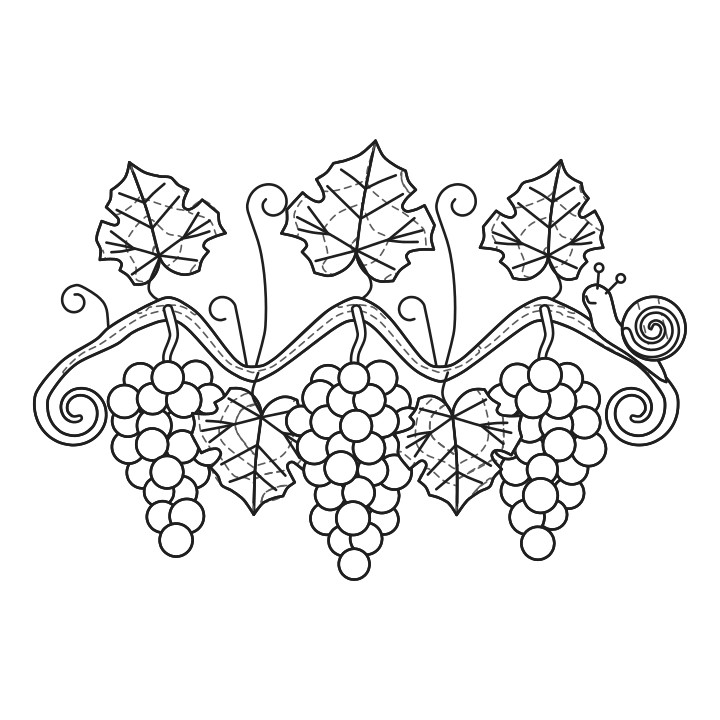
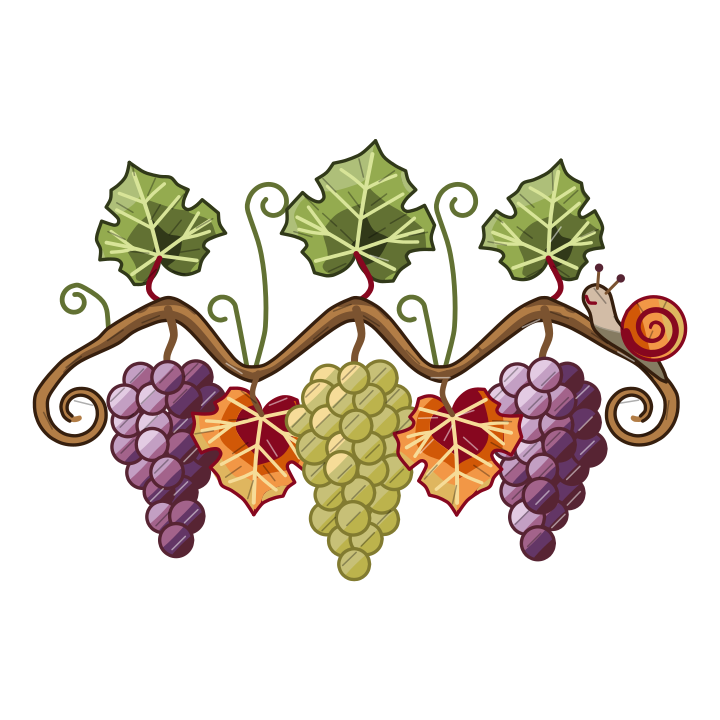
Grape vine edging hand embroidery pattern
Advanced · 23 colors · 4.8 × 3.3 in · 7 kinds of stitch
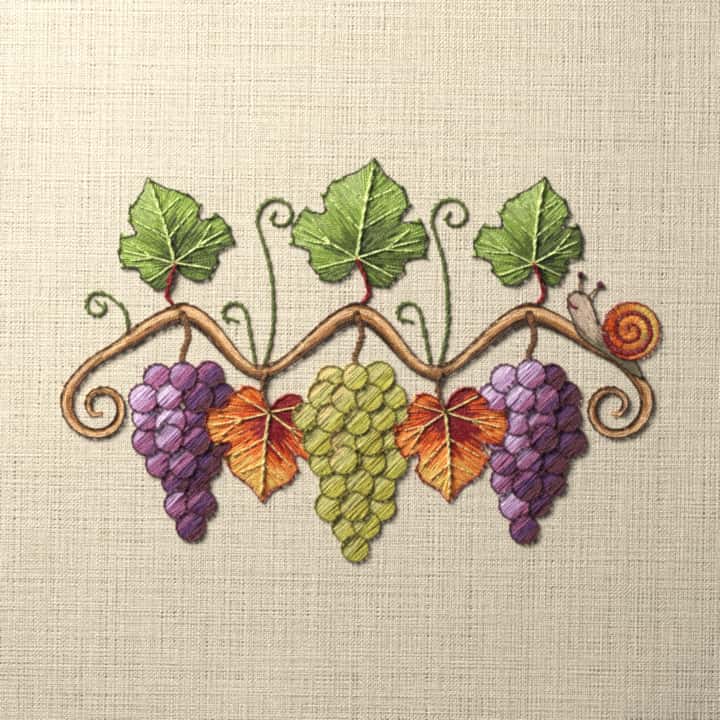
A number is a color of the list. Fine lines show which way the stitches lie: do not stitch them.
Download free PDFPDFYou may sell what you make from it by hand, in small quantities. The PDF itself is not to be sold or shared. Selling, classes and kits: the rules
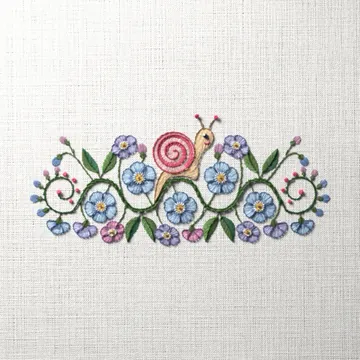
The vine runs the whole width in an even wave, thick on each crest and thin in each hollow, and a coil closes each end. A bunch hangs from every crest and an orange leaf from every hollow, so one wave can be traced again and again for a longer edging.
Choose a size
| Hoop | Inches | Centimeters | Satin stitch up to |
|---|---|---|---|
| 3 in (8 cm) | 1.9 × 1.3 in | 4.8 × 3.3 cm | 1/8 in (3 mm) |
| 4 in (10 cm) | 2.9 × 2 in | 7.4 × 5.1 cm | 1/8 in (3 mm) |
| 5 in (13 cm) | 3.9 × 2.6 in | 9.9 × 6.6 cm | 3/16 in (5 mm) |
| 6 in (15 cm) | 4.8 × 3.3 in | 12.2 × 8.4 cm | 1/4 in (6 mm) |
| 8 in (20 cm) | 6.8 × 4.6 in | 17.3 × 11.7 cm | 3/8 in (10 mm) |
- In a 3, 4, 5 or 6 inch hoop the French knots are drawn smaller than about 2 mm (a little over 1/16 in). Use one strand of floss for them there, or choose a larger hoop.
Before you start
- New to this? Try an easy pattern first, or see how to read one.
- Print at actual size (100%, not “fit”), trace the black lines, and put the fabric in the hoop, tight as a drum.
- Print at actual size (100%, not “fit”), tape the sheets and trace all of it. Hoop one part, stitch it, then move the hoop; raised parts and knots last.
- Floss has six strands: cut 18 inches (45 cm), pull out the number named one at a time, and lay them together.
- The back is seen: no knots. Start with tiny stitches; end around the backs of four or five stitches.
- On the drawing a ring is one French knot; a broken line inside a shape is where two shades meet: trace it, do not stitch it.
On linens. Pillowcase: middle of the hem band; napkin: one corner, on the diagonal. How to embroider pillowcases and napkins
What you need
- Hoop
- 6 in (15 cm), 4.8 × 3.3 in stitched. Another size
- Fabric
- Plain cotton or linen in a light color, cut 9 in (23 cm) square.
- Needle
- Embroidery needle, size 9, and size 5 for 4 strands.
- Floss
- 23 colors of six-strand cotton. Skeins: one of each color is enough, an estimate for the 6 inch hoop from the drawing’s lines and shapes.
- Also
- Water-soluble pen or sharp pencil, small scissors.
DMC is a brand, the number its color: another brand in a like color will do.
Threads and stitches
- 1DMC 937 Medium Avocado Green
- 2DMC 470 Light Avocado Green
- 3DMC 934 Black Avocado Green
- 4DMC 471 Very Light Avocado Green
- 5DMC 472 Ultra Light Avocado Green
- 6DMC 815 Medium Garnet
- 7DMC 435 Very Light Brown
- 8DMC 433 Medium Brown
- 9DMC 938 Ultra Dark Coffee Brown
- 10DMC 154 Very Dark Grape
- 11DMC 553 Violet
- 12DMC 327 Dark Violet
- 13DMC 210 Medium Lavender
- 14DMC 211 Light Lavender
- 15DMC 900 Dark Burnt Orange
- 16DMC 3853 Dark Autumn Gold
- 17DMC 3820 Dark Straw
- 18DMC 3822 Light Straw
- 19DMC 730 Very Dark Olive Green
- 20DMC 734 Light Olive Green
- 21DMC 733 Medium Olive Green
- 22DMC 640 Very Dark Beige Gray
- 23DMC 3782 Light Mocha Brown
Stitch in this order
Where a stitch page says otherwise, follow this list.
- Stem stitch 3 strandsTendrils
- Long and short stitch 1 strandLeaves, vine, bunch shadow, snail body
- Satin stitch 2 strandsStalks, grapes, green grapes, snail shell, shell spiral
- Back stitch1 strand: leaf veins (colors 5 and 18)2 strands: snail smile
- Stem stitch1 strand: leaf veins (colors 5 and 18)4 strands: leaf stalks
- Split stitch 1 strandLeaf edges, vine edge, grape edges, snail edge
- Straight stitch 2 strandsSnail horns
- French knot 2 strands, two wrapsSnail eyes
Take out lines that still show, press face down, finish the hoop.
About this pattern
Advanced. Uses long and short stitch over much of the design, 23 colors and a great deal of stitching.
Each grape is satin stitch with a fine split stitch edge. The vine, the lobed leaves and the snail’s body are long and short stitch, and the leaf veins are stem stitch and back stitch. The tendrils and leaf stalks are stem stitch. The snail has a satin stitch shell, straight stitch horns and French knot eyes.
1 DMC 937: leaves (shade 3 of 8), tendrils. 2 DMC 470: leaves (shade 5 of 8). 3 DMC 934: leaf edges (darker), leaves (shade 1 of 8). 4 DMC 471: leaves (shade 7 of 8). 5 DMC 472: leaf veins (darker). 6 DMC 815: leaves (shade 2 of 8), leaf edges and snail edge (lighter), shell spiral and snail smile, leaf stalks (darker). 7 DMC 435: vine (lighter). 8 DMC 433: vine (darker), stalks and snail horns, leaf stalks (lighter). 9 DMC 938: vine edge, snail edge (darker). 10 DMC 154: bunch shadow and grape edges (darker), grapes (darkest), snail eyes. 11 DMC 553: grapes (middle). 12 DMC 327: grapes (dark). 13 DMC 210: grapes (light). 14 DMC 211: grapes (lightest). 15 DMC 900: leaves (shade 4 of 8), snail shell (dark). 16 DMC 3853: leaves (shade 6 of 8), snail shell (middle). 17 DMC 3820: leaves (shade 8 of 8), snail shell (light). 18 DMC 3822: leaf veins (lighter), green grapes (light). 19 DMC 730: bunch shadow and grape edges (lighter). 20 DMC 734: green grapes (middle). 21 DMC 733: green grapes (dark). 22 DMC 640: snail body (darker). 23 DMC 3782: snail body (lighter).
A guide to this kind of work: Stitches for borders and edges.