Yule log, French Christmas tea towel hand embroidery pattern
Advanced · 17 colors · 8 kinds of stitch
Download free PDFPDF, US Letter · 89 KBFor your own stitching, gifts and handmade pieces you sell. Do not resell or share this PDF. What you may do, in full
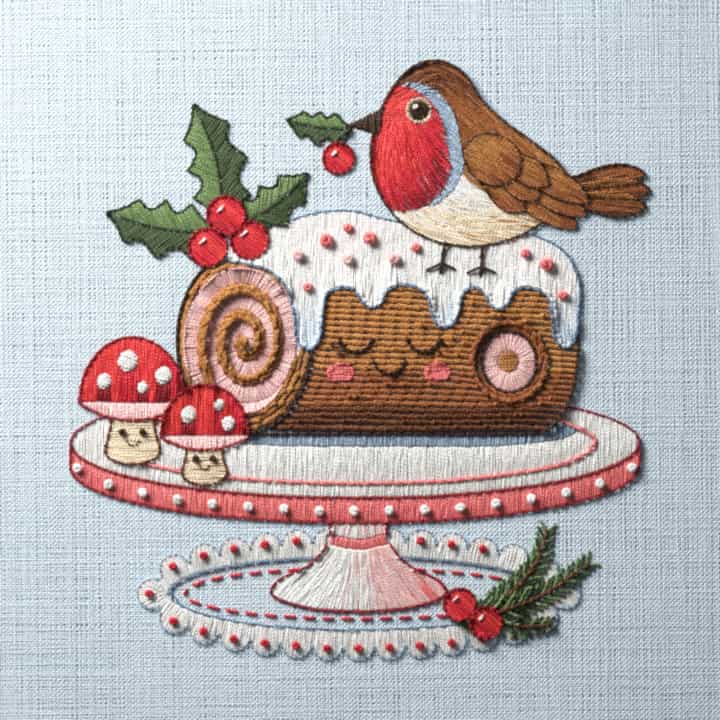
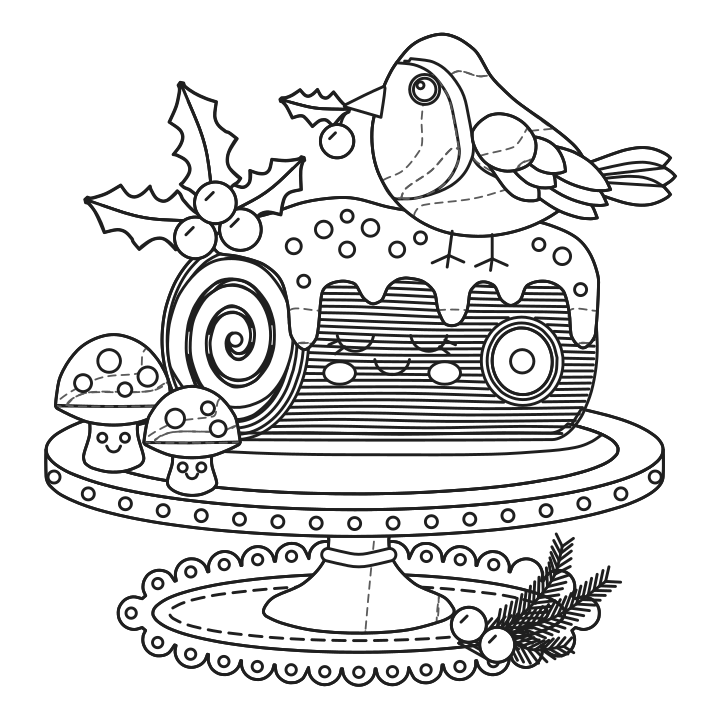
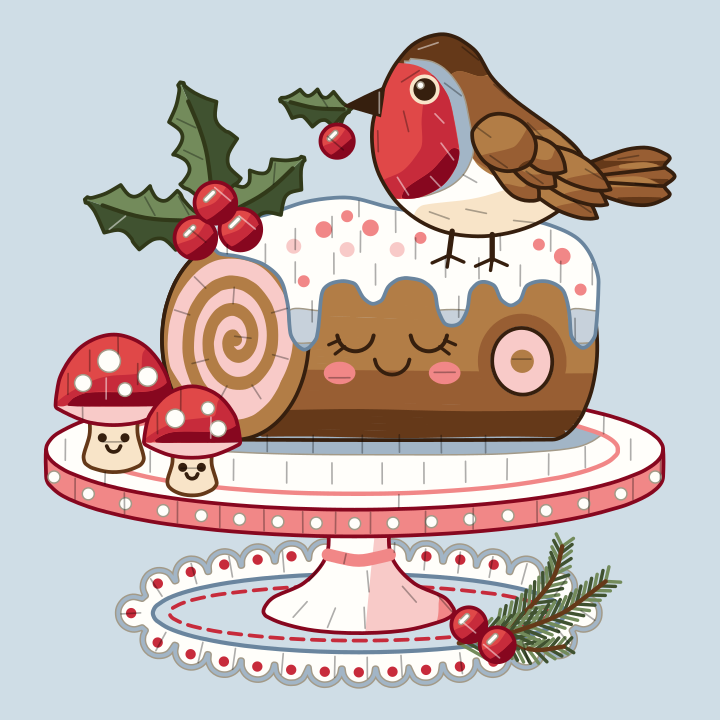
A chocolate Yule log sleeps on a rose cake stand, its cut end a spiral of cocoa and blush cream under dripping white icing. A robin on top brings a holly leaf and a berry, two toadstools smile on the plate, and a fir sprig lies on the doily. The bark and cocoa swirl are rows of stem stitch, the robin and icing are long and short stitch, and the berries, holly and plate are satin stitch. Back stitch edges each part in a darker thread, with French knots for the pearls and the dots on the rim. It is drawn for pale blue linen. In the picture of where the colors go, the fine lines show which way the stitches lie.
Size and details
Advanced. Uses long and short stitch, padded satin stitch, dozens of French knots, satin stitch over about a quarter of the cloth in a 6 inch hoop, 17 colors and a great deal of stitching; from a 5 inch hoop up some of the satin stitches are long.
17 colors of floss and 8 kinds of stitch:
- Satin stitch
- Stem stitch
- Back stitch
- Running stitch
- French knot
- Long and short stitch
- Straight stitch
- Padded satin stitch
- Which stitch goes where
| Hoop | Inches | Centimeters | Satin stitch up to |
|---|---|---|---|
| 3 in (8 cm) | 1.7 × 1.7 in | 4.3 × 4.3 cm | 3/16 in (5 mm) |
| 4 in (10 cm) | 2.5 × 2.6 in | 6.4 × 6.6 cm | 1/4 in (6 mm) |
| 5 in (13 cm) | 3.4 × 3.5 in | 8.6 × 8.9 cm | 3/8 in (10 mm) |
| 6 in (15 cm) | 4.2 × 4.4 in | 10.7 × 11.2 cm | 7/16 in (11 mm) |
| 8 in (20 cm) | 5.9 × 6.1 in | 15 × 15.5 cm | 5/8 in (16 mm) |
- In an 8 inch hoop the widest satin stitch shape is 5/8 in (16 mm) across. Satin stitches longer than about 12 mm (just under 1/2 in) tend to work loose: divide the shape into sections, or work it in long and short stitch.
- In a 3, 4 or 5 inch hoop the French knots are drawn smaller than about 2 mm (a little over 1/16 in). Use one strand of floss for them there, or choose a larger hoop.
The pattern is drawn inside a circle about half an inch (1.3 cm) smaller all around than the hoop.
What you need
- DMC BLANC WhitePlate and doily scallops, icing (light), robin belly (lighter) and 5 more parts
- DMC 931 Medium Antique BlueIcing edge, doily edge (darker)
- DMC 932 Light Antique BluePlate shadow and robin side, doily edge (lighter), icing (dark)
- DMC 321 RedDoily hem and doily knots, robin breast, toadstool caps and berries (middle)
- DMC 3712 Medium SalmonPlate rim, plate ring and rosy cheeks, sugar pearls (darker) and 2 more parts
- DMC 3779 Very Light RosewoodCream swirl, branch stump and toadstool gills, stand foot (middle) and 1 more part
- DMC 815 Medium GarnetPlate edge, berry edge, cap edge and stand edge, toadstool caps (dark) and 2 more parts
- DMC 435 Very Light BrownBark icing and robin back (light), log rim, wing feathers (lighter) and 6 more parts
- DMC 434 Light BrownBark icing, robin back and robin tail (middle), wing coverts (darker) and 2 more parts
- DMC 801 Dark Coffee BrownBark icing, robin tail, robin back and wing shoulder (dark), stalk edge and fir stem
- DMC 938 Ultra Dark Coffee BrownRobin edge, log edge, tail feathers, sleepy eyes and robin bill and 6 more parts
- DMC 3752 Very Light Antique BlueIcing (middle)
- DMC 986 Very Dark Forest GreenHolly leaves and fir needles (darker)
- DMC 988 Medium Forest GreenHolly leaves and fir needles (lighter)
- DMC 934 Black Avocado GreenHolly edge, holly veins and berry stalk
- DMC 350 Medium CoralToadstool caps, robin breast and berries (light)
- DMC 739 Ultra Very Light TanToadstool stalks, robin belly (darker), robin eye (lighter)
Skeins: 2 for plate and doily scallops, icing (light), robin belly (lighter) and 5 more parts; one of each other color. An estimate for the largest size, the 8 inch hoop: the length of each line and the area of each filled shape, a fifth added for tails and ends, a tenth of every 8 m (8.7 yd) skein kept spare.
The floss is six-strand cotton; the stitch guide says how many strands to use. You also need a hoop, an embroidery needle (a size 7 to 9 suits two or three strands) and plain cotton or linen fabric. To frame the piece in its hoop, cut a square 3 inches (8 cm) wider than the hoop: a 9 inch (23 cm) square for a 6 inch hoop.
When it is stitched, how to finish a hoop shows how to back it for the wall.
Stitch guide
- Put the pattern on the fabric (how to transfer a pattern) and the fabric in the hoop.
- Stitch the filled parts first, what lies behind before what lies in front of it.
- Then stitch the lines: stems, veins and outlines over the edges of the filled parts.
- Keep the knots for the end, so that the hoop and your hand do not flatten them.
Start each thread with a small knot on the back or one of the knotless starts, and end it by running the needle under the backs of a few stitches (starting and ending a thread). Use the strands this list gives, also where a page about a stitch names another number.
- Satin stitch 2 to 3 strandsDoily scallops, foot band, plate rim, plate, plate shadow, branch stump, stump heart, cream swirl, rosy cheeks, holly leaves, berries, and 5 more
- Stem stitch 1 to 6 strandsDoily edge, plate ring, bark icing, log rim, cocoa swirl, holly veins, robin legs, berry stalk, fir stem
- Back stitch 1 to 4 strandsDoily edge, stand edge, plate edge, log edge, sleepy eyes, smile, icing edge, holly edge, berry edge, stalk edge, cap edge, and 3 more
- Running stitch 3 strandsDoily hem
- French knot 1 to 4 strands, two wrapsDoily knots, rim knots, swirl heart, sugar pearls, eyes, eye light
- Long and short stitch 1 to 2 strandsStand foot, icing, robin tail, robin belly, robin back, robin side, robin breast, wing feathers, wing coverts, wing shoulder
- Straight stitch 2 to 3 strandsSleepy eyes, berry lights, robin feet, fir needles
- Padded satin stitch 2 strandsToadstool spots
Getting it onto your fabric
The PDF holds the pattern twice at actual size: once as drawn, and once mirrored for an iron-on transfer pen. Print it at 100% with scaling off and check the one-inch square (25.4 mm) with a ruler before you trace. How to transfer a pattern explains tracing, carbon paper and the other ways. The files are under Downloads.
Downloads
- Download free PDF PDF, US Letter, 3 pages, for a 6 inch (15 cm) hoop
- Download free PDF, A4 PDF, A4, 3 pages, for a 6 inch (15 cm) hoop
More patterns like this
Advanced 3–8 in hoop · 21 colors
French Sacred Heart with gold rays
Advanced 3–8 in hoop · 22 colors
Medieval French hare among flowers
Advanced 3–8 in hoop · 23 colors
18th century French flower corner
Advanced 3–8 in hoop · 12 colors
French chef in blue toile

Advanced 3–8 in hoop · 16 colors
Celebrate
Advanced 3–8 in hoop · 23 colors
Quilted birthday cake
Advanced 3–8 in hoop · 5 colors
French baroque floral monogram frame
Easy 3–8 in hoop · 7 colors
Small easy French rose spray
New to hand embroidery? Starting hand embroidery, step by step