French Sacred Heart with gold rays hand embroidery pattern
Advanced · 21 colors · 9 kinds of stitch
Download free PDFPDF, US Letter · 62 KBFor your own stitching, gifts and handmade pieces you sell. Do not resell or share this PDF. What you may do, in full
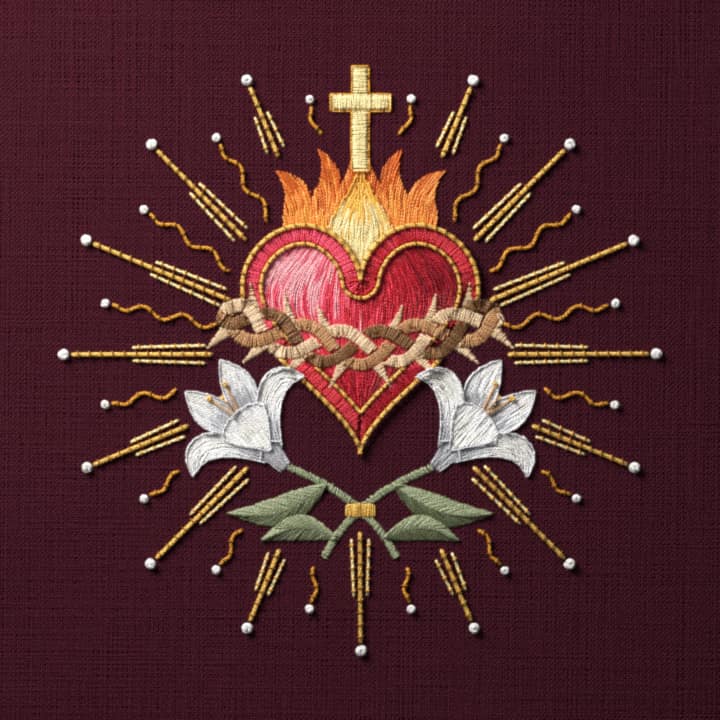
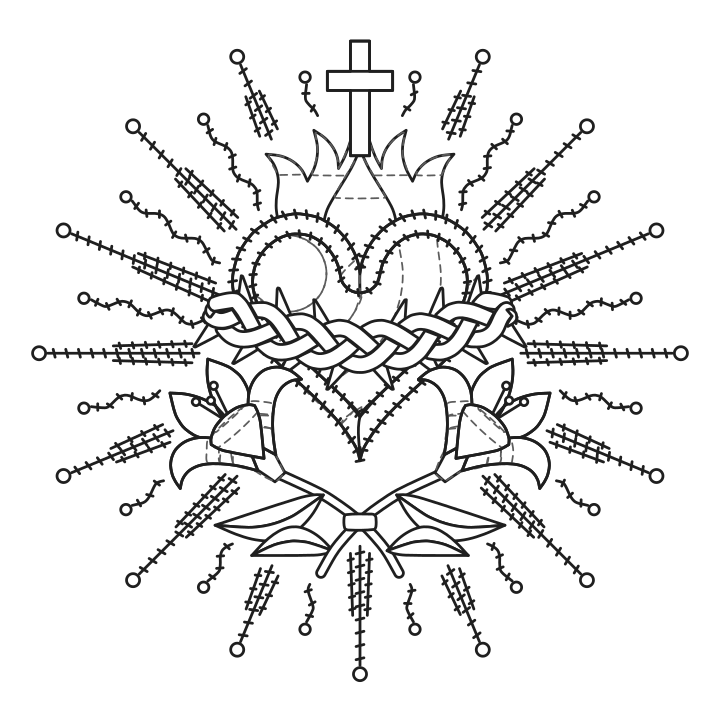
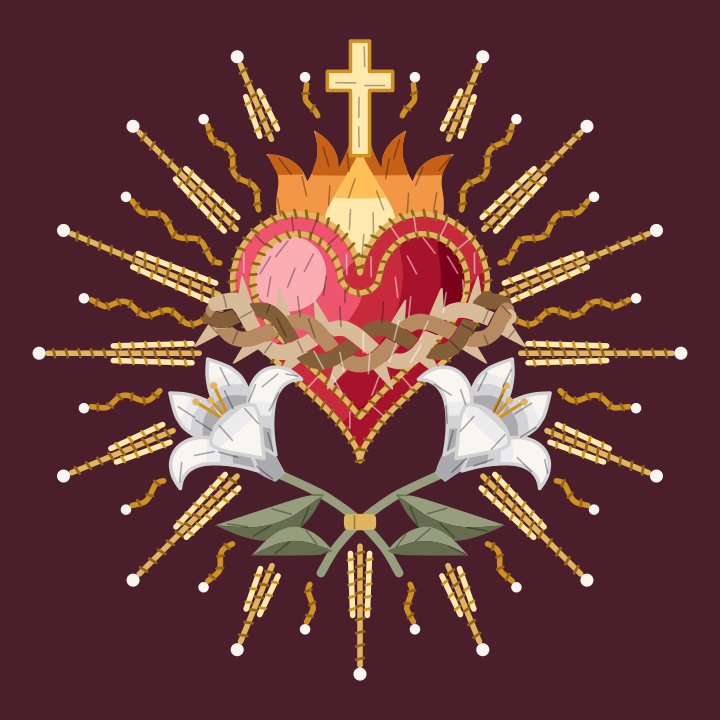
A crimson heart, rose in its upper left, wears a woven crown of thorns and carries a flame and a plain gold cross. Straight and waving gold rays alternate all around it, and two white lilies are crossed and tied below the point. The heart, flame and lilies are long and short stitch, the heart rim and the cross are padded satin stitch, and the crown is satin stitch. The rays and the cords round the heart are couching, every ray ends in a French knot, the lily leaves are fishbone stitch and the lily edges are split stitch. It is drawn for wine red linen. In the picture of where the colors go, the fine lines show which way the stitches lie.
Size and details
Advanced. Uses couching, long and short stitch, padded satin stitch, dozens of French knots, 21 colors and a great deal of stitching.
21 colors of floss and 9 kinds of stitch:
- Couching
- French knot
- Long and short stitch
- Padded satin stitch
- Back stitch
- Satin stitch
- Fishbone stitch
- Split stitch
- Straight stitch
- Which stitch goes where
| Hoop | Inches | Centimeters | Satin stitch up to |
|---|---|---|---|
| 3 in (8 cm) | 1.8 × 1.8 in | 4.6 × 4.6 cm | 1/16 in (1.6 mm) |
| 4 in (10 cm) | 2.7 × 2.7 in | 6.9 × 6.9 cm | 1/8 in (3 mm) |
| 5 in (13 cm) | 3.7 × 3.6 in | 9.4 × 9.1 cm | 3/16 in (5 mm) |
| 6 in (15 cm) | 4.6 × 4.5 in | 11.7 × 11.4 cm | 3/16 in (5 mm) |
| 8 in (20 cm) | 6.4 × 6.3 in | 16.3 × 16 cm | 5/16 in (8 mm) |
- In a 3, 4 or 5 inch hoop the French knots are drawn smaller than about 2 mm (a little over 1/16 in). Use one strand of floss for them there, or choose a larger hoop.
The pattern is drawn inside a circle about half an inch (1.3 cm) smaller all around than the hoop.
What you need
- DMC 783 Medium TopazShort rays (lighter), ray sides (darker), cross edge and stamens
- DMC 780 Ultra Very Dark TopazLong rays, gold cord and short rays (darker)
- DMC 3865 Winter WhiteLily petals (lightest), pearl tips
- DMC 3820 Dark StrawLong rays and gold cord (lighter), gold tie and stamen tips
- DMC 745 Light Pale YellowRay sides (lighter), flame (lightest), cross
- DMC 3853 Dark Autumn GoldFlame (dark)
- DMC 921 CopperFlame (darkest)
- DMC 742 Light TangerineFlame (light)
- DMC 498 Dark RedHeart and heart rim (dark)
- DMC 814 Dark GarnetHeart (darkest)
- DMC 321 RedHeart rim and heart (middle)
- DMC 335 RoseHeart rim and heart (light)
- DMC 3326 Light RoseHeart (lightest)
- DMC 3046 Medium Yellow BeigeThorns, crown of thorns (light)
- DMC 869 Very Dark Hazelnut BrownCrown of thorns (dark)
- DMC 3828 Hazelnut BrownCrown of thorns (middle)
- DMC 522 Fern GreenLily leaves (lighter), lily stems
- DMC 520 Dark Fern GreenLily leaves (darker)
- DMC 318 Light Steel GrayLily petals (darkest)
- DMC 415 Pearl GrayLily edges, lily petals (dark)
- DMC 762 Very Light Pearl GrayLily petals (light)
Skeins: one of each color is enough. An estimate for the largest size, the 8 inch hoop: the length of each line and the area of each filled shape, a fifth added for tails and ends, a tenth of every 8 m (8.7 yd) skein kept spare.
The floss is six-strand cotton; the stitch guide says how many strands to use. You also need a hoop, an embroidery needle (a size 7 to 9 suits two or three strands) and plain cotton or linen fabric. To frame the piece in its hoop, cut a square 3 inches (8 cm) wider than the hoop: a 9 inch (23 cm) square for a 6 inch hoop.
When it is stitched, how to finish a hoop shows how to back it for the wall.
Stitch guide
- Put the pattern on the fabric (how to transfer a pattern) and the fabric in the hoop.
- Stitch the filled parts first, what lies behind before what lies in front of it.
- Then stitch the lines: stems, veins and outlines over the edges of the filled parts.
- Keep the knots for the end, so that the hoop and your hand do not flatten them.
Start each thread with a small knot on the back or one of the knotless starts, and end it by running the needle under the backs of a few stitches (starting and ending a thread). Use the strands this list gives, also where a page about a stitch names another number.
- Couching 3 to 6 strandsShort rays, long rays, ray sides, gold cord
- French knot 1 to 2 strands, two wrapsPearl tips, stamen tips
- Long and short stitch 1 strandFlame, heart, lily petals
- Padded satin stitch 2 strandsHeart rim, cross
- Back stitch 1 strandCross edge
- Satin stitch 2 strandsThorns, crown of thorns, lily stems, gold tie
- Fishbone stitch 2 strandsLily leaves
- Split stitch 1 strandLily edges
- Straight stitch 1 strandStamens
Getting it onto your fabric
The PDF holds the pattern twice at actual size: once as drawn, and once mirrored for an iron-on transfer pen. Print it at 100% with scaling off and check the one-inch square (25.4 mm) with a ruler before you trace. How to transfer a pattern explains tracing, carbon paper and the other ways. The files are under Downloads.
Downloads
- Download free PDF PDF, US Letter, 3 pages, for a 6 inch (15 cm) hoop
- Download free PDF, A4 PDF, A4, 3 pages, for a 6 inch (15 cm) hoop
More patterns like this
Advanced 3–8 in hoop · 16 colors
Brown scapular with heart and lily
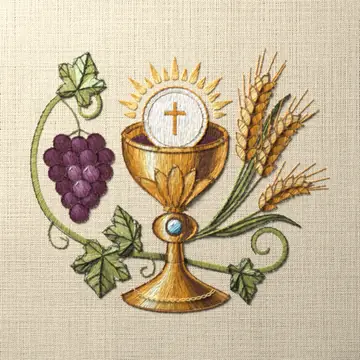
Advanced 3–8 in hoop · 24 colors
First communion cup, wheat and grapes
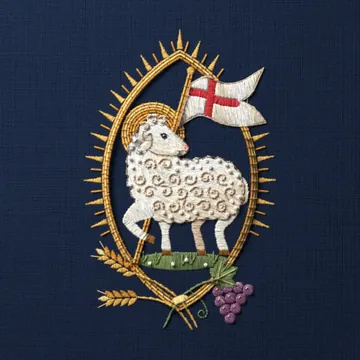
Advanced 3–8 in hoop · 17 colors
Lamb of God for a stole
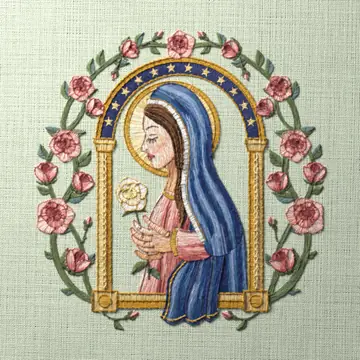
Advanced 3–8 in hoop · 24 colors
Virgin Mary in a rose arch
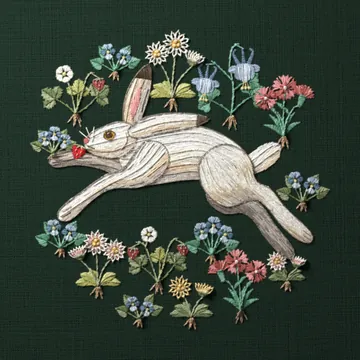
Advanced 3–8 in hoop · 22 colors
Medieval French hare among flowers
Advanced 3–8 in hoop · 23 colors
18th century French flower corner
Advanced 3–8 in hoop · 17 colors
Yule log, French Christmas tea towel
Advanced 3–8 in hoop · 23 colors
Memorial cross with a draped banner
New to hand embroidery? Starting hand embroidery, step by step