Gecko and plumeria hand embroidery pattern
Advanced · 18 colors · 4.5 × 4.7 in · 11 kinds of stitch
Download free PDFPDFPrints on US Letter and A4You may sell what you make from it by hand, in small quantities. The PDF itself is not to be sold or shared. Selling, classes and kits: the rules
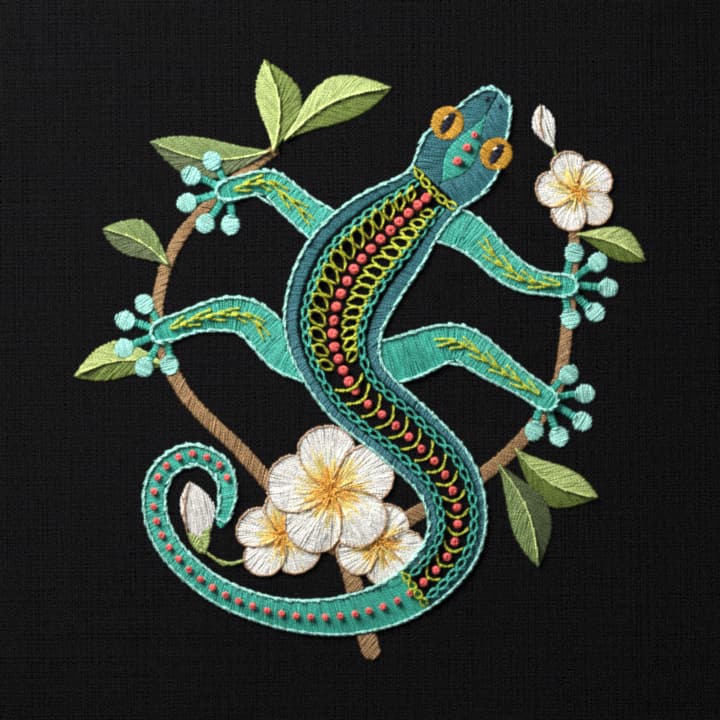
A gecko seen from above climbs to the upper right, all four feet holding a plumeria branch, and its tail sweeps under three ivory flowers to close round a single bud.
Size and details
Advanced. Uses long and short stitch, dozens of French knots, satin stitch over about a sixth of the cloth in a 6 inch hoop, 18 colors and a great deal of stitching; from a 5 inch hoop up some of the satin stitches are long.
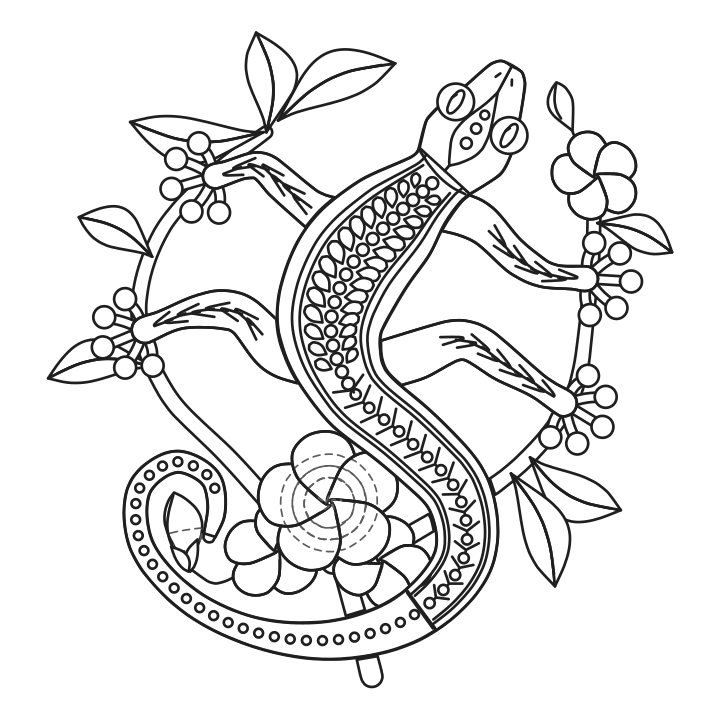
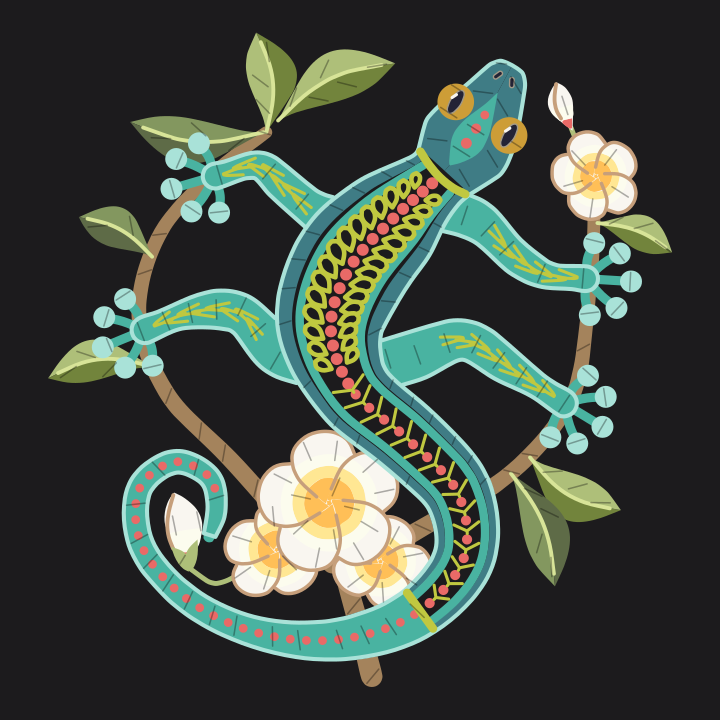
The head, legs and flanks are satin stitch in teal and jade, edged with stem stitch. Down the back runs a row of coral French knots between lazy daisies and chain stitch, and fly stitches follow on the tail; each leg carries a sprig of feather stitch. The flowers are long and short stitch, golden at the throat, with a fine split stitch edge, and the leaves are fishbone stitch. It is drawn for black linen. In the picture of where the colors go, the fine lines show which way the stitches lie.
| Hoop | Inches | Centimeters | Satin stitch up to |
|---|---|---|---|
| 3 in (8 cm) | 1.8 × 1.9 in | 4.6 × 4.8 cm | 3/16 in (5 mm) |
| 4 in (10 cm) | 2.7 × 2.8 in | 6.9 × 7.1 cm | 1/4 in (6 mm) |
| 5 in (13 cm) | 3.6 × 3.8 in | 9.1 × 9.7 cm | 3/8 in (10 mm) |
| 6 in (15 cm) | 4.5 × 4.7 in | 11.4 × 11.9 cm | 7/16 in (11 mm) |
| 8 in (20 cm) | 6.3 × 6.6 in | 16 × 16.8 cm | 5/8 in (16 mm) |
- In an 8 inch hoop the widest satin stitch shape is 5/8 in (16 mm) across. Satin stitches longer than about 12 mm (just under 1/2 in) tend to work loose: divide the shape into sections, or work it in long and short stitch.
- In a 3, 4, 5 or 6 inch hoop the French knots are drawn smaller than about 2 mm (a little over 1/16 in). Use one strand of floss for them there, or choose a larger hoop.
- In a 3 or 4 inch hoop the shortest lazy daisy loops are drawn smaller than about 2 mm (a little over 1/16 in). Use one strand of floss for them there, or choose a larger hoop.
What you need
- Fabric
- Plain cotton or linen in black, cut 9 in (23 cm) square. On white cloth its palest threads do not show: choose other colors under Options. A pencil line does not show on it: see how to transfer a pattern to dark fabric.
- Needle
- Embroidery needle, size 9 for 1 strand, size 7 for 2 or 3 (a lower number is a thicker needle).
- Floss
- 18 colors of six-strand cotton, listed below. DMC is a brand: another brand in a like color will do.
- Marker
- A pen or a sheet that suits the fabric: how to transfer a pattern says which.
Floss
- 1DMC 3863 Medium Mocha BeigeBranch
- 2DMC 3364 Pine GreenLeaves (middle)
- 3DMC 3362 Dark Pine GreenLeaves (darkest)
- 4DMC 472 Ultra Light Avocado GreenLeaves (lightest)
- 5DMC 469 Avocado GreenLeaves (dark)
- 6DMC 471 Very Light Avocado GreenLeaves (light), flower stalks
- 7DMC 3865 Winter WhitePlumeria petals and buds (light), eye lights
- 8DMC 351 CoralSpine, buds (darkest)
- 9DMC 746 Off WhitePlumeria petals and buds (lightest)
- 10DMC 422 Light Hazelnut BrownPetal edges, buds (dark)
- 11DMC 742 Light TangerinePlumeria petals (darkest), flower throats
- 12DMC 744 Pale YellowPlumeria petals (dark)
- 13DMC 3851 Light Bright GreenLegs, tail tip, toes, chain bands and crown
- 14DMC 964 Light SeagreenOutline and toe pads
- 15DMC 166 Medium Light Moss GreenLeg stitches, lazy daisies, tail stitches and collar
- 16DMC 3809 Very Dark TurquoiseFlanks and head
- 17DMC 3852 Very Dark StrawEyes
- 18DMC 310 BlackPupils and nostrils
Skeins: one of each color is enough. An estimate for the 6 inch hoop, from the length of each line and the area of each filled shape, with a fifth added for tails.
How to stitch it
- New to hand embroidery? Start here.
- Print at 100%, trace the pattern onto the fabric, and put it in the hoop: inner ring under, drawing up, tight as a drum.
- Floss is six strands. Cut 18 inches (45 cm), pull out the number given one at a time, and lay them together.
- Inside a filled shape start with two or three tiny stitches, which the filling covers. Start a line with a small knot on the back. End each thread by running the needle under the backs of a few stitches.
- Each small ring is one French knot. Each small loop is one lazy daisy: come up at its point. A fine broken line inside a shape is where two shades meet: trace it, do not stitch it.
- A number under “Where colors go” is a color of the list. The fine lines on the colors show which way the stitches lie.
Stitch in this order
Filled parts from the back of the picture forward, then lines, loops and knots. Where a stitch page names another number of strands, use the number here.
- Satin stitch 2 strandsBranch, buds, flower stalks, flower throats, toes, toe pads, legs, flanks, tail tip, head, crown, eyes, pupils
- Fishbone stitch 2 strandsLeaves
- Long and short stitch 2 strandsPlumeria petals
- Stem stitch3 strands: flower stalks2 strands: outline1 strand: leaves, buds
- Split stitch 1 strandPetal edges
- Feather stitch 2 strandsLeg stitches
- Chain stitch 2 strandsChain bands, collar
- Fly stitch 2 strandsTail stitches
- Straight stitch 2 strandsEye lights, nostrils
- Lazy daisy stitch 2 strandsLazy daisies
- French knot 2 strands, two wrapsSpine
When it is done, take off any lines that still show and finish the hoop.
More patterns like this
Advanced prints 3–14 in · 24 colors
Iguana and cactus at sunset
Advanced 3–8 in hoop · 20 colors
Green chameleon on a brown branch
Advanced prints 3–14 in · 24 colors
Roadrunner and lizard under a saguaro
Intermediate 3–8 in hoop · 8 colors
Desert lizard in a beadwork style
Advanced prints 3–14 in · 20 colors
Saguaro desert sunset with iguana
Advanced 3–8 in hoop · 20 colors
Hola
Easy prints 3–14 in · 7 colors
Lizard with patterned skin
Advanced prints 3–14 in · 20 colors
Red Hawaiian hibiscus
New to hand embroidery? Starting hand embroidery, step by step