Hula dancer with a plumeria lei hand embroidery pattern
Advanced · 23 colors · 6 kinds of stitch
Download free PDFPDF, US Letter · 179 KBFor your own stitching, gifts and handmade pieces you sell. Do not resell or share this PDF or copies of it. Selling, classes and kits: the rules
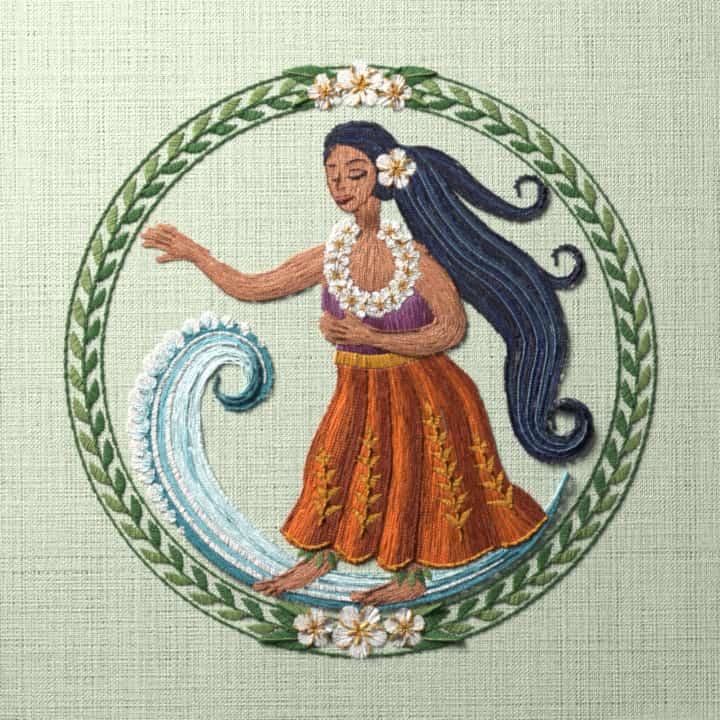
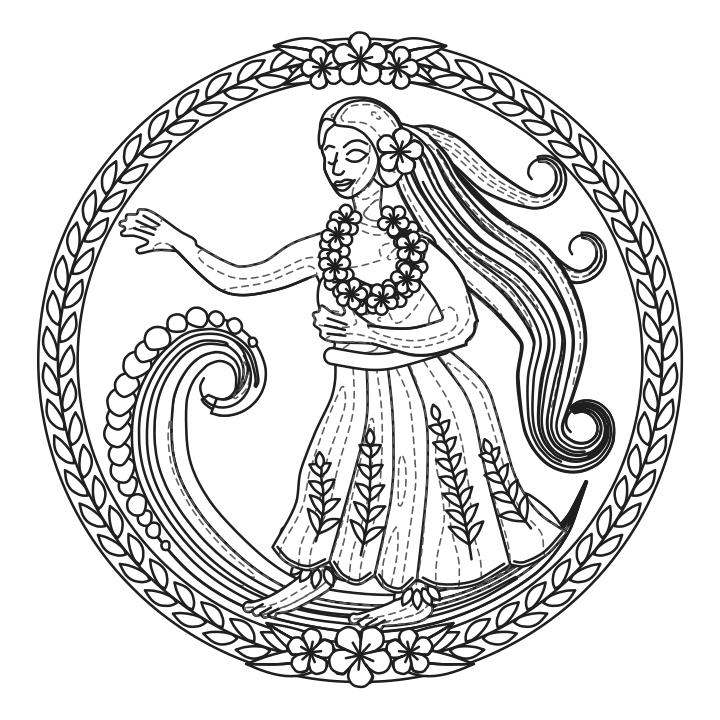
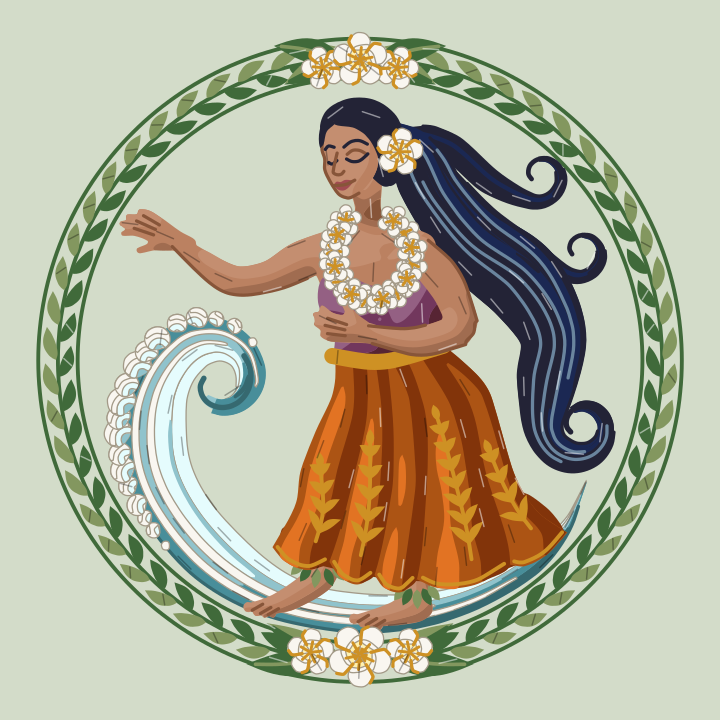
A hula dancer bends one knee and sweeps both hands to the left, her eyes lowered and a plumeria behind her ear. Her dark hair streams to the right and ends in three curls, and a wave runs under her feet and curls up at the left. Skin, hair, wrap, skirt, water and flowers are long and short stitch. The frame leaves, the gold fern sprigs and the white foam lines are satin stitch, the cords of the frame and the skirt hem are stem stitch, and split stitch draws the face, the fingers and the lights in the hair. Straight stitches make the yellow throats of the plumeria, and the larger leaves beside them include fishbone stitch. It is drawn for sage green linen. In the picture of where the colors go, the fine lines show which way the stitches lie.
Size and details
Advanced. Uses long and short stitch over much of the design, 23 colors and a great deal of stitching.
23 colors of floss and 6 kinds of stitch:
- Stem stitch
- Satin stitch
- Long and short stitch
- Split stitch
- Straight stitch
- Fishbone stitch
- Which stitch goes where
| Hoop | Inches | Centimeters | Satin stitch up to |
|---|---|---|---|
| 3 in (8 cm) | 2 × 2 in | 5.1 × 5.1 cm | 1/16 in (1.6 mm) |
| 4 in (10 cm) | 3 × 3 in | 7.6 × 7.6 cm | 1/16 in (1.6 mm) |
| 5 in (13 cm) | 3.9 × 4 in | 9.9 × 10.2 cm | 1/8 in (3 mm) |
| 6 in (15 cm) | 4.9 × 5 in | 12.4 × 12.7 cm | 1/8 in (3 mm) |
| 8 in (20 cm) | 6.9 × 7 in | 17.5 × 17.8 cm | 3/16 in (5 mm) |
The pattern is drawn inside a circle about half an inch (1.3 cm) smaller all around than the hoop.
What you need
- DMC 3346 Hunter GreenFrame cords and maile vine, maile leaves, cluster leaves and leaf anklets (darker)
- DMC 3364 Pine GreenMaile leaves, cluster leaves and leaf anklets (lighter)
- DMC 3810 Dark TurquoiseSurf (dark)
- DMC 747 Very Light Sky BlueSurf (lightest), foam (light)
- DMC 598 Light TurquoiseSurf (light), foam (dark)
- DMC 3808 Ultra Very Dark TurquoiseSurf (darkest), surf edges
- DMC 3865 Winter WhitePlumeria flowers (light), lei and foam lines, foam (middle)
- DMC 310 BlackHair (darker), hair edges, brows and lashes
- DMC 939 Very Dark Navy BlueHair (lighter)
- DMC 931 Medium Antique BlueHair lights
- DMC 3064 Desert SandSkin (lightest), feet (light), face (lighter)
- DMC 3772 Very Dark Desert SandSkin and feet (dark)
- DMC 407 Dark Desert SandSkin (light), feet (middle), face (darker)
- DMC 632 Ultra Very Dark Desert SandSkin edges and face lines, skin (darkest), lips (darker)
- DMC 918 Dark Red CopperSkirt (dark), skirt lining
- DMC 920 Medium CopperSkirt (middle)
- DMC 783 Medium TopazFern print, yellow throats, petal edges, waistband and skirt hem and 1 more part
- DMC 922 Light CopperSkirt (light)
- DMC 3835 Medium GrapeWrap (light)
- DMC 154 Very Dark GrapeWrap (dark)
- DMC 3834 Dark GrapeWrap (middle)
- DMC 3721 Dark Shell PinkLips (lighter)
- DMC 727 Very Light TopazPlumeria flowers (middle)
Skeins: 2 for hair (darker), hair edges, brows and lashes; one of each other color. An estimate for the largest size, the 8 inch hoop: the length of each line and the area of each filled shape, a fifth added for tails and ends, a tenth of every 8 m (8.7 yd) skein kept spare.
The floss is six-strand cotton; the stitch guide says how many strands to use. You also need a hoop, an embroidery needle (a size 9 or 10 for one strand, 7 to 9 for two or three, and 3 to 5 for four or more) and plain cotton or linen fabric. To frame the piece in its hoop, cut a square 3 inches (8 cm) wider than the hoop: a 9 inch (23 cm) square for a 6 inch hoop.
When it is stitched, how to finish a hoop shows how to back it for the wall.
Stitch guide
- Put the pattern on the fabric (how to transfer a pattern) and the fabric in the hoop.
- Stitch the filled parts first, what lies behind before what lies in front of it.
- Then stitch the lines: stems, veins and outlines over the edges of the filled parts.
Inside a filled shape start with two or three tiny stitches, which the filling covers: a knot shows as a bump. A line may start with a small knot on the back or one of the knotless starts. End each thread by running the needle under the backs of a few stitches. (Starting and ending a thread shows how.) Use the strands this list gives, and begin as it says, also where a page about a stitch names another number or begins with a knot.
- Stem stitch 1 to 4 strandsFrame cords, maile vine, surf, hair, skirt hem, fern print, cluster leaves
- Satin stitch 2 strandsMaile leaves, foam lines, leaf anklets, fern print, waistband, lips
- Long and short stitch 1 strandSurf, foam, hair, feet, skirt lining, skirt, skin, wrap, lei, face, plumeria flowers
- Split stitch 1 to 2 strandsSurf edges, hair edges, hair lights, skin edges, face lines, lashes, brows, lips, petal edges
- Straight stitch 1 to 2 strandsYellow throats
- Fishbone stitch 2 strandsCluster leaves
Getting it onto your fabric
The PDF holds the pattern twice at actual size: once as drawn, and once mirrored for an iron-on transfer pen. Print it at 100% with scaling off and check the one-inch square (25.4 mm) with a ruler before you trace. How to transfer a pattern explains tracing, carbon paper, the sticky wash-away sheet for knits, denim and dark cloth, and the other ways. The files are under Downloads.
Downloads
- Download free PDF PDF, US Letter, 3 pages, for a 6 inch (15 cm) hoop
- Download free PDF, A4 PDF, A4, 3 pages, for a 6 inch (15 cm) hoop
More patterns like this
Advanced prints 3–14 in · 7 colors
Plumeria Hawaiian quilt style block
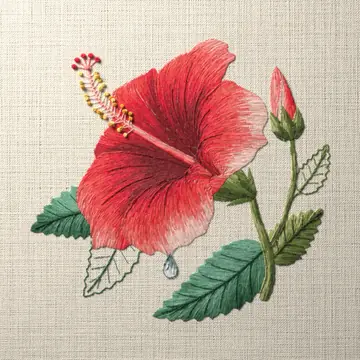
Advanced prints 3–14 in · 20 colors
Red hibiscus, a Hawaiian flower
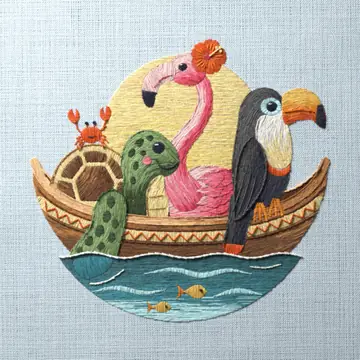
Advanced prints 3–14 in · 24 colors
Tropical friends in a canoe
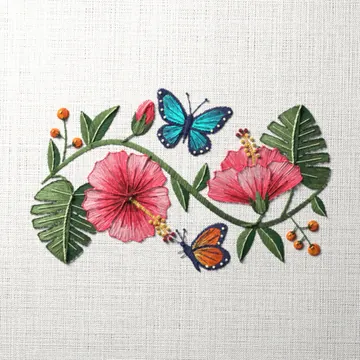
Advanced 3–8 in hoop · 21 colors
Tropical border with butterflies
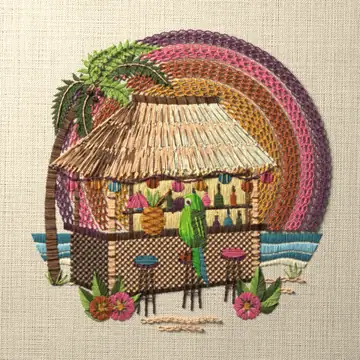
Advanced prints 3–14 in · 16 colors
Tiki bar on the beach at sunset
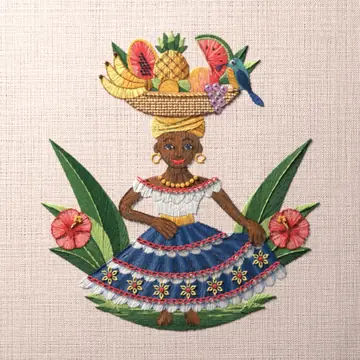
Advanced prints 3–14 in · 24 colors
Woman with a fruit basket on her head
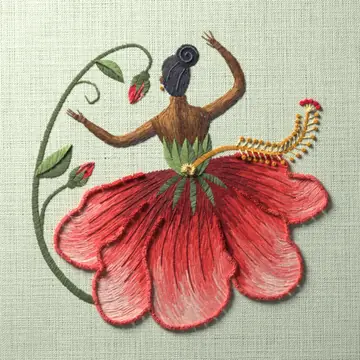
Advanced prints 3–14 in · 22 colors
Flower dancer in a hibiscus skirt
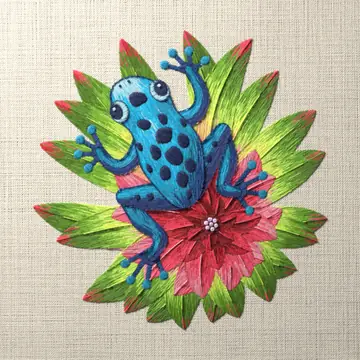
Advanced prints 3–14 in · 23 colors
Blue dart frog on a bromeliad
New to hand embroidery? Starting hand embroidery, step by step