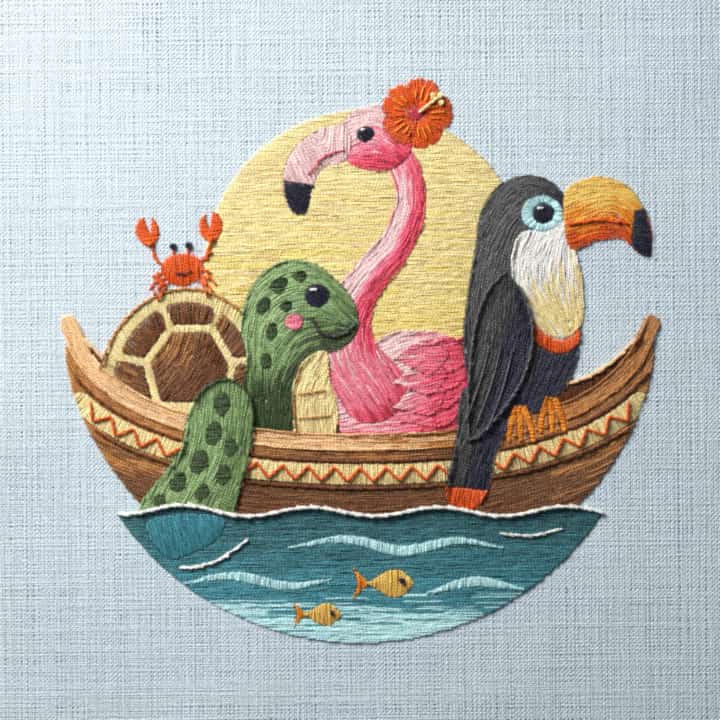
Tropical friends in a canoe hand embroidery pattern
Advanced · 24 colors · 7 kinds of stitch
Download free PDFPDF, US Letter · 76 KBFor your own stitching, gifts and handmade pieces you sell. Do not resell or share this PDF. What you may do, in full
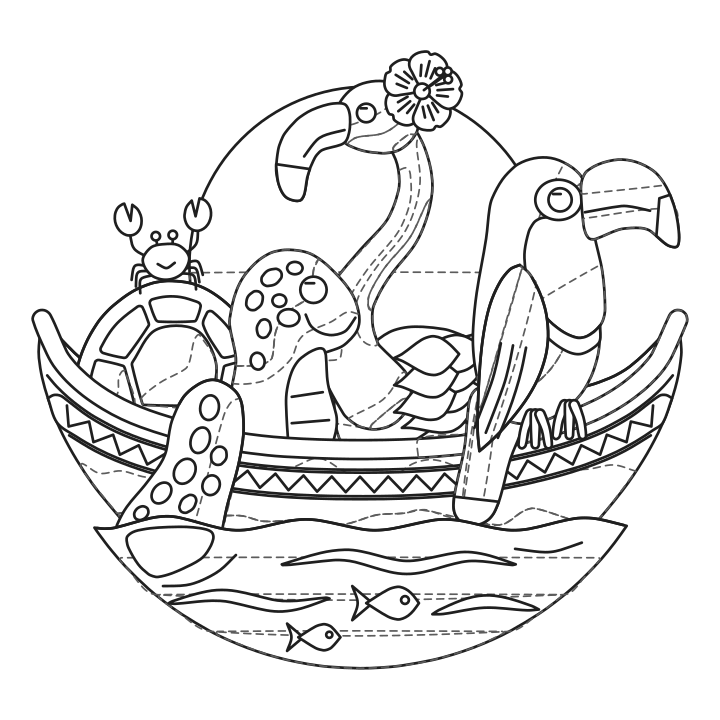
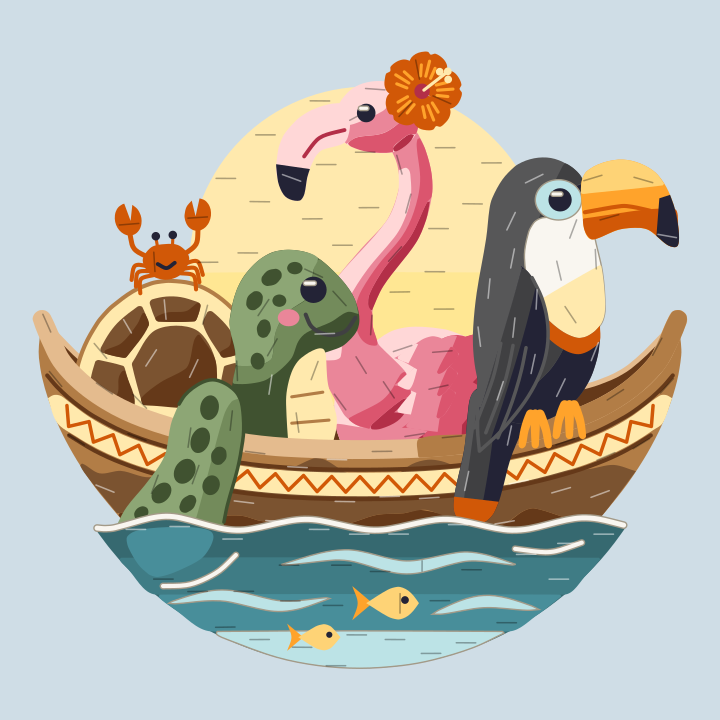
The turtle rows with one long flipper over the side and a red crab rides on its shell. The flamingo sits backwards with a hibiscus on its head, and the toucan keeps lookout from the rail. The animals, the canoe, the sun and the lagoon are long and short stitch, while the bills, the fish, the hibiscus and the band along the canoe are satin stitch. A back stitch zigzag runs along the canoe, the toucan’s wing is edged in split stitch, the foam is a line of stem stitch and the fish have French knot eyes. It is drawn for pale blue linen. In the picture of where the colors go, the fine lines show which way the stitches lie.
Size and details
Advanced. Uses long and short stitch over much of the design, satin stitch over about a sixth of the cloth in a 6 inch hoop, 24 colors and a great deal of stitching; from a 6 inch hoop up some of the satin stitches are long.
24 colors of floss and 7 kinds of stitch:
- Long and short stitch
- Satin stitch
- Stem stitch
- Straight stitch
- French knot
- Back stitch
- Split stitch
- Which stitch goes where
| Hoop | Inches | Centimeters | Satin stitch up to |
|---|---|---|---|
| 3 in (8 cm) | 1.9 × 1.8 in | 4.8 × 4.6 cm | 1/8 in (3 mm) |
| 4 in (10 cm) | 2.8 × 2.7 in | 7.1 × 6.9 cm | 3/16 in (5 mm) |
| 5 in (13 cm) | 3.8 × 3.5 in | 9.7 × 8.9 cm | 5/16 in (8 mm) |
| 6 in (15 cm) | 4.7 × 4.4 in | 11.9 × 11.2 cm | 3/8 in (10 mm) |
| 8 in (20 cm) | 6.6 × 6.2 in | 16.8 × 15.7 cm | 1/2 in (13 mm) |
- In an 8 inch hoop the widest satin stitch shape is 1/2 in (13 mm) across. Satin stitches longer than about 12 mm (just under 1/2 in) tend to work loose: divide the shape into sections, or work it in long and short stitch.
- In a 3, 4 or 5 inch hoop the French knots are drawn smaller than about 2 mm (a little over 1/16 in). Use one strand of floss for them there, or choose a larger hoop.
The pattern is drawn inside a circle about half an inch (1.3 cm) smaller all around than the hoop.
What you need
- DMC 745 Light Pale YellowSun (lighter), shell rim, canoe band and turtle chest and 2 more parts
- DMC 744 Pale YellowSun (darker)
- DMC 801 Dark Coffee BrownInside of the canoe and canoe lines, canoe (dark), shell plates (darker)
- DMC 437 Light TanRail (lighter), far rail
- DMC 963 Ultra Very Light Dusty RoseFlamingo body (light), flamingo head (lightest) and 3 more parts
- DMC 3832 Medium RaspberryFlamingo wing, flamingo body, flamingo neck and flamingo head (dark)
- DMC 3833 Light RaspberryFlamingo neck and flamingo wing (light) and 3 more parts
- DMC 3831 Dark RaspberryFlamingo wing and flamingo neck (darkest) and 3 more parts
- DMC 310 BlackToucan wing, toucan body and toucan tail (dark), eyes and 3 more parts
- DMC 3865 Winter WhiteToucan bib (lighter), foam and eye lights
- DMC 900 Dark Burnt OrangeHibiscus, canoe zigzag and crab, toucan bill (dark) and 5 more parts
- DMC 741 Medium TangerineToucan bill (middle), toucan feet and hibiscus veins, little fish (darker)
- DMC 433 Medium BrownCanoe (middle), shell plates (lighter)
- DMC 435 Very Light BrownCanoe (light), rail (darker), shell edge and chest lines
- DMC 986 Very Dark Forest GreenTurtle head and neck (dark), turtle spots and flipper edge
- DMC 988 Medium Forest GreenTurtle flipper (darker), turtle head and neck (middle)
- DMC 989 Forest GreenTurtle flipper (lighter), turtle head and neck (light)
- DMC 3799 Very Dark Pewter GrayToucan body, toucan wing and toucan tail (middle), smile
- DMC 413 Dark Pewter GrayToucan body, toucan wing and toucan tail (light), wing feathers
- DMC 3811 Very Light TurquoiseLagoon (lightest), swells and eye patch
- DMC 743 Medium YellowToucan bill (light), little fish (lighter)
- DMC 3808 Ultra Very Dark TurquoiseLagoon (darkest)
- DMC 3809 Very Dark TurquoiseLagoon (dark)
- DMC 3810 Dark TurquoiseLagoon (light), flipper under the water
Skeins: 2 for sun (lighter), shell rim, canoe band and turtle chest and 2 more parts; one of each other color. An estimate for the largest size, the 8 inch hoop: the length of each line and the area of each filled shape, a fifth added for tails and ends, a tenth of every 8 m (8.7 yd) skein kept spare.
The floss is six-strand cotton; the stitch guide says how many strands to use. You also need a hoop, an embroidery needle (a size 7 to 9 suits two or three strands) and plain cotton or linen fabric. To frame the piece in its hoop, cut a square 3 inches (8 cm) wider than the hoop: a 9 inch (23 cm) square for a 6 inch hoop.
When it is stitched, how to finish a hoop shows how to back it for the wall.
Stitch guide
- Put the pattern on the fabric (how to transfer a pattern) and the fabric in the hoop.
- Stitch the filled parts first, what lies behind before what lies in front of it.
- Then stitch the lines: stems, veins and outlines over the edges of the filled parts.
- Keep the knots for the end, so that the hoop and your hand do not flatten them.
Start each thread with a small knot on the back or one of the knotless starts, and end it by running the needle under the backs of a few stitches (starting and ending a thread). Use the strands this list gives, also where a page about a stitch names another number.
- Long and short stitch 1 strandSun, flamingo body, flamingo neck, flamingo head, flamingo wing, shell plates, and 11 more
- Satin stitch 2 strandsInside of the canoe, flamingo bill, flamingo bill tip, eyes, hibiscus, hibiscus heart, shell rim, and 12 more
- Stem stitch 1 to 3 strandsFar rail, bill line, shell edge, smile, crab legs, crab eyes, canoe lines, foam
- Straight stitch 1 to 3 strandsEye lights, hibiscus veins, hibiscus heart, chest lines, crab eyes
- French knot 1 strand, two wrapsHibiscus heart, crab eyes, eyes
- Back stitch 3 strandsCanoe zigzag
- Split stitch 1 to 2 strandsWing feathers, flipper edge
Getting it onto your fabric
The PDF holds the pattern twice at actual size: once as drawn, and once mirrored for an iron-on transfer pen. Print it at 100% with scaling off and check the one-inch square (25.4 mm) with a ruler before you trace. How to transfer a pattern explains tracing, carbon paper and the other ways. The files are under Downloads.
Downloads
- Download free PDF PDF, US Letter, 3 pages, for a 6 inch (15 cm) hoop
- Download free PDF, A4 PDF, A4, 3 pages, for a 6 inch (15 cm) hoop
More patterns like this
Advanced 3–8 in hoop · 22 colors
Flamingos at sunset with a mirror sun
Intermediate 3–8 in hoop · 7 colors
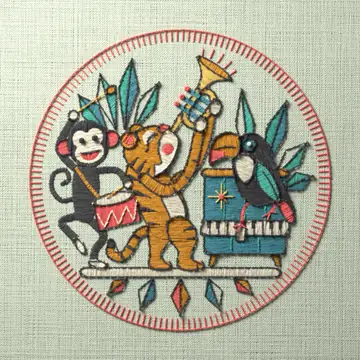
Jungle band with drum and trumpet
Advanced 3–8 in hoop · 23 colors
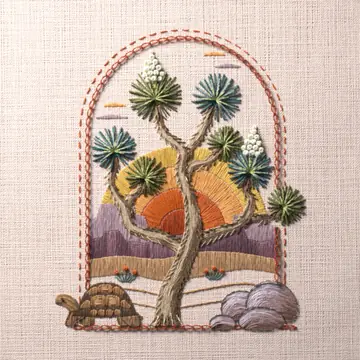
Joshua tree at desert sunset
Advanced 3–8 in hoop · 24 colors
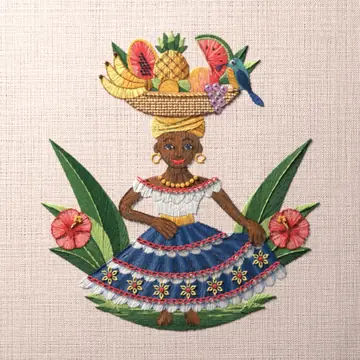
Woman with a fruit basket on her head
Advanced 3–8 in hoop · 23 colors
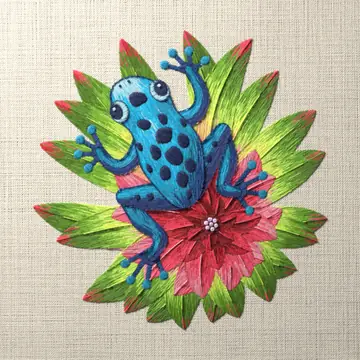
Blue dart frog on a bromeliad
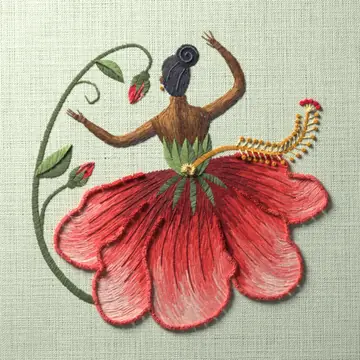
Advanced 3–8 in hoop · 22 colors
Flower dancer in a hibiscus skirt
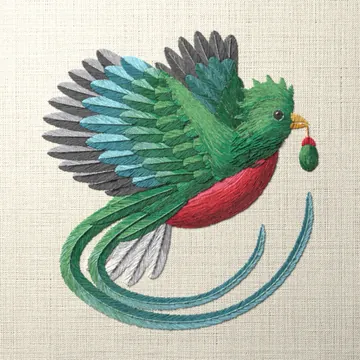
Advanced 3–8 in hoop · 22 colors
Guatemalan bird: a quetzal in flight
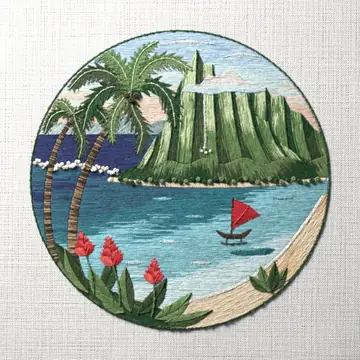
Advanced 3–8 in hoop · 22 colors
Palm tree island with green mountains
New to hand embroidery? Starting hand embroidery, step by step