Kimono doll in a glass case hand embroidery pattern
Advanced · 24 colors · 9 kinds of stitch
Download free PDFPDF, US Letter · 97 KBFor your own stitching, gifts and handmade pieces you sell. Do not resell or share this PDF. What you may do, in full
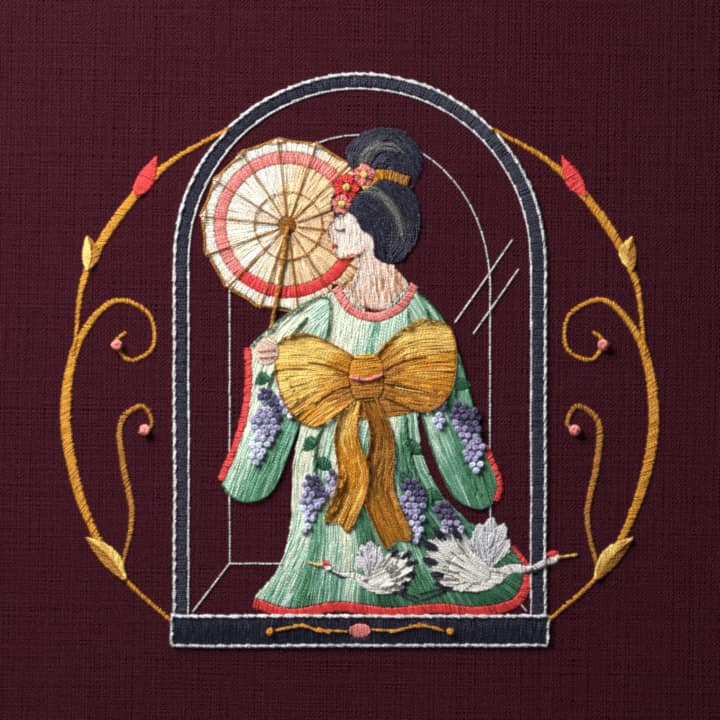
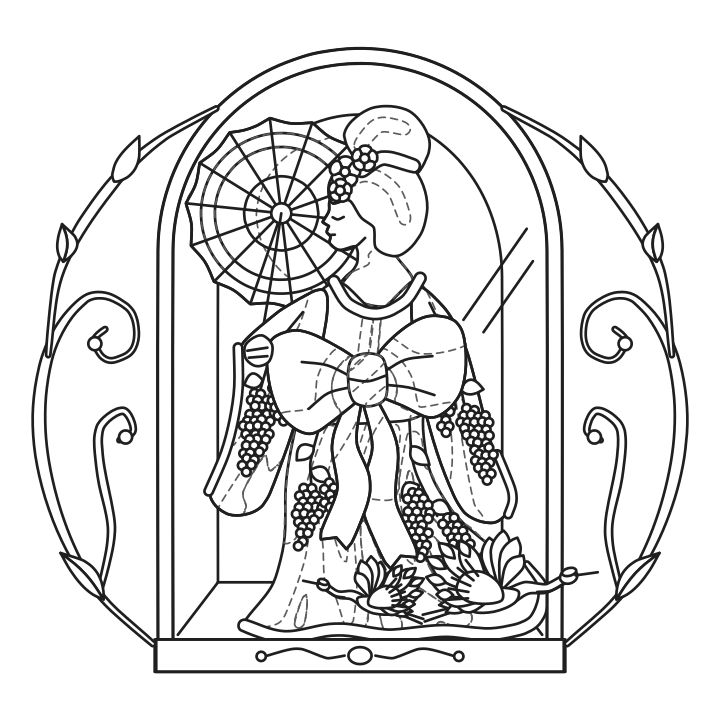
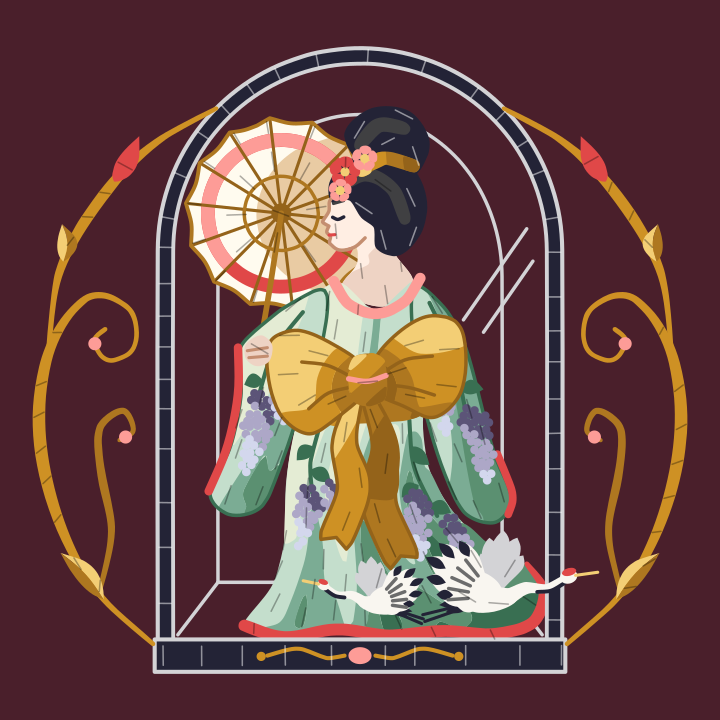
The doll stands with her back to us and her head just turned, an open paper parasol held before her. The jade kimono is long and short stitch that deepens toward the hem, the wisteria is French knots, and the big ochre bow is long and short stitch with split stitch folds. The cranes are satin stitch, and one stretches its neck past the hem and across the frame. The case is a dark satin stitch frame with stem stitch edges and fine back stitch glass, and gold satin stitch scrolls curl on both sides. It is drawn for wine red linen. In the picture of where the colors go, the fine lines show which way the stitches lie.
Size and details
Advanced. Uses long and short stitch over much of the design, more than a hundred French knots, 24 colors and a great deal of stitching; from a 6 inch hoop up the widest satin stitches are long.
24 colors of floss and 9 kinds of stitch:
- Back stitch
- Long and short stitch
- Satin stitch
- Straight stitch
- Stem stitch
- Split stitch
- French knot
- Couching
- Fishbone stitch
- Which stitch goes where
| Hoop | Inches | Centimeters | Satin stitch up to |
|---|---|---|---|
| 3 in (8 cm) | 1.9 × 1.8 in | 4.8 × 4.6 cm | 1/8 in (3 mm) |
| 4 in (10 cm) | 2.8 × 2.7 in | 7.1 × 6.9 cm | 3/16 in (5 mm) |
| 5 in (13 cm) | 3.8 × 3.6 in | 9.7 × 9.1 cm | 5/16 in (8 mm) |
| 6 in (15 cm) | 4.7 × 4.5 in | 11.9 × 11.4 cm | 3/8 in (10 mm) |
| 8 in (20 cm) | 6.6 × 6.3 in | 16.8 × 16 cm | 1/2 in (13 mm) |
- In an 8 inch hoop the widest satin stitch shape is 1/2 in (13 mm) across. Satin stitches longer than about 12 mm (just under 1/2 in) tend to work loose: divide the shape into sections, or work it in long and short stitch.
- In a 3, 4, 5 or 6 inch hoop the French knots are drawn smaller than about 2 mm (a little over 1/16 in). Use one strand of floss for them there, or choose a larger hoop.
The pattern is drawn inside a circle about half an inch (1.3 cm) smaller all around than the hoop.
What you need
- DMC 415 Pearl GrayFrame edges, far glass lines and glass lights, cranes (darker)
- DMC 738 Very Light TanParasol paper (darker)
- DMC 712 CreamParasol paper (lighter)
- DMC 350 Medium CoralParasol ring (darker), hem lining and sleeve lining and 4 more parts
- DMC 352 Light CoralParasol ring and silk flowers (lighter), collar and 3 more parts
- DMC 780 Ultra Very Dark TopazObi edges and parasol ribs, obi tails (darkest) and 6 more parts
- DMC 782 Dark TopazObi (middle), obi tails (dark) and 8 more parts
- DMC 3770 Very Light TawnyFace and neck (lighter)
- DMC 950 Light Desert SandFace and neck (darker), hand
- DMC 504 Very Light Blue GreenKimono (light)
- DMC 501 Dark Blue GreenKimono (darkest), kimono edges, wisteria vines and wisteria leaves
- DMC 502 Blue GreenKimono (dark)
- DMC 503 Medium Blue GreenKimono (middle)
- DMC 772 Very Light Yellow GreenKimono (lightest)
- DMC 333 Very Dark Blue VioletWisteria (dark)
- DMC 340 Medium Blue VioletWisteria (middle)
- DMC 3747 Very Light Blue VioletWisteria (light)
- DMC 310 BlackCase frame, case base and crane wing tips, hair (darker) and 4 more parts
- DMC 3865 Winter WhiteCranes (lighter), crane necks
- DMC 3821 StrawObi bow (lightest), scroll leaves (lighter) and 5 more parts
- DMC 317 Pewter GrayCrane feathers
- DMC 783 Medium TopazWhiplash scrolls (lighter), obi bow (light) and 5 more parts
- DMC 3064 Desert SandProfile and fingers
- DMC 3799 Very Dark Pewter GrayHair (lighter), brow
Skeins: one of each color is enough. An estimate for the largest size, the 8 inch hoop: the length of each line and the area of each filled shape, a fifth added for tails and ends, a tenth of every 8 m (8.7 yd) skein kept spare.
The floss is six-strand cotton; the stitch guide says how many strands to use. You also need a hoop, an embroidery needle (a size 7 to 9 suits two or three strands) and plain cotton or linen fabric. To frame the piece in its hoop, cut a square 3 inches (8 cm) wider than the hoop: a 9 inch (23 cm) square for a 6 inch hoop.
When it is stitched, how to finish a hoop shows how to back it for the wall.
Stitch guide
- Put the pattern on the fabric (how to transfer a pattern) and the fabric in the hoop.
- Stitch the filled parts first, what lies behind before what lies in front of it.
- Then stitch the lines: stems, veins and outlines over the edges of the filled parts.
- Keep the knots for the end, so that the hoop and your hand do not flatten them.
Start each thread with a small knot on the back or one of the knotless starts, and end it by running the needle under the backs of a few stitches (starting and ending a thread). Use the strands this list gives, also where a page about a stitch names another number.
- Back stitch 1 strandFar glass lines, parasol struts, eye, glass lights
- Long and short stitch 1 strandParasol paper, face and neck, kimono, obi, obi tails, obi bow, hair
- Satin stitch 2 strandsParasol ring, parasol hub, hem lining, collar, sleeve lining, wisteria leaves, cranes, crane tails, and 12 more
- Straight stitch 1 to 2 strandsParasol ribs, crane legs, crane bills, fingers, brow, mouth
- Stem stitch 1 to 4 strandsParasol edge, parasol handle, wisteria vines, crane throats, frame edges, base ornament
- Split stitch 1 strandKimono edges, crane feathers, obi edges, obi folds, profile
- French knot 1 to 2 strands, two wrapsWisteria, flower hearts, base ornament, scroll ends
- Couching 3 strandsObi cord
- Fishbone stitch 2 strandsScroll leaves
Getting it onto your fabric
The PDF holds the pattern twice at actual size: once as drawn, and once mirrored for an iron-on transfer pen. Print it at 100% with scaling off and check the one-inch square (25.4 mm) with a ruler before you trace. How to transfer a pattern explains tracing, carbon paper and the other ways. The files are under Downloads.
Downloads
- Download free PDF PDF, US Letter, 3 pages, for a 6 inch (15 cm) hoop
- Download free PDF, A4 PDF, A4, 3 pages, for a 6 inch (15 cm) hoop
More patterns like this
Advanced 3–8 in hoop · 24 colors
Children hanging doll clothes on a line
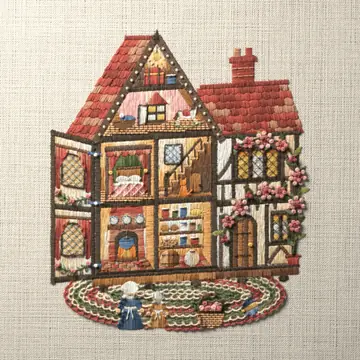
Advanced 3–8 in hoop · 23 colors
Tudor doll house with the front open
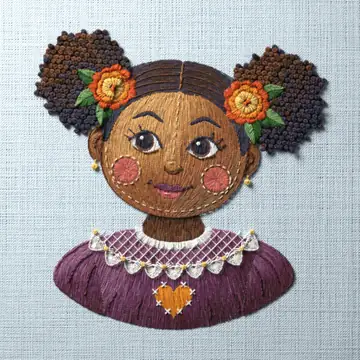
Advanced 3–8 in hoop · 21 colors
Rag doll face with flowers in her hair
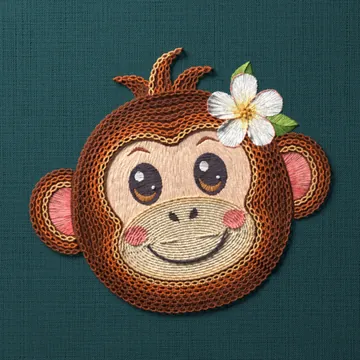
Advanced 3–8 in hoop · 19 colors
Small monkey doll face
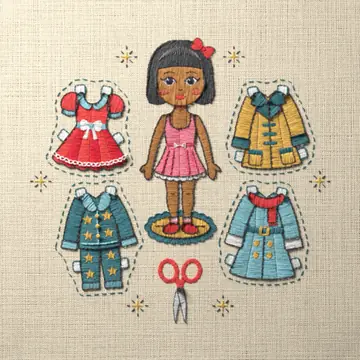
Advanced 3–8 in hoop · 16 colors
Paper doll with her four outfits
Advanced 3–8 in hoop · 15 colors
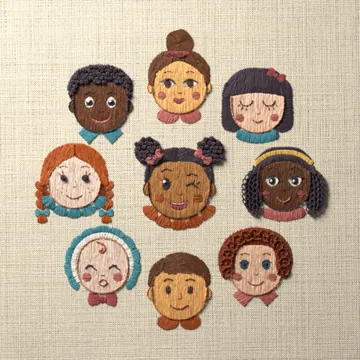
Nine doll faces sampler
Advanced 3–8 in hoop · 10 colors
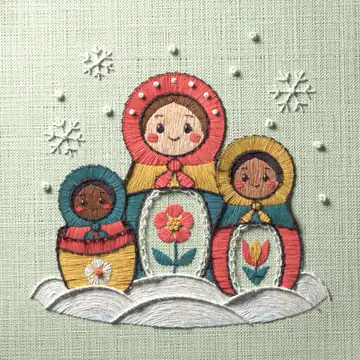
Russian nesting dolls in the snow
Easy 3–8 in hoop · 7 colors
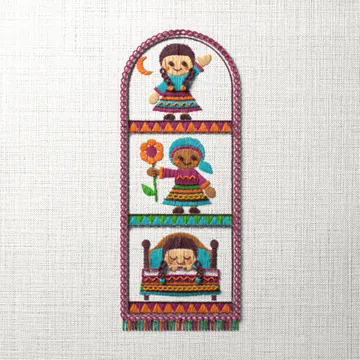
Easy worry doll bookmark
New to hand embroidery? Starting hand embroidery, step by step