Peek a boo ghost in a blue teapot hand embroidery pattern
Advanced · 9 colors · 3.9 × 4.5 in · 10 kinds of stitch
Download free PDFPDFPrints on US Letter and A4You may sell what you make from it by hand, in small quantities. The PDF itself is not to be sold or shared. Selling, classes and kits: the rules
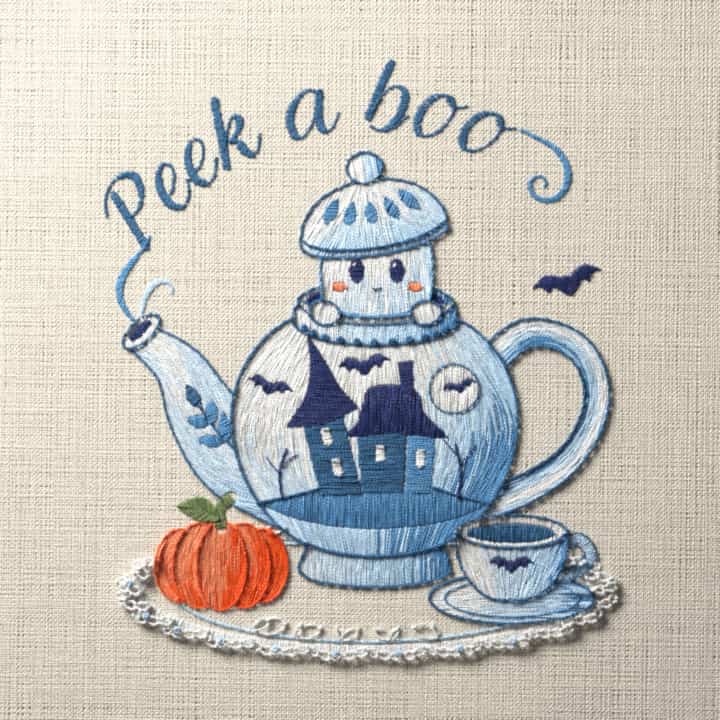
A shy ghost pushes up the lid of a round china teapot and wears it as a hat. Where a garden scene belongs, the bowl shows a crooked manor, bats and a full moon, and Peek a boo rises from the spout.
Size and details
Advanced. Uses long and short stitch over much of the design, nine colors and a great deal of stitching; from a 6 inch hoop up the widest satin stitches are long.
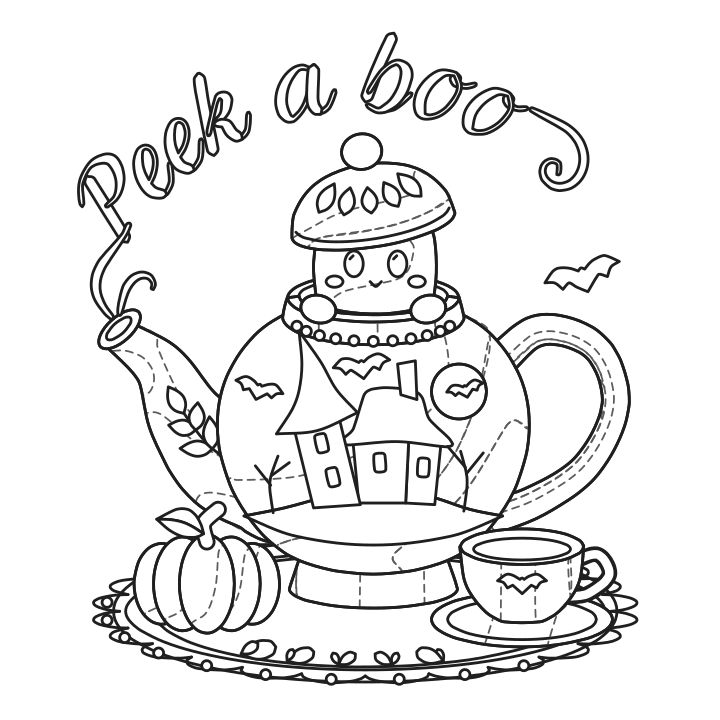
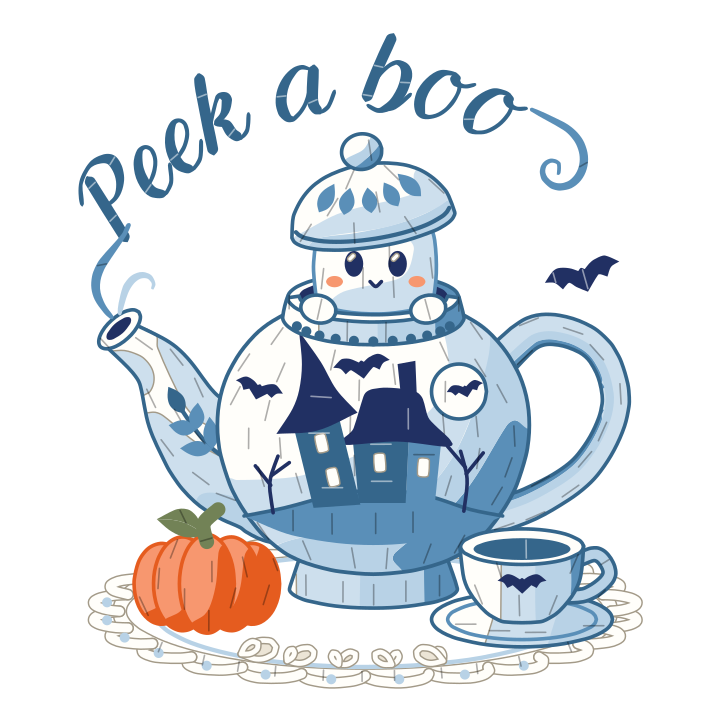
The pot, lid, cup, saucer, ghost and pumpkin are long and short stitch with split stitch outlines. The manor, hill, bats, moon, rims and letters are satin stitch, the bare trees are back stitch and the leaf is fishbone stitch. The lace cloth has chain stitch scallops, lazy daisy loops, a stem stitch ring and French knots. In the picture of where the colors go, the fine lines show which way the stitches lie.
| Hoop | Inches | Centimeters | Satin stitch up to |
|---|---|---|---|
| 3 in (8 cm) | 1.5 × 1.8 in | 3.8 × 4.6 cm | 3/16 in (5 mm) |
| 4 in (10 cm) | 2.3 × 2.7 in | 5.8 × 6.9 cm | 1/4 in (6 mm) |
| 5 in (13 cm) | 3.1 × 3.6 in | 7.9 × 9.1 cm | 5/16 in (8 mm) |
| 6 in (15 cm) | 3.9 × 4.5 in | 9.9 × 11.4 cm | 7/16 in (11 mm) |
| 8 in (20 cm) | 5.4 × 6.3 in | 13.7 × 16 cm | 9/16 in (14 mm) |
- In an 8 inch hoop the widest satin stitch shape is 9/16 in (14 mm) across. Satin stitches longer than about 12 mm (just under 1/2 in) tend to work loose: divide the shape into sections, or work it in long and short stitch.
- In a 3, 4 or 5 inch hoop the French knots and the shortest lazy daisy loops are drawn smaller than about 2 mm (a little over 1/16 in). Use one strand of floss for them there, or choose a larger hoop.
What you need
- Fabric
- Plain cotton or linen, cut 9 in (23 cm) square.
- Needle
- Embroidery needle, size 9 for 1 strand, size 7 for 2 or 3 (a lower number is a thicker needle).
- Floss
- 9 colors of six-strand cotton, listed below. DMC is a brand: another brand in a like color will do.
- Marker
- A pen or a sheet that suits the fabric: how to transfer a pattern says which.
Floss
- 1DMC BLANC WhiteBowl and spout (lightest), lace cloth, ghost (lighter), lid (light) and 14 more parts
- 2DMC 3325 Light Baby BlueBowl, foot, spout, collar and lid (dark), lace lines, handle (middle) and 6 more parts
- 3DMC 3841 Pale Baby BlueSpout, bowl, handle, collar and cup (light), saucer (middle) and 3 more parts
- 4DMC 322 Dark Baby BluePainted hill, bowl (darkest), ghost edge and painted manor (lighter) and 10 more parts
- 5DMC 312 Very Dark Baby BlueChina outline and letters, painted manor (darker) and 7 more parts
- 6DMC 823 Dark Navy BluePainted roofs, opening and painted bats, painted lines (darker) and 3 more parts
- 7DMC 722 Light Orange SpicePumpkin (lighter), ghost cheeks
- 8DMC 720 Dark Orange SpicePumpkin (darker), pumpkin ribs
- 9DMC 3363 Medium Pine GreenPumpkin leaf and pumpkin stem
Skeins: one of each color is enough. An estimate for the 6 inch hoop, from the length of each line and the area of each filled shape, with a fifth added for tails.
How to stitch it
- New to hand embroidery? Start here.
- Print at 100%, trace the pattern onto the fabric, and put it in the hoop: inner ring under, drawing up, tight as a drum.
- Floss is six strands. Cut 18 inches (45 cm), pull out the number given one at a time, and lay them together.
- Inside a filled shape start with two or three tiny stitches, which the filling covers. Start a line with a small knot on the back. End each thread by running the needle under the backs of a few stitches.
- Each small ring is one French knot. Each small loop is one lazy daisy: come up at its point. A fine broken line inside a shape is where two shades meet: trace it, do not stitch it.
- A number under “Where colors go” is a color of the list. The fine lines on the colors show which way the stitches lie.
Stitch in this order
Filled parts from the back of the picture forward, then lines, loops and knots. Where a stitch page names another number of strands, use the number here.
- Satin stitch 2 strandsLace cloth, spout mouth, painted leaves, painted hill, painted moon, painted manor, painted roofs, painted windows, painted bats, opening, ghost eyes, ghost cheeks, rim, ghost hands, lid knob, lid petals, pumpkin stem, cup handle, cup rim, tea, letters, steam
- Long and short stitch 1 strandHandle, spout, foot, bowl, collar, ghost, lid, pumpkin, saucer, cup
- Fishbone stitch 2 strandsPumpkin leaf
- Chain stitch 3 strandsLace scallops
- Stem stitch 2 strandsLace lines, china lines, lid band
- Split stitch1 to 3 strands: china outline2 strands: ghost edge1 or 2 strands: painted lines1 strand: ghost mouth, pumpkin ribs, china lines
- Back stitch 1 to 2 strandsPainted lines
- Straight stitch 2 strandsEye lights
- Lazy daisy stitch 2 strandsLace loops
- French knot 2 strands, two wrapsLace knots, collar dots
When it is done, take off any lines that still show and finish the hoop.
More patterns like this
Advanced prints 3–14 in · 21 colors
Boo y’all ghost in a cowboy boot
Advanced prints 3–14 in · 16 colors
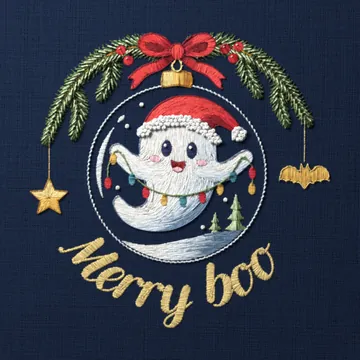
Christmas ghost bauble, Merry Boo
Advanced 3–8 in hoop · 18 colors
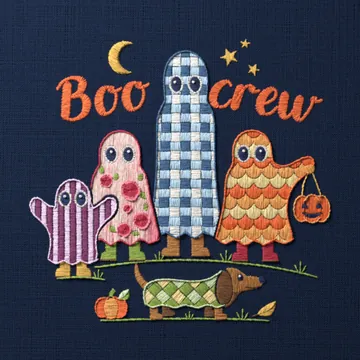
Boo crew under patterned sheets
Advanced 3–8 in hoop · 16 colors
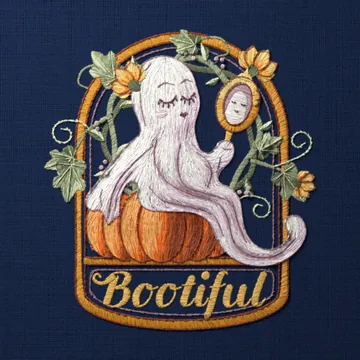
Bootiful
Advanced prints 3–14 in · 17 colors
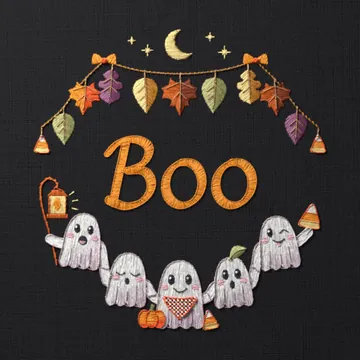
Boo with ghosts holding hands
Advanced 3–8 in hoop · 10 colors
Little ghost with a lantern
Advanced prints 3–14 in · 17 colors
Spells and potions with a witch’s hat
Advanced prints 3–14 in · 21 colors
Wickedly cute with a crow
New to hand embroidery? Starting hand embroidery, step by step