Rapunzel braid skirt border hand embroidery pattern
Advanced · 24 colors · 7 kinds of stitch
Download free PDFPDF, US Letter · 141 KBFor your own stitching, gifts and handmade pieces you sell. Do not resell or share this PDF. What you may do, in full
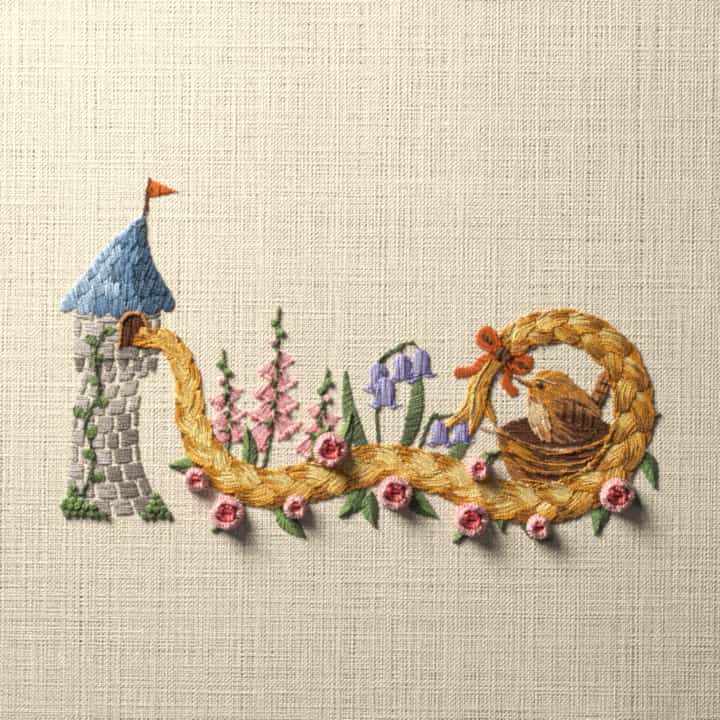
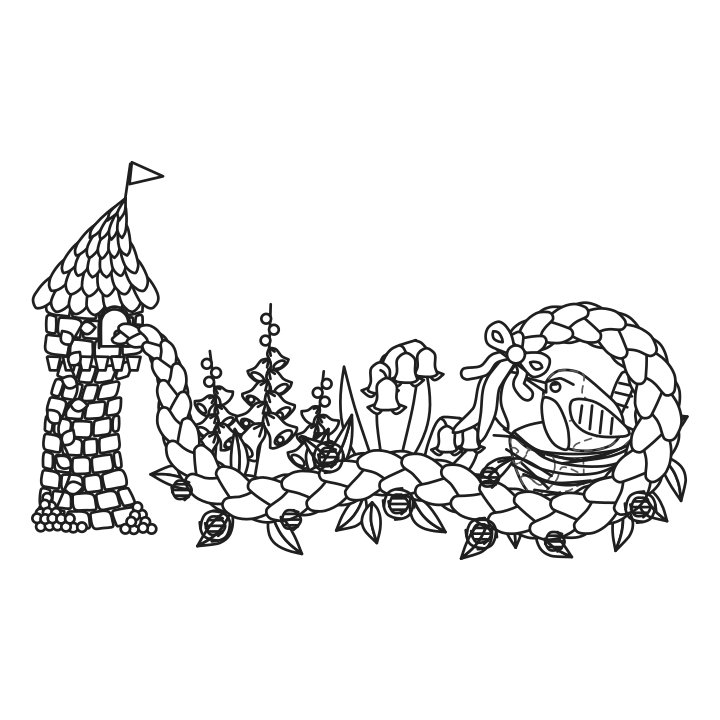
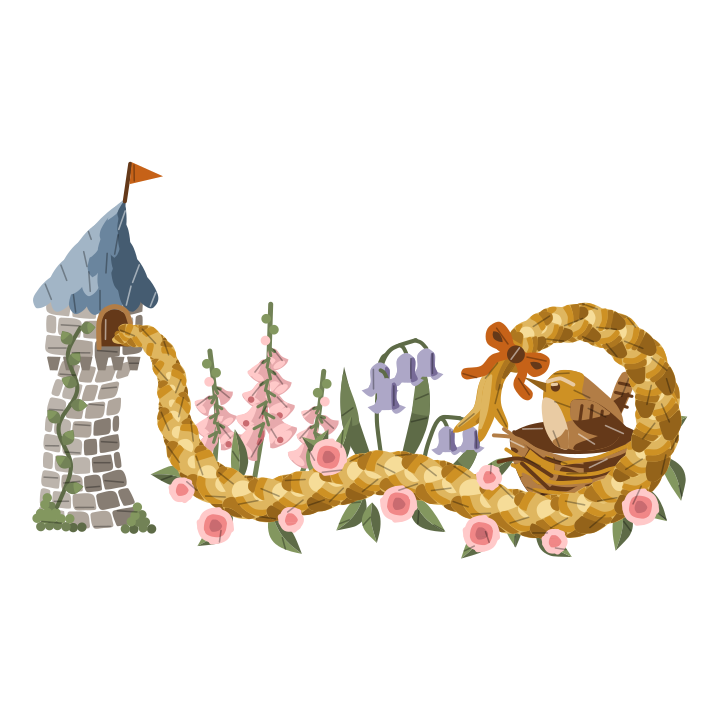
A crooked tower with a slate blue roof and ivy stands at the left, and from its little window a honey-gold braid falls and plaits its way along the hem. Every strand of the braid is long and short stitch, darker where it dips under its neighbor. The stones, roof tiles, ribbon and bluebells are satin stitch, the moss is French knots and the roses are bullion knots with fishbone stitch leaves. Foxgloves rise behind the braid, and in its last loop a wren with a pale brow and a cocked tail sits in her nest. There is no figure, only the hair. In the picture of where the colors go, the fine lines show which way the stitches lie.
Size and details
Advanced. Uses long and short stitch, bullion knots, dozens of French knots, 24 colors and a great deal of stitching.
24 colors of floss and 7 kinds of stitch:
- Satin stitch
- Stem stitch
- French knot
- Long and short stitch
- Straight stitch
- Fishbone stitch
- Bullion knot
- Which stitch goes where
| Hoop | Inches | Centimeters | Satin stitch up to |
|---|---|---|---|
| 3 in (8 cm) | 1.9 × 1.1 in | 4.8 × 2.8 cm | 1/8 in (3 mm) |
| 4 in (10 cm) | 2.8 × 1.7 in | 7.1 × 4.3 cm | 3/16 in (5 mm) |
| 5 in (13 cm) | 3.7 × 2.3 in | 9.4 × 5.8 cm | 1/4 in (6 mm) |
| 6 in (15 cm) | 4.7 × 2.8 in | 11.9 × 7.1 cm | 5/16 in (8 mm) |
| 8 in (20 cm) | 6.5 × 4 in | 16.5 × 10.2 cm | 7/16 in (11 mm) |
- In a 3, 4 or 5 inch hoop the knots are drawn smaller than about 2 mm (a little over 1/16 in). Use one strand of floss for them there, or choose a larger hoop.
The pattern is drawn inside a circle about half an inch (1.3 cm) smaller all around than the hoop.
What you need
- DMC 647 Medium Beaver GrayTower stones (middle)
- DMC 648 Light Beaver GrayTower stones (light)
- DMC 646 Dark Beaver GrayTower stones (dark), corbels
- DMC 932 Light Antique BlueRoof tiles (light)
- DMC 931 Medium Antique BlueRoof tiles (middle)
- DMC 930 Dark Antique BlueRoof tiles (dark)
- DMC 801 Dark Coffee BrownNest and nest twigs (dark), nest hollow and window, wren wing (darker) and 6 more parts
- DMC 921 CopperRibbon (lighter), ribbon tails and pennant
- DMC 435 Very Light BrownWren, nest and nest twigs (middle), wren tail and wren wing (lighter) and 2 more parts
- DMC 3362 Dark Pine GreenRose leaves and long leaves (darker), bluebell stems, ivy and moss (dark)
- DMC 3363 Medium Pine GreenFoxglove stems and foxglove sepals, long leaves (lighter), ivy and moss (middle)
- DMC 3364 Pine GreenRose leaves (lighter), moss and ivy (light), foxglove buds (darker)
- DMC 761 Light SalmonRoses and foxglove bells (light), bell mouths, foxglove buds (lighter)
- DMC 3688 Medium MauveFoxglove bells (middle)
- DMC 3687 MauveRoses and foxglove bells (dark), bell spots
- DMC 340 Medium Blue VioletBluebells (lighter)
- DMC 3746 Dark Blue VioletBluebells (darker)
- DMC 783 Medium TopazBraid (middle), braid end, wren, nest twigs and nest (light)
- DMC 738 Very Light TanWren breast (lighter), wren brow and eye light
- DMC 780 Ultra Very Dark TopazBraid and braid end (darkest), wren beak
- DMC 782 Dark TopazBraid and braid end (dark)
- DMC 3820 Dark StrawBraid (light), braid end (lightest)
- DMC 3822 Light StrawBraid (lightest)
- DMC 3712 Medium SalmonRoses (middle)
Skeins: one of each color is enough. An estimate for the largest size, the 8 inch hoop: the length of each line and the area of each filled shape, a fifth added for tails and ends, a tenth of every 8 m (8.7 yd) skein kept spare.
On clothes. Wash and dry the garment first. Denim and twill need no backing and take a sharp needle, embroidery or chenille; T-shirts, sweatshirts and other knits need a stabilizer that sticks or irons on. How to embroider on clothes has every step, and the placement chart says where a design goes.
In a hoop. The floss is six-strand cotton; the stitch guide says how many strands to use. You also need a hoop, an embroidery needle (a size 7 to 9 suits two or three strands) and plain cotton or linen fabric. To frame the piece in its hoop, cut a square 3 inches (8 cm) wider than the hoop: a 9 inch (23 cm) square for a 6 inch hoop.
When it is stitched, how to finish a hoop shows how to back it for the wall.
Stitch guide
- Put the pattern on the fabric (how to transfer a pattern) and the fabric in the hoop.
- Stitch the filled parts first, what lies behind before what lies in front of it.
- Then stitch the lines: stems, veins and outlines over the edges of the filled parts.
- Keep the raised parts and the knots for the end, so that the hoop and your hand do not flatten them.
Start each thread with a small knot on the back or one of the knotless starts, and end it by running the needle under the backs of a few stitches (starting and ending a thread). Use the strands this list gives, also where a page about a stitch names another number.
- Satin stitch 2 strandsTower stones, corbels, roof tiles, pennant, window, ivy, bell mouths, long leaves, bluebells, nest hollow, wren beak, ribbon tails, ribbon
- Stem stitch 1 to 3 strandsPennant pole, window frame, ivy, foxglove stems, bluebell stems, wren brow, nest twigs
- French knot 1 to 2 strands, two wrapsMoss, foxglove buds, bell spots, wren eye
- Long and short stitch 1 strandFoxglove bells, wren tail, wren, wren breast, wren wing, nest, braid, braid end
- Straight stitch 1 to 2 strandsFoxglove sepals, wren bars, eye light
- Fishbone stitch 2 strandsRose leaves
- Bullion knot 2 strandsRoses
Getting it onto your fabric
The PDF holds the pattern twice at actual size: once as drawn, and once mirrored for an iron-on transfer pen. Print it at 100% with scaling off and check the one-inch square (25.4 mm) with a ruler before you trace. How to transfer a pattern explains tracing, carbon paper and the other ways. The files are under Downloads.
Downloads
- Download free PDF PDF, US Letter, 3 pages, for a 6 inch (15 cm) hoop
- Download free PDF, A4 PDF, A4, 3 pages, for a 6 inch (15 cm) hoop
More patterns like this
Advanced 3–8 in hoop · 24 colors
Young prince with a crown in the snow
Advanced 3–8 in hoop · 17 colors
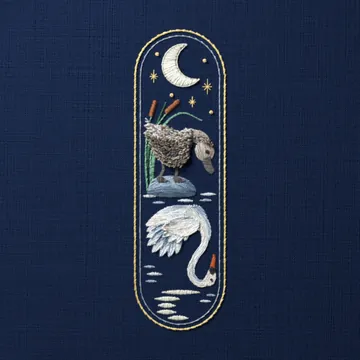
Ugly duckling and swan bookmark
Advanced 3–8 in hoop · 16 colors
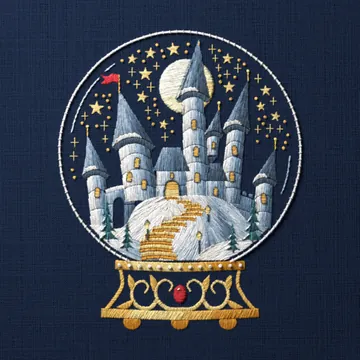
Castle snow globe at night
Advanced 3–8 in hoop · 16 colors
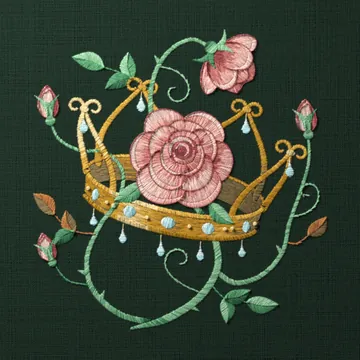
Princess crown with roses
Advanced 3–8 in hoop · 14 colors
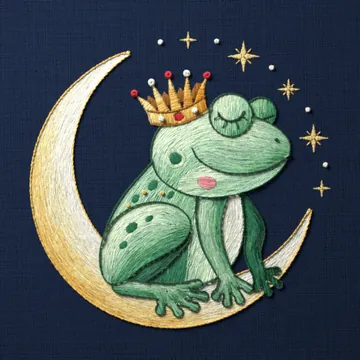
Little frog with a crown
Advanced 3–8 in hoop · 23 colors
Rose panel for a dress bodice
Intermediate 3–8 in hoop · 5 colors
Little castle with pennant towers
Easy 3–8 in hoop · 6 colors
Storybook castle with pennants
New to hand embroidery? Starting hand embroidery, step by step