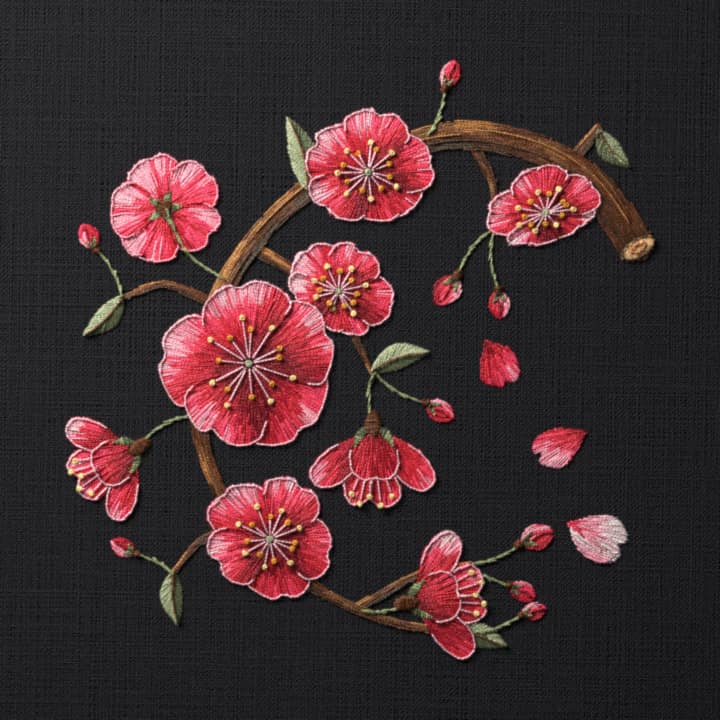
Red cherry blossom on dark gray hand embroidery pattern
Advanced · 18 colors · 8 kinds of stitch
Download free PDFPDF, US Letter · 145 KBFor your own stitching, gifts and handmade pieces you sell. Do not resell or share this PDF. What you may do, in full
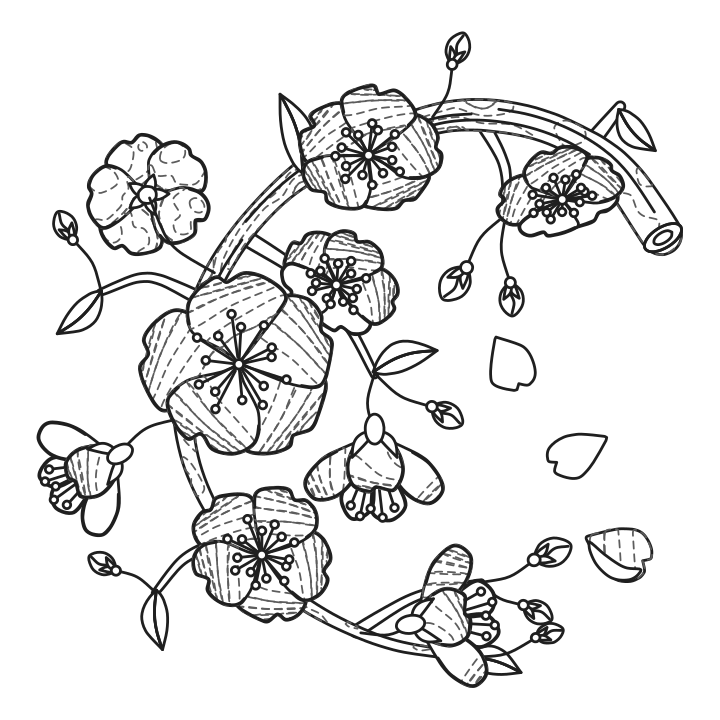
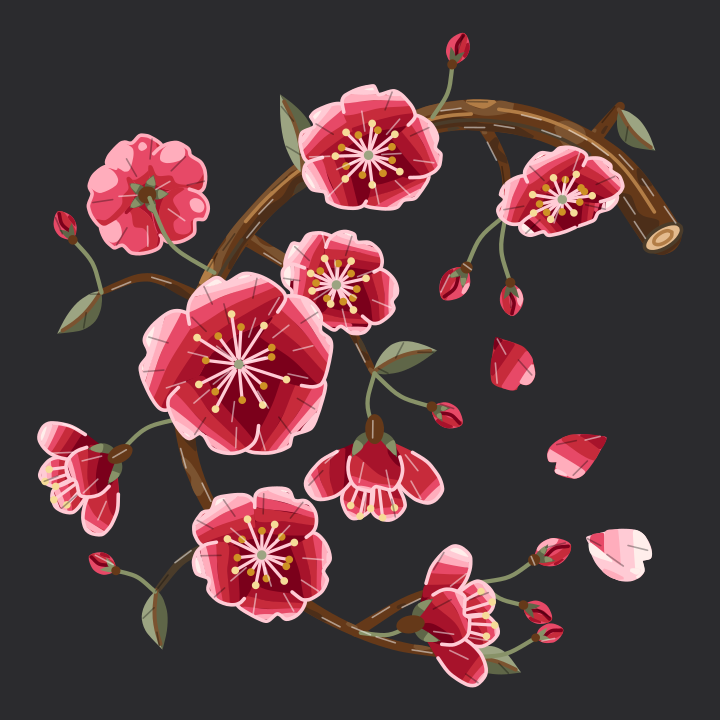
An old branch comes in at the upper right and weeps down the left side in one long curve. Blossoms of every age ride it: full face, tilted, in profile, from behind and in tight bud, and three petals are falling through the open side. The petals, buds and bark are worked in long and short stitch, garnet at the heart and palest pink at the tip, with a fine rim in split stitch. The stamens are straight stitches tipped with gold French knots, the stalks are stem stitch and the young leaves are fishbone stitch. It is drawn for charcoal linen. In the picture of where the colors go, the fine lines show which way the stitches lie.
Size and details
Advanced. Uses long and short stitch over much of the design, padded satin stitch, dozens of French knots, 18 colors and a great deal of stitching.
18 colors of floss and 8 kinds of stitch:
- Long and short stitch
- Split stitch
- Satin stitch
- Fishbone stitch
- Stem stitch
- Padded satin stitch
- Straight stitch
- French knot
- Which stitch goes where
| Hoop | Inches | Centimeters | Satin stitch up to |
|---|---|---|---|
| 3 in (8 cm) | 1.8 × 1.8 in | 4.6 × 4.6 cm | 1/16 in (1.6 mm) |
| 4 in (10 cm) | 2.7 × 2.7 in | 6.9 × 6.9 cm | 1/16 in (1.6 mm) |
| 5 in (13 cm) | 3.6 × 3.6 in | 9.1 × 9.1 cm | 1/8 in (3 mm) |
| 6 in (15 cm) | 4.5 × 4.5 in | 11.4 × 11.4 cm | 1/8 in (3 mm) |
| 8 in (20 cm) | 6.3 × 6.3 in | 16 × 16 cm | 3/16 in (5 mm) |
- In a 3, 4, 5 or 6 inch hoop the French knots are drawn smaller than about 2 mm (a little over 1/16 in). Use one strand of floss for them there, or choose a larger hoop.
The pattern is drawn inside a circle about half an inch (1.3 cm) smaller all around than the hoop.
What you need
- DMC 801 Dark Coffee BrownBranch (middle), twigs (light), calyx (dark)
- DMC 898 Very Dark Coffee BrownBranch and twigs (darkest)
- DMC 433 Medium BrownBranch (light), young leaves (dark), twigs (lightest)
- DMC 3031 Very Dark Mocha BrownBark ridges (darker), twigs and branch (dark)
- DMC 435 Very Light BrownBark ridges (lighter), branch (lightest), cut end (darker)
- DMC 437 Light TanCut end (lighter)
- DMC 3051 Dark Green GrayYoung leaves and calyx (middle)
- DMC 3053 Green GrayYoung leaves (light), flower hearts
- DMC 3052 Medium Green GrayFlower stalks, calyx (light)
- DMC 3801 Very Dark MelonPetals and falling petals (shade 4 of 7), petal backs and buds (light)
- DMC 498 Dark RedPetals and falling petals (shade 2 of 7), petal backs (dark), buds (darkest)
- DMC 321 RedPetals and falling petals (shade 3 of 7), petal backs (middle), buds (dark)
- DMC 3706 Medium MelonPetals and falling petals (shade 5 of 7), petal backs and buds (lightest)
- DMC 814 Dark GarnetPetals and falling petals (shade 1 of 7), bud folds, petal backs (darkest)
- DMC 3708 Light MelonPetal rims and filaments, petals and falling petals (shade 6 of 7)
- DMC 819 Light Baby PinkPetals and falling petals (shade 7 of 7)
- DMC 783 Medium TopazAnthers (darker)
- DMC 3822 Light StrawAnthers (lighter)
Skeins: one of each color is enough. An estimate for the largest size, the 8 inch hoop: the length of each line and the area of each filled shape, a fifth added for tails and ends, a tenth of every 8 m (8.7 yd) skein kept spare.
The floss is six-strand cotton; the stitch guide says how many strands to use. You also need a hoop, an embroidery needle (a size 7 to 9 suits two or three strands) and plain cotton or linen fabric. To frame the piece in its hoop, cut a square 3 inches (8 cm) wider than the hoop: a 9 inch (23 cm) square for a 6 inch hoop.
When it is stitched, how to finish a hoop shows how to back it for the wall.
Stitch guide
- Put the pattern on the fabric (how to transfer a pattern) and the fabric in the hoop.
- Stitch the filled parts first, what lies behind before what lies in front of it.
- Then stitch the lines: stems, veins and outlines over the edges of the filled parts.
- Keep the knots for the end, so that the hoop and your hand do not flatten them.
Start each thread with a small knot on the back or one of the knotless starts, and end it by running the needle under the backs of a few stitches (starting and ending a thread). Use the strands this list gives, also where a page about a stitch names another number.
- Long and short stitch 1 strandTwigs, branch, buds, petal backs, petals, falling petals
- Split stitch 1 strandBark ridges, cut end, bud folds, petal backs, petal rims
- Satin stitch 2 strandsCut end, calyx
- Fishbone stitch 2 strandsYoung leaves
- Stem stitch 1 to 2 strandsYoung leaves, flower stalks
- Padded satin stitch 2 strandsCalyx
- Straight stitch 1 strandFilaments
- French knot 1 to 2 strands, two wrapsAnthers, flower hearts
Getting it onto your fabric
The PDF holds the pattern twice at actual size: once as drawn, and once mirrored for an iron-on transfer pen. Print it at 100% with scaling off and check the one-inch square (25.4 mm) with a ruler before you trace. How to transfer a pattern explains tracing, carbon paper and the other ways. The files are under Downloads.
Downloads
- Download free PDF PDF, US Letter, 3 pages, for a 6 inch (15 cm) hoop
- Download free PDF, A4 PDF, A4, 3 pages, for a 6 inch (15 cm) hoop
More patterns like this
Advanced 3–8 in hoop · 21 colors
Plum blossom crescent and moon
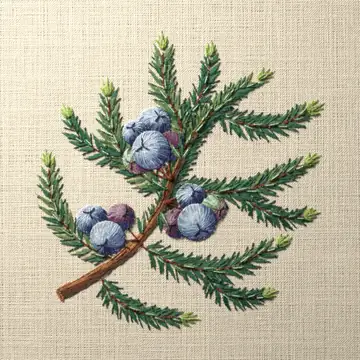
Advanced 3–8 in hoop · 20 colors
Juniper sprig with blue berries
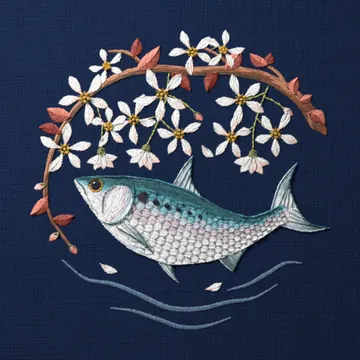
Advanced 3–8 in hoop · 24 colors
Shad fish and shadbush blossom
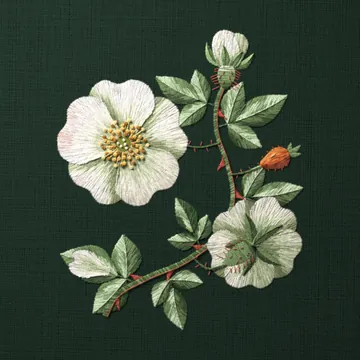
Advanced 3–8 in hoop · 23 colors
Cherokee rose branch
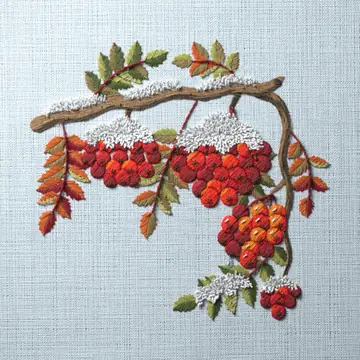
Advanced 3–8 in hoop · 13 colors
Mountain ash branch in the snow
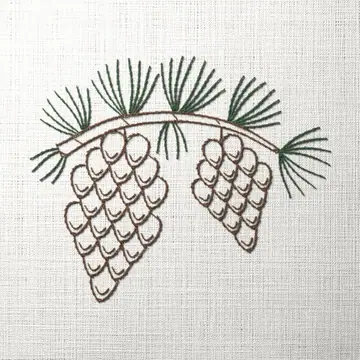
Easy 3–8 in hoop · 2 colors
Pine cones on a branch
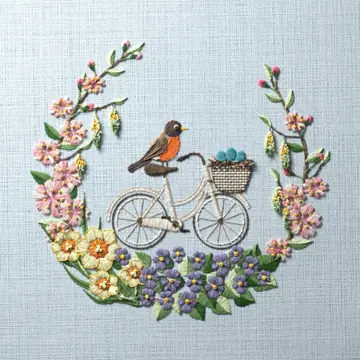
Advanced 3–8 in hoop · 16 colors
Spring bicycle in a blossom wreath
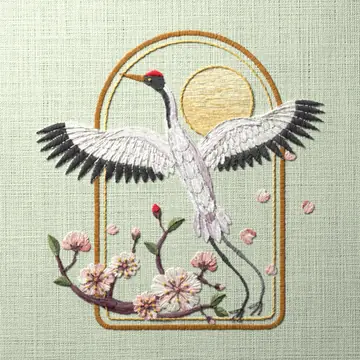
Advanced 3–8 in hoop · 21 colors
Flying crane with cherry blossom
New to hand embroidery? Starting hand embroidery, step by step