Rustic wedding mason jar with flowers hand embroidery pattern
Advanced · 16 colors · 4.3 × 4.6 in · 10 kinds of stitch
Download free PDFPDFPrints on US Letter and A4You may sell what you make from it by hand, in small quantities. The PDF itself is not to be sold or shared. Selling, classes and kits: the rules
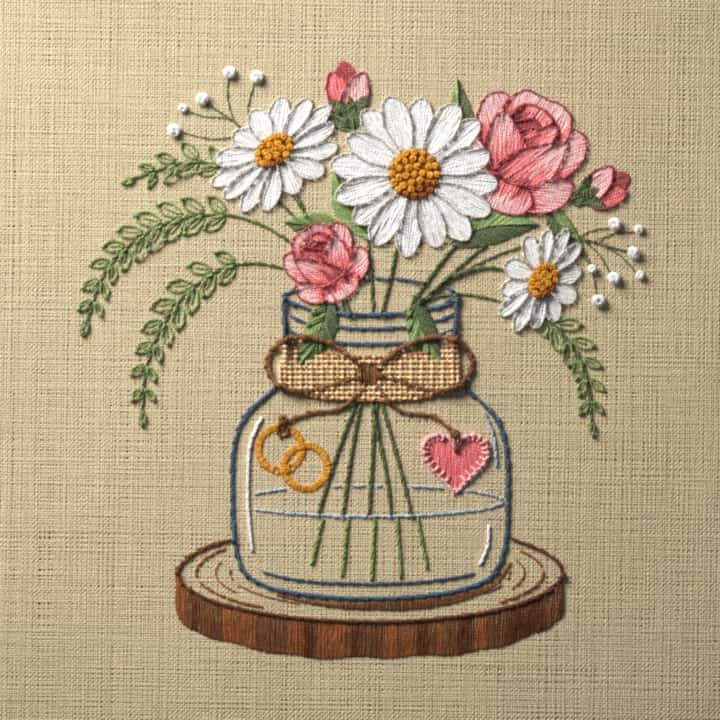
A glass mason jar stands on a thick slice of log, filled with three daisies, two pink roses, two buds, baby’s breath and ferns that spill to both sides.
Size and details
Advanced. Uses long and short stitch, dozens of French knots, 16 colors and a great deal of stitching; from a 6 inch hoop up the widest satin stitches are long.
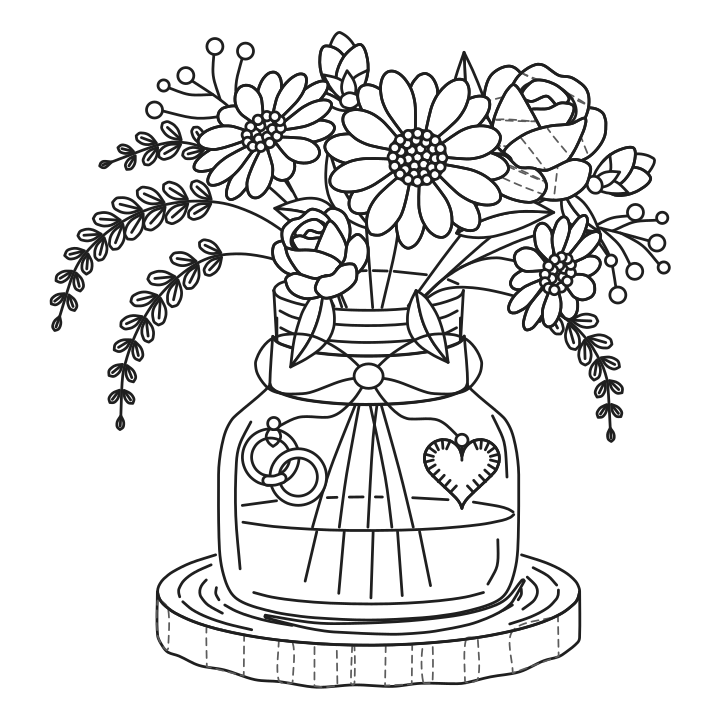
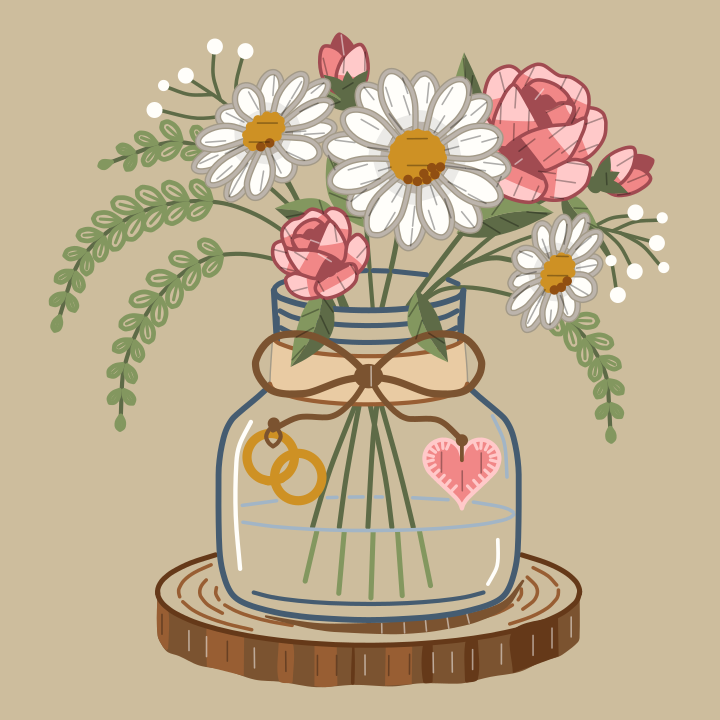
The daisy and rose petals are long and short stitch with a fine split stitch edge, the daisy hearts and the baby’s breath are French knots, and the fern leaves are lazy daisy loops with a straight stitch inside. The broad leaves are fishbone stitch and the burlap band is woven filling stitch. The glass, the stems and the twine are stem stitch; the stems turn paler below the water line, which is back stitch. The rings, the heart and the bark are satin stitch. In the picture of where the colors go, the fine lines show which way the stitches lie.
| Hoop | Inches | Centimeters | Satin stitch up to |
|---|---|---|---|
| 3 in (8 cm) | 1.7 × 1.8 in | 4.3 × 4.6 cm | 3/16 in (5 mm) |
| 4 in (10 cm) | 2.6 × 2.8 in | 6.6 × 7.1 cm | 1/4 in (6 mm) |
| 5 in (13 cm) | 3.5 × 3.7 in | 8.9 × 9.4 cm | 5/16 in (8 mm) |
| 6 in (15 cm) | 4.3 × 4.6 in | 10.9 × 11.7 cm | 3/8 in (10 mm) |
| 8 in (20 cm) | 6.1 × 6.4 in | 15.5 × 16.3 cm | 9/16 in (14 mm) |
- In an 8 inch hoop the widest satin stitch shape is 9/16 in (14 mm) across. Satin stitches longer than about 12 mm (just under 1/2 in) tend to work loose: divide the shape into sections, or work it in long and short stitch.
- In a 3, 4 or 5 inch hoop the French knots and the shortest lazy daisy loops are drawn smaller than about 2 mm (a little over 1/16 in). Use one strand of floss for them there, or choose a larger hoop.
What you need
- Fabric
- Plain cotton or linen in tan, cut 9 in (23 cm) square. On white cloth its palest threads do not show: choose other colors under Options.
- Needle
- Embroidery needle, size 9 for 1 strand, size 7 for 2 or 3, size 3 for 4 to 6 (a lower number is a thicker needle).
- Floss
- 16 colors of six-strand cotton, listed below. DMC is a brand: another brand in a like color will do.
- Marker
- A pen or a sheet that suits the fabric: how to transfer a pattern says which.
Floss
- 1DMC 433 Medium BrownBark (middle), twine bow and jar shadow
- 2DMC 801 Dark Coffee BrownBark (dark), log slice
- 3DMC 434 Light BrownBark (light), growth rings and burlap edges
- 4DMC 3362 Dark Pine GreenStems, fern stems, sprig stems and sepals, leaves (darker)
- 5DMC 3364 Pine GreenFerns and stems under water, leaves (lighter)
- 6DMC BLANC WhiteDaisy petals (light), baby's breath and glass lights
- 7DMC 3721 Dark Shell PinkRoses and rosebuds (dark), rose edges
- 8DMC 3712 Medium SalmonRoses and rosebuds (middle), heart
- 9DMC 761 Light SalmonRoses and rosebuds (light), heart edge
- 10DMC 648 Light Beaver GrayDaisy edges, daisy petals (dark)
- 11DMC 3024 Very Light Brown GrayDaisy petals (middle)
- 12DMC 783 Medium TopazDaisy hearts (lighter), rings
- 13DMC 975 Dark Golden BrownDaisy hearts (darker)
- 14DMC 932 Light Antique BlueWater line and glass shade
- 15DMC 930 Dark Antique BlueJar
- 16DMC 738 Very Light TanBurlap band
Skeins: one of each color is enough. An estimate for the 6 inch hoop, from the length of each line and the area of each filled shape, with a fifth added for tails.
How to stitch it
- New to hand embroidery? Start here.
- Print at 100%, trace the pattern onto the fabric, and put it in the hoop: inner ring under, drawing up, tight as a drum.
- Floss is six strands. Cut 18 inches (45 cm), pull out the number given one at a time, and lay them together.
- Inside a filled shape start with two or three tiny stitches, which the filling covers. Start a line with a small knot on the back. End each thread by running the needle under the backs of a few stitches.
- Each small ring is one French knot. Each small loop is one lazy daisy: come up at its point. A fine broken line inside a shape is where two shades meet: trace it, do not stitch it.
- A number under “Where colors go” is a color of the list. The fine lines on the colors show which way the stitches lie.
Stitch in this order
Filled parts from the back of the picture forward, then lines, loops and knots. Where a stitch page names another number of strands, use the number here.
- Satin stitch3 strands: bark2 strands: jar shadow, rosebuds, sepals, roses, daisy hearts, rings, heart, twine bow
- Fishbone stitch 2 strandsLeaves
- Long and short stitch 1 strandRosebuds, roses, daisy petals
- Woven filling stitch 3 strandsBurlap band
- Stem stitch2 to 6 strands: twine bow2 to 4 strands: jar3 strands: log slice, stems under water2 or 3 strands: stems2 strands: fern stems, burlap edges, heart edge
- Back stitch3 strands: glass shade2 strands: water line1 or 2 strands: growth rings, sprig stems
- Straight stitch4 strands: twine bow2 strands: heart edge1 strand: ferns
- Split stitch3 or 4 strands: glass lights1 strand: rose edges, daisy edges
- Lazy daisy stitch 2 strandsFerns
- French knot two wraps2 or 3 strands: baby's breath2 strands: daisy hearts, twine bow
When it is done, take off any lines that still show and finish the hoop. A guide to this kind of work: Stitches for flowers.
More patterns like this
Advanced 3–8 in hoop · 22 colors
Bless your heart sweet tea jar
Advanced prints 3–14 in · 24 colors
Art teacher’s jar of blooming brushes
Advanced 3–8 in hoop · 23 colors
Dill pickle jar with dill flowers
Advanced 3–8 in hoop · 24 colors
Jar of crayons and brushes
Advanced prints 3–14 in · 17 colors
Mrs with an anemone heart
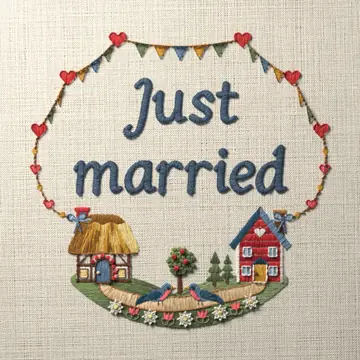
Advanced prints 3–14 in · 19 colors
Just married with two folk cottages
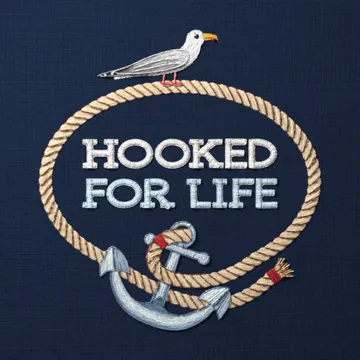
Advanced prints 3–14 in · 19 colors
Hooked for life, rope and an anchor
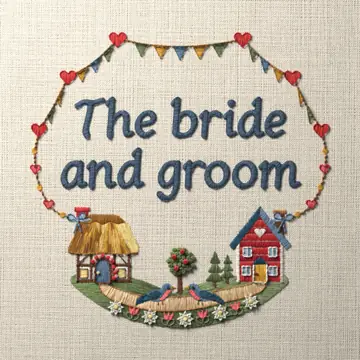
Advanced prints 3–14 in · 19 colors
The bride and groom with two cottages
New to hand embroidery? Starting hand embroidery, step by step