Sheep border with blanket stitch edge hand embroidery pattern
Advanced · 22 colors · 8 kinds of stitch
Download free PDFPDF, US Letter · 106 KBFor your own stitching, gifts and handmade pieces you sell. Do not resell or share this PDF or copies of it. Selling, classes and kits: the rules
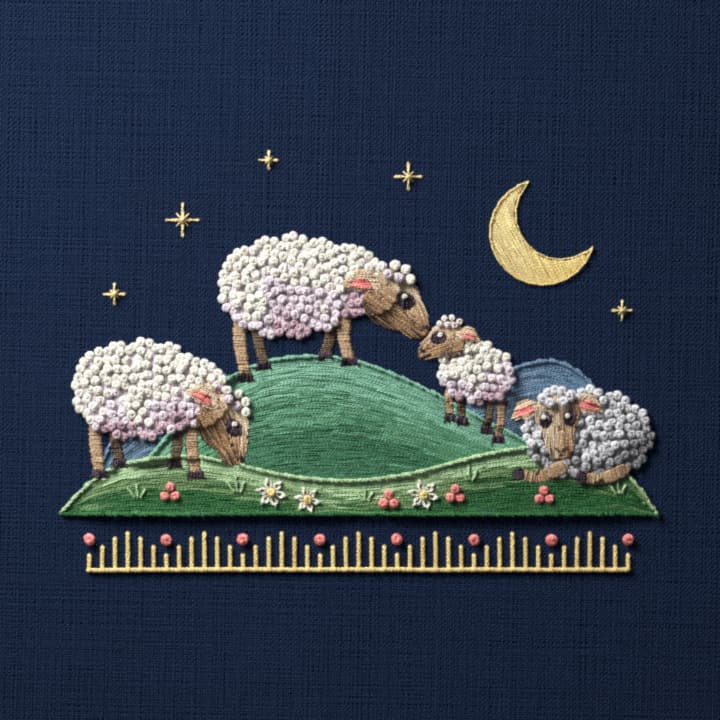
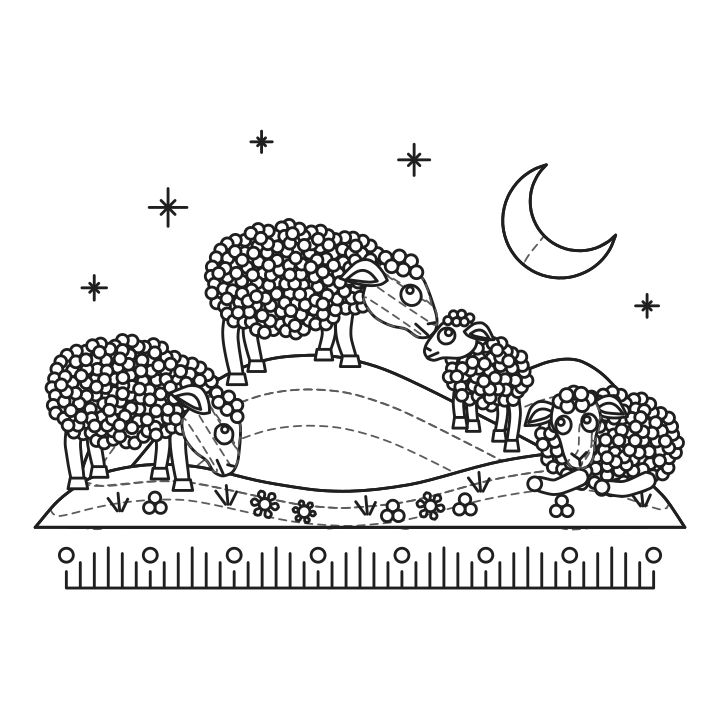
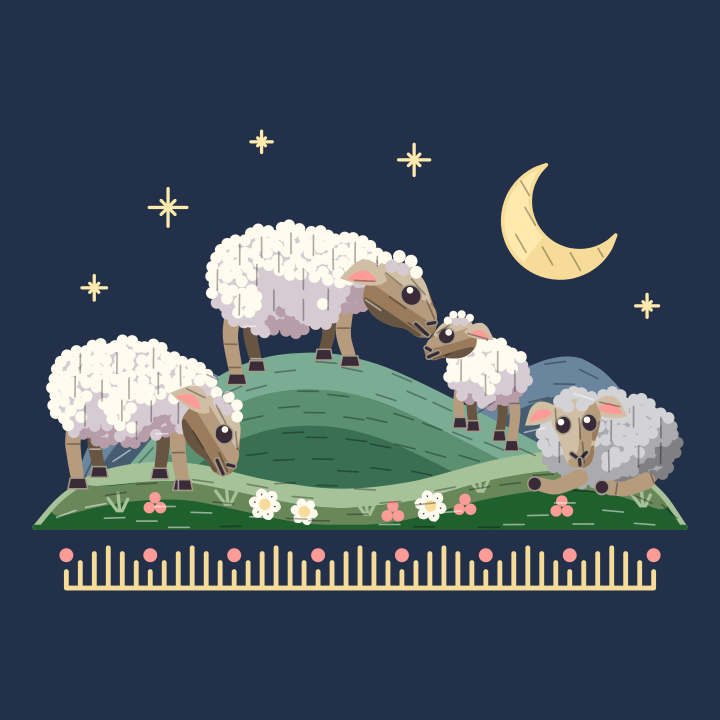
A ewe on the crest of a hill bends to touch noses with her lamb while one ewe grazes and a gray one rests in the grass, under a crescent moon and five stars. The wool is packed French knots over long and short stitch, with smooth brown faces in long and short stitch and satin stitch for legs, ears and moon. The three hills are long and short stitch that runs with the slope, each crest drawn in stem stitch, with lazy daisy flowers, straight stitch grass and coral clover in French knots. Beneath runs one row of gold blanket stitch, its spokes growing and shrinking in seven little hills, for the edge of a wool throw or a baby blanket. It is drawn for navy linen. In the picture of where the colors go, the fine lines show which way the stitches lie.
Size and details
Advanced. Uses long and short stitch over much of the design, more than a hundred French knots, 22 colors and a great deal of stitching; from a 5 inch hoop up the widest satin stitches are long.
22 colors of floss and 8 kinds of stitch:
- Satin stitch
- Split stitch
- Straight stitch
- Long and short stitch
- Stem stitch
- Lazy daisy stitch
- French knot
- Blanket stitch
- Which stitch goes where
| Hoop | Inches | Centimeters | Satin stitch up to |
|---|---|---|---|
| 3 in (8 cm) | 1.8 × 1.2 in | 4.6 × 3 cm | 3/16 in (5 mm) |
| 4 in (10 cm) | 2.7 × 1.9 in | 6.9 × 4.8 cm | 1/4 in (6 mm) |
| 5 in (13 cm) | 3.5 × 2.5 in | 8.9 × 6.4 cm | 3/8 in (10 mm) |
| 6 in (15 cm) | 4.4 × 3.1 in | 11.2 × 7.9 cm | 7/16 in (11 mm) |
| 8 in (20 cm) | 6.2 × 4.4 in | 15.7 × 11.2 cm | 5/8 in (16 mm) |
- In an 8 inch hoop the widest satin stitch shape is 5/8 in (16 mm) across. Satin stitches longer than about 12 mm (just under 1/2 in) tend to work loose: divide the shape into sections, or work it in long and short stitch.
- In a 3, 4, 5 or 6 inch hoop the French knots are drawn smaller than about 2 mm (a little over 1/16 in). Use one strand of floss for them there, or choose a larger hoop.
- In a 3, 4, 5, 6 or 8 inch hoop the shortest lazy daisy loops are drawn smaller than about 2 mm (a little over 1/16 in). Use one strand of floss for them there, or choose a larger hoop.
The pattern is drawn inside a circle about half an inch (1.3 cm) smaller all around than the hoop.
What you need
- DMC 745 Light Pale YellowMoon (lighter), stars
- DMC 3822 Light StrawBlanket stitch edge and daisy hearts, moon (darker)
- DMC 930 Dark Antique BlueFar hills (darker)
- DMC 931 Medium Antique BlueFar hills (lighter)
- DMC 501 Dark Blue GreenMiddle hill (dark)
- DMC 502 Blue GreenMiddle hill (middle)
- DMC 503 Medium Blue GreenMiddle hill (light)
- DMC 319 Very Dark Pistachio GreenNear hill (dark)
- DMC 320 Medium Pistachio GreenNear hill (middle)
- DMC 368 Light Pistachio GreenNear hill (light), grass
- DMC 712 CreamWool (lightest), daisies and eye lights
- DMC 352 Light CoralClover, edge knots and ear linings
- DMC 839 Dark Beige BrownLegs (darker), faces (darkest)
- DMC 3371 Black BrownHooves, eyes, nostrils and mouths
- DMC 841 Light Beige BrownLegs (lighter), faces (light)
- DMC 3743 Very Light Antique VioletWool (middle light)
- DMC 3042 Light Antique VioletWool (dark)
- DMC 840 Medium Beige BrownFaces (dark)
- DMC 842 Very Light Beige BrownFaces (lightest), ears
- DMC 318 Light Steel GrayWool (middle dark)
- DMC 414 Dark Steel GrayWool (darkest)
- DMC 415 Pearl GrayWool (light)
Skeins: one of each color is enough. An estimate for the largest size, the 8 inch hoop: the length of each line and the area of each filled shape, a fifth added for tails and ends, a tenth of every 8 m (8.7 yd) skein kept spare.
On a soft blanket. Fleece and plush swallow fine stitches and stretch: lay a wash-away film on top, hoop a backing and baste the blanket to it, and take four to six strands. Do not iron fleece; most of it melts. On a knit, use a sticky wash-away sheet. How to embroider fleece and plush has the steps.
In a hoop. The floss is six-strand cotton; the stitch guide says how many strands to use. You also need a hoop, an embroidery needle (a size 9 or 10 for one strand, 7 to 9 for two or three, and 3 to 5 for four or more) and plain cotton or linen fabric. To frame the piece in its hoop, cut a square 3 inches (8 cm) wider than the hoop: a 9 inch (23 cm) square for a 6 inch hoop.
When it is stitched, how to finish a hoop shows how to back it for the wall.
Stitch guide
- Put the pattern on the fabric (how to transfer a pattern) and the fabric in the hoop.
- Stitch the filled parts first, what lies behind before what lies in front of it.
- Then stitch the lines: stems, veins and outlines over the edges of the filled parts.
- Keep the knots for the end, so that the hoop and your hand do not flatten them.
Begin with no knot on the back where it is seen and washed, as on a towel, a napkin or clothes; for a piece in a hoop a small knot is fine. End each thread by running the needle under the backs of a few stitches. (Starting and ending a thread shows how.) Use the strands this list gives, and begin as it says, also where a page about a stitch names another number or begins with a knot.
- Satin stitch 2 strandsMoon, legs, hooves, eyes, ears, ear linings
- Split stitch 1 strandMoon
- Straight stitch 1 to 2 strandsStars, grass, mouths, nostrils
- Long and short stitch 1 to 2 strandsFar hills, middle hill, near hill, wool, faces
- Stem stitch 3 strandsFar hills, middle hill, near hill
- Lazy daisy stitch 2 strandsDaisies
- French knot 1 to 2 strands, two wrapsDaisy hearts, clover, wool, eye lights, edge knots
- Blanket stitch 6 strandsBlanket stitch edge
Getting it onto your fabric
The PDF holds the pattern twice at actual size: once as drawn, and once mirrored for an iron-on transfer pen. Print it at 100% with scaling off and check the one-inch square (25.4 mm) with a ruler before you trace. How to transfer a pattern explains tracing, carbon paper, the sticky wash-away sheet for knits, denim and dark cloth, and the other ways. The files are under Downloads.
Downloads
- Download free PDF PDF, US Letter, 3 pages, for a 6 inch (15 cm) hoop
- Download free PDF, A4 PDF, A4, 3 pages, for a 6 inch (15 cm) hoop
More patterns like this
Advanced prints 3–14 in · 21 colors
Woolly sheep in the snow
Advanced 3–8 in hoop · 21 colors
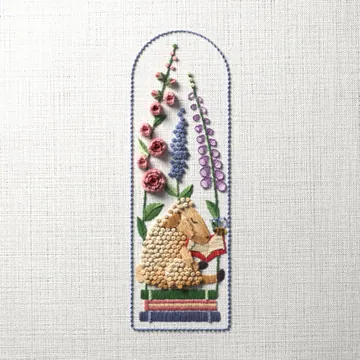
Sheep reading a book bookmark
Advanced 3–8 in hoop · 16 colors
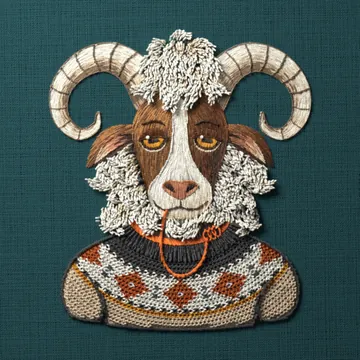
Icelandic sheep in a yoke sweater
Advanced 3–8 in hoop · 23 colors
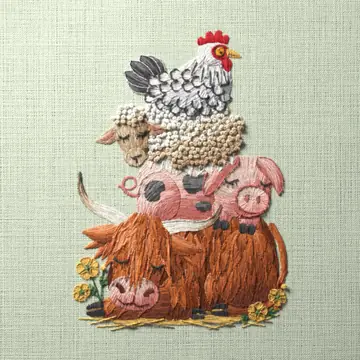
Stacked farm animals fast asleep
Easy prints 3–14 in · 3 colors
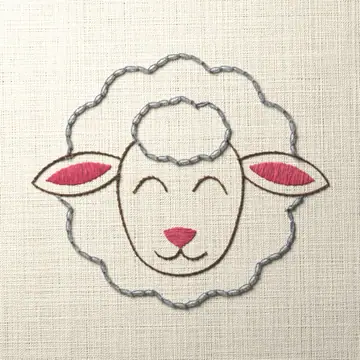
Sheep face in a scalloped fleece
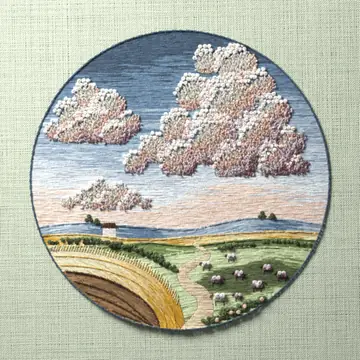
Advanced prints 3–14 in · 22 colors
Stumpwork landscape with 3D clouds
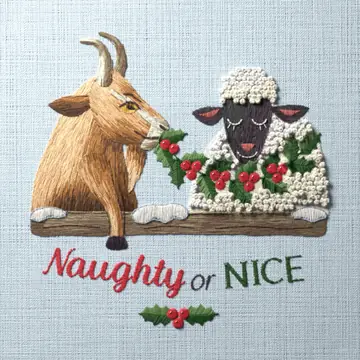
Advanced prints 3–14 in · 22 colors
Naughty or nice
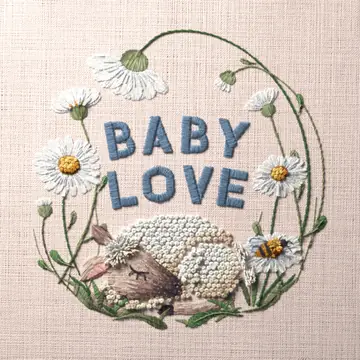
Advanced prints 3–14 in · 22 colors
Baby love in daisies
New to hand embroidery? Starting hand embroidery, step by step