Small dagger and rose hand embroidery pattern
Advanced · 17 colors · 3.4 × 4.8 in · 8 kinds of stitch
Download free PDFPDFPrints on US Letter and A4You may sell what you make from it by hand, in small quantities. The PDF itself is not to be sold or shared. Selling, classes and kits: the rules
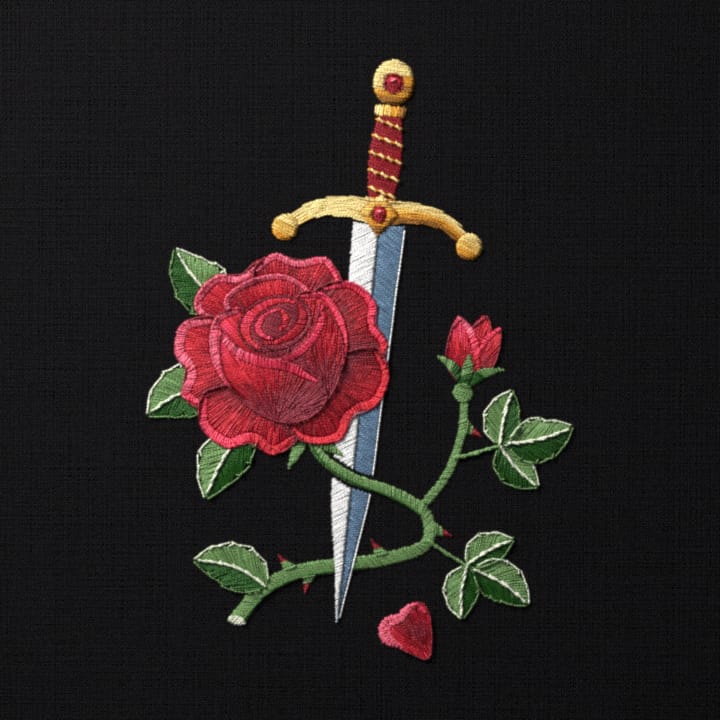
A slim dagger points down, its blade split into a near white half and a steel blue half in slanted satin stitch with a fine split stitch ridge.
Size and details
Advanced. Uses padded satin stitch, long and short stitch, 17 colors and a great deal of stitching.
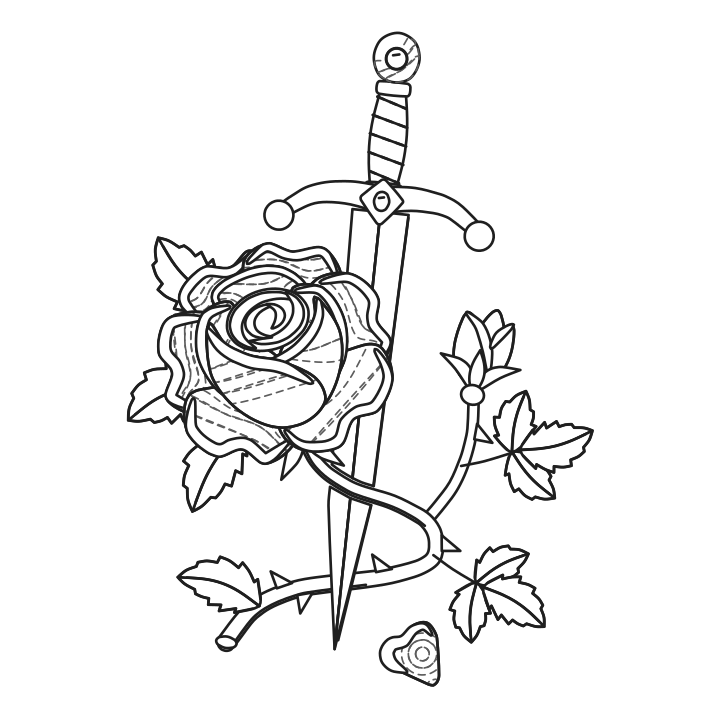
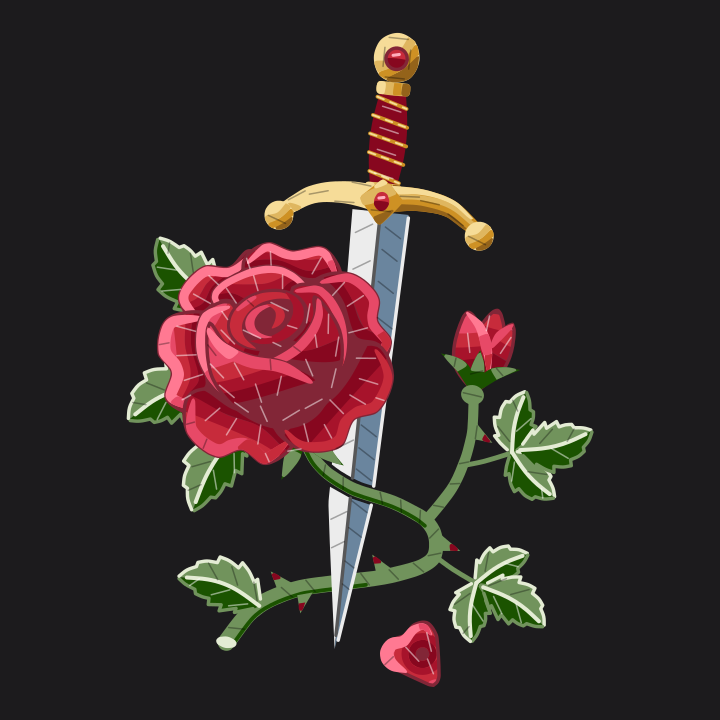
A thorny rose stem in satin stitch leaves the rose, crosses over the blade, turns and passes behind it to a cut end. The rose, seen three quarters on, is long and short stitch from deep wine to crimson, with satin stitch along the turned lips. The leaves are satin stitch in two greens with a pale stem stitch vein, the guard is long and short stitch in gold, the pommel is padded satin stitch, and gold whipped back stitch winds round the oxblood grip. It is drawn for black linen. In the picture of where the colors go, the fine lines show which way the stitches lie.
| Hoop | Inches | Centimeters | Satin stitch up to |
|---|---|---|---|
| 3 in (8 cm) | 1.4 × 1.9 in | 3.6 × 4.8 cm | 1/8 in (3 mm) |
| 4 in (10 cm) | 2 × 2.9 in | 5.1 × 7.4 cm | 3/16 in (5 mm) |
| 5 in (13 cm) | 2.7 × 3.8 in | 6.9 × 9.7 cm | 1/4 in (6 mm) |
| 6 in (15 cm) | 3.4 × 4.8 in | 8.6 × 12.2 cm | 5/16 in (8 mm) |
| 8 in (20 cm) | 4.8 × 6.7 in | 12.2 × 17 cm | 7/16 in (11 mm) |
What you need
- Fabric
- Plain cotton or linen in black, cut 9 in (23 cm) square. On white cloth its palest threads do not show: choose other colors under Options. A pencil line does not show on it: see how to transfer a pattern to dark fabric.
- Needle
- Embroidery needle, size 9 for 1 strand, size 7 for 2 or 3 (a lower number is a thicker needle).
- Floss
- 17 colors of six-strand cotton, listed below. DMC is a brand: another brand in a like color will do.
- Marker
- A pen or a sheet that suits the fabric: how to transfer a pattern says which.
On clothes. Wash and dry the garment first. Denim and twill need no backing and take a sharp needle, embroidery or chenille; T-shirts, sweatshirts and other knits need a backing that sticks or irons on. How to embroider on clothes has every step, the guide to jackets and coats says how to get behind a lining, the guide to patches has the other way, for a jacket whose lining is not opened, and the placement chart says where a design goes.
Floss
- 1DMC 895 Very Dark Hunter GreenLeaves and sepals (darker), stem shade
- 2DMC 3347 Medium Yellow GreenLeaves, sepals and thorns (lighter), stem, leaf edges (darker)
- 3DMC 772 Very Light Yellow GreenLeaf edges (lighter), leaf veins and cut end
- 4DMC 762 Very Light Pearl GrayBlade light side, blade ridge (lighter)
- 5DMC 931 Medium Antique BlueBlade shadow side
- 6DMC 413 Dark Pewter GrayBlade ridge (darker)
- 7DMC 815 Medium GarnetRose petals, bud and fallen petal (darkest), grip, pommel stone and thorns (darker)
- 8DMC 783 Medium TopazGuard, pommel, guard ends and collars (dark), grip wire (darker)
- 9DMC 3822 Light StrawGuard, pommel, guard ends and collars (lightest), grip wire (lighter)
- 10DMC 3820 Dark StrawGuard, collars, pommel and guard ends (light)
- 11DMC 780 Ultra Very Dark TopazGuard, pommel, guard ends and collars (darkest)
- 12DMC 321 RedRose petals and fallen petal (light), turned petal edges (dark) and 3 more parts
- 13DMC 902 Very Dark GarnetRose petals and bud (dark), petal shade, rose heart (darkest) and 2 more parts
- 14DMC 3706 Medium MelonStone light
- 15DMC 498 Dark RedRose petals, bud and fallen petal (middle), rose heart (dark)
- 16DMC 3801 Very Dark MelonTurned petal edges (middle), rose petals, rose heart, bud and fallen petal (lightest)
- 17DMC 3705 Dark MelonTurned petal edges (light)
Skeins: one of each color is enough. An estimate for the 6 inch hoop, from the length of each line and the area of each filled shape, with a fifth added for tails.
How to stitch it
- New to hand embroidery? Start here.
- Print at 100%, trace the pattern onto the fabric, and put it in the hoop: inner ring under, drawing up, tight as a drum.
- Floss is six strands. Cut 18 inches (45 cm), pull out the number given one at a time, and lay them together.
- Begin with no knot on the back where it is seen and washed, as on a towel, a napkin or clothes; for a piece in a hoop a small knot is fine. End each thread by whipping it around the backs of four or five stitches, with one small hitch.
- A dashed line is whipped back stitch. A fine broken line inside a shape is where two shades meet: trace it, do not stitch it.
- A number under “Where colors go” is a color of the list. The fine lines on the colors show which way the stitches lie.
Stitch in this order
Filled parts from the back of the picture forward, then lines. Where a stitch page names another number of strands, use the number here.
- Satin stitch 2 strandsLeaves, stem, cut end, blade light side, blade shadow side, thorns, grip, collars, turned petal edges, sepals, rose heart
- Padded satin stitch 2 strandsPommel, pommel stone, guard ends, guard
- Long and short stitch 1 strandGuard, bud, rose petals, fallen petal
- Split stitch 1 strandLeaf edges, blade ridge, petal shade
- Stem stitch3 strands: stem2 strands: leaf veins1 strand: stem shade
- Whipped back stitch 2 strandsGrip wire
- Back stitch 1 strandStone rim
- Straight stitch 2 strandsStone light
When it is done, take off any lines that still show. A guide to this kind of work: How to embroider a rose.
More patterns like this
Advanced prints 3–14 in · 22 colors
Excalibur, the sword in the stone
Advanced 3–8 in hoop · 24 colors
Jeweled sword and scabbard
Advanced 3–8 in hoop · 23 colors
Jeweled sword with a rose vine
Intermediate 3–8 in hoop · 5 colors
Crossed swords behind a round shield
Advanced prints 3–14 in · 23 colors
Tarot suit symbols in flowers
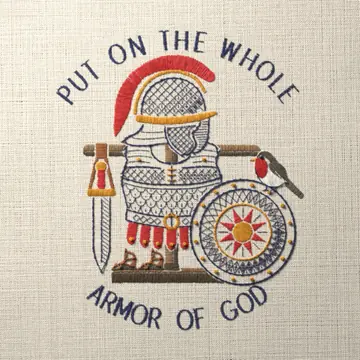
Advanced 3–8 in hoop · 8 colors
Armor of God with shield and sword
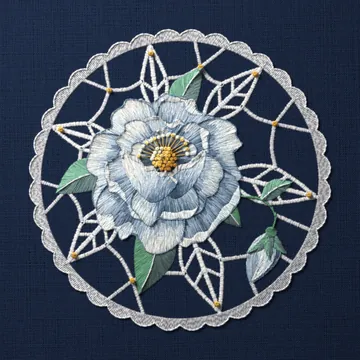
Advanced prints 3–14 in · 17 colors
Winter solstice rose in cutwork
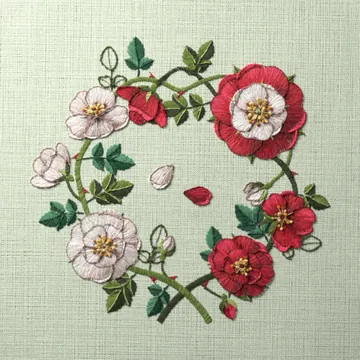
Advanced prints 3–14 in · 18 colors
York and Lancaster rose wreath
New to hand embroidery? Starting hand embroidery, step by step