Small Florida Keys cottage hand embroidery pattern
Easy · 7 colors · 3.8 × 3.8 in · 8 kinds of stitch

Download free PDFPDFPrints on US Letter and A4You may sell what you make from it by hand, in small quantities. The PDF itself is not to be sold or shared. Selling, classes and kits: the rulesNew to it? Next: how to start
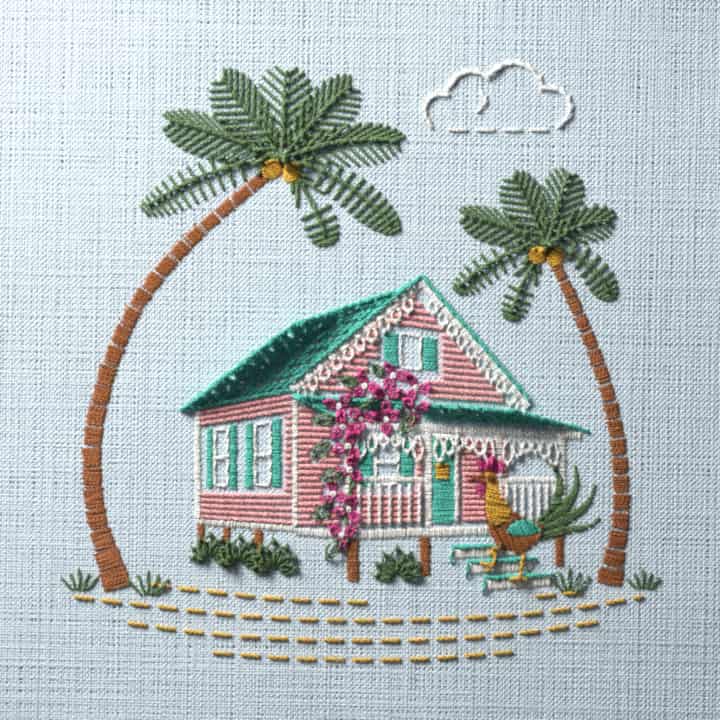
A pink conch cottage stands on short piers between two coconut palms of unequal height. Magenta bougainvillea spills down the corner post and a proud rooster struts up the front steps.
Size and details
Easy. Short satin stitches, no shading.
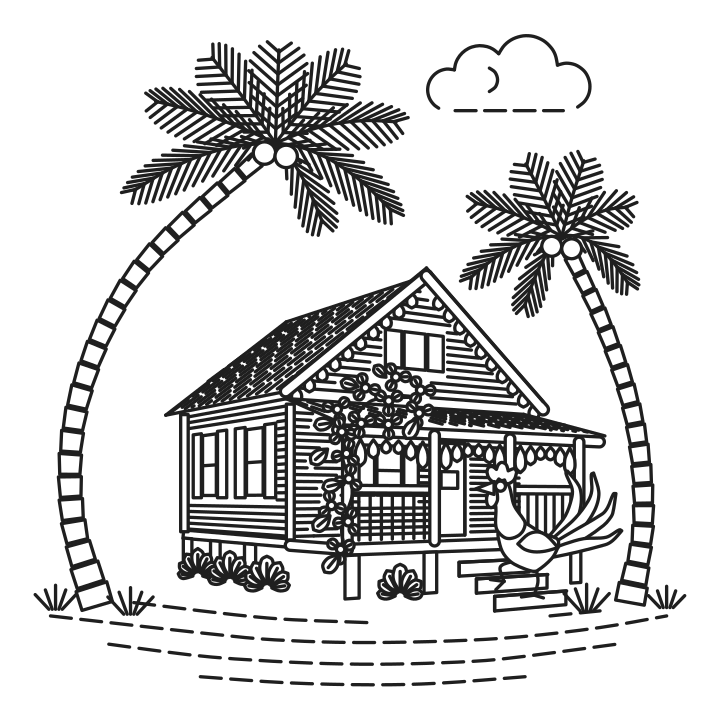
The clapboards are rows of split stitch and the tin roof is rows of running stitch edged in stem stitch. Shutters, posts, palm trunks and the rooster are small shapes in satin stitch, the porch lace and the bougainvillea are lazy daisy stitch, and the palm leaflets are straight stitch. Window frames are back stitch, French knots make the flower hearts and the rooster’s eye, and the sand is running stitch. It is drawn for pale blue linen. In the picture of where the colors go, the fine lines show which way the stitches lie.
| Hoop | Inches | Centimeters | Satin stitch up to |
|---|---|---|---|
| 3 in (8 cm) | 1.5 × 1.5 in | 3.8 × 3.8 cm | 1/8 in (3 mm) |
| 4 in (10 cm) | 2.3 × 2.3 in | 5.8 × 5.8 cm | 1/8 in (3 mm) |
| 5 in (13 cm) | 3.1 × 3.1 in | 7.9 × 7.9 cm | 3/16 in (5 mm) |
| 6 in (15 cm) | 3.8 × 3.8 in | 9.7 × 9.7 cm | 1/4 in (6 mm) |
| 8 in (20 cm) | 5.4 × 5.4 in | 13.7 × 13.7 cm | 5/16 in (8 mm) |
- In a 3 or 4 inch hoop the French knots are drawn smaller than about 2 mm (a little over 1/16 in). Use one strand of floss for them there, or choose a larger hoop.
- In a 3, 4 or 5 inch hoop the shortest lazy daisy loops are drawn smaller than about 2 mm (a little over 1/16 in). Use one strand of floss for them there, or choose a larger hoop.
On a towel. Wash and dry the towel first. To start with, put the bottom of the design 2 to 3 inches (5 to 7.5 cm) above the hem, in the middle or in a lower corner. Keep the stitches low, and press from the back. How to embroider a towel has every step, and the placement chart has the figures for other towels.
What you need
- Fabric
- Plain cotton or linen in pale blue, cut 9 in (23 cm) square. On white cloth its palest threads do not show: choose other colors under Options.
- Needle
- Embroidery needle, size 9 for 1 strand, size 7 for 2 or 3, size 5 for 4 (a lower number is a thicker needle).
- Floss
- 7 colors of six-strand cotton, listed below. DMC is a brand: another brand in a like color will do.
- Marker
- A pen or a sheet that suits the fabric: how to transfer a pattern says which.
Floss
- 1DMC 3849 Light Teal GreenTin roof, roof edges, shutters, door, step edges and rooster wing
- 2DMC 760 SalmonFront wall and side wall
- 3DMC 3865 Winter WhitePorch beam, porch rail, window frames, porch posts and gable boards and 6 more parts
- 4DMC 434 Light BrownPalm trunks, piers, rooster, rooster beak and rooster eye
- 5DMC 729 Medium Old GoldSand, coconuts, rooster neck, rooster legs and door panes
- 6DMC 367 Dark Pistachio GreenPalm fronds, sea grape leaves, rooster tail and beach grass and 2 more parts
- 7DMC 3607 Light PlumBougainvillea and rooster comb
Skeins: one of each color is enough. An estimate for the 6 inch hoop, from the length of each line and the area of each filled shape, with a fifth added for tails.
How to stitch it
- New to hand embroidery? Start here.
- Print at 100%, trace the pattern onto the fabric, and put it in the hoop: inner ring under, drawing up, tight as a drum.
- Floss is six strands. Cut 18 inches (45 cm), pull out the number given one at a time, and lay them together.
- Begin with no knot on the back where it is seen and washed, as on a towel, a napkin or clothes; for a piece in a hoop a small knot is fine. End each thread by whipping it around the backs of four or five stitches, with one small hitch.
- Each small ring is one French knot. Each small loop is one lazy daisy: come up at its point. A dashed line is running stitch.
- A number under “Where colors go” is a color of the list. The fine lines on the colors show which way the stitches lie.
Stitch in this order
Filled parts from the back of the picture forward, then lines, loops and knots. Where a stitch page names another number of strands, use the number here.
- Satin stitch 2 strandsShutters, sills and corner boards, piers, door, door panes, gable boards, porch beam, porch rail, porch posts, front steps, palm trunks, coconuts, rooster tail, rooster, rooster neck, rooster wing, rooster comb, rooster beak
- Running stitch 3 strandsTin roof, cloud, sand
- Stem stitch3 strands: roof edges, window frames, palm fronds, rooster legs2 or 3 strands: step edges, cloud2 strands: bougainvillea stems
- Split stitch4 strands: front wall3 strands: side wall
- Back stitch 2 strandsWindow frames
- Straight stitch3 strands: porch rail, palm fronds, rooster legs2 strands: window frames, beach grass1 strand: bougainvillea, bougainvillea leaves, sea grape leaves
- Lazy daisy stitch 2 strandsGable lace, porch lace, bougainvillea, bougainvillea leaves, sea grape leaves
- French knot 1 strand, two wrapsBougainvillea hearts, rooster eye
When it is done, take off any lines that still show and finish the hoop.
More patterns like this
Easy prints 3–14 in · 7 colors
Easy flamingo love heart
Intermediate prints 3–14 in · 6 colors
Florida alligator among water lilies
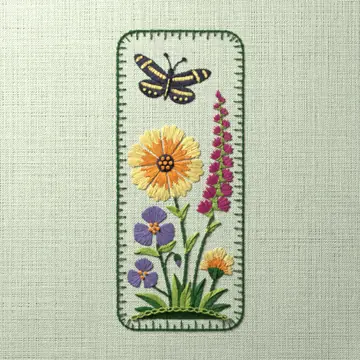
Easy 3–8 in hoop · 7 colors
Easy Florida wildflower bookmark
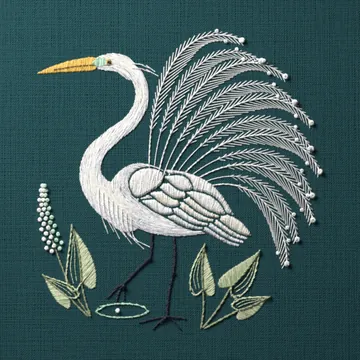
Advanced 3–8 in hoop · 9 colors
Florida pillow with a white egret
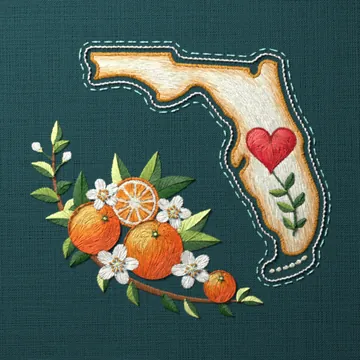
Advanced 3–8 in hoop · 22 colors
Florida outline with a heart
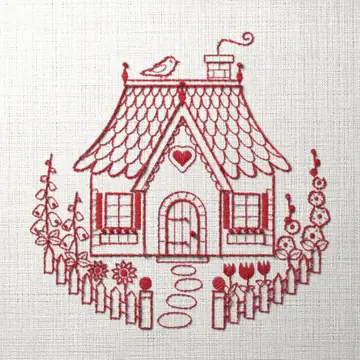
Easy prints 3–14 in · 1 color
Redwork cottage with a scalloped roof
Advanced 3–8 in hoop · 3 colors
Thatched cottage in three reds
Advanced prints 3–14 in · 18 colors
Pixel cottage in the snow at night
New to hand embroidery? Starting hand embroidery, step by step