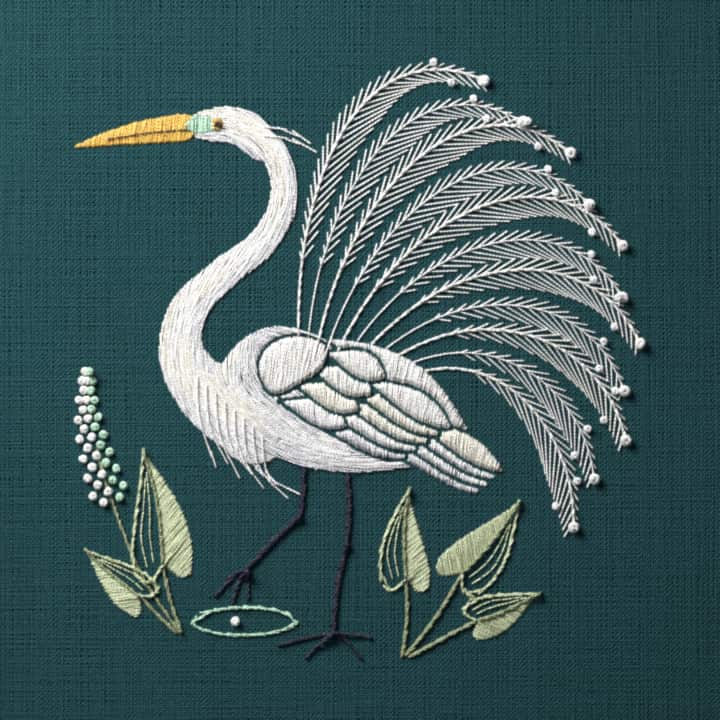
Florida pillow with a white egret hand embroidery pattern
Advanced · 9 colors · 4.3 × 4.5 in · 8 kinds of stitch
Download free PDFPDFPrints on US Letter and A4You may sell what you make from it by hand, in small quantities. The PDF itself is not to be sold or shared. Selling, classes and kits: the rules
A great egret wades across a teal pillow center with its breeding plumes thrown back like a bridal veil.
Size and details
Advanced. Uses long and short stitch, padded satin stitch, dozens of French knots, nine colors and a great deal of stitching; from a 6 inch hoop up the widest satin stitches are long.
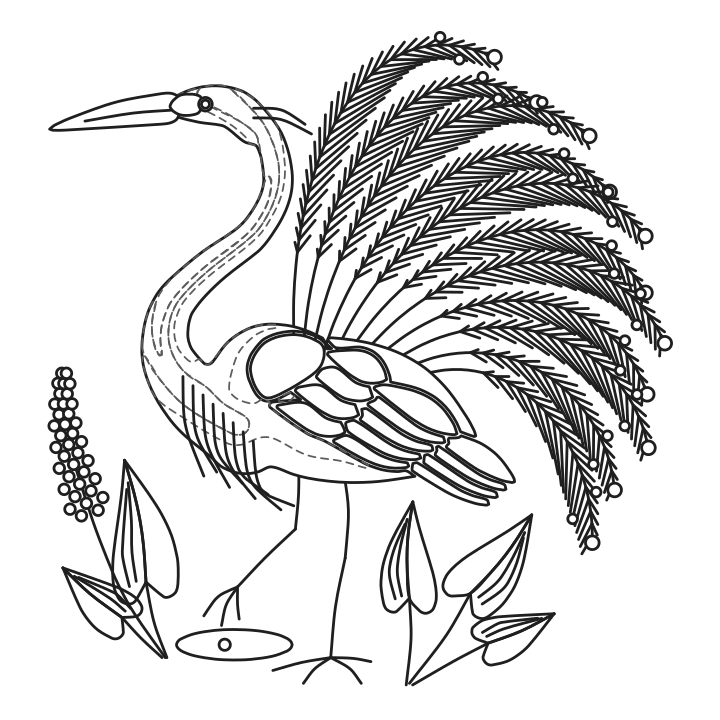
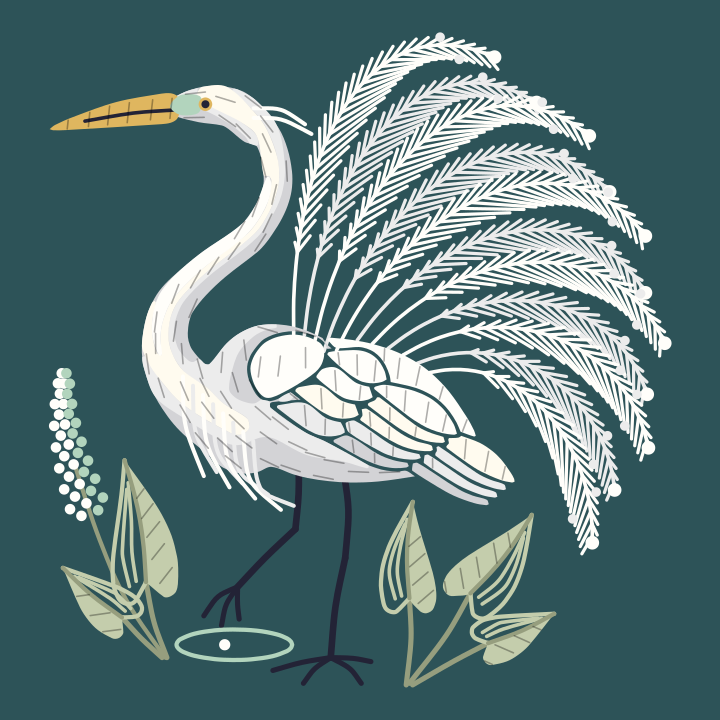
Neck and body are long and short stitch in white, ecru and pearl gray, and each wing feather is padded satin stitch with a fine line of bare cloth left round it. The plumes are single straight stitches set along split stitch shafts, and French knots bead the tips like dew. Pickerelweed at the foot is half satin stitch and half open stem stitch outline, and one pale water ring lies under the lifted foot. In the picture of where the colors go, the fine lines show which way the stitches lie.
| Hoop | Inches | Centimeters | Satin stitch up to |
|---|---|---|---|
| 3 in (8 cm) | 1.7 × 1.8 in | 4.3 × 4.6 cm | 3/16 in (5 mm) |
| 4 in (10 cm) | 2.6 × 2.7 in | 6.6 × 6.9 cm | 1/4 in (6 mm) |
| 5 in (13 cm) | 3.4 × 3.6 in | 8.6 × 9.1 cm | 5/16 in (8 mm) |
| 6 in (15 cm) | 4.3 × 4.5 in | 10.9 × 11.4 cm | 7/16 in (11 mm) |
| 8 in (20 cm) | 6 × 6.3 in | 15.2 × 16 cm | 9/16 in (14 mm) |
- In an 8 inch hoop the widest satin stitch shape is 9/16 in (14 mm) across. Satin stitches longer than about 12 mm (just under 1/2 in) tend to work loose: divide the shape into sections, or work it in long and short stitch.
- In a 3, 4 or 5 inch hoop the French knots are drawn smaller than about 2 mm (a little over 1/16 in). Use one strand of floss for them there, or choose a larger hoop.
What you need
- Fabric
- Plain cotton or linen in dark teal, cut 9 in (23 cm) square. On white cloth its palest threads do not show: choose other colors under Options. A pencil line does not show on it: see how to transfer a pattern to dark fabric.
- Needle
- Embroidery needle, size 9 for 1 strand, size 7 for 2 or 3, size 3 for 4 or 5 (a lower number is a thicker needle).
- Floss
- 9 colors of six-strand cotton, listed below. DMC is a brand: another brand in a like color will do.
- Marker
- A pen or a sheet that suits the fabric: how to transfer a pattern says which.
Floss
- 1DMC 762 Very Light Pearl GrayVeil plumes and plume shafts (darker), neck and body (dark) and 5 more parts
- 2DMC BLANC WhiteVeil plumes and plume shafts (lighter), wing feathers (lightest) and 8 more parts
- 3DMC 522 Fern GreenLeaf stalks and leaf midribs
- 4DMC 3813 Light Blue GreenFlower spike (darker), water ring and lores
- 5DMC 524 Very Light Fern GreenPickerelweed leaves, leaf veins and leaf outlines
- 6DMC 310 BlackLegs, toes and bill line, eye (darker)
- 7DMC 415 Pearl GrayNeck and body and wing feathers (darkest), tail feathers (dark)
- 8DMC 712 CreamNeck and body, wing feathers and tail feathers (light), wing coverts (middle)
- 9DMC 3820 Dark StrawBill, eye (lighter)
Skeins: one of each color is enough. An estimate for the 6 inch hoop, from the length of each line and the area of each filled shape, with a fifth added for tails.
How to stitch it
- New to hand embroidery? Start here.
- Print at 100%, trace the pattern onto the fabric, and put it in the hoop: inner ring under, drawing up, tight as a drum.
- Floss is six strands. Cut 18 inches (45 cm), pull out the number given one at a time, and lay them together.
- Inside a filled shape start with two or three tiny stitches, which the filling covers. Start a line with a small knot on the back. End each thread by running the needle under the backs of a few stitches.
- Each small ring is one French knot. A fine broken line inside a shape is where two shades meet: trace it, do not stitch it.
- A number under “Where colors go” is a color of the list. The fine lines on the colors show which way the stitches lie.
Stitch in this order
Filled parts from the back of the picture forward, then lines and knots. Where a stitch page names another number of strands, use the number here.
- Satin stitch 2 strandsPickerelweed leaves, bill, lores, eye
- Long and short stitch 1 strandNeck and body
- Padded satin stitch 2 strandsWing feathers, tail feathers, wing coverts, shoulder
- Straight stitch 1 strandVeil plumes
- Split stitch 1 to 2 strandsPlume shafts
- Stem stitch5 strands: legs3 strands: toes2 or 3 strands: leaf stalks2 strands: leaf outlines, leaf midribs, water ring1 strand: breast plumes, crest
- Back stitch 1 strandLeaf veins, bill line
- French knot two wraps2 strands: flower spike, water drop, pearl knots1 strand: eye
When it is done, take off any lines that still show and finish the hoop. A guide to this kind of work: Stitches for fur, hair and feathers.
More patterns like this
Intermediate prints 3–14 in · 6 colors
Florida alligator among water lilies
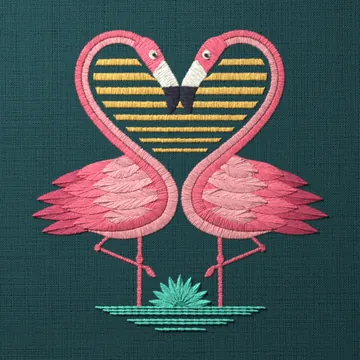
Easy prints 3–14 in · 7 colors
Easy flamingo love heart
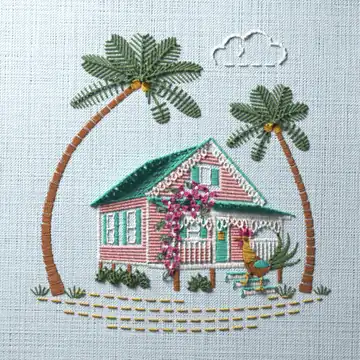
Easy 3–8 in hoop · 7 colors
Small Florida Keys cottage
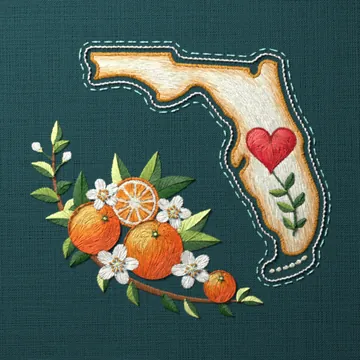
Advanced 3–8 in hoop · 22 colors
Florida outline with a heart
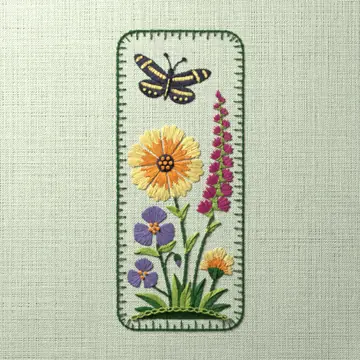
Easy 3–8 in hoop · 7 colors
Easy Florida wildflower bookmark
Advanced 3–8 in hoop · 8 colors
Japanese mending crane in boro patches
Advanced 3–8 in hoop · 7 colors
White cranes and pine, Korean style
Advanced 3–8 in hoop · 12 colors
Red and gold kimono with cranes
New to hand embroidery? Starting hand embroidery, step by step